There’s a particular kind of fear that only a parent knows. The fear that comes watching your child choose a life you can’t quite protect them.
Vinayak is an engineer by education. He was in product, good at his job, well liked and adding value. Everything about it looked right from where I stood: Security, salary, work place etc.
But he felt that he didn’t fit. Not as a complaint but a quiet truth. He didn’t like the closed spaces, the stillness and the daily routine.
On a family holiday, he took to deep sea diving. He went back again, to the same diving site. He learnt. He trained. And he started interning with them and helping tourists. He would check the oxygen cylinders, give demos, instructions. And he soon got certification as a deep sea diving instructor.
And one fine day, he announced that he is quitting from his corporate life. He went abroad and learnt more. And more. And more. He trained. Got every certification - On diving, surviving etc.
He is now a deep sea diving instructor, working in Indonesia. He earls less than half the pay, carries cylinders, spends long hours underwater, lives without the comforts I spent a career trying to provide. No AC room. Not even a wash basin in his room. No safety net.
He is happy. Underwater, undercompensated, and, by every real measure, more himself than he ever was in that office.
My fear hasn’t fully gone. I don’t think it’s meant to. He didn’t need me to protect him from this choice. He needed me to trust that he knew himself better than I did. That’s the harder thing to learn, as a parent: sometimes love means stepping back and letting someone be honest, brave and trusted.
I am proud. He had the courage that I didn’t have. He gave up comforts and chose what his heart said. He trained. Learnt. He was happy to be a subordinate than be the promoters son. He chose the difficult path. The not so treaded path. He is happy. And I am proud.
Happy birthday Vinayak.
Pakistan Genomic Resource (PGR), founded by Danish Saleheen, is the world's largest genetic database of human knockouts. It has been quietly building since 2017, from 10,000 individuals (Saleheen et al. Nature 2017) to nearly 200,000 today.
A new paper in Nature by Koch et al. reports a new analysis of 173,303 Pakistanis from PGR, offering genetic insights from natural inbreeding experiments in humans.
Koch et al. Nature 2026
https://t.co/Uk9YaeN1Ev
In biology, to understand what a gene does, you delete it, a standard experiment. Knock out the gene in a mouse and see what breaks: organ fails, behaviour changes, animal dies. Thirty years of biology built this way. It works, until it doesn't. Because, you know, mice are not humans.
To know the function of a gene in humans, you need a similar experiment. But that's unethical, you cannot deliberately delete a gene in a human. Except you don't have to, because nature has already been doing that experiment.
Occasionally, a person inherits a broken copy of a gene from both parents and is born with no working version at all--a human knockout. The problem is finding them. In most of the world's populations, where mating is largely random, these events are nearly invisible. For a gene-inactivating variant at 0.1% frequency, you'd expect one homozygous individual in every million people.
That math collapses in populations like Pakistan, where consanguineous marriage has been practised for centuries. In first-cousin marriages, the odds of observing a human knockout for the same 0.1% variant rise to roughly 1 in 16,000, a 63-fold enrichment. And the rarer the variant, the larger the advantage: ~630-fold for a 0.01% variant, ~6,300-fold for a 0.001% variant. The variants too rare to ever be seen in European biobanks become findable here.
Sequencing more than 170,000 individuals from highly consanguineous communities, the authors report a mind blowing statistic: at least one living human knockout was observed for 6,476 genes, which is nearly 1/3rd of the entire protein-coding genome!
What do we find when we finally have the human knockouts?
Studying the phenotypes in the human knockouts helps us confirm or refute our understanding of the gene's function based on animal studies. A few examples I highlight below.
PRDM9
PRDM9 might be one of the most popular genes among animal biologists. It encodes a protein that controls where chromosomes break and recombine during sperm and egg formation. Deleting the gene has caused infertility in every animal. PRDM9 was classified as the first hybrid sterility gene in vertebrates, so fundamental that crosses between mouse species with different PRDM9 alleles can't produce a fertile offspring. PGR now has 4 human PRDM9 knockouts : three women, one man. All fertile, with 2 to 7 children each. A 14-year biological fact, overturned by four families in Pakistan.
LRRK2
LRRK2 is a well-established Parkinson's disease risk gene. Activating mutations in LRRK2 are among the most common risk factors for Parkinson's. LRRK2 is a therapeutic target with many companies exploring ways to switch off this gene in the brain to treat Parkinson's. Large-scale sequencing studies have found individuals with partial loss of LRRK2, who did not show any concerning health issues, predicting adverse effects of LRRK2 inhibition in humans. Animal knockouts though warned of kidney damage. Now PGR has two LRRK2 knockouts, both with kidney disease, confirming animal studies.
RXFP1
RXFP1 encodes the receptor for a pregnancy hormone called relaxin, which has long been studied in rodents. Animal studies suggested it played a critical role in cardiovascular adaptation and connective tissue remodelling, fuelling relaxin-targeted drug development, which failed in late-stage trials. PGR found 16 RXFP1 knockouts, expanded to 26 via recall-by-genotype, all tested with cardiac imaging. None had consistent cardiovascular or reproductive deficits, retrospectively explaining the failure of relaxin-targeted drug programmes that might have spent millions of dollars. Mouse physiology failed to inform humans in the case of relaxin.
Gene constraint insights
Existing large-scale biobanks are predominantly European-based outbred populations, which shaped our understanding of gene constraints largely based on intolerance to partial loss of function. Now PGR, a South Asian-based cohort enriched for consanguineous communities, is beginning to offer insights into gene constraints based on intolerance to complete loss of function.
PGR showed that nearly 1/3rd of human genes tolerate complete loss of function. As much as the genes for which knockouts were found, the genes for which knockouts weren't found can offer biological insights.
The authors find genes depleted for knockouts in PGR are enriched for genes essential for cell survival, known Mendelian disease genes (both dominant and recessive) and genes broadly expressed across human tissues.
A fascinating insight is significant enrichment for knockouts in tissue-specific genes (OR=2.39). Human knockouts confirm what drug developers have always thought: tissue-specific genes are much safer therapeutic targets than broadly expressed genes.
The above insight should be read with caveats. The sample size of PGR is small, hence not saturated for human knockouts. It's likely the number of genes will increase as the sample size grows. There is a survivorship bias, like any other volunteer-based cohort. Absence of a gene knockout here doesn't mean biological impossibility. It means incompatibility with being a 'healthy' adult volunteer. If you build a cohort based on a hospital-based pediatric rare disease South Asian cohort, you'd expect to see knockouts that never appeared in PGR.
South Asian populations represent nearly a quarter of humanity, yet they have been largely absent from the genomic revolution. PGR shows what absence has been costing the field: overturned biological assumptions, failed trials, missed targets. The biology was always there. We just weren't looking in the right place.
Another reason medicine should teach the humanities.
First, it might make us more humane. Second, it might remind us not to speak confidently about subjects we know little about.
2 grown adults asking funds worth 9 cr to save their child who has spinal muscular atrophy and needs a “life saving injection”
was the couple unaware that it’s genetically inherited condition where prenatal genetic testing along with abortion would’ve costed them less than 9 cr?
A lot of you reached out after my last post, offering to donate books for a small library in our oncology waiting area.
I’m genuinely moved by the response.
Many patients and attendants spend hours waiting between consultations, chemotherapy sessions, investigations, and reports. A good book can make those hours a little lighter.
I’m now exploring the logistics and speaking with the hospital administration about creating a dedicated reading corner.
If you have books you’d like to donate, novels, biographies, poetry, children’s books, or books in Urdu, Hindi, or English please send me a DM.
If this comes together, it won’t be my library.
It will be a library built by all of us, for patients and their families.
I always ask my patients if they read or like to read, and sometimes they start talking about “back in days” how they used to be fascinated by such and such writing. I make sure on next cycle of chemotherapy/consultation they get their favourite authors latest book.
It's not easy to be Vinesh Phogat in this country.
9th May: Wrestling Federation of India issued her notice and debarred her from participating in Asian Games Trial. According to new rules, only 2025 medal winners could compete. Vinesh was returning from maternity leave so she had no medals in 2025.
18th May: Vinesh moved Delhi High Court against WFI's rules. A single judge bench refused to grant her relief.
22nd May: Vinesh appealed against this order before a division bench of the Delhi High Court. The bench allowed her to participate in the Asian Games Trial and came down heavily on WFI. The bench described WFI's rules as exclusionary and unfair to athletes returning after maternity leave. The bench also called the WFI notice to Vinesh as "vindictive".
29th May: WFI appealed against Delhi High Court order before the Supreme Court. Supreme Court refused to reverse Delhi HC's order. Vinesh was allowed to compete.
30th May morning: WFI said Vinesh could compete only in 50 kg category. Vinesh was ready for 53 kg category.
Vinesh protested. Later, WFI reversed its decision and allowed her to compete in the 53 kg category.
Now, think about it. A national icon like Vinesh had to fight through to the Supreme Court just for her right to compete in the trials. It's shameful. Imagine her frustration.
What an amazing win for patients battling pancreatic cancer. I can't quite describe it fully, but this video felt incredibly powerful. Pharma and drug making is an ultra competitive business and when you see moments like this, where clinicians are compelled to give a standing ovation for breakthrough science that is going to DOUBLE the OS of their patients, you remember what the industry is all about.
Incredible science. What a win.
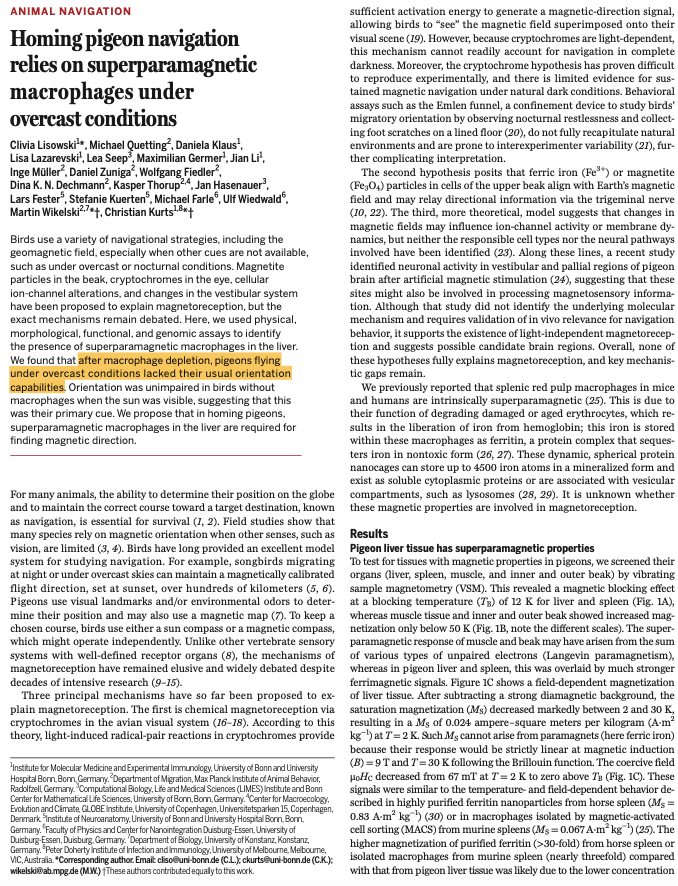
There is a new paper in Science proposing a mechanism for how homing pigeons navigate on cloudy days. (Hint: It's magnetic fields.)
As with many magnetobiology papers, though, I'm skeptical of their proposed mechanism.
These researchers, from Germany, found that pigeons have macrophages in their liver that accumulate lots of iron. They confirmed this with staining and other analyses. These macrophages also tend to cluster near nerve fibers in the liver (this is important for later).
Then they did a really interesting experiment:
- Train 34 pigeons to fly a particular 19-kilometer route. Ensure they all do this well.
- Split the pigeons into two groups: treatment and control.
- Inject the treatment group pigeons with liposomes loaded with clodronate. The macrophages eat these liposomes, and then clodronate kills the cells and scatters the iron.
- Release the pigeons, from both groups, on an overcast day (it's thought that pigeons use magnetic fields to navigate when there is no sun).
- All of the control pigeons reached their destination within 70 minutes, but the treated pigeons scattered in random directions.
- (Important control experiment: The treated pigeons, released on a sunny day, flew like normal and reached their destination.)
- This is taken as evidence that ??? macrophages --> iron --> navigation ??? via magnetic fields. But the mechanism is fuzzy.
This experiment is super interesting, and it's clear that the treated pigeons really are unable to home to their destination using a magnetic field. But I'm not entirely convinced by the mechanism these authors propose.
The main claim is that these iron-loaded macrophages "align" in a magnetic field, and that they shift according to the bird's orientation so that it can fix its direction. These macrophages (somehow) send signals to the nerve fibers in the liver, which then pass the messages to the brain, which allows the bird to navigate.
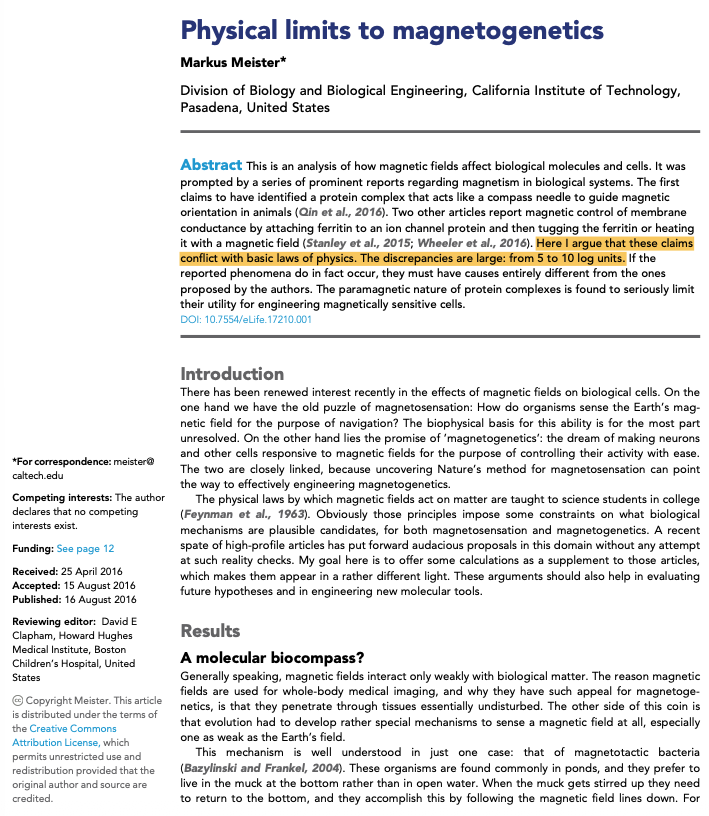
The news coverage for this story suggests how this might happen: "One idea is that as the bird shifts its position relative to Earth’s magnetic field lines, the ferritin changes orientation and tugs on the web of fibers within a macrophage, possibly triggering the release of signaling molecules." (All you need to do is read the 2016 Meister paper, from the images below, to understand why such a mechanism is physically dubious.)
The problem, though, is that the authors show (in their own study) that the iron in these pigeons' livers only act as a stable magnet at super low temperatures, below about 12 degrees Kelvin (or -260 degrees Celsius). At normal, physiological temperatures, the iron would be scrambled by the thermal motions of the tissue. Every measurement in the paper is taken at cryogenic temperatures, but a bird's body temperature is much higher, which means heat would likely destroy any magnetic alignment.
The authors claim that MILLIONS of iron particles in the liver are all acting together to escape this effect, but they don't demonstrate the mechanism convincingly at all. If this claim is true, why not take homing pigeons (control vs. macrophage-depleted) and then rotate a magnetic field around them? You could record their neurons to see if there is some kind of signal coming from the liver.
HBCHRC Muzaffarpur is a tertiary cancer care centre under Tata Memorial Centre, Mumbai (Department of Atomic Energy, Government of India).
Our Department of Surgical Oncology is a busy, high-volume academic and clinical unit running 4–5 operation theatres daily, offering extensive exposure to complex oncological surgery.
Areas of expertise and operative exposure include:
• Hepato-Pancreato-Biliary (HPB) Surgery – approximately 1–2 Whipple procedures/week, 2–3 Radical Cholecystectomies/week, and 1–2 Hepatectomies/month
Colorectal surgeries including MIS
• Multivisceral resections
• Advanced visceral oncology
• Uro-oncology
• Thoracic oncology
• Sarcoma surgery
• Breast oncology
Along with strong operative exposure, we maintain an active academic environment with 1–2 structured academic sessions/presentations every week.
We are inviting applications from motivated candidates for positions as:
• Senior Residents (Post MS/DNB)
• Fellows / MCh-qualified candidates
This is an excellent opportunity for candidates seeking hands-on experience in high-volume oncologic surgery along with structured academic growth.
Interested candidates may contact me directly for further details.
Prof.(Dr.)Mayank Tripathi
@DocPriyamMD . AI is only going to accelerate that process.
With AI, medicine may move away from organ-specific silos altogether. Fields like cardiology and gastroenterology, as we know them today, may eventually blur into far more integrated systems-based approaches.
@DocPriyamMD He has completely overlooked that we are not merely points of contact with people; medicine advances because researchers continuously generate new knowledge that eventually translates into clinical practice
@DocPriyamMD But I feel this is rather a narrow view. The OP is assuming medicine will remain limited to our current level of knowledge and present-day practice.
As a doctor, and even more so as a surgical oncologist, I meet cancer patients at one of the most vulnerable moments of their lives. They come carrying fear, hope, denial, faith, and often a quiet desperation that they may not even have put into words yet. To the general public, cancer still often feels like a death sentence, even though medically that is no longer always true.
In a busy clinic, where I may see a hundred patients in a day, saying, “You have cancer. This is the stage. This is the prognosis,” can become part of the day’s routine for me. But for the person hearing it, nothing about that moment is routine. The instant those words are spoken, life changes shape. The world they knew tilts. What comes next is no longer a clinical question alone; it becomes a question of identity, of family, of children, of parents, of unfinished dreams.
I often feel that for the next ten or fifteen minutes, they are no longer truly hearing words. They are hearing an earthquake inside themselves. In that brief silence, they are not listening to a doctor so much as watching their whole life pass before them—what has been lived, what may be lost, what must now be faced. Their mind is no longer in the consultation room; it is moving through the corridors of fear and possibility.
That is why, perhaps, in oncology, communication can never be a one-time event. We cannot say, “I have already told you this once.” Because what we say on the first day is often not fully received on the first day. It must be said again, gently and patiently, across visits, across moments, across changing emotions. Each conversation is not repetition; it is compassion. It is our duty to walk beside them, not only as clinicians, but as fellow human beings carrying, for a little while, some part of their burden.
This is not merely treatment. It is testimony. And it is, perhaps, one of the most sacred responsibilities medicine asks of us.
Maria Popova is famous for her personal blog, The Marginalian, where she's published more than six million words.
All the nights I've spent reading her writing were like an entry point into intellectual curiosity. She's introduced me to more writers and ideas than just about anybody, and this conversation is about how she does it.
Timestamps:
00:00 Introduction
00:37 Why writers should visit archives
04:39 Lessons from reading diaries
09:41 Letters vs diaries
11:35 Presence over productivity
18:30 How language shapes thought
19:48 Why Maria started reading poetry
36:46 Why college failed her
39:58 Reading to survive
41:41 Why epiphanies don’t stick
43:57 Thoughts on famous quotes
47:32 Why AI can never make art
53:10 Stop calling it content
I've shared the full interview with Maria Popova below. If you'd rather watch it on YouTube, or listen on Apple / Spotify, check out the reply tweets.