2008 Crude oil is $147 ( today term $225.00 )
Compare to today almost double ( current Curde oil $114)
Yes, oil bonds created a future liability. Nobody needs to deny that.
But let's put the numbers in perspective.
The reported lifetime repayment of UPA-era oil bonds, including principal and interest, reached around ₹2.36 lakh crore.
Meanwhile, the Union government's major food, fertiliser and petroleum subsidies alone totalled around ₹4.54 lakh crore in FY2025-26.
That's almost twice the entire oil-bond in one year...
@bhupendra9314@_DeepS01@darvasboxtrader Curde oil is $114.00 not reached that level... hope it wont..
2008 all Global market... now mainly Indain market falling
The 2008 global financial crisis hit markets worldwide, not just India. Yet under PM Manmohan Singh, India rebounded strongly, recording GDP growth of 8.6% in 2009–10 and 8.9% in 2010–11.
Crude oil had surged to nearly $147/barrel in 2008 — equivalent to roughly $225–$230 in today’s dollars. That was a massive external shock for an oil-importing economy like India.
@drmannypt@darvasboxtrader In 2008 Crude oil also hit nearly $147/barrel in 2008. Adjusted for US inflation, that’s approximately $225–$230 in today’s dollars, compared with today’s $112 oil price...It was hard time he managed well
The 2008 market crash was triggered by a global financial crisis, not an India-specific problem. Markets worldwide were affected.
Also Crude oil also hit nearly $147/barrel in 2008. Adjusted for US inflation, that’s approximately $225–$230 in today’s dollars, compared with today’s $112 oil price...
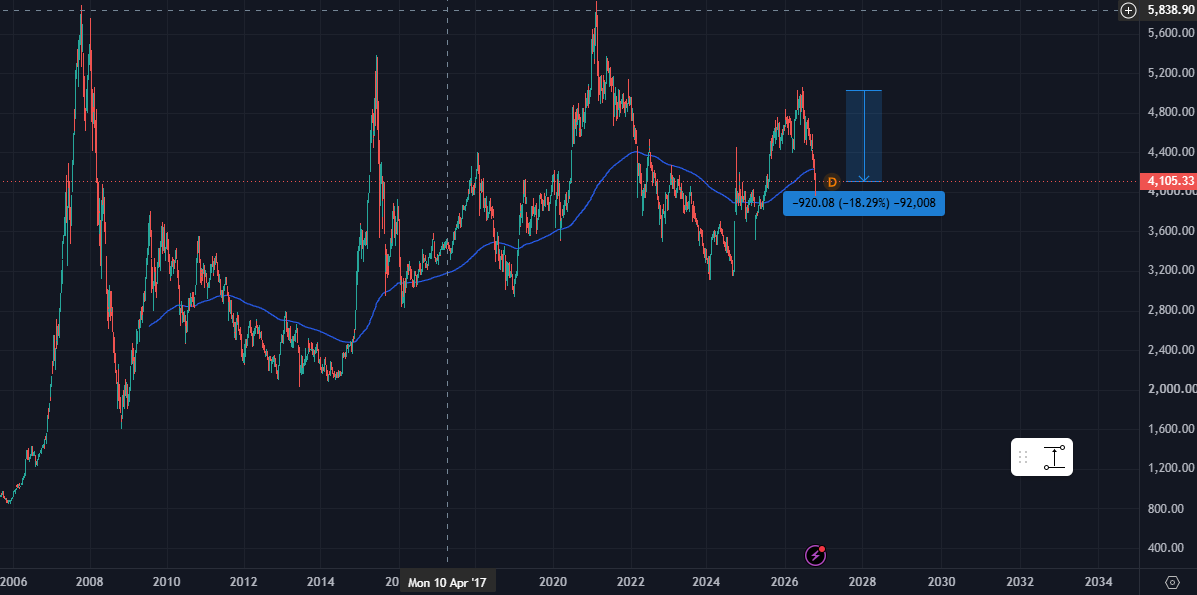
Meanwhile in China Market..
1) China's Nominal GDP skyrocketed by nearly 500%, ballooning from $3.61 trillion in 2007 to an estimated $21.55 trillion by late 2026
2) CSI 300 Index has delivered a negative price return of ~23% over the exact same period, dropping from its late-2007 peak of 5,338 points to 4,105.33 points as of October 23, 2026
3) CSI 300 has slid roughly 20% from its recent high,
@TejaswiPalam The company plans to withdraw from the global SSL/TLS certificate business following a security key compromise. It stated that no data breach has occurred and that core operations remain
unaffected.
Over the past week, significant developments indicate that the Russia-Ukraine war ( 1700+ days war) may be nearing a pause or an end, with Ukrainian President Zelensky seemingly ready to freeze the current frontlines despite retaining roughly 75% of the original territory. This shift signals a potential acceptance that a decisive Ukrainian victory is unlikely. Although European countries, led by Germany, remain strongly supportive of Ukraine and reject any form of unconditional surrender since it would represent Europe's surrender as well, the stark reality of Russia's persistent threat alters the regional security landscape.
Europe, especially border countries like Finland—which shares a 1340 km border with Russia and recently joined NATO due to growing fears of Russian expansion—is witnessing rising anxiety. Discussions about defensive measures, including laying human mines at borders, reflect the seriousness of the threat perceived from Russia.
Germany’s Chancellor Olaf Scholz articulated that Russia's war poses a fundamental risk to all of Europe, emphasizing that Ukraine acts as the continent’s frontline defense. Any peace deal favoring Russian interests would set a dangerous precedent for future Russian advances across Europe.
Meanwhile, diplomatic efforts intensify with upcoming trilateral talks involving Russia, the US, and Ukraine. There is also cooperation between Russia and the US concerning diesel supply and prisoner exchanges, hinting at complex negotiations underway. However, critical demands—particularly around controlling the Donbas region—remain unresolved.
Further global complicating factors include potential high-stakes meetings between Vladimir Putin, Donald Trump, and Xi Jinping, which could reshape geopolitical alliances, impacting Europe, Taiwan, and Iran. Iran, in particular, has rejected US mediation overtures, indicating no immediate resolution on that front.
Ultimately, while a temporary freeze of the war seems likely, the broader conflict dynamics, geopolitical tensions, and unresolved demands leave the future uncertain, setting the stage for continued volatility in Europe and beyond