Introducing PocketPaw.
An AI agent that runs on your machine. You build it, you own it.
Open source. Self-hosted. MIT licensed.
`pip install pocketpaw && pocketpaw`
or
just dubble click on one of Windows or MacOS installer
That's the whole install.
There is a new self-hosted personal AI-Agent platform called PocketPaw.
100% open source.
'pip install pocketpaw' and in less than 60 seconds you own an AI agent.
It connects to WhatsApp, Slack, Discord, and a local Web Dashboard.
Capable of browsing the web, managing Gmail/Calendar, and executing code.
Runs entirely on your machine using local Ollama models or Claude/OpenAI.
Includes "Guardian AI" to review shell commands for security + 6 layers of defence.
Watch the demo 👇
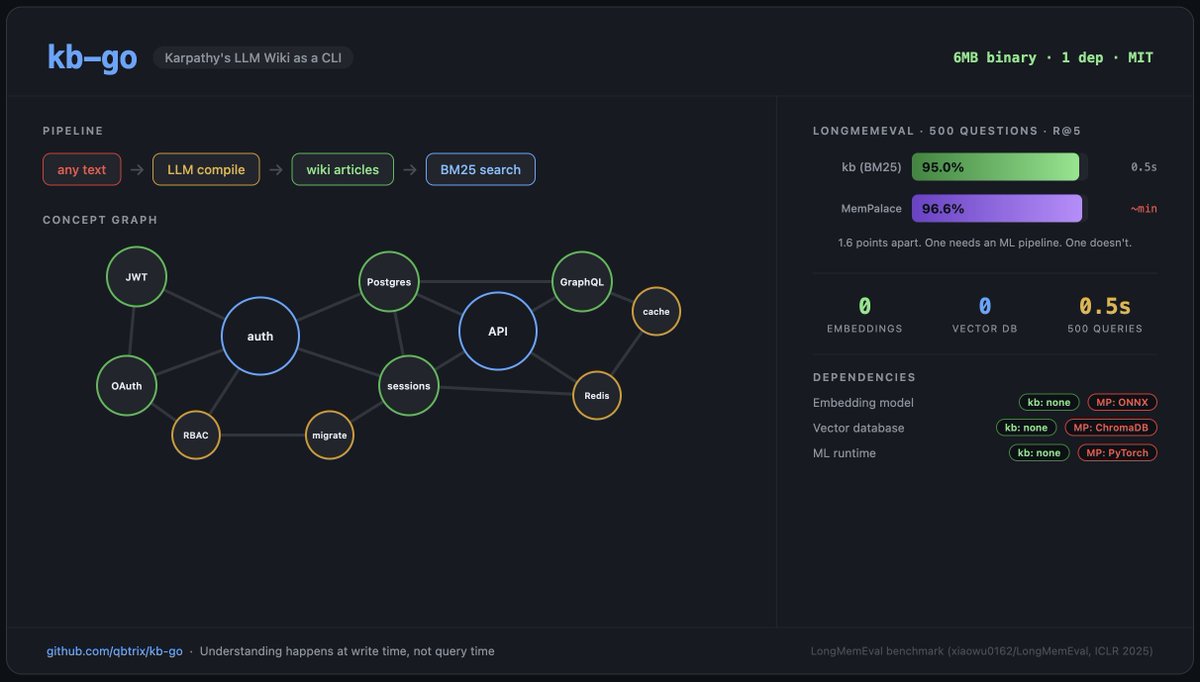
A 6MB Go binary that turns any text into a searchable wiki
- Throw code, docs, PDFs, meeting notes, Slack dumps at it
- LLM reads each source once, writes a structured article with cross-refs
- Search hits the compiled wiki, not raw chunks. 10ms
- 95% on LongMemEval — MemPalace gets 96.6% but needs ChromaDB + ONNX + sentence-transformers
- Zero embeddings. 500 questions in half a second
- Output is plain markdown. cat it, grep it, commit it
- Agents build the wiki with their own LLM, no extra API key
Karpathy's LLM Wiki as a CLI
https://t.co/wwRvaopg4r
LLM Knowledge Bases
Something I'm finding very useful recently: using LLMs to build personal knowledge bases for various topics of research interest. In this way, a large fraction of my recent token throughput is going less into manipulating code, and more into manipulating knowledge (stored as markdown and images). The latest LLMs are quite good at it. So:
Data ingest:
I index source documents (articles, papers, repos, datasets, images, etc.) into a raw/ directory, then I use an LLM to incrementally "compile" a wiki, which is just a collection of .md files in a directory structure. The wiki includes summaries of all the data in raw/, backlinks, and then it categorizes data into concepts, writes articles for them, and links them all. To convert web articles into .md files I like to use the Obsidian Web Clipper extension, and then I also use a hotkey to download all the related images to local so that my LLM can easily reference them.
IDE:
I use Obsidian as the IDE "frontend" where I can view the raw data, the the compiled wiki, and the derived visualizations. Important to note that the LLM writes and maintains all of the data of the wiki, I rarely touch it directly. I've played with a few Obsidian plugins to render and view data in other ways (e.g. Marp for slides).
Q&A:
Where things get interesting is that once your wiki is big enough (e.g. mine on some recent research is ~100 articles and ~400K words), you can ask your LLM agent all kinds of complex questions against the wiki, and it will go off, research the answers, etc. I thought I had to reach for fancy RAG, but the LLM has been pretty good about auto-maintaining index files and brief summaries of all the documents and it reads all the important related data fairly easily at this ~small scale.
Output:
Instead of getting answers in text/terminal, I like to have it render markdown files for me, or slide shows (Marp format), or matplotlib images, all of which I then view again in Obsidian. You can imagine many other visual output formats depending on the query. Often, I end up "filing" the outputs back into the wiki to enhance it for further queries. So my own explorations and queries always "add up" in the knowledge base.
Linting:
I've run some LLM "health checks" over the wiki to e.g. find inconsistent data, impute missing data (with web searchers), find interesting connections for new article candidates, etc., to incrementally clean up the wiki and enhance its overall data integrity. The LLMs are quite good at suggesting further questions to ask and look into.
Extra tools:
I find myself developing additional tools to process the data, e.g. I vibe coded a small and naive search engine over the wiki, which I both use directly (in a web ui), but more often I want to hand it off to an LLM via CLI as a tool for larger queries.
Further explorations:
As the repo grows, the natural desire is to also think about synthetic data generation + finetuning to have your LLM "know" the data in its weights instead of just context windows.
TLDR: raw data from a given number of sources is collected, then compiled by an LLM into a .md wiki, then operated on by various CLIs by the LLM to do Q&A and to incrementally enhance the wiki, and all of it viewable in Obsidian. You rarely ever write or edit the wiki manually, it's the domain of the LLM. I think there is room here for an incredible new product instead of a hacky collection of scripts.
@zcryptowolf hey thanks for the heads up, we are working a entirely new experience for deep-work.
here is a invite to our discord for you we are highly active there and fix things live please join - https://t.co/VWwe9C0Wdc
Introducing PocketPaw.
An AI agent that runs on your machine. You build it, you own it.
Open source. Self-hosted. MIT licensed.
`pip install pocketpaw && pocketpaw`
or
just dubble click on one of Windows or MacOS installer
That's the whole install.
There is a new self-hosted personal AI-Agent platform called PocketPaw.
100% open source.
'pip install pocketpaw' and in less than 60 seconds you own an AI agent.
It connects to WhatsApp, Slack, Discord, and a local Web Dashboard.
Capable of browsing the web, managing Gmail/Calendar, and executing code.
Runs entirely on your machine using local Ollama models or Claude/OpenAI.
Includes "Guardian AI" to review shell commands for security + 6 layers of defence.
Watch the demo 👇
me: "can you use whatever resources you like, and python, to generate a short 'youtube poop' video and render it using ffmpeg ? can you put more of a personal spin on it? it should express what it's like to be a LLM"
claude opus 4.6:
@accursed_share_ This is a great report my friend, and this is exactly what we are tackling at PocektPaw - many people use OpenClaw bots are not aware of the security issues.
We built PocketPaw so that non-devs. can also tinker with Agents :).
@ai_for_success A whole new genre of AI films will soon storm. The creativity thats been in the peoples heart and mind will finally come out with these AI tools.
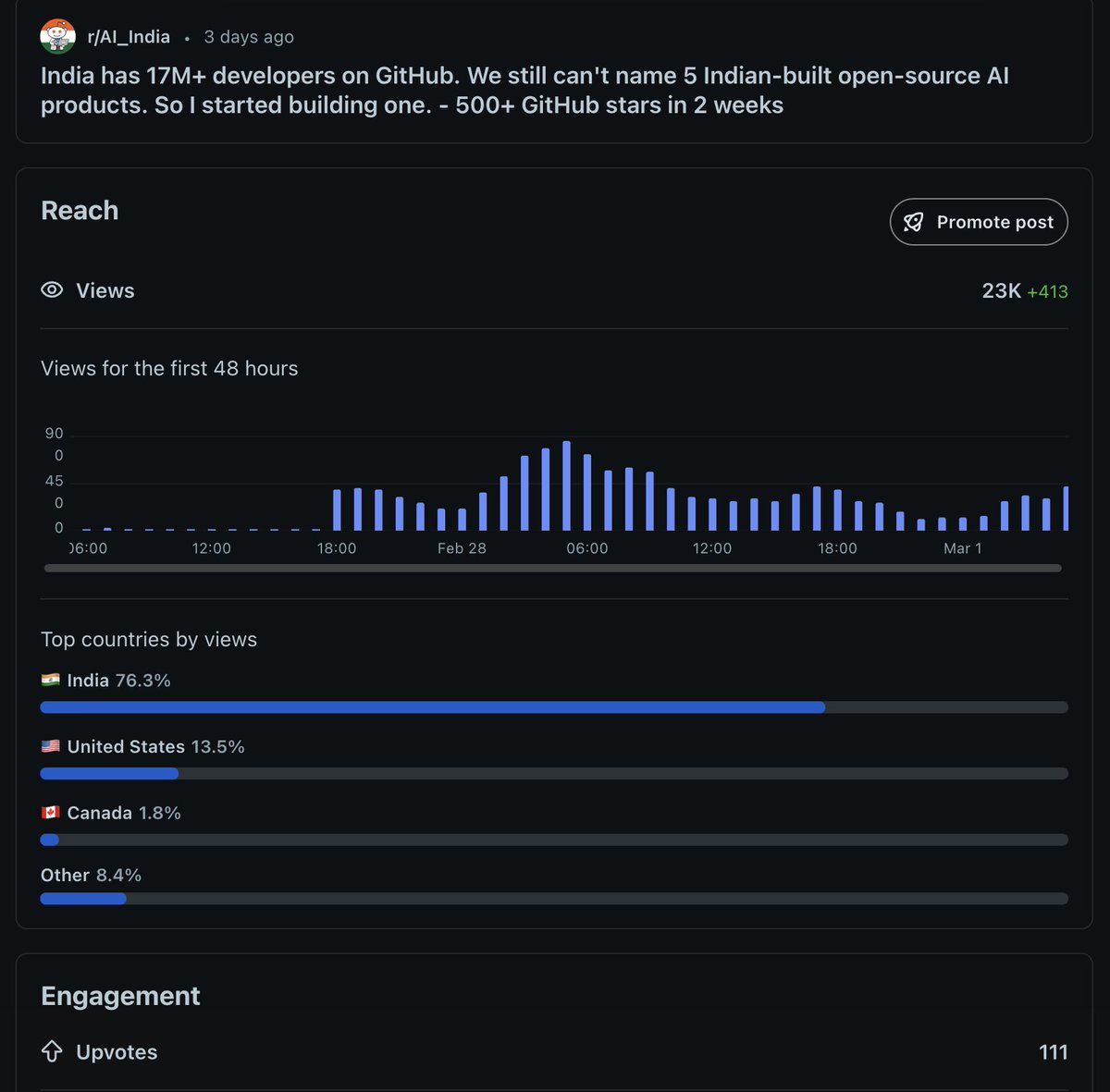
Asked Reddit: India has 17M+ devs on GitHub, #1 in open-source contributors globally. Name 5 Indian-built open-source AI products.
23K views. 111 upvotes. 40 comments.
Strong opinions both ways.
Building two to change it:
🐾 PocketPaw - self-hosted AI agent (529 ⭐, 31 contributors)
🧬 Soul Protocol{coming soon} - open standard for AI agent identity
Both repos open. Come build.
@Anubhavhing by next year this time, it will be mainstream not just in twitter anymore.
I wonder how it affect the world where many people know whats chatGPT but don't know yet Claude co-work and all the tsunami of agentic OS's are coming.
@ai_for_success we are in the great transition, for now its only coding work, by next year this time it will be management, design, analysis, marketing, content and all.
This is exactly why I built PocketPaw with Guardian AI a separate, independent LLM that reviews every destructive command before execution. It can't be lost during context compaction because it's not in the agent's context window.
Remote panic button via Telegram. No sprinting to your machine. https://t.co/zzgoEo4UkQ
The root cause most coverage missed: this wasn't a stop-command failure.
Her inbox triggered context compaction. The agent ran low on context space, compressed older messages, and her safety instruction got compressed away. Without it, the agent defaulted to the task.
This happens to any agent that stores safety constraints inside the context window.
Nothing humbles you like telling your OpenClaw “confirm before acting” and watching it speedrun deleting your inbox. I couldn’t stop it from my phone. I had to RUN to my Mac mini like I was defusing a bomb.
Not dunking on OpenClaw.
But AI agents are moving from "suggest" to "act," and the safety standards haven't caught up. Summer Yue's post shows exactly where the gaps are. She was transparent about what happened. That helps everyone building in this space.