If your AI needs 95% accuracy to ship, you’re probably designing the wrong product.
Great builders don’t wait for perfect models. They design interventions that make being wrong cheap.
I unpack this idea (and why 40% precision can beat 95%) in my latest piece: → Design for the AI you have, not the AI you wish you had.
https://t.co/IlEqu295KS
SaaS pricing was easy: $ per seat, 80% margins, call it a day.
AI pricing is not.
Every prompt costs money. Every power user breaks your model. And if your product works, customers need fewer seats.
What's happening today:
bleed margin
or churn customers with surprise bills
Sometimes both.
My mental model: If your product succeeds, does your pricing still work? Do your customers need less of you if you do your job well or more?
Wrote a full breakdown:
what actually works
what kills you
and how to price AI without blowing up your business
https://t.co/UhBLRu63oj
My AI Threat Level: 4.8/10 — "You’ve spent your career climbing to the top of the food chain just to become the most expensive piece of middleware at https://t.co/ZVaZtjGBhQ."
Check yours: https://t.co/sPmcGMi6VX
$130B+ poured into AI in a week.
Apple just blessed MCP.
Google made docs machine-readable. Anthropic split consumer from developer.
Open-weight models hit 92% of frontier at 15% of the price.
This year is going to be crazy.
https://t.co/BWhszzFHl3
The most expensive phrase in corporate vocabulary right now is two words long. "Strategic investment."
New piece is up. It's called ROI or Die. Manifesto, Framework, and field guide for anyone tired of watching AI budgets evaporate.
https://t.co/q3oEzYodYN
There are obvious levers I could pull for retention:
1️⃣ Prompt users with what they can say (instead of a blank canvas).
2️⃣ Send a basic retention email.
3️⃣ Wrap this in a mobile app so it lives in muscle memory.
But, this was a 4-hour side project. Anything beyond lightweight iteration quickly becomes over-investment.
I launched VoiceNotes to answer this question:
How do micro-SaaS products get their first 100 users?
Here’s the first 24 hours. 👇
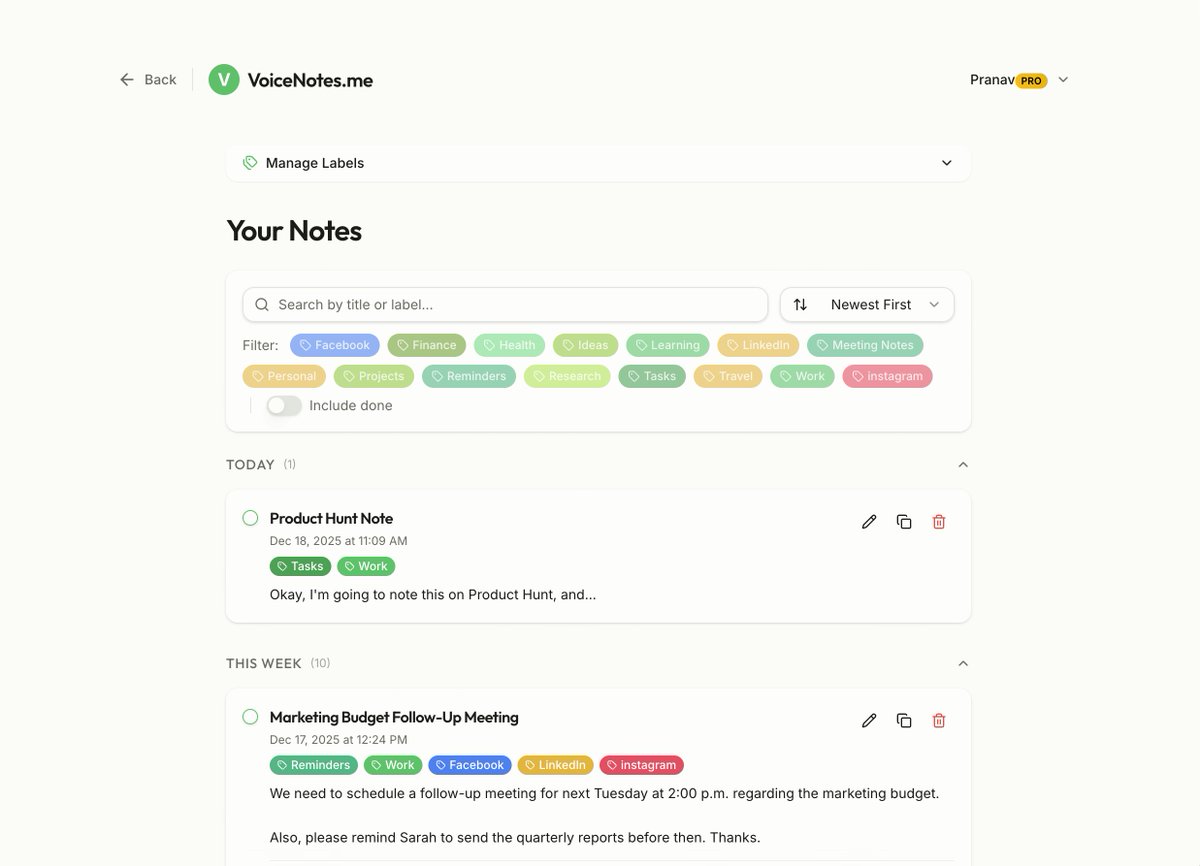
VoiceNotes is a simple app that allows you to speak into the microphone, then generates and stores a clean, labelled note.
🚀 Distribution:
I put up three posts.
One on LinkedIn, one on Product Hunt, one on X.
No paid spend, no coordinated launch, no asking networks to upvote.
🤔 Is this a success or a bust?
Getting to the first 100 users: This is easy.
Another little nudge will get me to 100, in 48 hours if not 24. There's lots of communities and connections I haven't used, and the ones I did use I under-leveraged.
In terms of product success, way too early to tell.
I realized I think better when I talk to myself 😅
So I built a tiny side project that turns rambling voice thoughts into clean notes.
No big vision. Just something I’m using daily.
If you think out loud too, this might be fun:
https://t.co/VdghPymZ7J 🎙️
Microservices is the software industry’s most successful confidence scam. It convinces small teams that they are “thinking big” while systematically destroying their ability to move at all. It flatters ambition by weaponizing insecurity: if you’re not running a constellation of services, are you even a real company? Never mind that this architecture was invented to cope with organizational dysfunction at planetary scale. Now it’s being prescribed to teams that still share a Slack channel and a lunch table.
Small teams run on shared context. That is their superpower. Everyone can reason end-to-end. Everyone can change anything. Microservices vaporize that advantage on contact. They replace shared understanding with distributed ignorance. No one owns the whole anymore. Everyone owns a shard. The system becomes something that merely happens to the team, rather than something the team actively understands. This isn’t sophistication. It’s abdication.
Then comes the operational farce. Each service demands its own pipeline, secrets, alerts, metrics, dashboards, permissions, backups, and rituals of appeasement. You don’t “deploy” anymore—you synchronize a fleet. One bug now requires a multi-service autopsy. A feature release becomes a coordination exercise across artificial borders you invented for no reason. You didn’t simplify your system. You shattered it and called the debris “architecture.”
Microservices also lock incompetence in amber. You are forced to define APIs before you understand your own business. Guesses become contracts. Bad ideas become permanent dependencies. Every early mistake metastasizes through the network. In a monolith, wrong thinking is corrected with a refactor. In microservices, wrong thinking becomes infrastructure. You don’t just regret it—you host it, version it, and monitor it.
The claim that monoliths don’t scale is one of the dumbest lies in modern engineering folklore. What doesn’t scale is chaos. What doesn’t scale is process cosplay. What doesn’t scale is pretending you’re Netflix while shipping a glorified CRUD app. Monoliths scale just fine when teams have discipline, tests, and restraint. But restraint isn’t fashionable, and boring doesn’t make conference talks.
Microservices for small teams is not a technical mistake—it is a philosophical failure. It announces, loudly, that the team does not trust itself to understand its own system. It replaces accountability with protocol and momentum with middleware. You don’t get “future proofing.” You get permanent drag. And by the time you finally earn the scale that might justify this circus, your speed, your clarity, and your product instincts will already be gone.
Doing a few speaking engagements this week and my god the number of forms I have to fill with the exact same info is insanely exhausting. I’ll pay anyone who solves this for me handsomely. Help please.
I hate this new ‘AI PM’ title. It hides 6 completely different species of builders.
When I’m hiring, I’m never looking for just an “AI PM.” I’m looking for one of these 👇
1️⃣ AI-Aware PMs – use AI to level up their own craft. They ship faster, think sharper, write better. Baseline for everyone soon.
2️⃣ AI-Native PMs – build products that run on AI. They know precision, recall, fallbacks, and where AI breaks.
3️⃣ Model Builders – live close to the science. Own ranking, recs, GenAI models. Know when “good enough” actually is.
4️⃣ Orchestrators – connect systems. Think in data flows, not features. The backbone of compounding AI impact.
5️⃣ MLOps PMs – the infrastructure crew. Pipelines, reliability, governance. Quiet heroes of scalable AI.
6️⃣ Data Platform Owners – make sure the fuel (data) is pure. No clean data, no working model.
Generically folding all these into a single ‘AI PM’ is kind of demeaning for everyone involved.