@latereigns@vikhyatk I live by Lake Union in Westlake, and whenever my friend visits, he parks in the huge lot there. Every single time, he comes back to a sticker waiting on his Tesla when he���s about to leave lol
What if a robot could take a goal and determine how to achieve it?
Today, we’re introducing Auto-Engineering on GRID.
Robotics has more models, simulators, and hardware than ever. Turning them into working deployments still takes specialized engineering.
For two years, we’ve been building that robotics know-how into unified intelligence GRID - spanning robots, skills, models, and proven approaches.
Auto-Engineering puts it to work by completely automating how robot intelligence is built, tested, and deployed.
Robots are maturing. AI models are advancing.
Deployments are rarely scaling.
Today, deploying a robot still means stitching together systems that were never designed to work together. For every robot. Every time.
The industry needs a unified intelligence infrastructure that any robot, any model and any workflow can plug into.
We call this an intelligence grid.
Infrastructure that makes intelligence composable, deployable, and continuously adapting. Every connected robot evolves as the platform advances.
More on what we're building: https://t.co/AMpxxFmtuc
Robots are shipping faster than industry can deploy them at scale.
Hardware is maturing rapidly. AI models are beginning to deliver real capability. But there's no unified intelligence layer connecting them.
We're calling this an intelligence grid.
Agents have transformed software, now it's time for robotics.
Today, we’re revealing our blueprint for building agentic robots –– machines that can reason, converse, compose, and remember.
Last week, we shared DreamControl — a scalable framework for whole-body humanoid control that fuses diffusion priors with reinforcement learning to enable real-world scene interaction.
Diffusion + RL → natural whole-body skills
Policies run in real time → bridges sim-to-real with unprecedented naturalness
Hybrid edge + cloud infrastructure → leverages AI models on the cloud
Towards general-purpose humanoids that interact, adapt, and assist autonomously...
❓How can humanoids learn to squat and open a drawer?
Reward-tuning for every such whole-body task is infeasible.
🚀Meet DreamControl: robots "dream" how people move and manipulate objects in varied scenarios, practice using them in simulation, and then act naturally in the real-world.
🌐 https://t.co/tCt026UAGy 1/n
The power of generative models — now embodied in humanoids.
Announcing DreamControl –– After a year-long research effort at General Robotics — we present a scalable framework for whole-body humanoid control that fuses diffusion priors with reinforcement learning to unlock real-world scene interaction.
Diffusion + RL → natural whole-body skills on real robots.
DreamControl enables humanoids to move beyond locomotion demos → performing natural, human-like skills such as ––
Picking & lifting objects, Opening drawers & doors, Precise punching, kicking, and jumping, Bimanual manipulation tasks
Our key innovation: a diffusion prior over human motion that guides RL, eliminating the need for massive teleoperation datasets, and producing motions that look human while transferring to real hardware.
Trained purely in simulation, deployed on the @UnitreeRobotics G1 humanoid, DreamControl policies run in real time, bridging sim-to-real with unprecedented naturalness.
We leverage a novel hybrid edge + cloud infrastructure that runs RL-trained policies on the edge backed by powerful AI models running in the cloud
This is the next step in General Robotics’ journey toward general-purpose humanoid assistants that interact, adapt, and assist autonomously.
Paper: https://t.co/sTnYZHKPNd
Blog: https://t.co/Sm4OFRqBKb
1/n
Robots don’t gain navigation skills by repeating one map.
They learn by surviving many.
Procedural generation gives us controlled variation — new layouts, clutter, and lighting with every run. This builds robustness and mitigates overfitting.
Real → Sim → Robot — fast.
With Gaussian splats, GRID brings physical assets into simulation tools like AirGen and @nvidia Isaac Sim, enabling AI skills to be tested in sim and deployed to real robots in minutes.
#Robotics#PhysicalAI#Simulation
Hello Roboticists,
Trossen Robots are now live on Open GRID.
With just a few lines of code, any Trossen arm — old or new — can tap into AI skills from the cloud.
One example:
Teleoperation via API → data collection on Isaac Sim → playback on real hardware 👇🏻
Making Trossen robots useful, fast.
https://t.co/f3DXaLxLh7
@trossenrobotics@NVIDIARobotics
Scaled Foundations is now General Robotics.
We’re building general-purpose intelligence for every robot. Across any scenario in the physical world.
Blog: https://t.co/gsRC3OK0Yz
#NVIDIAInception member @ScaFoAI is integrating Isaac Sim into its GRID platform to bridge simulation and real-world apps.
Learn how to get started with GRID during this #NationalRoboticsWeek 👉 https://t.co/KKCo8FY37X
Winning moments at #GTC 2025
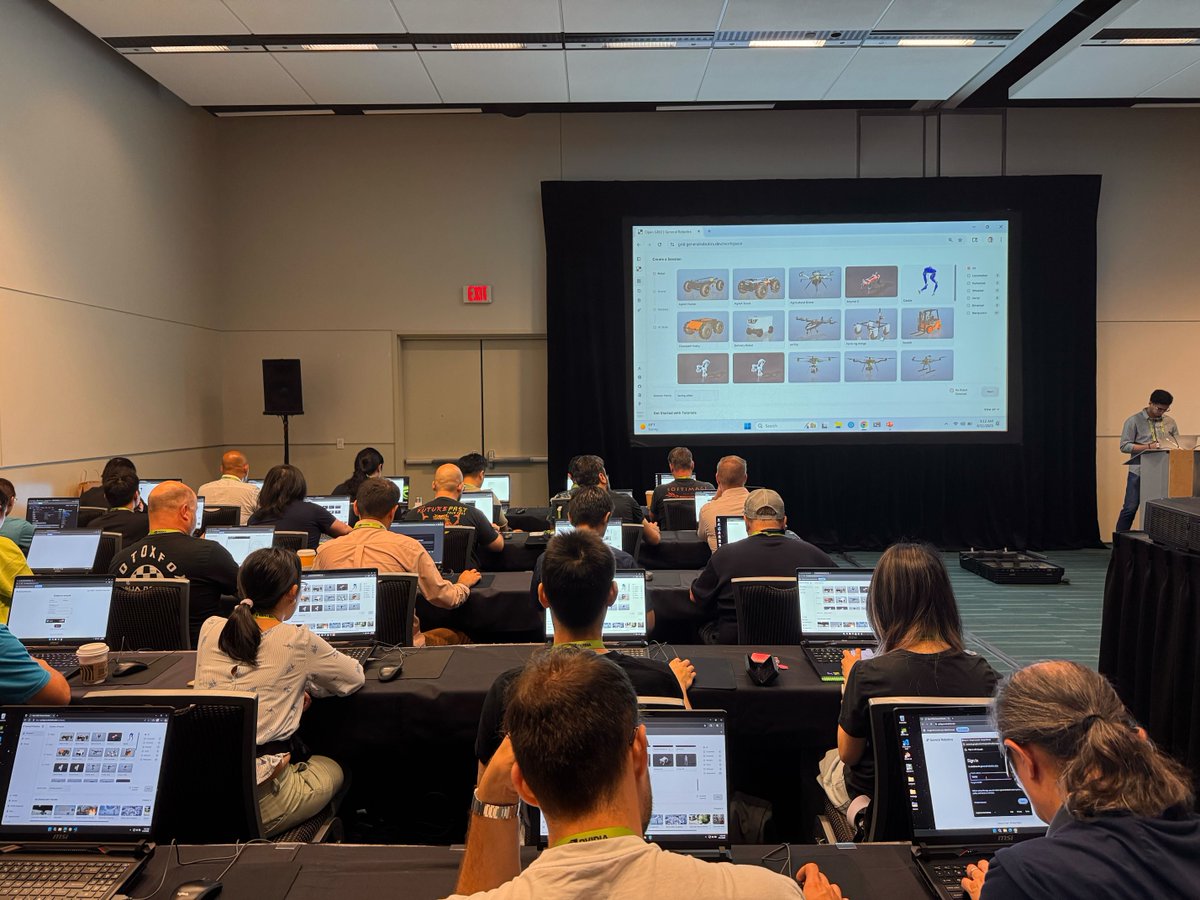
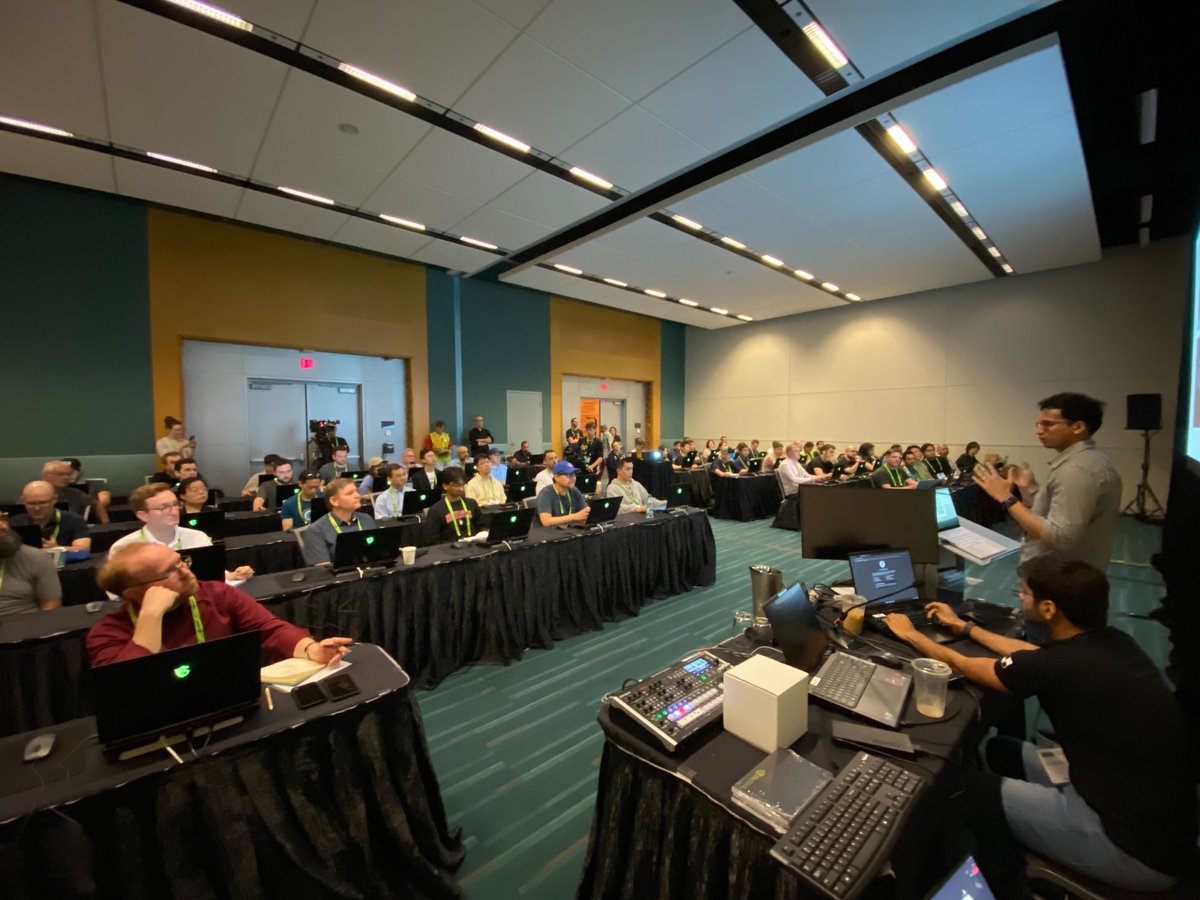
110+ users developing robot AI on Isaac at the same time? ✅ Check.
Deploying the skill developed on a real robot? ✅ Check.
Playing around with multiple form factors and scenes? ✅ Check.
Missed us at GTC?
Follow along the session here: https://t.co/DEHTvC1aFR
Big thanks to our volunteers, @NVIDIARobotics and the team!
#NVIDIAGTC2025 #GTC25