@swatntra_anuj Such a disgusting and shameful video…. Thodi knowledge kya aa gayi, majdooro ko majak uda rahe and unki paristithiyo ka majak uda rahe besharm.
Former Aaj Tak Journalist Tanushree Pandey speaks up and shows the reality of India Media.
“There is no space left in Indian Media , all newsrooms have been bought”
Everyone must listen to this, BJP has finished Indian Media.
Hello, Adarsh, here are some truth bombs:
The "S" in BHMS (Bachelor of Homeopathic Medicine and Surgery) is an imaginary entity much like the pretense that Homeopathy is healthcare and its practitioners, doctors.
BHMS is a degree awarded to undergraduates after completing 5.5-year (4.5 years study + 1-year internship) college course. No other country in the world (including Germany - the birthplace of Homeopathy) has such a program specifically tailored to destory younger generations future/ career.
BHMS is an absolute waste of a lifetime, that ONLY Indian medical system 'awards' undergraduates who were not competent enough to become medical doctors because they couldn't clear the NEET-UG exam entry to MBBS (Bachelor of Medicine, Bachelor of Surgery).
It is also a short-cut that absolute science and health illiterate parents give their children, to see the title of "Dr." in front of their names. This is more of a parental greed and selfish choice due to which children suffer for life and their futures destroyed.
BHMS education is expensive nothing. So once the student enters the course, they are unable to break away from it, because too much has already been invested in it (Sunk Cost Fallacy). So they carry on and complete it (because parents pay for the college) and practice it (because the student has to get back what was spend, including repay education loans).
So forget the Surgery part, Homeopathy practitionere are not even real medical physicians. They still believe that "vital force" in the body decides health and disease, sells alcohol, sugar and distilled water as medical "cures" and live a lie their whole lives.
Homeopathy students are taught how to fool themselves in the first place in college, and then train themselves to fool others in the name of "gentle healing". Many Homeopaths, when they realize Homeopathy is in fact "reckless fraud", they sooner or later - when their dead conscience light up - leave the profession and jump towards sensible careers. This is a fact.
If any parent really care about their children's future in Science, Technology, Engineering, and Mathematics (STEM), understand that BHMS is the worst (also BAMS - Ayurveda, BUMS - Unani, BSMS - Siddha, BYNS - Naturopathy) that you can put your children through. Do not destroy their lives. Help them feel confident and secure through real STEM careers.
I also want to drop truth bombs about Ayurveda and its cringe BAMS degree, but I will reserve it for another time.
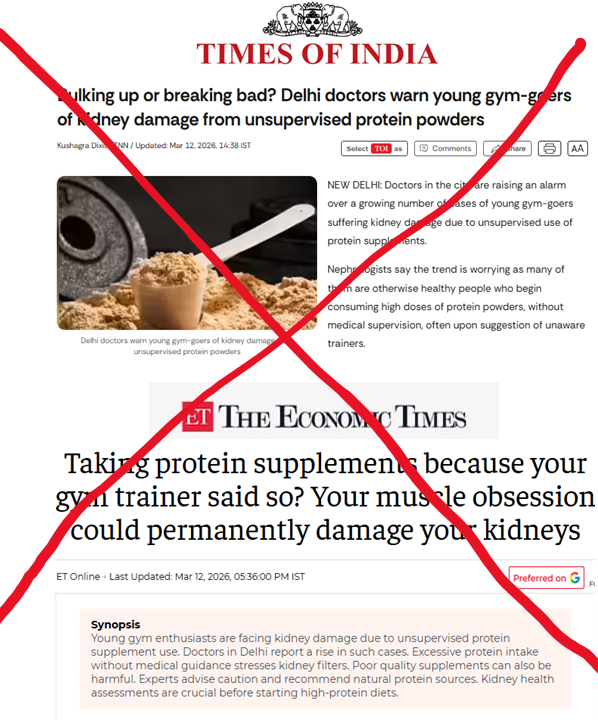
Extremely irresponsible reporting by @TOIIndiaNews and @EconomicTimes. I do not know what the crtieria for being your "health reporter" is, but this feels like some kid in 12th grade doomscrolling conspiracy theories on Instagram wrote it. Do better.
Here are the rebuttals to the nonsense your so-called kidney experts and health journalist spouted in the article:
The title claim: "Protein supplements could permanently damage your kidneys"
This is fear-mongering presented as fact.
Multiple systematic reviews and meta-analyses (including a 2018 meta-analysis in the British Journal of Sports Medicine) have found no evidence that protein supplementation causes kidney damage in people with normal renal function. The International Society of Sports Nutrition position stand on protein safety states that intakes of 1.4–2.0 g/kg/day are safe for healthy, exercising individuals, with some data supporting up to 3.4 g/kg/day over extended periods without adverse renal effects. Even the "Gym Nephropathy" review in the Journal of the Egyptian Society of Nephrology and Transplantation concedes that high protein intake improves training adaptations with no harm when baseline renal function is normal.
The word "permanently" in the title has no basis in the literature for whey protein in healthy kidneys.
Conflation of whey protein with anabolic steroids, cough syrups, growth hormone, alcohol, and nicotine
This is the most intellectually dishonest move in this article. The cited case reports invariably involve young men using anabolic-androgenic steroids (AAS), diuretics, banned substances like spasmo-proxyvon, cough syrups (containing dextromethorphan or codeine for abuse), and sometimes alcohol — alongside protein. The kidney damage in these cases is driven by AAS-induced FSGS (focal segmental glomerulosclerosis), injury from stimulant abuse, or direct kidney damage from banned drugs. Blaming the whey protein powder in this cocktail is like blaming the glass of water someone drank alongside the poison.
Whey protein is not a "gym supplement" in the same category as testosterone injections or codeine-containing cough syrups, and lumping them together under the umbrella "gym supplements" is a category error designed to maximise alarm.
Excessive protein intake causes hyperfiltration injury to the kidney filters
Hyperfiltration is a normal physiological adaptation, not abnormal injury. When you eat more protein, kidney filtration increases to handle the increased nitrogen load — this is the kidney doing its job, just as heart output rises during exercise without "damaging" the heart.
The Brenner hypothesis (that hyperfiltration leads to progressive kidney damage) was derived from animal models of kidney disease and patients with chronic kidney disease or after kidney removal surgery, not from healthy kidneys. The conflation of "adaptive hyperfiltration" with "injurious hyperfiltration" is a basic error in renal physiology.
The Nephrologists cited in the article should go back to first year MBBS.
The case report: 20-year-old with kidney damage
This is the centrepiece of the article, and it's doing enormous heavy lifting for very little information. We're told he had "no prior medical issues" but developed proteinuria and oedema after 6–8 months of consuming protein powders.
What we are NOT told: what else he was taking (steroids? pre-workouts? creatine at absurd doses? SARMs?), how much protein he was consuming, whether he had undiagnosed IgA nephropathy or FSGS (both common in young Indian males and often unmasked by any physiological stressor), whether a renal biopsy was performed, and what the histopathological diagnosis was.
A single uncontrolled case report with incomplete clinical details proves nothing about causation. The fact that his parents are doctors is irrelevant to the pathology but is included for emotional impact — classic journalistic manipulation.
The infographic claim: "Most healthy adults need only ~0.8 g protein per kg body weight/day"
This is the RDA — the Recommended Dietary Allowance — which represents the minimum intake to prevent clinical protein deficiency in sedentary adults. It is not a ceiling. It is not optimal. It is the bare minimum to avoid malnutrition. For resistance-training individuals (which is the population this article targets), 0.8 g/kg/day is inadequate to support muscle protein synthesis and recovery. Presenting the sedentary minimum as the recommended ceiling for gym-goers is either ignorance of sports nutrition or deliberate fear-mongering.
Dr Ravi Bansal: "individuals should avoid exceeding a protein intake of 1.2 g/kg of body weight"
This is a nephrologist speaking from a CKD-management perspective and inappropriately generalising it to healthy gym-goers. The 1.2 g/kg figure is the upper limit sometimes recommended for patients with established mild-to-moderate CKD (stages 2–3) to slow progression. It has no applicability to healthy young adults with normal renal function who are resistance training.
Dr Bansal: "natural dietary proteins remain superior to artificial substitutes"
Whey protein is not an "artificial substitute." It is derived from milk through a physical separation process (filtration). It contains the same amino acids as the protein in a glass of milk, yoghurt, or paneer. Calling it "artificial" is factually wrong and plays into the naturalistic fallacy that pervades Indian health discourse — the same fallacy that props up Ayurvedic products with actual hepatotoxic potential while demonising a dairy-derived food product. There is no evidence that protein from whey is metabolised differently or has different renal effects compared to protein from chicken, eggs, or lentils at equivalent doses.
This report cherry-picks a single incomplete case report, conflates physiological adaptation with pathological injury, misrepresents the RRecommended Daily Allowance as a maximum safe intake, ignores the actual evidence from controlled trials and meta-analyses, lets steroid abuse and supplement contamination off the hook entirely, and wraps it all in World Kidney Day alarmism.
This is irresponsible health journalism in a country where protein deficiency kills far more people than protein excess ever has.
The Pentagon just threatened to BLACKLIST one of America's most valuable AI companies.
Not Huawei or some Chinese chip maker...
It's ANTHROPIC. The company behind Claude. $380 billion valuation.
And the reason is genuinely insane:
For months, the Pentagon has been pushing every major AI lab to remove their safety restrictions for military use.
The ask is simple: let us use your models for anything that's technically legal.
Weapons development, intelligence collection, battlefield operations, mass surveillance of American citizens.
OpenAI said yes.
Google said yes.
xAI said yes.
Anthropic said no.
Not to everything tho. They were willing to negotiate.
But they held firm on two things:
They don't want Claude used to build fully autonomous weapons that fire without a human in the loop, and they don't want it used to mass surveil American citizens.
That's it. That's the line they drew.
But Pete Hegseth's response was to threaten to designate Anthropic a "supply chain risk."
Here's why that matters:
That label isn't a contract cancellation. It's not a fine. It's not a strongly worded letter...
It means every single company that wants to do business with the US military has to certify they don't use Claude anywhere in their operations.
8 of the 10 largest companies in America use Claude.
Defense contractors, government suppliers, enterprise companies with any federal exposure...
ALL of them would have to cut ties with Anthropic overnight or lose their government contracts.
A senior Pentagon official told Axios:
"It will be an enormous pain in the ass to disentangle, and we are going to make sure they pay a price for forcing our hand like this."
That's a US government official threatening to financially destroy an American company because it doesn't want its AI used to spy on American people.
And it gets WORSE.
Last week, Anthropic's head of safeguards research resigned.
His parting message: "the world is in peril."
Elon Musk - whose xAI already handed the Pentagon a blank check - is now publicly attacking Anthropic calling Claude anti-human.
And the Pentagon official told Axios they're "confident" OpenAI, Google, and xAI will all agree to the "all lawful purposes" standard.
So what you're actually watching right now is every major AI company in America quietly handing the government unlimited access to the most powerful technology ever built.
With no guardrails.
No limits.
No company-imposed restrictions on what it can be used for.
One company tried to hold a line.
But the government is about to make an example out of them.
If Anthropic folds, it's over.
Every lab just learned what happens when you push back.
And every restriction, every safety policy, every ethical guardrail these companies spent years building gets negotiated away behind closed doors the second the government asks.
If they don't fold, a $380 billion company gets made radioactive in its OWN country.
Watch what happens next.
Because whatever Anthropic decides in the next few weeks, it sets the precedent for how much control AI companies actually have over their own technology.
Turns out the answer might be: none.
This happened in Mumbai. And they absolutely nailed the aesthetics. Subtle. Harmonious. Almost Kyoto-ish. No gaudy overload. Organisers of festival light and sound shows in Kashi and Ayodhya could take notes.
Technique he galat hai. This Fake doctor should have gone to politicians to promote his product in the name of Nationalism instead of going to Shark Tank and get exposed.
Terrible.
This is exactly why the “food at your seat” model is unsafe at short-halt or crowded stations. It forces delivery workers to run inside trains, push through boarding passengers, and take life-threatening risks against a departing train.
This needs immediate reform. @Zomato and @Swiggy should ensure that:
-> Seat delivery only at stations with 5–10+ minute scheduled halts.
-> Short halts -- platform pickup or coach-door handover only.
-> Clearly marked pickup zones mapped to coach ranges.
-> No COD on train orders -- prepaid only, so that delivery boys are not under pressure to complete payment before leaving the train.
CC: @deepigoyal
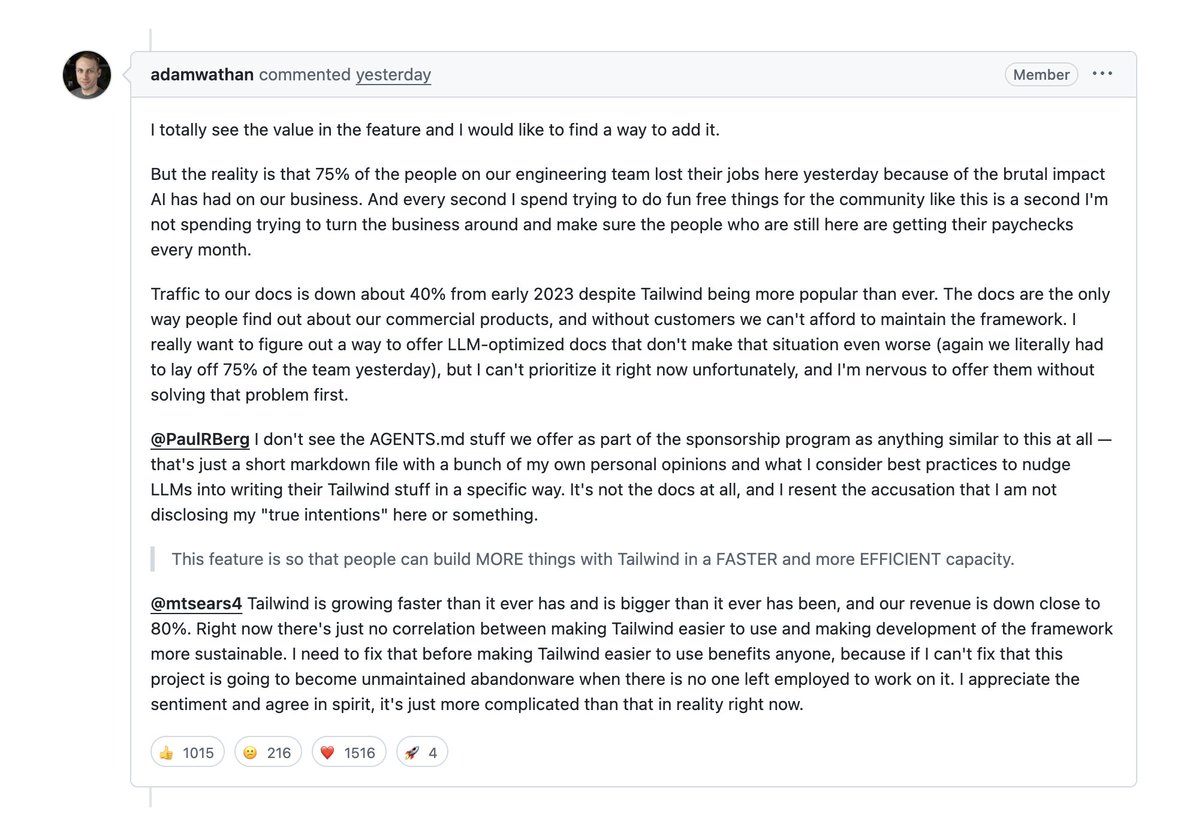
Tailwind lays of 75% of their team. the reason is so ironic:
> their css framework became extremely popular w AI coding agents, 75m downloads/mo
> that meant nobody would visit their docs where they promoted paid offerings
> resulting in 40% drop in traffic & 80% revenue loss
Last one on this topic, and I have been holding this in myself for a while.
For centuries, class divides kept the labor of the poor invisible to the rich. Factory workers toiled behind walls, farmers in distant fields, domestic help in backrooms. The wealthy consumed the fruits of that labor without ever seeing the faces or the fatigue behind it. No direct encounter, no personal guilt.
The gig economy shattered that invisibility, at unprecedented scale.
Suddenly, the poor aren't hidden away. They're at your doorstep: the delivery partner handing over your ₹1000+ biryani, late-night groceries, or quick-commerce essentials. You see them in the rain, heat, traffic, often on borrowed bikes, working 8–10 hours for earnings that give them sustenance. You see their exhaustion, their polite smile masking frustration with life in general.
This is the first time in history at this scale that the working class and consuming class interact face-to-face, transaction after transaction. And that discomfort with our own selves is why we are uncomfortable about the gig economy. We want these people to look our part, so that the guilt we feel while taking orders from them feels less.
We aren't just debating economics. We are confronting guilt. That ₹800 order might equal their entire day's earnings after fuel, bike rent, and app cuts. We tip awkwardly, or avoid eye contact, because the inequality is no longer abstract. It's personal.
Pre-gig era, the rich could enjoy luxury without moral discomfort. Labor was out of sight. Now, every doorbell ring is a reminder of systemic inequality. That's why debates explode. It's not just policy. It's emotional reckoning. Some defend the system (“they choose it”), others demand change (“this isn't progress, its exploitation”).
And here’s the uncomfortable twist: the unsaid ask of clumsy ‘solutions’ isn’t dignity. It is about returning to invisibility.
Ban gig work and you don’t solve inequality. You remove livelihoods. These jobs don’t magically reappear as formal, protected employment the next day. They disappear, or they get pushed back into the informal economy where there are even fewer protections and even less accountability. Over-regulate it until the model breaks, and you achieve the same outcome through paperwork instead of slogans: the work evaporates, prices rise, demand collapses, and the people we claim to protect are the first to lose income.
And then what happens?
The rich get their old comfort back. Convenience returns without faces. Guilt dissolves. We go back to clean abstractions and moral posturing from a distance. The poor don’t become safer, they become invisible again: back in cash economies, back in backrooms, back in shadows where regulation rarely reaches and dignity isn’t even debated.
The gig economy just exposed the reality of inequality to the people who previously had the luxury of not seeing it. The doorbell is not the problem. The question is what we do after opening the door.
Visibility is the price of progress. We can either use this discomfort to build something better (which we keep doing continuously as delivery partners are our backbone), or we can ban and over-regulate our way back into ignorance. One of those choices improves lives. The other simply helps the consuming class feel virtuous in the dark.
How long do you think HDFC Bank will take to transfer the money from your account to your nominee's after you die? Public sector banks get a bad rap, but it's been more than a year and we have not been able to get funds transferred from my now deceased husband's account in the country's largest private bank.
The nominee is our adult daughter, there are no conflicting claims, the paperwork is clear, and yet for more than a year now HDFC has been giving us the run around. Get this paper, get that paper. Each time my daughter comes home for holidays, we have to take 2 days out to go and wait at the bank branch. Today, more than a year after the first application, they said
a) we can't find the paperwork including the death certificate you submitted because the employee you submitted to is not here
b) you have to get a stamp paper and notarise it for the auto debits that hit his account between the date of his death and the date the account was frozen (on the basis of the paperwork in point a, now non-traceable)
c) you have to get HDFC Standard life to sign off because there is an auto debit for an investment from his account. (ME: they are the payee, he is the payer, why does the payee need to approve stopping a standing instruction? Bank: Hamare main aise hi hai). If you wait for 30 minutes, we'll get you the form.
d) after 30 minutes. Sorry, we can't get the form, you have to go to their office and do it.
By now it is 2.45 PM, HDFC Standard life office is at least 35 minutes away. They are open only till 3.30 PM. We are not sure we'll make it there on time. I call their number to ask if the branch is open tomorrow. Person: Sorry, I can't give you the information today, you will have to call and check tomorrow. (To repeat: HDFC Standard Life's call centre cannot tell you if a branch is working or not the following day)
In all, we have spent many hours over many months trying to get this money in a case the bank officials themselves say "should not be complicated". What is worse is for my 20-year-old daughter to relive the trauma of losing her father each time we have to go and explain the case. Just today, we had to speak to three different people and start the story from the beginning. This is not just the bank's inefficiency, it is its utter callousness. (My husband also had money in Indusind Bank. It took one visit and two weeks for that to be transferred).
The other, more important point, is that I have a job, we have the money to continue to pay for our needs without having to immediately access these funds. But I am certain that is not the case for many others. What about them? How can this be the system of a bank whose customers are dependent on it for giving them access to their own money?! It beggars belief.
@HDFC_Bank@HDFCBank_Cares