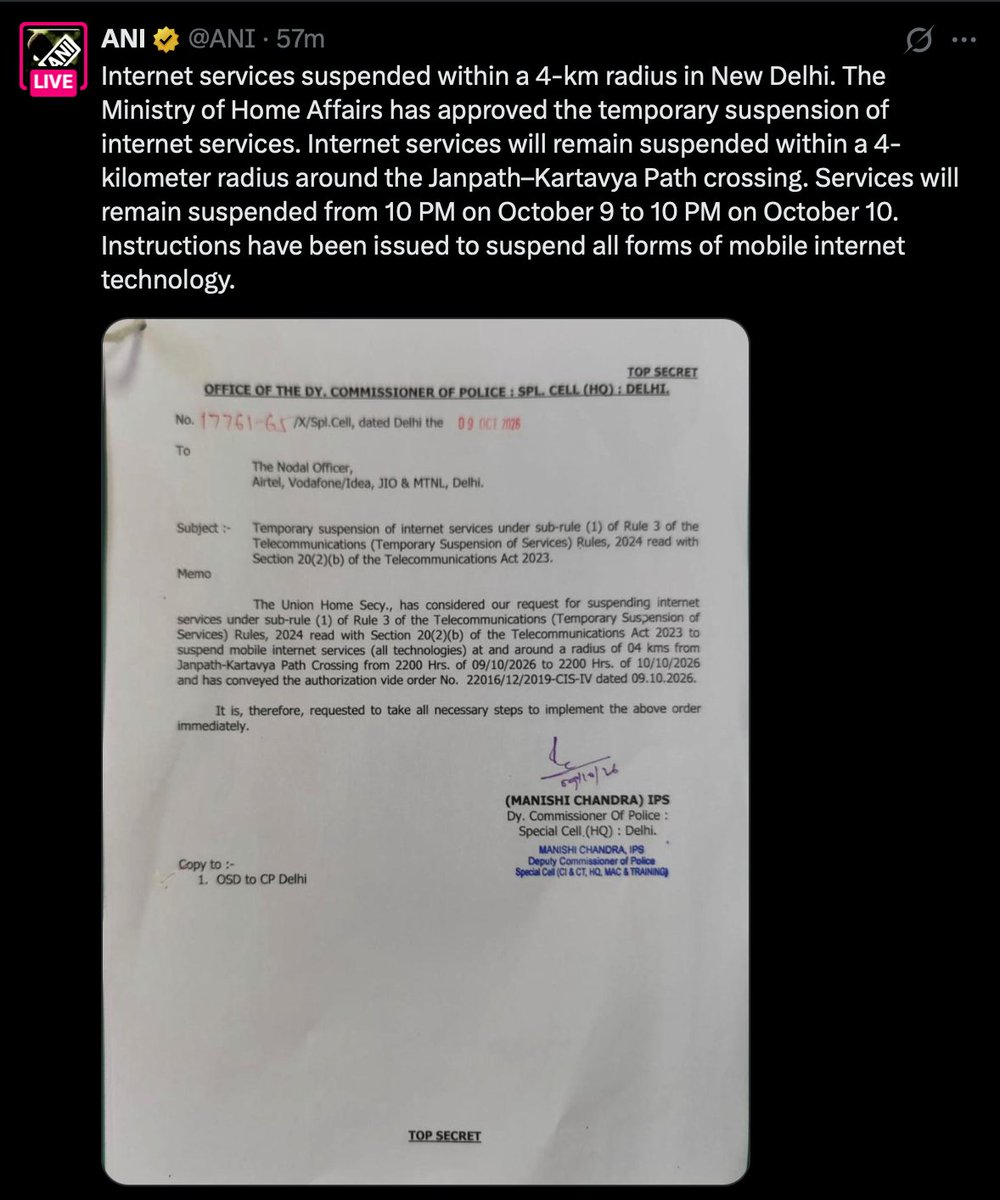
Statement: IFF condemns the internet shutdown in Delhi ahead of the 10 October protest. The order remains unpublished, and the police communication conveying it is marked "Top Secret".
9 October 2026
The Internet Freedom Foundation (IFF) condemns the internet shutdown imposed in parts of Delhi ahead of the protest called for tomorrow, 10 October 2026, at Jantar Mantar, seeking the resignation of the Chief Election Commissioner. A communication dated 9 October 2026 from the Deputy Commissioner of Police, Special Cell (HQ), Delhi to the nodal officers of Airtel, Vodafone Idea, Jio and MTNL, shared by the news agency ANI, records that the Union Home Secretary has authorised, on the request of the Delhi Police, the suspension of "mobile internet services (all technologies)" within a radius of four kilometres of the Janpath-Kartavya Path crossing, from 10 pm on 9 October to 10 pm on 10 October 2026. It refers to order No. 22016/12/2019-CIS-IV dated 9 October 2026 and is marked "Top Secret" at the top and bottom of the page.
As per a media report by Live Law, the Solicitor General informed the Supreme Court today that the shutdown is confined to "certain sensitive pockets" and will be reviewed on the basis of security inputs. The communication describes a circle of about 50 square kilometres across the centre of the capital, which takes in Jantar Mantar, Connaught Place, India Gate, Parliament, the Supreme Court, the Delhi High Court, New Delhi Railway Station and hospitals including Ram Manohar Lohia and Lady Hardinge. This is about seven times the area of the suspension ordered around Jantar Mantar on 2 October, and it runs for twice as long.
Delhi Police has refused permission for the protest, and prohibitory orders under Section 163 of the Bharatiya Nagarik Suraksha Sanhita, 2023 are in force in New Delhi district. Delhi Police asked for the gates of 57 metro stations to be closed from 9 pm today, and the Railways cancelled trains due at New Delhi and Hazrat Nizamuddin between 4 am and 2 pm tomorrow. Hearing a challenge to these measures today, the Supreme Court directed that there be no complete prohibition on metro and train services and asked the authorities to keep in mind the principle of proportionality. As reported, that order did not examine the internet shutdown. We call for the order to be withdrawn, and for mobile internet to remain available across Delhi tomorrow.
At the time of release of this statement, we have not been able to locate any suspension order published by the Ministry of Home Affairs, the Department of Telecommunications, the Government of NCT of Delhi or the Delhi Police. The public knows the area and hours of this shutdown from a police communication marked "Top Secret" that was shared by ANI, and not from the government. That communication records no reasons, and the order of the Union Home Secretary to which it refers has not been made public. This is now a pattern and the order for the shutdown of 2 October around Jantar Mantar became public four days later, when the Hindu obtained a copy.
This secrecy is contrary to the law declared by the Supreme Court. In Anuradha Bhasin v. Union of India, (2020) 3 SCC 637, the Court held that "an order, particularly one that affects lives, liberty and property of people, must be made available". It directed the authorities to "publish all orders in force and any future orders" suspending telecom services, including the internet, "to enable the affected persons to challenge it before the High Court or appropriate forum". A democracy "sworn to transparency and accountability", the Court said, "necessarily mandates the production of orders as it is the right of an individual to know". The Telecommunications (Temporary Suspension of Services) Rules, 2024, framed under Section 20 of the Telecommunications Act, 2023, now provide that every suspension order "shall be published", must state its reasons, and must be limited to a clearly defined geographical area and a specified duration. No order may be made unless the authority has considered that its objectives cannot be achieved by any other reasonable means.
The communication shared by ANI invokes Rule 3 of these Rules, the same Rule that requires the order to be published. It is nevertheless marked "Top Secret", the highest security classification used by the Government of India. In January 2021, the Ministry of Home Affairs issued orders bearing the same number to suspend the internet at Singhu, Ghazipur and Tikri during the farmers' protest, and those orders remain available on the Ministry's own website. An order cannot be published and kept "Top Secret" at the same time.
The government has placed no evidence before the public that a shutdown makes a protest safer. The available research is to the contrary as a 2019 study of shutdowns and protest in India by Jan Rydzak, then at Stanford's Global Digital Policy Incubator, found shutdowns "much more strongly associated with increases in violent collective action than with non-violent mobilization". The Office of the UN High Commissioner for Human Rights reported in 2022 that many shutdowns justified on grounds of public safety or national security "were followed by spikes in violence" (A/HRC/50/55). In December 2021, the Parliamentary Standing Committee on Communications and Information Technology recorded that neither the Department of Telecommunications nor the Ministry of Home Affairs had studied the impact of shutdowns.
A shutdown also prevents people from documenting and reporting what happens at a protest. The same UN report found that, “the inability to access tools to document and rapidly report abuses seems to contribute to further violence”. Without mobile internet, a journalist at Jantar Mantar cannot file her report or broadcast live. A protester cannot upload a video as events unfold, and a person who is injured or detained cannot send a location to family or a lawyer. On 20 July 2026, mobile internet in Central Delhi was switched off amid reports of the use of force to disperse protesters. In Manipur in 2023, video of an assault on two women on 4 May reached the public only on 19 July, while a shutdown imposed on 3 May was still in force. This is the impact an internet shutdown has which rather than preventing violence prevents the documentation of illegality.
Our demands:
We call upon the Ministry of Home Affairs and the Delhi Police to:
1) Withdraw order No. 22016/12/2019-CIS-IV dated 9 October 2026 and keep mobile internet services running across Delhi on 10 October 2026.
2) Publish that order, and every other suspension order issued in connection with the protest, forthwith, together with the reasons recorded in writing.
3) Withdraw the "Top Secret" marking, and stop classifying suspension orders and the communications that convey them to telecom operators.
4) Place the order before the Review Committee within five days, as the Rules require, and publish its final order, as the Supreme Court required on 23 February 2024.
5) Ensure that journalists and members of the public can record and report from the protest sites without obstruction.
In India, he wouldn't even be considered for Nobel Prize as he doesn't even wear formal shirts and pants. I know of someone who works in a big Indian corporate who got scolded by his boss in a meeting for wearing Denim pants. That's the level we are at.
Sad.
@thdxr Is there any way to enable/see subagents (without clicing inside the compressed timeline or clicking the top right button) and also getting toks/s inside GUI?