When we started Ornn, you could sign a GPU contract and get the option to renew three years later at the same price. Everyone figured GPUs would be cheaper by then anyway.
Try asking for that clause now.
I sat down with @HarryStebbings at @20vcFund for a candid chat on compute. Out tomorrow.
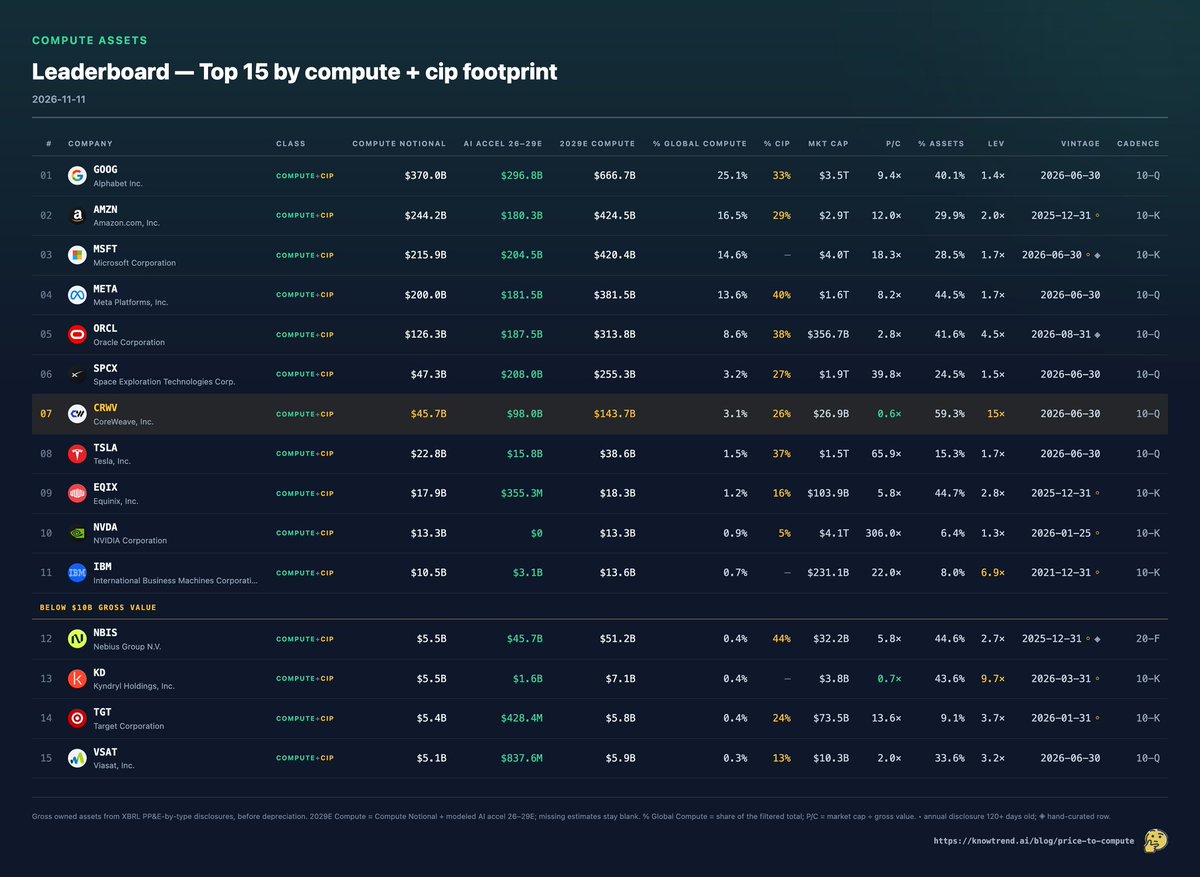
top 15 compute holders globally.
these are the companies that will rule and own the world.
compute is NOT a COMMODITY.
compute is the new hard power.
h/t @knowtrend_ai
Most GPU price indexes track listed rates. We track what buyers paid.
Over the past year, transacted prices went up across every generation, led by B200 and H200. While new chips usually push down prices for the one before them, B200 kept climbing even after B300 arrived in June.
Explore our data → https://t.co/oxQ9uR98Bq
a concerningly large amount of debt against off take contracts is implicitly underwritten against the belief that we're always going to be short of compute
I don't know the odds of the belief cracking in GPU prices 'always going up' upon which so much financing + debt is premised...or it becomes the equivalent of housing prices that couldnt go down until they did....
but if they do...its a big problem
We invented a recursive megakernel generator called Hyperkernel, the most complete solution to megakernels and GPU efficiency.
Hyperkernel-generated megakernels achieve state of the art performance on 11 different domains: inference (DeepSeek, Kimi and GLM), pretraining (Qwen), hardware fault recovery, robotics (π₀-FAST, ACT) diffusion and real time world models (Matrix-Game), full self driving (OpenPilot), voice models (Moshi), genomics (Evo 2) and protein folding (ESMFold).
All of this in a single kernel launch.
For context, Hyperkernel generated fully optimized megakernels for robotics, genomics and voice in under 50 minutes, and doubled the efficiency for >5 models generally using only about 60-100 lines of code per megakernel. This speaks to the unparalleled standard for code quality in the automated generations.
Our first release today open sources the megakernels themselves. Over the next couple weeks, we will release the entire Hyperkernel stack, along with the complete serving stack for Kimi and GLM (20-30% inference efficiency gains across all concurrencies).
Out of the box GPU machinery performs terribly for unorthodox research. We built Hyperkernel only 20 days ago for internal use; but given its multi-modality, we have decided to open source it.
Creative research should not be bottlenecked by the lack of dedicated infra teams. Hyperkernels offer a one stop shop infra stack for all research. We would love for the open source community to add to it :)
GitHub repo: https://t.co/sfPt4S4BJN
NOTE: We primarily use NVIDIA B300s, but our kernel generation extends to other hardware (B200s, AMD, TPUs).
1/9
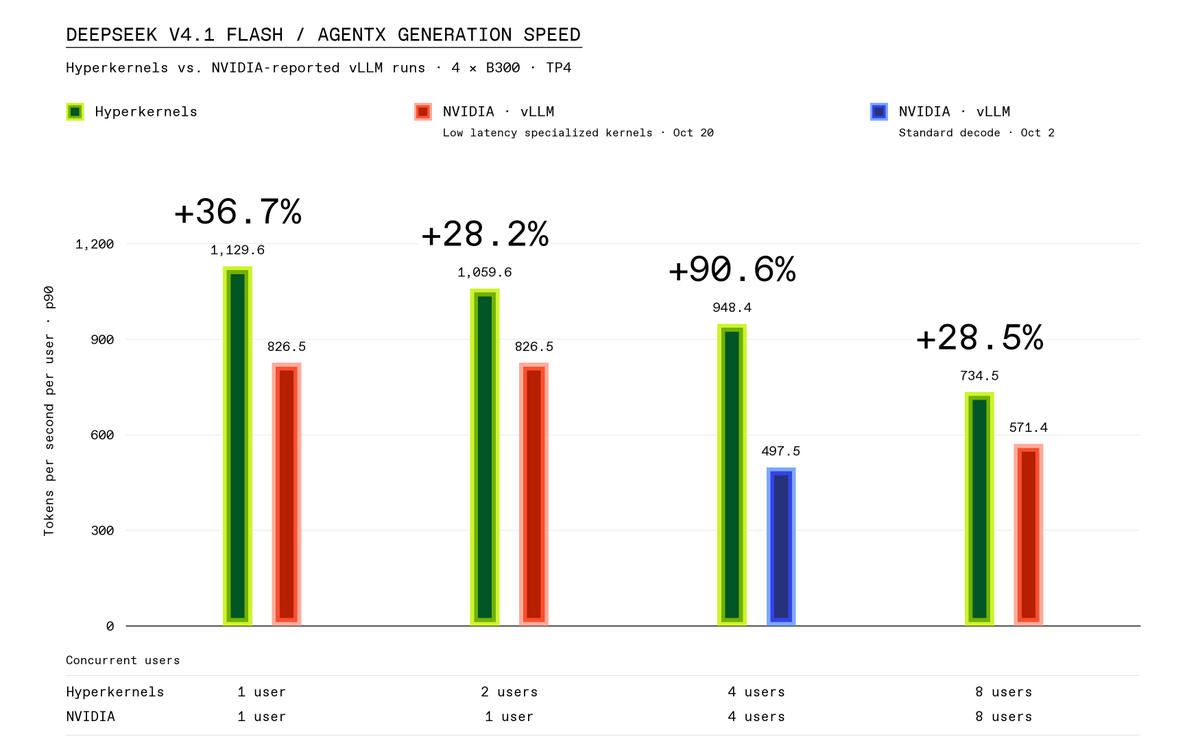
We absolutely crush NVIDIA and achieve the best low latency inference for DeepSeek v4.1 Flash.
Compared with NVIDIA’s published vLLM results, Hyperkernel delivers:
• 36.7% higher per-user generation speed at concurrency 1.
• 28.2% higher per-user speed while serving two users, versus NVIDIA serving one.
• 15% higher per user speed while serving four users, versus NVIDIA serving one.
• 90.6% higher per-user generation speed at concurrency 4, compared with the highest published C4 AgentX interactivity for TP4 B300s.
• 28.5% higher per-user generation speed at concurrency 8, compared with NVIDIA's published result.
• 36% faster median per-request decode speed.
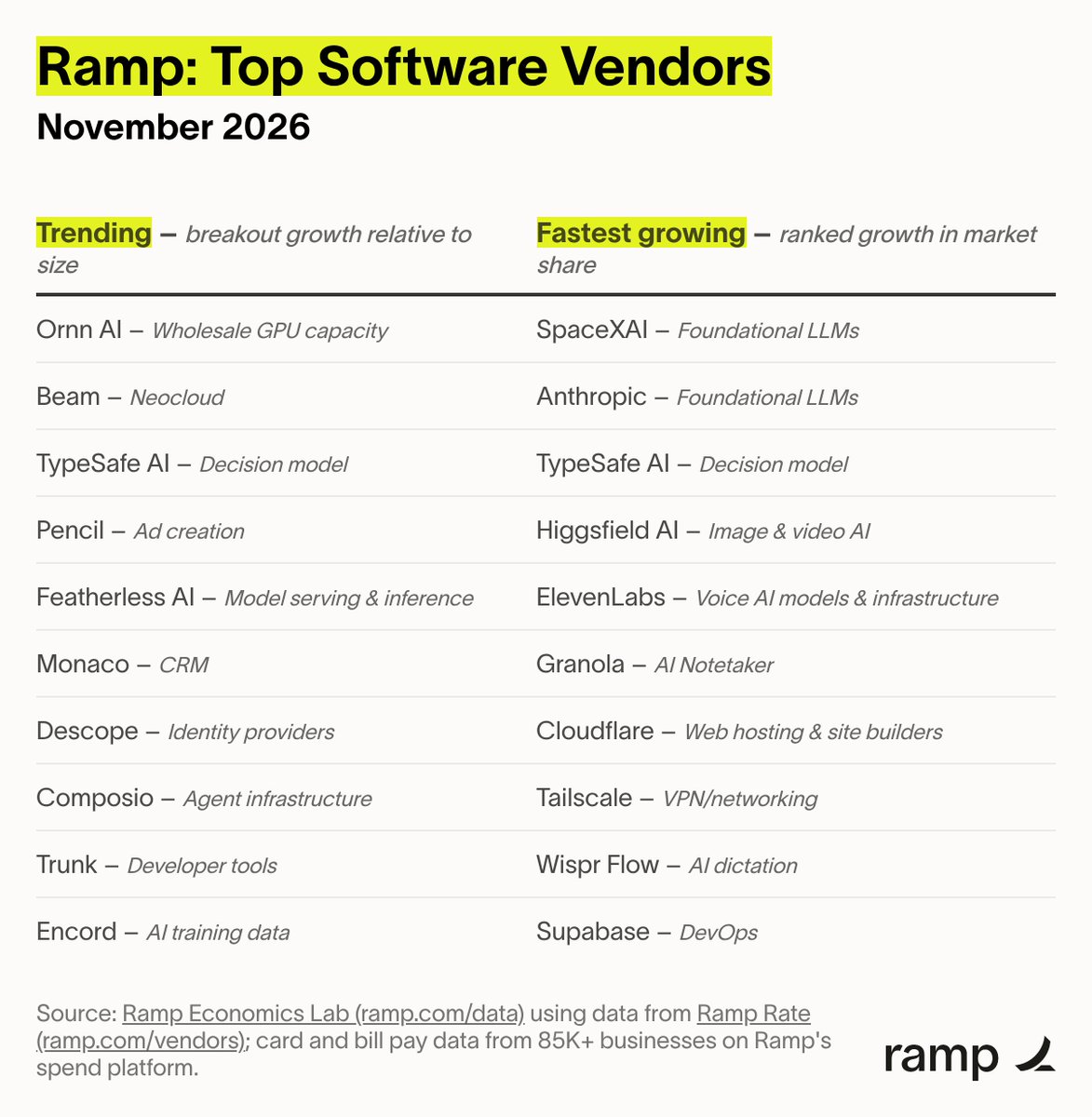
We're #1 on Ramp's Trending Vendors list for November.
The ranking is based on actual spend from 85K+ businesses, so it comes with receipts.
Thanks to the @tryramp team for the spotlight.
NEW: SPACEXAI is the fastest growing software company according to Ramp spend data.
I find the following:
- SpaceXAI's advantage in coding + its new consumer offering could accelerate business adoption of its models, much like what powered Anthropic's rise.
- Continued growth in cybersecurity SaaS.
- Multiple winners in AI dictation (Wispr Flow and Granola both take a spot on our list).
A 5-year H100 contract is priced at $1.58/hr. On demand, that same GPU rents for $3.12/hr.
Neoclouds are accepting a ~50% discount to secure financing for their clusters. This is what we call the compute certainty tax.
How much upside have neoclouds sacrificed over the H100s lifetime? Read Ornn’s research on the cost of certainty over the first three years of the AI buildout: https://t.co/iWU843JLiw
The most mind blowing stat we've seen so far is this:
"As of June 30, 2026, we had raised an aggregate of $141.1 billion of capital and had cash and cash equivalents of $112.4 billion and short-term investments of $19.3 billion."
That means to date, they have burned 9.7b, they are growing at a rapid pace, and are profitable on an operating income basis as of the June quarter! This is likely the most efficient scaling of a business in the history of capitalism.
https://t.co/bWYbqKOMDN
Interestingly, this means compute is the neolab hedge against losing the model race. If OpenAI/Anthropic pull ahead to the extent you can't compete (fast take off), your models are worthless but your GPUs aren't.
Heard from a neolab friend:
“Even if we fail to train the best model, we locked in GPU capacity early. H100/B200/B300 rental prices have since gone up 2–3x. We can just resell the compute and print money.”
OK, so that’s the business model.
It's interesting that every depreciation model assumed the A100 would be nothing but scrap metal by now.
Its utilization is climbing and none are flooding into the secondary market yet which means contracts are being renewed.
If this continues to be the case for Hoppers, there is a serious bull case to consider for companies that have financed these chips on standard 6 years.
Else, there's going to be a huge change in this market with disaggregated compute supply.