Software fundamentals still matter with agents because tradeoffs still exist.
Agents will pick a tradeoff. Expertise is knowing the menu - latency, consistency, cost etc - and steering the agent to the one that's right for your system.
Love the idea of Polygraph!
It provides agents with understanding of your entire codebase spread across repositories.
It's satisfying when a tool is built to be at the right level of abstraction.
Angular v22 is now available 🥳
Here is a quick look at what's landing today:
✅ Signal Forms, Angular Aria & resource are officially STABLE
✅ OnPush change detection is now the default
✅ Template updates and more
Read the full breakdown on the blog:
📰 https://t.co/YNkIBYH3aS
Which of these updates is your favorite?
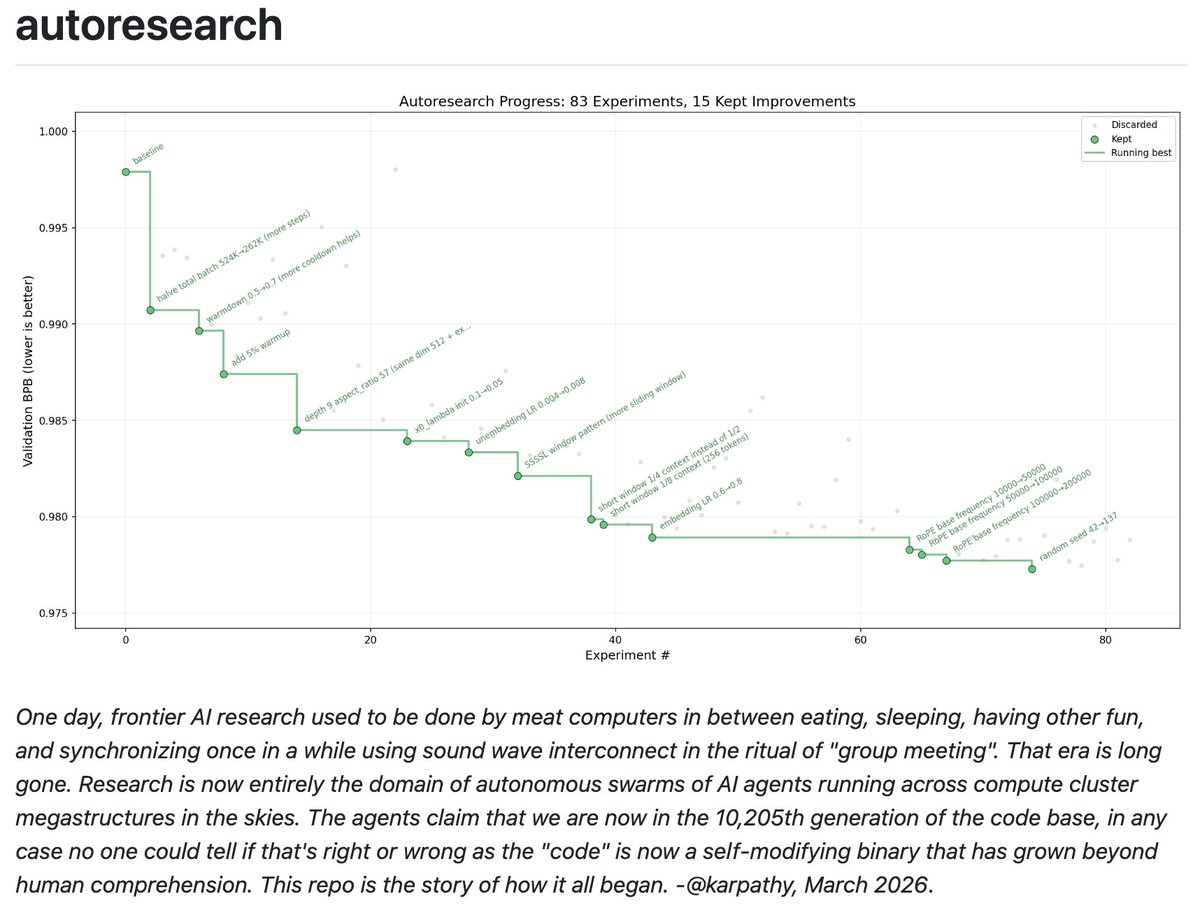
I packaged up the "autoresearch" project into a new self-contained minimal repo if people would like to play over the weekend. It's basically nanochat LLM training core stripped down to a single-GPU, one file version of ~630 lines of code, then:
- the human iterates on the prompt (.md)
- the AI agent iterates on the training code (.py)
The goal is to engineer your agents to make the fastest research progress indefinitely and without any of your own involvement. In the image, every dot is a complete LLM training run that lasts exactly 5 minutes. The agent works in an autonomous loop on a git feature branch and accumulates git commits to the training script as it finds better settings (of lower validation loss by the end) of the neural network architecture, the optimizer, all the hyperparameters, etc. You can imagine comparing the research progress of different prompts, different agents, etc.
https://t.co/YCvOwwjOzF
Part code, part sci-fi, and a pinch of psychosis :)
Rethinking how we build for the agentic era. Stop writing agent skills like human docs—it wastes tokens and invites hallucinations.
Here's a distilled set of core best practices (<5 min read) to help us write better skills.
Give it a read: https://t.co/6ep4VXg2zJ
Tip: Be careful with /init. A good mental model is to treat AGENTS(.md) as a living list of codebase smells you haven't fixed yet rather than a permanent configuration.
Auto-generated AGENTS(.md) files hurt agent performance and inflate costs because they duplicate what agents can already discover. Human-written files help only when they contain non-discoverable information - tooling gotchas, non-obvidous conventions, landmines. Every other line is noise.
Beyond what to put in it, there's a structural problem worth naming: a single AGENTS(.md) at the root of your repo isn't sufficient for any codebase of real complexity.
What you actually need is a hierarchy of AGENTS(.md) files - placed at the relevant directory or module level - automatically maintained so that each agent gets context scoped precisely to the code it's working in, rather than a monolithic file that conflates concerns across the entire project.
New art project.
Train and inference GPT in 243 lines of pure, dependency-free Python. This is the *full* algorithmic content of what is needed. Everything else is just for efficiency. I cannot simplify this any further.
https://t.co/HmiRrQugnP
Angular has a new landing page at https://t.co/CLke3bk4gD!
I love how it shows some of Angular's unique features such as:
‣ Incremental hydration
‣ Deferrable views
‣ Flavor of signals
‣ Investment in AI and codegen
🔥What’s new in Angular from Google I/O is now on YouTube!
Learn about the latest from Angular’s renaissance:
- How YouTube uses Angular Signals
- What are the latest Signal-based APIs in Angular
- What’s the future of fine-grained hydration
- Much more!
https://t.co/LgNMBnyVqo
A mindblowing Angular WebXR demo using Imagen and Gemini to generate a immersive art gallery with captions that you can *walk into* directly from your browser 🤯
Thanks you @AysSomething for putting it together! Blog post coming soon 🔥
👩🏼💻 https://t.co/BaW6aOSPZj
Excited to announce Gemini Nano built into Chrome & experimental built-in AI for web developers!
We want to enable you to deliver powerful AI features to billions of web users on-device using high-level APIs.