Close to home for Latent Space, Pfizer was recently onstage in NYC at the AI Engineer Summit with their example:
https://t.co/11MtPj0uel
I have more examples linked at the end of the GraphRAG Manifesto including some (LinkedIn) who deployed into production, saw a massive improvement, and wrote a research paper about it.
Lots more have come out since I wrote the post. You’ll find more at https://t.co/4zZNDj0BjW
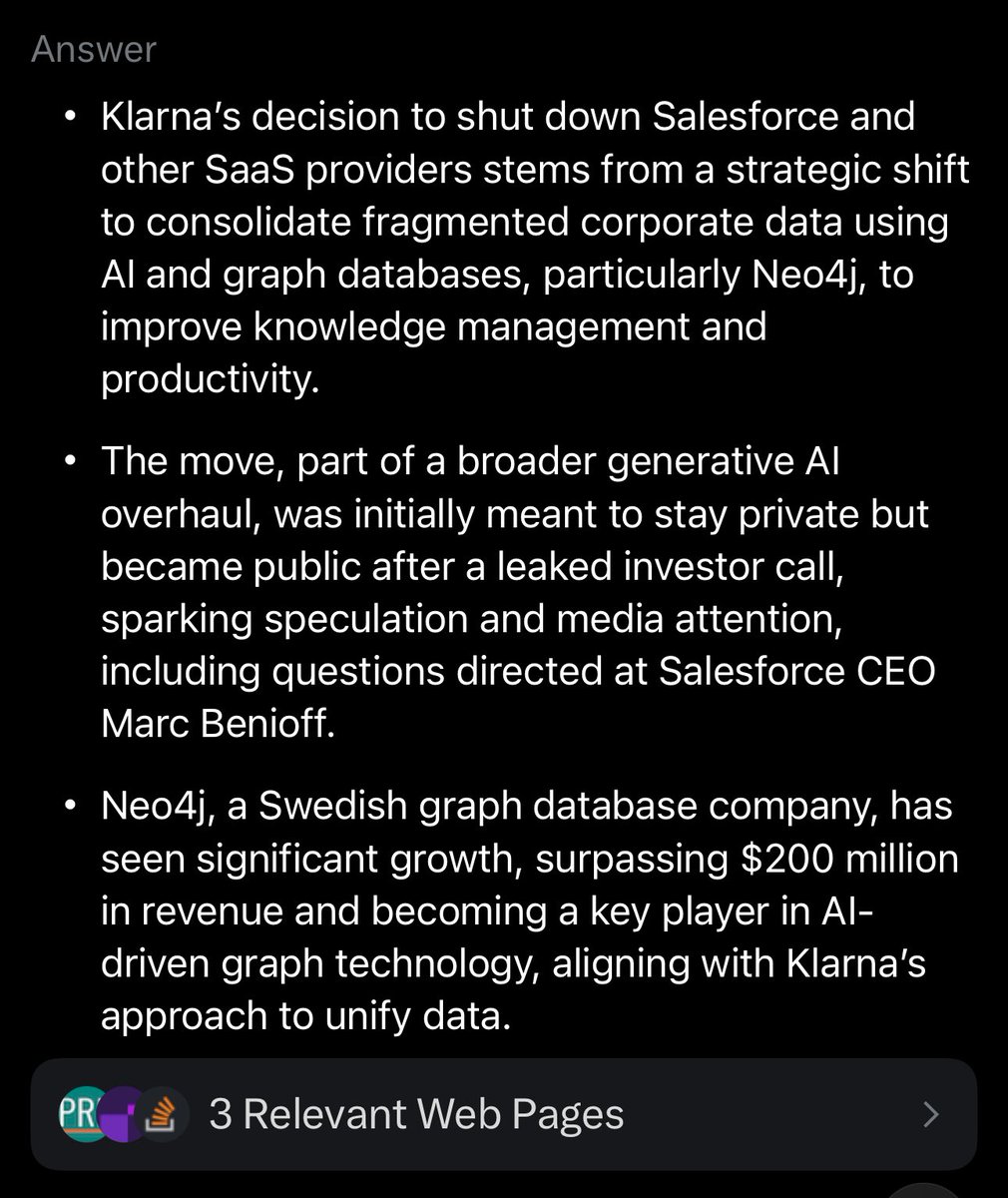
I do get your point and will let folks add in their experiences here. But it’s worth pointing out that part of the thread came from the CEO of Klarna, who considers what they built only to have been possible because of GraphRAG with a graph database (Neo4j in this case):
https://t.co/zfWvvbPvPC
He talks some more about it on this Sequoia Training Data episode starting at minute 30:
https://t.co/7vzlH3BDVg
Today’s @latentspacepod with @dharmesh is *of course* an awesome listen:
https://t.co/YAZFLjIVt4
A thread expanding on the graph database portion the discussion 🧵:
@latentspacepod@dharmesh@emileifrem@DMRadioOnline@neo4j 10/ Besides PageRank, one of my favorite graph algorithms is https://t.co/K2xbmAgN99
It’s a great way to resolve anonymous user breadcrumbs into a pseudonymous single identity.
@yaakovepstein51 Neo4j Aura starts at $65 perGB per month, includes hosting/patches/backups/etc., and can be gotten through your cloud marketplace of choice. Otherwise Neo4j has an open source Community Edition that may or may not work depending on your scalability/availability/security needs.
Klarna’s AI journey is rooted in the power of graphs. I agree with Sebastian that the value of Neo4j/knowledge graphs/GraphRAG is in the top line. It’s not about replacing SaaS, but bringing data from the many silos into a graph, and using that for better AI decisions.