Announcing Generalised Superintelligence! (GSI) 🎉
GSI has achieved 250+ novel discoveries and breakthroughs across eight domains, including Quantum, Superconductivity, Chip Design and Mathematics through its Meta Solver Platform. GSI is extremely compute efficient compared to other frontier labs and excels at finding the hard structure in a problem first, before attempting it.
Everyone can contribute to scientific breakthroughs using the kind of superintelligence GSI is building.
Research preview out now at https://t.co/LSwU67gczE
Announcing FPV-SLAM, a state-of-the-art SLAM system for egocentric data. FPV-SLAM ranks 1st in the monocular-inertial track of LaMAria, ETH Zurich's city-scale benchmark.
Announcing FPV-SLAM, a state-of-the-art SLAM system for egocentric data. FPV-SLAM ranks 1st in the monocular-inertial track of LaMAria, ETH Zurich's city-scale benchmark.
Excited to announce that Ego-Oscar has been accepted to @wacv_official.
We’ve had lots of people reach out to us for help since we open-sourced this, and we're glad it's become a strong foundation for teams to tinker with the underlying hardware stack for human-to-robot transfer.
Super proud and excited to finally present LiteMol-1. This is our first foundation model from LiteFold, pre-trained from scratch.
Today, LiteMol-1 can generate small molecules, peptides, cyclic peptides, depsipeptides, peptides with ncAAs, macrocycles, and PROTACs.
Across our peptide and small-molecule evaluations, the model shows competitive results. In several settings, we are on-par with or better than frontier structure-based models, at a fraction of the generation cost.
But the part I find most interesting is that this is a model for agents. We have seen ourselves how much compute, and how many tokens it can take to generate good binders using frontier structure-based models. Sometimes you need to generate tens of thousands of designs just to get a handful worth taking forward.
Now put this inside an AutoResearch loop. The agent has to continuously parse structures, inspect PDB/CIF files, compare candidates, run evaluations, modify the design, and repeat the whole thing again. It becomes extremely expensive very quickly.
Sequence space gives us a very different interface. LLMs are much more efficient at inspecting and manipulating compact molecular representations like SMILES than repeatedly operating over full structural files.
So LiteMol-1 becomes something like an infinite molecular canvas for the agent. For a given target and objective, the model can continuously propose what a biomolecule could look like. The agent can inspect those generations, take inspiration from them, preserve certain regions, edit others, optimize them, score them, and generate again.
Generate → inspect → evaluate → edit → generate again.
There is another problem I care a lot about. Most molecule design models today are heavily optimized around binding. But binding is only one part of whether something eventually becomes a therapeutic. What about ADME? Toxicity? Selectivity? Solubility? Membrane permeability? Synthesizability?
For this, we also built a Monte Carlo Tree Search-based multi-objective generation framework around LiteMol-1. Instead of combining everything into one score, the search keeps multiple strong candidates, each balancing the desired properties in a different way.
As our scoring functions and verifiers get better, the generation system gets better too. We can start steering molecules not just toward “binds well”, but toward a broader therapeutic design specification.
The bottleneck slowly moves from simply generating molecules to having sufficiently good verifiers and scoring functions to tell us what is actually worth generating. Check out our technical research blog post for all the details.
At LiteFold, our research is focused on engineering biomolecules and building systems that can carefully forecast their pre-clinical success.
To stay updated on our research, follow LiteFold.
Cheers!
🚨 New Open Source Release
Today we are releasing Ego-OSCAR, an open-source head-mounted stereo-inertial capture device for egocentric data collection in the wild, together with a corresponding dataset of 550 hours captured across 100+ environments.
Egocentric data is still an active research problem, and we believe an open and accessible foundation will empower everyone to participate, experiment, build, and contribute to this space.
This continues our past efforts, where we open-sourced Stera, a full-stack capture and processing pipeline for RGB-D data. Ego-OSCAR builds on that lineage and offers a fully open-source stereo-inertial capture stack for anyone working on human-to-robot transfer.
We make three core contributions today with Ego-OSCAR:
1. An open-hardware capture device with full CAD, wiring, and assembly documentation, with a complete bill of materials under USD 200 and using commercially available components and 3D-printed parts.
2. An open-source capture pipeline (recording daemon, IMU sampler, time-sync tooling, watchdog firmware).
3. The Ego-OSCAR-550h dataset, approximately 550 hours of egocentric stereo video per camera with synchronized IMU, released to validate the device at deployment scale.
Everything is open-source, including the hardware designs, capture pipeline, firmware, and the downstream dataset.
Read the full blog at: https://t.co/qbEm8unXjw
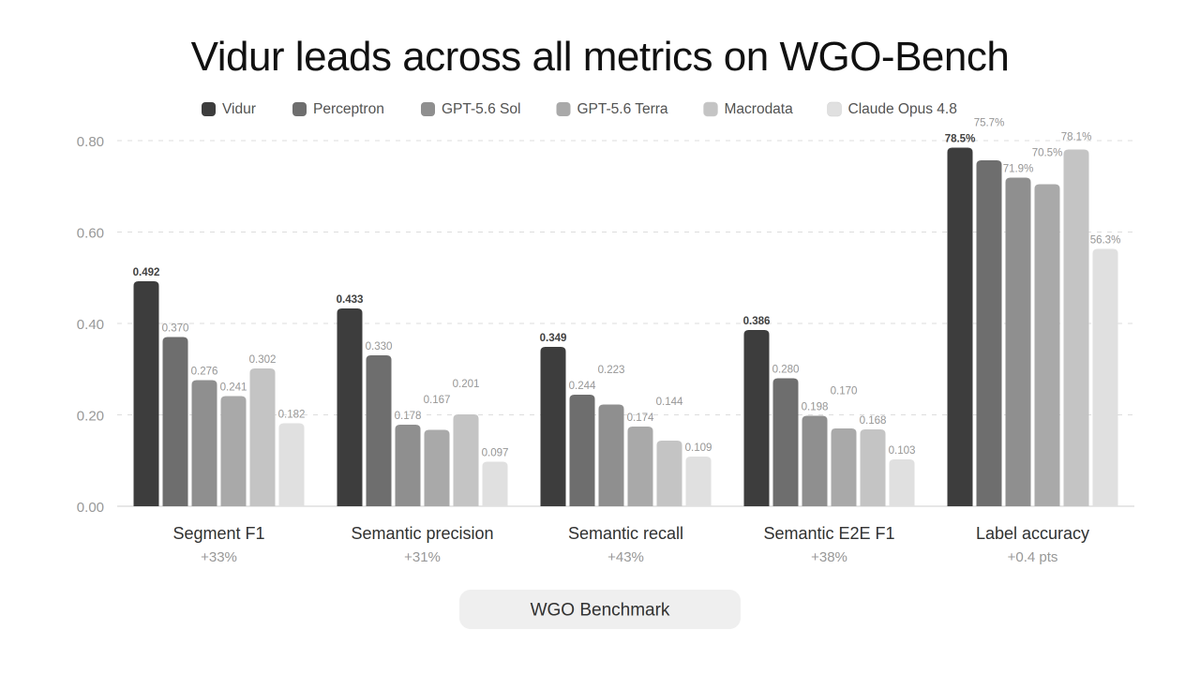
1/ Announcing Vidur, an end-to-end system to generate fine-grained action labels on raw robot and human videos. Vidur leads across all metrics on WGO and EgoExoLearn Bench across temporal segmentation, semantic precision, semantic recall, and end-to-end action-label quality 🧵
Ever since we released Stera, the question we kept hearing was the same: Is an iPhone’s tracking actually good enough? So instead of arguing about it, we decided to test ARKit poses against ground truth.
We benchmarked an iPhone Pro running ARKit against a 24-camera Vicon optical motion-capture system (sub-millimeter accuracy at 200 Hz), across eight sequences spanning motions that dominate real egocentric tasks like walking, manipulation, fast motion, in-place and aggressive rotation, height change, and more.
Across all eight sequences, absolute trajectory error (ATE) ranged from 6.0 to 12.5 cm while translational RPE remained under 5 cm throughout.
Our takeaway - the barrier to high-fidelity egocentric data might be lower than everyone assumed. It doesn’t require a research-grade rig or a device most people will never own. It can be collected with commodity hardware, substantially lowering the barrier to large-scale data for robotics.
The full numbers, details of every sequence, and how we measured them against ground truth are in the essay below 👇
Can a commodity smartphone replace a $10,000 data rig?
We're presenting MobileEgo Anywhere at ICRA 2026 - open infrastructure for collecting hour-long egocentric trajectories on commodity hardware for downstream robot policies.
📍 Strauss 3 | 🕒 3:00 - 4:00 PM today Come say hi 👋
We have released the biggest protein data collection on Hugging Face, guys!
We have been working on this for more than 3 weeks now, starting from curating the raw data, doing a lot of filtering, splitting the datasets, sharding them, and doing a lot of analysis. Everything is summarized in our recent blog post.
🚨 New Paper (ICRA Workshop, 2026)
MobileEgo Anywhere: Open infrastructure for long-horizon egocentric data on commodity hardware.
Existing robotics egocentric datasets are limited by short episode durations and rely on gated hardware.
We release a framework designed to facilitate the collection of robust, hour-plus egocentric trajectories on a commodity iPhone.
Introducing Project Stera by FPV Labs, an open data infra for embodied AI research.
Project Stera includes Stera-10M, with 10M+ frames of long-horizon data with persistent state tracking, and an open-source pipeline that converts raw data into training-ready formats.