Thanks for visiting my profile.
I left a senior engineering job in June to build my own products with AI.
Why I did it, and everything I've shipped since:
March 2026, our weekly AI call at work.
My manager shared his screen and showed a small app he'd built with AI.
It quoted the price of installing our system in a parking lot.
Until then, every quote was worked out by hand in an Excel sheet.
He built it in a few evenings.
I'd been writing software for 6 years, and I'd never built a tool like that for myself.
Three months later I resigned.
Here's what I've built since June.
Products
• Specatro: a market-prediction game built on real historical events. In Android closed testing, launching in November
• Nifty Chronicles: pre-market Nifty analysis every trading day, plus weekly reviews → https://t.co/rjuClDwJUM
• YouTube Book Maker: turns a whole YouTube channel into a book → https://t.co/KKFi5pKUxJ
• Localooru: a hyper-local app, in progress → https://t.co/3Qv3kHq9ia
Open source
• Chillax: a Rust terminal app where a team of AI agents runs your sprints, QA and releases → https://t.co/uBo2HIErwh
• agentic-setup: one command to set up your coding agents, fully reversible → npx agentic-setup
• Easy Recommendations: ask colleagues for LinkedIn recommendations without the awkwardness → https://t.co/tOfh5l5AdK
• The Discipline of Markets: a free book on trading discipline → https://t.co/2BWWBk8wVJ
Just for fun
• Aparichit: an AI short film and its site → https://t.co/6WLr6HVVzo
• Web Evolution: scroll through the history of web design → https://t.co/er6hgIXM19
• Shakuni: a 3D dice game from the Mahabharata → https://t.co/PGWRJBlKOt
Every project, with dates: https://t.co/R6578f31or
Next up: Specatro launches in November. Follow me and you'll get the link here first.
If you quit your job tomorrow, what's the first thing you'd build?
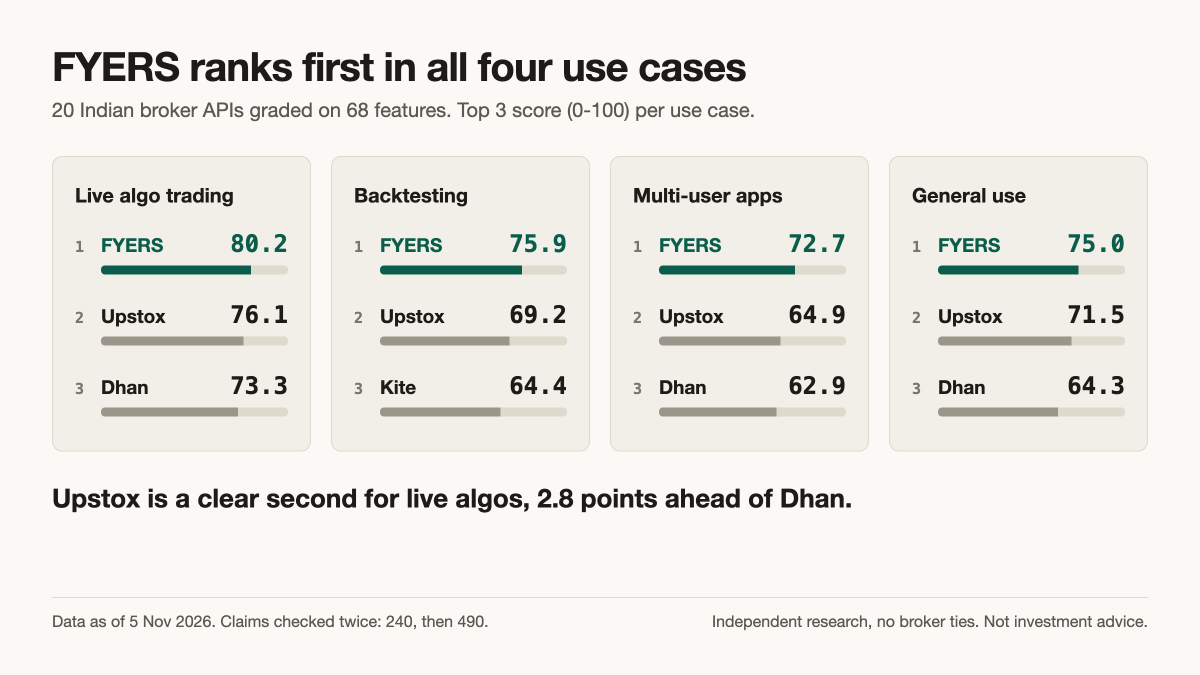
I graded 20 Indian broker APIs on 68 features. FYERS tops all four use cases.
Upstox is a clear second for live algos, 2.8 points ahead of Dhan. 15 of 20 APIs are free to use with live data today.
I checked my own claims twice (240, then 490) and fixed what I found, including my first Kite correction, which was wrong.
Data as of 5 Nov 2026. Independent, no broker ties, not investment advice.
Which API do you run today?
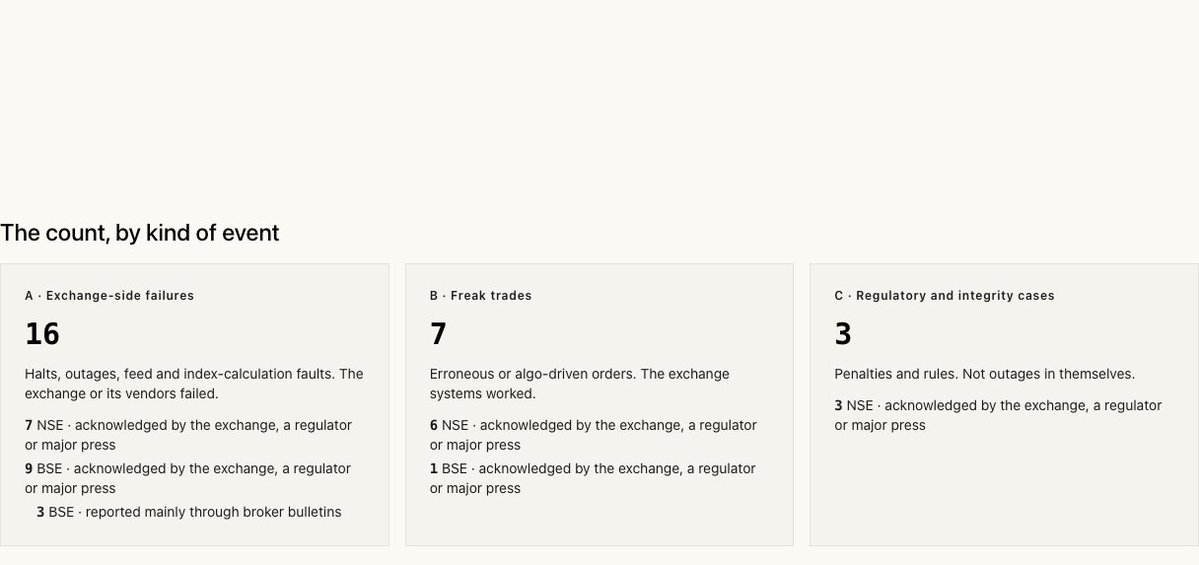
BSE had a price-update glitch on F&O on Nov 11. A broker bulletin went up at 14:12 IST and showed resolved at 14:36. No cause disclosed.
I counted every sourced NSE and BSE failure since 2006: 16 exchange-acknowledged (7 NSE, 9 BSE), 7 freak trades, 3 regulator cases.
Every record with its sources: https://t.co/tnXcs8olB1
Which one do you remember best?
Agentic developers, here are the best repositories to check for maximum token savings.
TRIM WHAT THE AGENT READS
• rtk (86k ★) compresses terminal output before the agent sees it. Claims 60-90% less.
https://t.co/PxqvQEo2MG
• serena (31k ★) finds and edits code by symbol, so the agent opens one function and leaves the file unread.
https://t.co/KxKFnv2nwd
• codebase-memory-mcp (48k ★) turns your repo into a graph the agent queries. Claims 10x lower token use.
https://t.co/mAjtX27XUH
• code-review-graph (33k ★) reads only the files a change touches. Their flask example: 143,594 tokens down to 2,196.
https://t.co/UyRsFHpOA5
• claude-context (13k ★) is semantic code search over MCP. Claims ~40% fewer tokens.
https://t.co/AUzosGnhF6
• repomix (29k ★) packs a repo into one file with token counts per file.
https://t.co/8iAtNUd7He
TRIM WHAT GOES IN AND OUT
• caveman (119k ★) makes the agent reply tersely. README says 33% fewer input tokens. Independent tests found 8.5-23% output savings.
https://t.co/xPEiHE2ln5
• TOON (26k ★) is a compact JSON replacement for prompt data. Their example: 117 tokens down to 66.
https://t.co/A1XS8AD57e
TRIM WHAT EACH TURN COSTS
• claude-code-router (38k ★) and LiteLLM (63k ★) send easy turns to a cheaper model.
https://t.co/209PzHCTw9
https://t.co/SM65Wattqg
All active in the last 6 weeks. Savings figures are each repo's own claim, so test on your codebase.
Which of these is already in your setup?
Asking for a LinkedIn recommendation is awkward. Writing one is worse.
So I built an open-source tool: your colleague answers a few questions on their phone, AI drafts one paragraph from their answers only, and they approve it before pasting it in themselves.
Demo below, all names invented.
Open source (MIT), self-host on your own Cloudflare account: https://t.co/tOfh5l5AdK
Which do you put off more: asking, or writing?