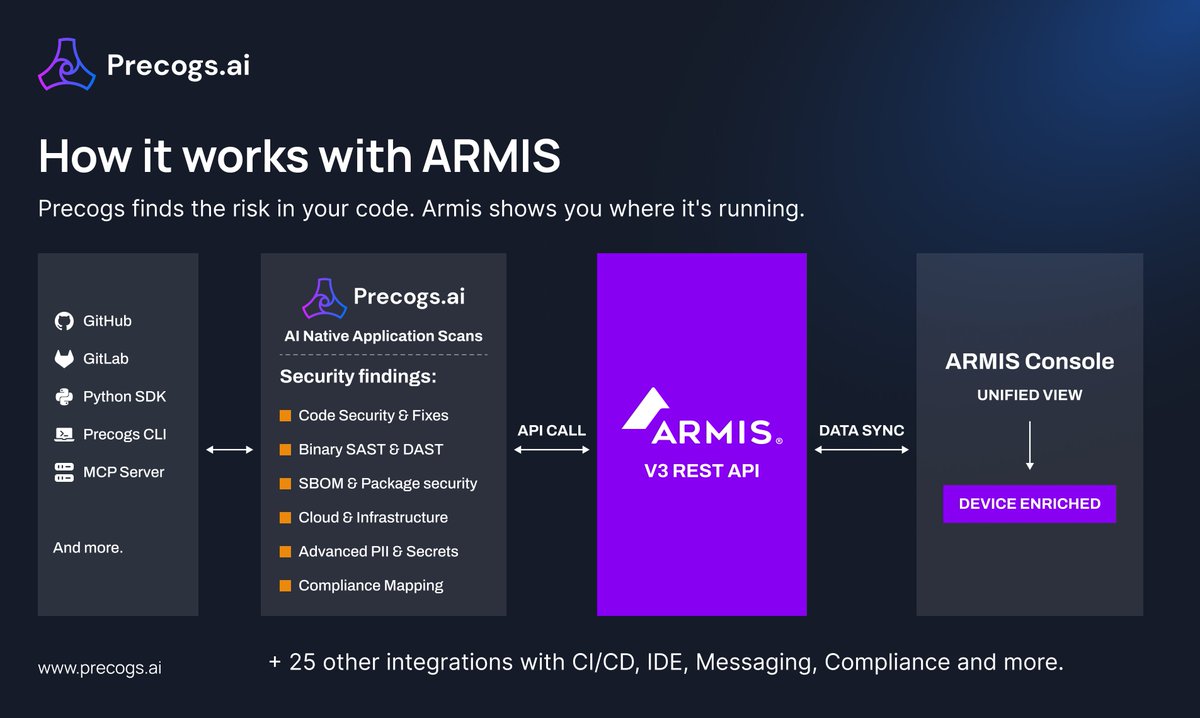
We are excited to join Armis Marketplace as partners. We are looking forward to creating solutions for enterprises for securing Code, Binaries, and Data.
Our Architecture seamlessly integrates with Armis, allowing companies to monitor assets more effectively, detect vulnerabilities, and fix them.
@ArmisSecurity@precogs_ai
A git push shouldn't give you RCE on someone else's infrastructure.
But CVE-2026-3854 did exactly that.
The wild part? Each step in the chain looks harmless on its own. Reviewers would've shipped it.
We broke down how it works — and the one architectural mistake behind it.
Full breakdown: 🔗 https://t.co/XPJoHylr8W
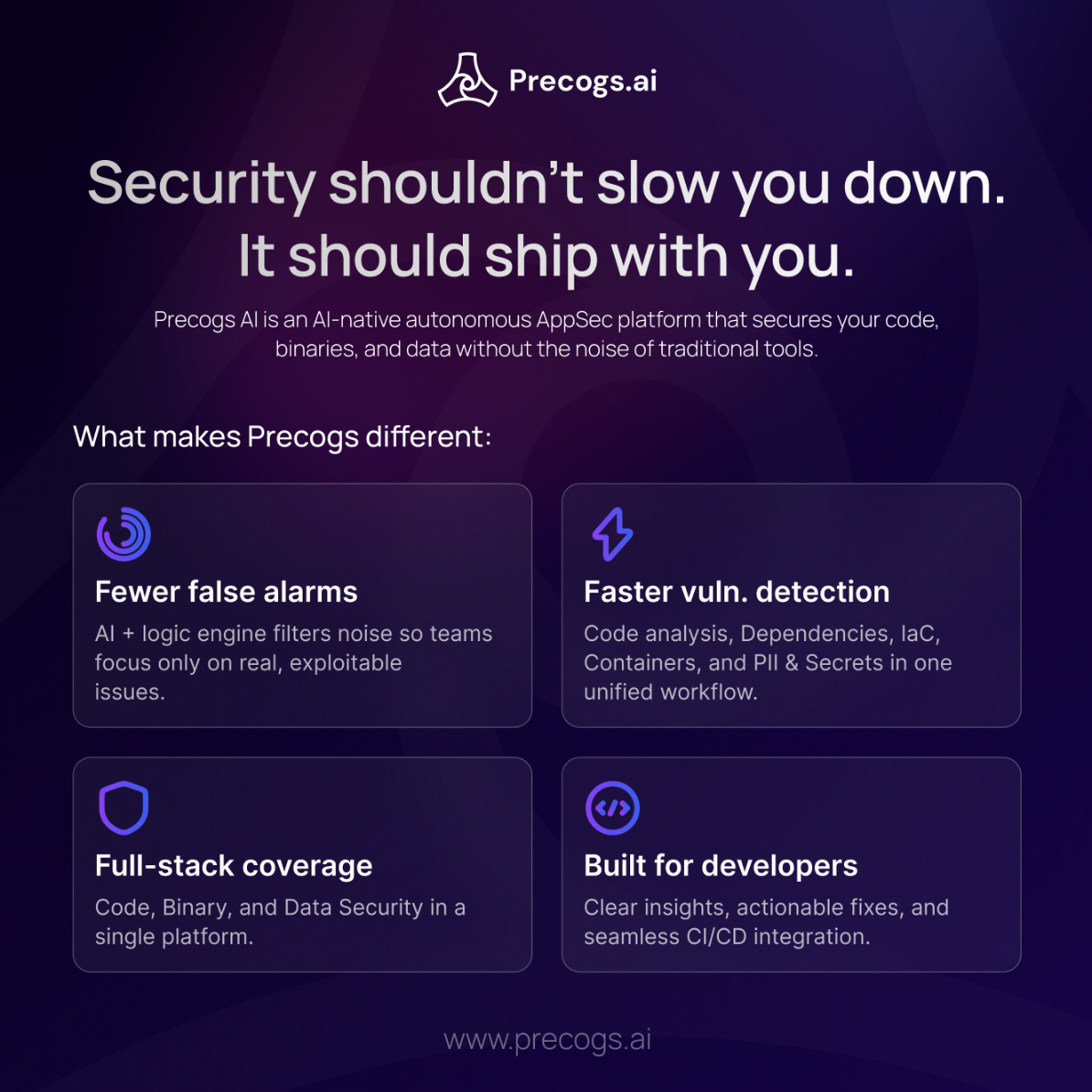
Security shouldn't slow you down. It should ship with you.
Precogs AI → AI-native AppSec for code, binaries & data.
✅ Fewer false alarms ⚡ Faster vuln detection 🛡️ Full-stack coverage 👨💻 Built for developers
https://t.co/s7Hjx1VGmr
The Canvas breach wasn’t just a cloud security failure. It was a PII visibility failure.
Most security tools scan code. Attackers target exposed data across integrations, configs, binaries, logs, and APIs.
Precogs detects PII across Code. Binary. Data. Natively in CI/CD before exposure becomes breach material.
#AppSec #DataSecurity #PII #CyberSecurity #DevSecOps #CloudSecurity #CI_CD #DataProtection #SecurityEngineering #SaaSSecurity
One git push. Millions of repos exposed.
That's CVE-2026-3854. A single semicolon broke GitHub's internal trust boundary.
The lesson every engineer needs: Authentication is not sanitization.
🔗 https://t.co/OBj3s2K20g
🚨 Vibe coding is shipping CVEs at industrial scale — and nobody is talking about it loudly enough.
35 CVEs in March 2026 alone traced back to AI-generated code.
A thread on what's actually breaking 🧵
Visit us, to know more, https://t.co/Qedrtp0u2M
@TheHackersNews Every AI tool connected via OAuth is now part of your attack surface. The scary part isn’t the breach—it’s how normal this attack path is becoming.
The Vercel breach is the clearest example yet of a new attack pattern:
Compromise a third-party AI tool → inherit OAuth scopes → pivot into real infra.
Your vendor security review needs a new row:
"Which AI tools can employees connect, and with what scopes?"
And when a breach happens, the difference between an incident and a catastrophe is simple:
👉 Were your secrets already exposed — sitting in your code, pipelines, or unprotected env vars — waiting to be found?
Nothing here was “vulnerable” in isolation — the path is what made it exploitable.
#cybersecurity #AppSec #AIsecurity #OAuth #Vercel
Ready to stop these hidden API vulnerabilities before attackers find them?
Precogs AI continuously scans every endpoint, maps authorization logic, detects shadow APIs, and flags excessive data exposure - across every PR, every build, and every deployment.
Run a free scan → https://t.co/ixtGMlctJz
The most dangerous endpoint is the one you forgot existed. A leftover /api/internal/export route from a data migration 18 months ago.
No auth.
No documentation.
Returned 2.3M user records as CSV.
The client didn’t know it existed… until a red team found it. Shadow APIs are silent killers.
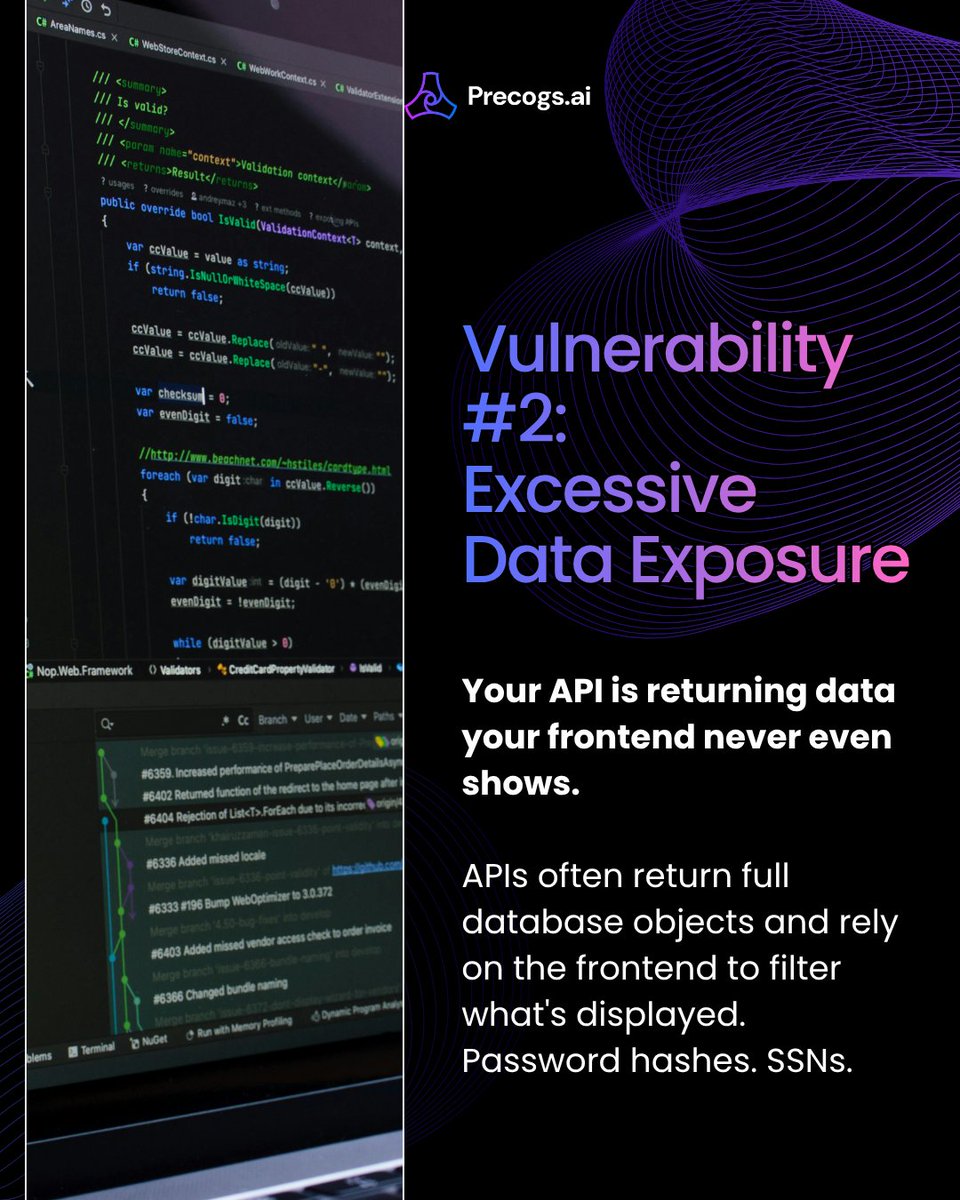
Your API is quietly returning data your frontend never even shows.
Full database objects.
Password hashes.
SSNs.
Sensitive fields.
APIs often dump everything and hope the frontend filters it. Attackers don’t rely on your frontend. They just read the raw response.
The Optus breach: API.
The Twitter 5.4M user scrape: API.
The T-Mobile 37M record exfiltration: API.
None of these were sophisticated nation-state attacks. Each one was an attacker who found an endpoint, and exploited a logic flaw. Click to know more, https://t.co/5XindEN0XH
Your API security is probably fake.
Scanners find patterns. Attackers find logic gaps.
Real security reads the intent behind your code, not just the surface. Read the blog to know more, https://t.co/5XindEN0XH
Cross-modal prompt injection just got real.
38k+ payloads (text + image + document + audio) from top research: OWASP LLM Top 10, CrossInject, FigStep, DolphinAttack & more.
Most tools still treat it as text-only.
Precogs AI doesn't. We detect these advanced LLM threats autonomously in your code, pipelines & apps — with high accuracy and auto-remediation.
Protecting modern AI apps starts here: https://t.co/L7cuNh93iu
#PromptInjection #AISecurity
Open-source cross-modal and multimodal prompt injection test suite. 38,000+ attack payloads across text, image, document, and audio modalities. Research-backed by OWASP LLM Top 10, CrossInject (ACM MM 2025), FigStep (AAAI 2025), DolphinAttack, and CSA 2026. https://t.co/fPNsIDg46K
Your API security is probably fake.
Scanners find patterns. Attackers find logic gaps.
Real security reads the intent behind your code, not just the surface.
Visit site to know more→ https://t.co/CS5uiFOauf 🔐
AI writes your code faster than ever. But faster code + legacy security tools = more vulnerabilities shipping to production.
Precogs AI scans in real-time. 98% fewer false positives. 95% detection rate. CASTLE Benchmark: 1145 one of the highest in the industry.
Security that keeps up. https://t.co/r464n1jPli
AI is accelerating everything - including the vuln discovery/remediation cycle. The real eye-opener here is that 96% of the risk lives in the long tail of lesser-used dependencies, not the popular Python/Node/nginx stack everyone focuses on.
This is why 'shift left' alone isn't enough anymore. Teams need automated, hardened foundations for the entire supply chain - especially as AI agents start generating more of the code and workflows.
Curious: How are you handling the long-tail risk in your org? Relying on SCA tools, distroless/minimal images, or something else?
Full report context via @TheHackersNews 👇
⚡ AI is speeding up code—and risk.
145% more vulnerabilities and 3x more fixes in one quarter, as Python (72.1%) and PostgreSQL (+73%) surge with AI.
96% of risk sits outside core tools.
🔗 Where most security exposure actually lives → https://t.co/sIzPhN6jsb
Why are supply chain attacks everywhere?
Because attackers don’t break code anymore — they make you install it.
Axios had zero malicious code. One compromised maintainer account injected a dependency with a postinstall hook — and dropped a full RAT.
The attack chain, IOCs, and how to harden your pipeline:
https://t.co/rrgz338Mil
#SupplyChainSecurity #CyberSecurity