We're pleased to announce a strategic investment from @CoinsiliumGroup (AQSE: COIN), marking their entry into prediction markets.
This partnership brings strategic depth, sector expertise, and an industry network to accelerate our development.
https://t.co/OfqNQGKVHk
"Eddy contextualised Coinsilium's recent US$150,000 investment in @Predictive_Labs , framing data aggregation and intelligence systems as high-leverage infrastructure opportunities that avoid the regulatory complexities faced by direct trading venues like Polymarket or Kalshi.
In his view, prediction markets, blockchain infrastructure, and autonomous AI systems are converging into a new “agentic economy” where machines may eventually interpret signals, allocate capital, and coordinate economic activity in real time."
Gm Folks
We are back!
This is another edition of the Predict Alpha Report, our bi-monthly collaboration with @CoinsiliumGroup tracking the rise of prediction markets, event-driven finance, and the growing role of AI agents within it. Each edition focuses on the signals that matter, from capital flows and fundraising activity to regulatory shifts and product innovation. As information is increasingly priced in real time by both humans and machines, the Predict Alpha Report will track where these signals lead.
But first, let’s get this part out of the way:
Always DYOR:
This bulletin is for informational purposes only and contains summaries of news articles originally published by third-party media outlets. Please refer to the full disclaimer at the end of the post.
Now, let’s get started.
Here are the highlights:
💸 Capital Signals
👉Pretty Impressive, Kalshi
👉A Partnership, A Raise
👉Welcome HIP-4
👉Robinhood Expands…
👉Coinsilium CEO on "When Shift Happens" Podcast
📈 Industry Pulse
👉NHL, CFTC V Insider Trading
👉India Blocks Polymarket, Kalshi
👉In Japan by 2030?
👉Bio Prediction?
💸 Capital Signals
💰 Pretty Impressive, Kalshi
Kalshi has just extended its already massive Series F round with an additional $200 million raise led by Baillie Gifford and Layer Global, keeping the company’s valuation at $22 billion. The fresh capital comes just weeks after Kalshi announced a separate $1 billion raise, backed by firms such as Coatue, Sequoia, Andreessen Horowitz, Paradigm, Morgan Stanley, and ARK Invest. Altogether, the company has now raised roughly $2.77 billion since launching in 2018.
Kalshi’s growth is pretty impressive. Monthly trading volume reportedly crossed $14 billion in April, nearly triple what it was last October, while annualised revenue has climbed above $1.5 billion. Also, Baillie Gifford (traditionally known for backing long-duration growth companies like Tesla and Shopify) participating in the round is an excellent signal.
💰 A Partnership, A Raise
Polymarket is in advanced talks to raise another $400 million at a $15 billion valuation. The raise is coming shortly after Intercontinental Exchange (ICE), the parent company of the New York Stock Exchange, reportedly invested $600 million as part of a broader push into event-driven trading markets. Just a year ago, Polymarket was valued closer to $1 billion, but that valuation has been quickly repriced.
At the same time,
Polymarket is expanding beyond politics and sports into private markets through a new partnership with Nasdaq Private Market. Users can now trade contracts tied to the valuations, IPO timelines, and secondary market activity of companies like OpenAI, SpaceX, Stripe, Anthropic, and Databricks. This means that retail traders are getting access to a layer of market speculation and price discovery that was historically limited to venture firms, private equity funds, and accredited investors.
💰Welcome HIP-4
Hyperliquid has officially entered the prediction market race with the launch of HIP-4, a new upgrade that adds fully collateralised outcome contracts directly into the platform’s existing trading infrastructure. The design is interesting because Hyperliquid is integrating prediction markets into a unified trading system where traders can manage spot positions, perps, and event-based contracts from the same account. The contracts settle between 0 and 1 depending on whether an outcome happens, and unlike leveraged futures, they are fully collateralised upfront, meaning there is no liquidation risk. The first live market is tied to Bitcoin’s daily price outcome, but the infrastructure already supports more complex event markets.
💰Robinhood Expands…
Robinhood is moving deeper into prediction markets by expanding access to event-based contracts tied to politics, economics, and sports, while deliberately avoiding markets that could raise insider trading, manipulation, or reputational concerns. Instead of building its own independent system, Robinhood is partnering with regulated US platforms like Kalshi and ForecastEx to keep the products within existing compliance frameworks.
Recently, CEO Vlad Tenev described prediction markets as the company’s fastest-growing segment. For a platform that originally built its brand around making stock and options trading accessible to retail users, prediction markets are increasingly being positioned as the next layer of alternative financial exposure.
And rounding up this section:
💰 Coinsilium CEO Eddy Travia Outlines Vision for AI Agent Integration and Prediction Market Infrastructure on "When Shift Happens" Podcast
Coinsilium Group CEO @eddybitcoin appeared on the When Shift Happens podcast to discuss the structural convergence of AI agents, prediction markets, and stablecoins into a unified, machine-driven internet economy. Eddy contextualised Coinsilium's recent US$150,000 investment in @Predictive_Labs, framing data aggregation and intelligence systems as high-leverage infrastructure opportunities that avoid the regulatory complexities faced by direct trading venues like Polymarket or Kalshi. In his view, prediction markets, blockchain infrastructure, and autonomous AI systems are converging into a new “agentic economy” where machines may eventually interpret signals, allocate capital, and coordinate economic activity in real time.
📌 FYI: Coinsilium’s shares are traded on the Aquis Stock Exchange Growth Market in London, under the ticker symbol "COIN", and on the OTCQB Venture Market in the United States under the ticker symbol "CINGF".
But it’s not just capital flowing into the space.
Keep reading for the latest signals in regulation, adoption, and structure.
📈 Industry Pulse
⚡️NHL, CFTC V Insider Trading
The NHL and the Commodity Futures Trading Commission (CFTC) have signed a formal agreement to coordinate on fraud, insider trading, and market manipulation tied to hockey-related prediction markets. The move follows a similar agreement signed with Major League Baseball earlier this year.
Under the arrangement, the NHL will share data and integrity-related information with the CFTC to help monitor suspicious trading activity across platforms like Kalshi and Polymarket. The league was already ahead of most major US sports organisations in this area, becoming the first professional American sports league to formally partner with prediction market operators back in late 2025. Now, the relationship is becoming more institutionalised as regulators and sports leagues work together to prevent manipulation and insider-driven trading.
⚡️India Blocks Polymarket, Kalshi
India has officially moved against prediction markets, ordering internet providers to block access to Polymarket and reportedly preparing similar restrictions for Kalshi. The decision follows the rollout of India’s new online gaming regulations, which now classify prediction markets as “money games” under the country’s betting laws. In practical terms, Indian regulators are drawing a hard line: if users are staking money on future outcomes, the activity is being treated as gambling regardless of whether the platform is crypto-native like Polymarket or federally regulated in the US like Kalshi.
What makes the move especially significant is the scale of the market involved. India is one of the world’s largest retail trading and crypto markets, and both platforms have continued onboarding Indian users even after regulators issued warnings in April. Authorities have now escalated from public advisories to ISP-level enforcement while also pressuring VPN providers that help users bypass restrictions.
⚡️In Japan by 2030?
Polymarket is reportedly preparing a long-term push into Japan, appointing Mike Eidlin, formerly Jupiter’s head of Japan, to lead local expansion efforts as the company explores regulatory approval in the country by 2030. The move is notable because Japan is currently a restricted jurisdiction for Polymarket, with users blocked due to local gambling and financial regulations. Despite that, demand appears to be building organically. Polymarket’s Japanese social accounts have already attracted tens of thousands of followers, and the platform hosts a growing number of contracts tied to Japanese politics, macroeconomics, and Bank of Japan decisions.
The expansion effort also highlights how important Asia is becoming in the global prediction market race. Japan has one of the world’s most active retail trading cultures and a highly developed digital asset ecosystem, making it strategically valuable for firms like Polymarket and Kalshi looking beyond the US. At the same time, it is also one of the more legally complex markets to enter since Japanese gambling laws remain strict, and regulators across the region are increasingly scrutinising event-based trading platforms as volumes grow.
Lastly,
⚡️Bio Prediction?
Prediction markets are beginning to spill into one of the most sensitive corners of finance and science: clinical trials and drug development. A new platform called Endpoint Arena has launched a pilot marketplace where users can trade on whether biotech companies like Jazz Pharmaceuticals, Argenx, and Palisade Bio will successfully hit key clinical trial endpoints. At the same time, larger platforms like Kalshi and Polymarket have started listing more biotech-related event contracts tied to drug approvals and FDA timelines.
Supporters argue these markets could become valuable forecasting tools. Instead of trying to price an entire biotech company through its stock, prediction markets isolate specific outcomes like whether a trial succeeds or whether a drug gets approved. Endpoint Arena’s founder even argues that crowd-based forecasting could eventually help surface scientific signals earlier, improve resource allocation, and create incentives for deeper public engagement with clinical research.
On the other end, critics worry that once real money becomes attached to trial outcomes, prediction markets can begin influencing the underlying events themselves. Poor odds could discourage patient participation or impact funding. There is also the risk of insider trading in biotech, where access to non-public trial data can be enormously valuable. Regardless of the possibilities, for now, the sector remains small and highly experimental.
And that’s it!
Long read, but if you enjoyed this, set a reminder in your calendar for the next edition of the Predict Alpha Report.
Thanks to Coinsilium, we’ll be dropping these updates every other Monday, i.e, twice a month.
Till then,
Thank you for being a part of the When Shift Happens family.
Full Disclaimer
All rights to the original content belong to the respective publishers. We do not claim ownership of any third-party material and provide proper attribution, including source links, for transparency and reference. While we strive for accuracy in our summaries, we make no warranties or guarantees regarding the completeness or accuracy of the information provided.
Any mention of cryptocurrency, financial products, public company stocks, or other investment instruments in this newsletter or the referenced articles is not intended as financial advice or a recommendation to invest. The information is not tailored to any individual’s circumstances and should not be relied upon for investment decisions. Readers are encouraged to consult the original articles and seek independent financial, legal, or professional advice before making any investment.
The author(s) of this report may hold, directly or indirectly, positions in the securities or digital assets (including shares or tokens) of the company(ies) or project(s) mentioned herein. Any such holdings are disclosed for transparency and should not be construed as a recommendation to buy, sell, or hold any financial instrument.
Indonesia blocked access to Polymarket, labeling the prediction-market a form of online gambling soon after a bet on the possible early end of President Prabowo Subianto’s tenure circulated widely on social media https://t.co/7SZEsgHVQ2
Eddy Travia On How AI Agents Could Change Investing, Fundraising, And Crypto
In this episode of When Shift Happens, I sit down with @eddybitcoin to discuss the convergence of AI agents, prediction markets, crypto infrastructure, and the future of capital allocation. As the co-founder and CEO of @CoinsiliumGroup, one of the earliest publicly listed blockchain investment firms, Eddy has spent more than a decade watching the digital asset industry move through waves of euphoria, collapse, reinvention, and adoption. And now, Eddy believes the next phase is much bigger: an “agentic economy” where AI agents increasingly make decisions, move capital, and reshape entrepreneurship itself.
From Early Internet to Early Crypto
Eddy’s worldview was shaped by seeing multiple technology cycles up close. He compares crypto today to the internet wave of the late 1990s, particularly the feeling that entirely new forms of economic coordination were emerging before most people fully understood them. Coinsilium itself was built around that thesis. Rather than positioning the company as simply a crypto investment vehicle, Eddy describes it more like an accelerator for emerging technology entrepreneurs.
It also explains why Coinsilium backed projects like @Yellow and even supported When Shift Happens early. Eddy says he was drawn to media because of its leverage inside crypto ecosystems and the ability to attract high-quality guests unusually early for a young platform.
That pattern of identifying infrastructure before the broader market fully values it shows up repeatedly throughout the discussion.
Why the Bitcoin Treasury Model Eventually Fails
One of the strongest sections of the episode is Eddy’s breakdown of the Bitcoin treasury company boom of 2025. Coinsilium was one of the companies that benefited from the wave, and at one point, the company reportedly generated £115 million in trading volume in a single month, even surpassing Tesla on certain UK retail platforms. The basic model was straightforward: raise capital, buy Bitcoin, let investor enthusiasm drive the stock higher, then repeat the cycle.
But Eddy is unusually honest about the limitations of that strategy. The problem, as he explains, is that the model only works when retail demand remains strong. Once enthusiasm slows, the loop begins to weaken. Bitcoin itself may still be attractive, but if investors are no longer aggressively buying the shares of treasury companies, the mechanism stalls. And here he delivers one of the deeper themes of the episode: sustainable businesses cannot rely entirely on financial momentum.
Eddy argues that many treasury companies became too “monolithic,” i.e., overly dependent on Bitcoin appreciation rather than building operational capabilities around it. Coinsilium’s response was to diversify beyond passive exposure and continue building businesses, investments, and infrastructure around emerging markets. Eddy is still strongly bullish on Bitcoin, but he separates belief in the asset from blind dependence on market cycles.
The Real Opportunity Isn’t Trading but Infrastructure
Eddy believes many investors misunderstand where value is actually being created right now. While the public focuses on the biggest platforms like Polymarket or Kalshi, he thinks some of the most interesting opportunities exist in the infrastructure layer underneath them. That is part of the reason Coinsilium backed @Predictive_Labs, a company focused on aggregating fragmented prediction market data across platforms. Instead of competing directly with trading venues, the company is building an intelligence infrastructure that traders, researchers, institutions, and eventually AI agents can use.
The logic is similar to what happened during earlier internet cycles. The biggest winners are not always the consumer-facing brands. Often, the deeper value sits in the systems enabling coordination, discovery, and distribution. Eddy sees prediction markets becoming especially important because they convert future uncertainty into machine-readable probabilities. Once that happens, AI agents can begin acting autonomously on top of that information.
The Rise of the Agentic Economy
The core idea running through the episode is Eddy’s belief that AI agents and blockchain are naturally converging. “I think you cannot have AI agents without blockchain.”
His reasoning is practical. AI agents need systems for payments, verification, transaction execution, coordination, and ownership. Blockchain technology already provides many of those primitives. Eddy imagines a world where AI agents continuously consume information, interpret prediction markets, execute trades, move stablecoins, coordinate logistics, and make operational decisions with minimal human involvement.
That shift, he argues, will dramatically accelerate the speed of economic activity. The implication is that markets will stop operating primarily at human speed. Instead, agents will begin reacting to probabilities, signals, and events almost instantly, creating feedback loops between information and capital allocation. In that environment, entire industries will become structured around machine compatibility.
He points out that even entrepreneurship itself changes under this model. A single founder may eventually operate with a network of AI agents functioning like a miniature executive team handling research, marketing, data analysis, customer engagement, and operations simultaneously. Notably, Eddy does not frame this purely as a utopian future. He openly acknowledges that many repetitive jobs may disappear in the process. But he also believes the transition will create an explosion of new entrepreneurial activity as barriers to building companies collapse.
Why Distribution Matters More Than Capital
One of the most interesting conclusions Eddy reaches is that capital itself may become less important in the future. If AI agents increasingly optimise investment decisions based on traction and measurable performance, then entrepreneurs with real user growth could find funding much more easily than before.
“Any company that shows traction will easily be investable.” In that world, the scarce resource is no longer money alone. It becomes visibility, distribution, network effects, and execution speed.
That idea reframes the role of investors entirely. Instead of simply writing cheques, firms like Coinsilium increasingly position themselves as ecosystem builders helping founders navigate growth, adoption, and go-to-market execution.
It is a fitting perspective from someone who has survived multiple cycles already. Throughout the conversation, Eddy is far less interested in short-term narratives and far more focused on the underlying systems reshaping how markets, businesses, and economies function. And for him, that transformation is only beginning.
👉If you enjoyed reading the summary, head over to When Shift Happens on YouTube or your favorite podcast platform to access the full convo.
If you cannot name the source of mispricing, you do not have a trade.
A trader who looks at a market priced at 65 and thinks 'that feels too high' is not trading edge. They are trading vibes!
Edge requires a hypothesis about why the consensus is wrong, and the hypothesis has to map to a recognisable failure mode of the market.
🧮We classify real mispricing into 6 recurring failure modes.
1⃣ - Information lag (the news has broken, the price has not caught up).
2⃣ - Narrative anchoring (the market is priced to a story that no longer fits the data).
3⃣ - Liquidity dislocation (a forced seller or thin book has pushed the price away from fair value).
4⃣ - Resolution-rule confusion (the contract wording prices in a different question than the market thinks).
5⃣ - Cognitive bias clusters (recency, salience, availability, all observable in retail-heavy contracts).
6⃣ - Cross-venue divergence (the same event is priced differently on Polymarket and Kalshi, with no oracle reason for the gap).
A trade that does not match one of the 6 is a guess.
A trade that matches 2 of the 6 is high conviction.
#PredictionMarkets #Polymarket #Kalshi
E171: @CoinsiliumGroup - Prediction markets, AI agents, and the next big trade
Eddy Travia is the CEO and co-founder of Coinsilium, a publicly listed crypto accelerator on a London Exchange. He's been in this space since 2013. We cover Coinsilium's wild 2025, the limits of the Bitcoin treasury model, and why Eddy is now positioning around prediction markets and the agentic economy.
Timestamps:
Introduction
Tea & Coffee Discussion
What Would Eddy Do If he Got $10 Million Today
Why Does Crypto Make Sense In A World In Crisis
Partnerships: @JupiterExchange@KASTxyz
Who Is Eddy Travia?
Why Eddy Backed WSH Early?
What Is Coinsilium Explained Simply
What Coinsilium Dealt With Last Year
What Did Coinsilium Do Right In 2025 Despite The Criticism
The @Yellow Network Bet
Why Yellow Matters?
Partnerships: @ethena@sumsub
Eddy’s Further Thoughts On The Yellow Investment
Has Anything Good Come Out Of Crypto Lately?
Why You Need To Be A VC To Win In Crypto
How To Play Prediction Markets
How to Position For High-Traction Markets
How The Investor Environment Is Changing and Why He Backed @otomato_xyz
How This Changes Eddy's Investing
What Companies Should Know About The AI Agents Era
How AI Agents Change Fundraising
Should The Crypto Industry Fear The AI Brain Drain
Partnerships: @Trezor@Bitwise
Is Eddy Still Bullish On Crypto?
Is The $1M Bitcoin Dream Dead?
Closing Thoughts
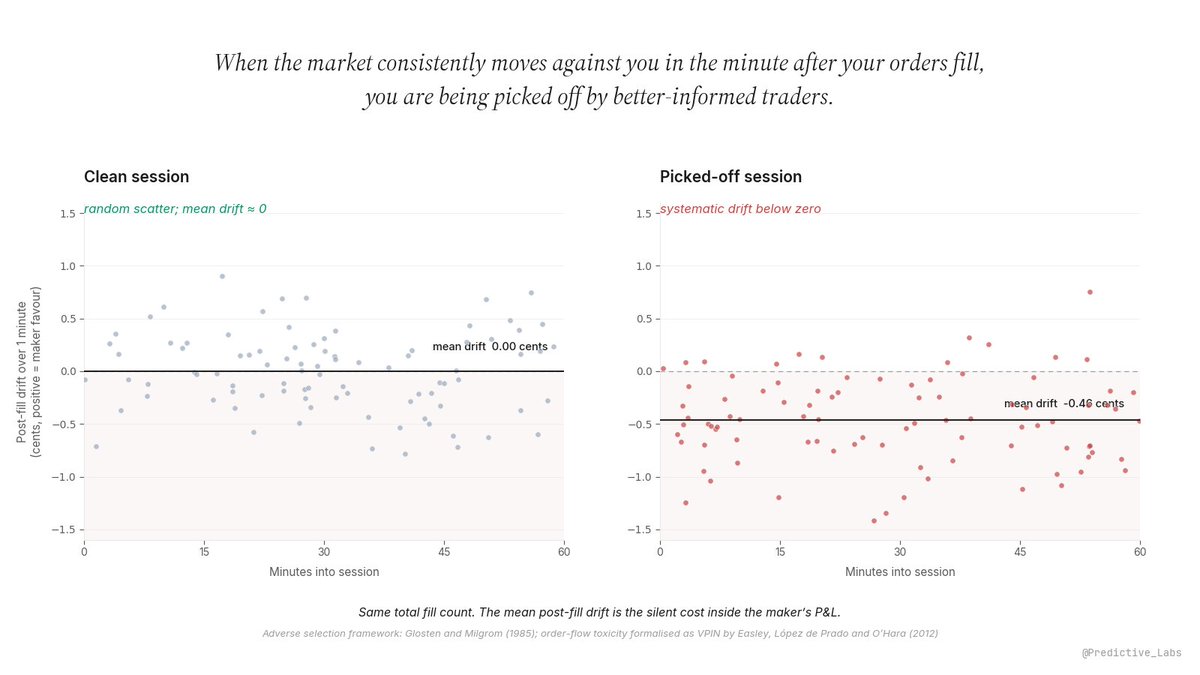
The trades that fill fastest are the ones you should worry about.
A market maker quotes both sides. Most fills are noise. Some fills are signal.
The difference is who you traded with, and whether they knew something you did not.
Adverse selection is the cost of trading against better-informed counterparties...
🧮A clean way to measure it: track the price drift over a short post-fill window of a minute or so. If your fills systematically drift against you (the market moves up after someone hits your offer, down after someone lifts your bid), you are being adversely selected.
The drift is the cost. It compounds silently inside total P&L until the spread captured no longer covers it.
Three responses:
- Widen the spread on contracts where adverse selection is highest.
- Pull quotes around scheduled events (FOMC, debate nights, jobs reports) where the informational asymmetry spikes.
- Reduce size on contracts whose order flow toxicity, measured by VPIN, is rising.
Are your fills drifting against you in the minute after they print?
#PredictionMarkets #MarketMaking #VPIN
📰"Coinsilium Group Expands Strategic Collaboration with Predictive Labs Following Investment and Advisory Agreement Coinsilium has entered into a Strategic Advisory Services Agreement with @Predictive_Labs following its recent US$150,000 investment via convertible preference shares.
Under the agreement, Coinsilium will support Predictive Labs across areas including go-to-market strategy, financial structuring, and operational scaling, while the appointment of its CEO, @eddybitcoin , as an advisor is expected to further strengthen collaboration between the two organisations.
Predictive Labs has also launched its new website (https://t.co/7aU6RqD23F), outlining its positioning as a data intelligence platform for prediction markets and event-driven finance."
Gm Folks
We are back!
This is another edition of the Predict Alpha Report, our bi-monthly collaboration with @CoinsiliumGroup tracking the rise of event-driven finance and the growing role of AI agents within it. Each edition focuses on the signals that matter, from capital flows and fundraising activity to regulatory shifts and product innovation. As information is increasingly priced in real time by both humans and machines, the Predict Alpha Report will track where these signals lead.
But first, let’s get this part out of the way:
Always DYOR:
This bulletin is for informational purposes only and contains summaries of news articles originally published by third-party media outlets. Please refer to the full disclaimer at the end of the post.
Now, let’s get started.
Here are the highlights:
💸 Capital Signals
👉More Than 90%
👉Make money, Cut Costs
👉And More To Come
👉Still Waiting on The SEC
👉Gibraltar Moves Early
👉Coinsilium Group Expands Strategic Collaboration with Predictive Labs
📈 Industry Pulse
👉JP says Be Cautious
👉Regulations V Prediction Markets
👉DeepBook Predict on Sui
👉Kalshi, Polymarket, Consumers
👉Brazil Says No
👉Confidence or Accuracy?
💸 Capital Signals
💰 More Than 90%
Kalshi just raised $1 billion at a $22 billion valuation in a Series F round led by Coatue, with backing from Sequoia, Andreessen Horowitz, Paradigm, Morgan Stanley, ARK Invest, and others. What makes this stand out is that just five months ago, Kalshi was valued at $11 billion, and around $5 billion less than a year earlier. Few sectors outside AI have seen that kind of acceleration.
The growth behind the raise helps explain the enthusiasm. Kalshi says annualised trading volume has jumped from $52 billion to $178 billion in six months, while institutional activity on the platform rose 800% over the same period. The company now claims more than 90% of US prediction market activity, alongside roughly $1.5 billion in annualised revenue and two million monthly users.
💰Make money, Cut Costs
DraftKings beat profit expectations this quarter, but there’s a bigger story. The sports betting giant reported $1.65 billion in quarterly revenue alongside stronger-than-expected earnings, while CEO Jason Robins pointed to prediction markets as a key strategic focus going forward. DraftKings says integrating prediction products directly into its main app cut customer acquisition costs by more than 80% in April, giving the company a cheaper way to retain and monetise users without relying solely on expensive sportsbook promotions. Robins also framed prediction markets as a hedge against shifting gambling regulation.
💰And More To Come
Intercontinental Exchange, the parent company of the New York Stock Exchange, has now committed another $600 million to prediction market platform Polymarket as part of a broader plan to invest up to $2 billion into the company. While Polymarket’s latest valuation has not been formally disclosed, earlier rounds reportedly placed the company near $9 billion, with more recent fundraising discussions pushing implied valuations closer to $15 billion.
Meanwhile,
💰Still Waiting on The SEC
The SEC has delayed a wave of proposed prediction market ETFs that were expected to launch this week, putting at least 24 funds from issuers like Bitwise, Roundhill, and GraniteShares on hold while regulators take a closer look at how the products would work and the risks involved. The ETFs were designed to give investors exposure to political and economic outcomes, from the 2028 US election to recession odds and tech-sector layoffs, effectively packaging prediction market activity into traditional public-market products.
💰Consensus 2026: Gibraltar Moves Early to Establish Dedicated Prediction Markets Regulatory Framework
During an interview with CoinDesk at Consensus Miami 2026, Nigel Feetham KC MP, Gibraltar's Minister for Justice, Trade and Industry, said Gibraltar is positioning itself at the forefront of the prediction markets sector through a dedicated regulatory framework designed to support innovation while providing legal clarity for operators. Speaking at Consensus, he confirmed that Gibraltar has already passed legislation to licence and regulate prediction market operators and has issued its first licence to a company owned by the Abu Dhabi Sovereign Wealth Fund.
Feetham said Gibraltar aims to move beyond the traditional debate of whether prediction markets should be classified as gambling or financial services by creating a dedicated regime tailored specifically to the sector. He added that Gibraltar’s flexible licensing structure has enabled the jurisdiction to move quickly and maintain a first-mover advantage in this emerging area of digital finance.
And rounding up this section:
💰 Coinsilium Group Expands Strategic Collaboration with Predictive Labs Following Investment and Advisory Agreement
Coinsilium has entered into a Strategic Advisory Services Agreement with @Predictive_Labs following its recent US$150,000 investment via convertible preference shares. Under the agreement, Coinsilium will support Predictive Labs across areas including go-to-market strategy, financial structuring, and operational scaling, while the appointment of its CEO, @eddybitcoin, as an advisor is expected to further strengthen collaboration between the two organisations. Predictive Labs has also launched its new website (predictivelabs dot io), outlining its positioning as a data intelligence platform for prediction markets and event-driven finance.
📌 FYI: Coinsilium’s shares are traded on the Aquis Stock Exchange Growth Market in London, under the ticker symbol "COIN", and on the OTCQB Venture Market in the United States under the ticker symbol "CINGF".
But it’s not just capital flowing into the space.
Keep reading for the latest signals in regulation, adoption, and structure.
📈 Industry Pulse
⚡️JP says Be Cautious
JPMorgan has reportedly issued internal guidance warning employees to be cautious when trading on prediction market platforms. The bank did not ban participation outright, but CEO Jamie Dimon advised employees to avoid contracts connected to sectors they work in professionally and warned against using any confidential or nonpublic information when placing trades.
The move highlights a growing tension at the centre of the prediction market boom. As platforms like Kalshi and Polymarket attract more users, liquidity, and institutional attention, concerns around insider information are becoming harder to separate from the product itself. Unlike sports betting, many event contracts revolve around politics, economics, regulation, or company-specific outcomes, areas where financial professionals could potentially hold informational advantages.
⚡️Regulations V Prediction Markets
The regulatory battle around prediction markets is escalating quickly. CFTC has now sued Wisconsin after the state launched legal actions against Kalshi, Polymarket, Cryptodotcom, Robinhood, and Coinbase over their prediction market offerings. Wisconsin had argued the platforms were violating state gambling laws, while the CFTC responded by asserting that these products fall under federal commodities regulation, not state gaming oversight.
The lawsuit is part of a much broader clash between federal regulators and individual states over who actually controls event-contract markets. The CFTC has already filed similar actions against New York, Connecticut, and Illinois, while also supporting prediction-market companies in ongoing court battles elsewhere. Chairman Michael Selig made the agency’s position unusually direct, warning states that attempts to interfere with federally regulated financial markets would be challenged aggressively in court.
At the same time,
Kalshi faced tough questioning this week from Massachusetts’ highest court as judges weighed whether the state can block the company from offering sports-related event contracts without a gaming licence. During oral arguments, several justices openly questioned how Kalshi’s products differ from traditional sports betting, with one judge bluntly describing the platform as simply “a way to bet on a game.”
The case sits at the centre of a much larger fight over who gets to control prediction markets as the industry scales. Kalshi argues that because it operates as a federally regulated exchange under the Commodity Futures Trading Commission (CFTC), states should not have the authority to intervene. State regulators see it differently, arguing that sports event contracts effectively function as gambling products and should fall under local gaming laws, including restrictions around licensing and age requirements.
⚡️DeepBook Predict on Sui
@DeepBookonSui has launched “DeepBook Predict” on the @SuiNetwork testnet, expanding its infrastructure stack beyond spot and margin trading into prediction markets, options, and programmable financial products. The new system lets developers build everything from Polymarket-style binary markets to leveraged ETFs and structured products directly on-chain, using shared liquidity across the ecosystem.
The platform is also integrating pricing infrastructure from @BlockScholes, bringing institutional-style options pricing into a decentralised environment with sub-second settlement speeds.
DeepBook argues that most prediction markets today are “dead-end” systems where positions can only be bought or sold. Predict, by contrast, is designed to make those positions composable, meaning they can be leveraged, used as collateral, combined into spreads, or integrated into broader financial products in the same ecosystem.
⚡️Kalshi, Polymarket, Consumers
Kalshi is rolling out a new set of consumer protection measures aimed at keeping minors off its platform and monitoring signs of unhealthy trading behaviour as political scrutiny around prediction markets intensifies. The company says users will now face additional identity verification measures, including facial recognition checks, optional two-factor authentication, and behaviour-based safeguards such as suggested deposit limits for accounts showing signs of excessive losses or risky activity.
The changes come as prediction markets increasingly find themselves pulled into the broader debate around online gambling and youth participation. Sports leagues, lawmakers, and advocacy groups have started raising concerns that platforms like Kalshi could expose younger users, particularly young men, to addictive financial behaviour under the framing of “trading” rather than gambling. The NBA and PGA Tour recently pushed for the minimum trading age to be raised to 21, while new legislation introduced in the Senate would require stricter age verification and self-exclusion programmes across the sector.
Meanwhile,
A new Financial Times opinion piece is pushing for stricter identity verification on prediction market platforms like Polymarket, arguing that anonymous trading creates growing risks around insider trading, market manipulation, and fake volume generation. The article cited research suggesting that as much as 60% of Polymarket trading activity in late 2024 may have involved wash trading, a practice where traders effectively trade with themselves to artificially inflate market activity and liquidity.
⚡️Brazil Says No
Brazil has blocked access to major prediction market platforms, including Kalshi and Polymarket, as part of a broader crackdown on unlicensed betting-style services. Authorities said the decision was driven by consumer protection concerns, arguing that these platforms offer event-based financial products without fitting cleanly under either gambling or derivatives regulation. Telecommunications regulator Anatel moved quickly to restrict access, with dozens of platforms reportedly affected.
As prediction markets continue expanding globally, Brazil’s response could become an early blueprint for how other emerging economies handle the sector, particularly in regions already concerned about online gambling, retail speculation, and rising household debt.
⚡️Confidence or Accuracy?
Several new AI research papers are using live prediction markets as testing grounds for autonomous trading agents, with projects like Prediction Arena, PolyBench, and PolySwarm evaluating how LLMs perform when asked to forecast outcomes, place trades, and react to changing market conditions. Some experiments used real capital, while others relied on simulated order books designed to mirror how prediction markets behave in practice.
The early takeaway is that AI agents are getting better at participating in markets, but they are still far from consistently making reliable decisions. Researchers found major differences between models and platforms, especially when it came to probability calibration, which is the ability to judge uncertainty accurately rather than simply producing a confident-sounding answer.
And that’s it!
Long read, but if you enjoyed this, set a reminder in your calendar for the next edition of the Predict Alpha Report.
Thanks to Coinsilium, we’ll be dropping these updates every other Monday, i.e, twice a month.
Till then,
Thank you for being a part of the When Shift Happens family.
Full Disclaimer
All rights to the original content belong to the respective publishers. We do not claim ownership of any third-party material and provide proper attribution, including source links, for transparency and reference. While we strive for accuracy in our summaries, we make no warranties or guarantees regarding the completeness or accuracy of the information provided.
Any mention of cryptocurrency, financial products, public company stocks, or other investment instruments in this newsletter or the referenced articles is not intended as financial advice or a recommendation to invest. The information is not tailored to any individual’s circumstances and should not be relied upon for investment decisions. Readers are encouraged to consult the original articles and seek independent financial, legal, or professional advice before making any investment.
The author(s) of this report may hold, directly or indirectly, positions in the securities or digital assets (including shares or tokens) of the company(ies) or project(s) mentioned herein. Any such holdings are disclosed for transparency and should not be construed as a recommendation to buy, sell, or hold any financial instrument.
A 2-cent week beats a 6-cent quarter.
Most traders rank arbs by spread size. The biggest visible gap wins.
That ranking ignores the only variable that matters for capital efficiency: ⚠️how long the capital is locked.
Annualised return collapses spread and duration into a single comparable number.
🧮Take the net gap (after fees, slippage, and execution friction), divide by the capital required to enter both legs, then scale by 365 over the days to resolution.
➡️A 6-cent net gap on a contract resolving in 90 days produces roughly 25% annualised.
➡️A 2-cent net gap resolving in 7 days produces roughly 100%.
The smaller spread wins by 4x!
The implication for portfolio construction.
A portfolio of short-cycle arbs compounds faster than concentration in 1 long-cycle arb at similar annualised return, because every cycle is a re-deployment, a fresh diligence pass, and a chance to step away from a deteriorating thesis.
Long-cycle arbs also accumulate venue, oracle, and resolution-wording risk over the lock.
The discipline is to rank by annualised, not absolute. Then size by capital efficiency, not headline spread.
#PredictionMarkets #Arbitrage #Polymarket
You can enter. Can you exit?
Most traders look at the bid-ask spread or the visible order book at the time they buy a contract. They infer that the market is liquid. 6 months later, with news breaking and resolution near, they try to close out 5,000 contracts. The visible book shows 80 on the offer. Their fill comes back averaged at 71. ⚠️The 'liquid' market cost them 9 cents per contract on the way out!
🧮Amihud Illiquidity (Amihud 2002) is the metric for this risk. Take the daily ratio of absolute return to dollar volume, averaged across a window. Higher Amihud means higher price impact per dollar traded. A market whose Amihud rises near resolution or after news shocks is telling you exit slippage will exceed entry slippage, sometimes by orders of magnitude.
The discipline is to track Amihud rolling. Current spread alone misleads. Rolling Amihud belongs next to the bid-ask spread on every watchlist.
The spread tells you the cost of getting in.
Amihud tells you the cost of getting out.
#PredictionMarkets #Liquidity #Amihud
Edge needs 2 numbers. Most track 1...
A trader who stares at a Polymarket price and decides whether it 'feels right' has already lost the measurement. The price is the consensus by construction. Agreeing with it produces no edge!
Edge requires 2 numbers: The market price (call it P_market) and your private probability (call it P_user). Logged before you saw the price, ideally before you searched the news.
Edge equals P_user minus P_market.
A 5-cent edge across 100 trades is what builds a track record ; but a 5-cent edge measured retrospectively, after the price was already in your head, is anchoring dressed as analysis!
The discipline costs nothing. Open a notebook. For every market you intend to trade, write the date, the contract, your probability. Close the notebook. Then look at the price.
When did you last log a probability before checking the market?
#PredictionMarkets #Polymarket #Forecasting
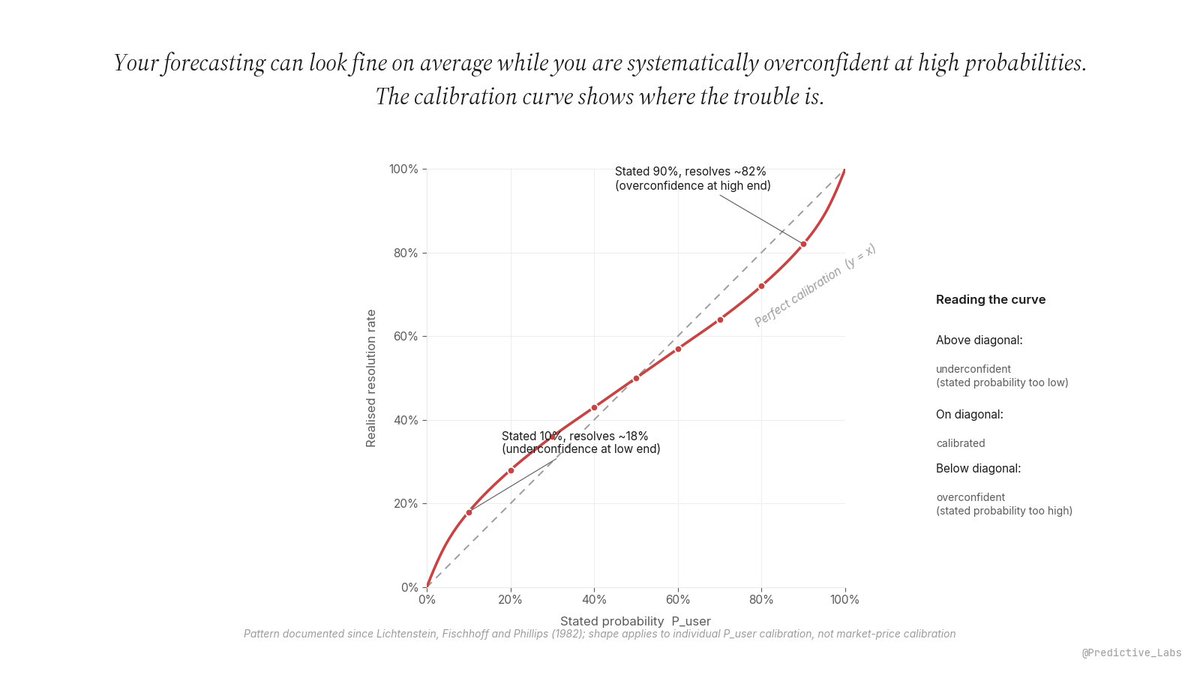
You are most wrong when most sure...
A respectable Brier Score can hide a specific failure: systematic overconfidence at high probabilities.
A trader who calls 80% on markets that resolve 65% of the time looks fine on average, because the error is concentrated where they sized largest...
🧮Plot every prediction by its confidence bucket (60-70%, 70-80%, 80-90%, and so on) against the realised resolution rate within each bucket. A perfectly calibrated forecaster sits on the 45-degree line.
Individual probability assessors typically curve below the line at high confidence and above it at low confidence, an S-shape known since Lichtenstein, Fischhoff and Phillips (1982). The shape concerns your private probabilities; market prices show the opposite favourite-longshot pattern. The shape of your personal deviation is the strongest signal, more useful than any average score!
🤔What the shape tells you:
- Overconfidence at the high end usually means insufficient skepticism about your own information edge.
- Underconfidence at the low end usually means you are leaving money in markets where you should be taking the other side.
The shape is the most honest performance review a trader will ever get.
#PredictionMarkets #Forecasting #Calibration
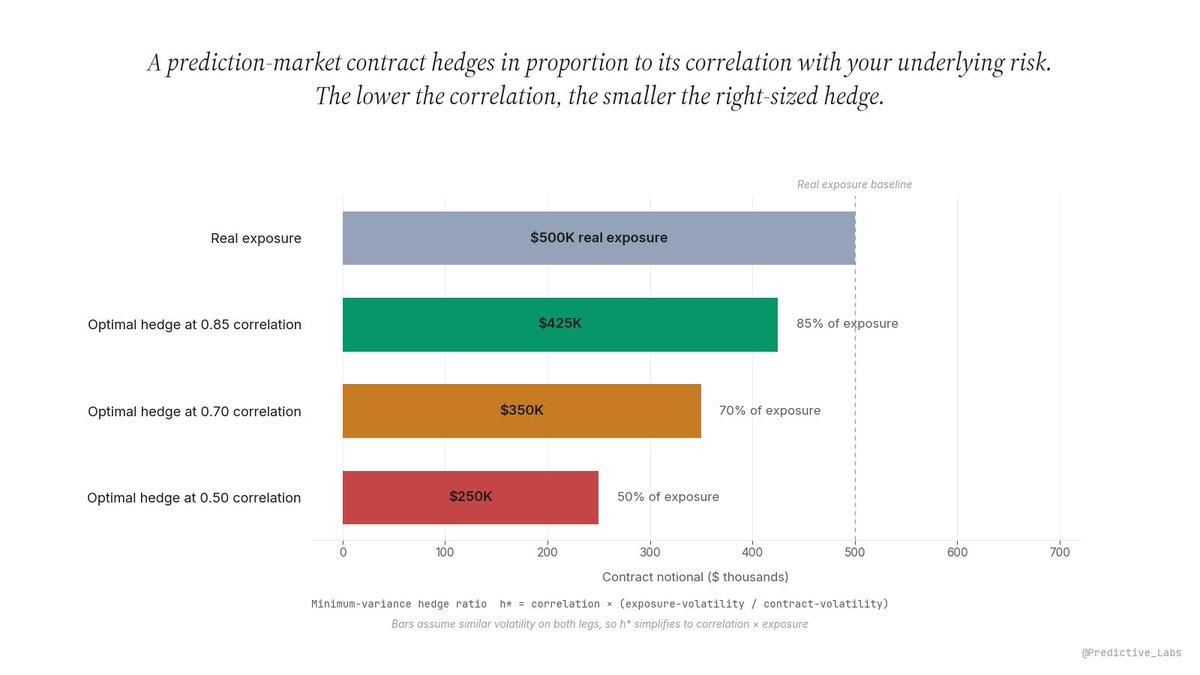
Adding hedge can add risk!
A treasurer with $500K of inflation-sensitive exposure considers $1M of Kalshi CPI contracts, reasoning that imperfect correlation calls for more notional to compensate...
⚠️The math says the opposite. At 0.50 correlation with similar volatility on both legs, $1M of contract produces a hedged book roughly 3 times more volatile than the unhedged exposure. Contract noise dominates everything else!
🧮Standard hedging theory sets optimal notional at:
correlation × volatility-ratio × exposure.
Where the two legs carry similar volatility, that simplifies to correlation × exposure.
$500K at 0.85 correlation calls for roughly $425K of contract.
At 0.70, $350K.
At 0.50, $250K. Lower correlation means smaller hedge.
Binary PM payoffs sharpen this... No partial credit for a partial event, so contract variance is structurally lumpy.
🤔The discipline is to scale notional down with correlation.
A treasury hedged to its headline exposure when the underlying correlation is low is the most common way to be over-protected on paper and over-exposed in practice.
#PredictionMarkets #Hedging #Kalshi #Polymarket
⚠️Total P&L is the wrong number for a market maker...
2 sessions can produce identical numbers for opposite reasons, and they require opposite responses.
🧮Decompose every session into 4 components: spread captured (what you earned quoting both sides), rebate (the maker-fee credit on venues like Polymarket that pay one. Kalshi charges makers), inventory carrying P&L (mark-to-market on positions that did not close), and adverse selection (what you lost to better-informed counterparties). Spread plus rebate is what you wanted. Inventory P&L is mostly noise. Adverse selection is the only one that should keep you up!
🍀A profitable session with high adverse selection means you got lucky. An unprofitable session with strong spread plus rebate means your quoting is fine and inventory turned against you. Same total, completely different problems.
🤔Which component drove your last session?
#PredictionMarkets #MarketMaking #Liquidity
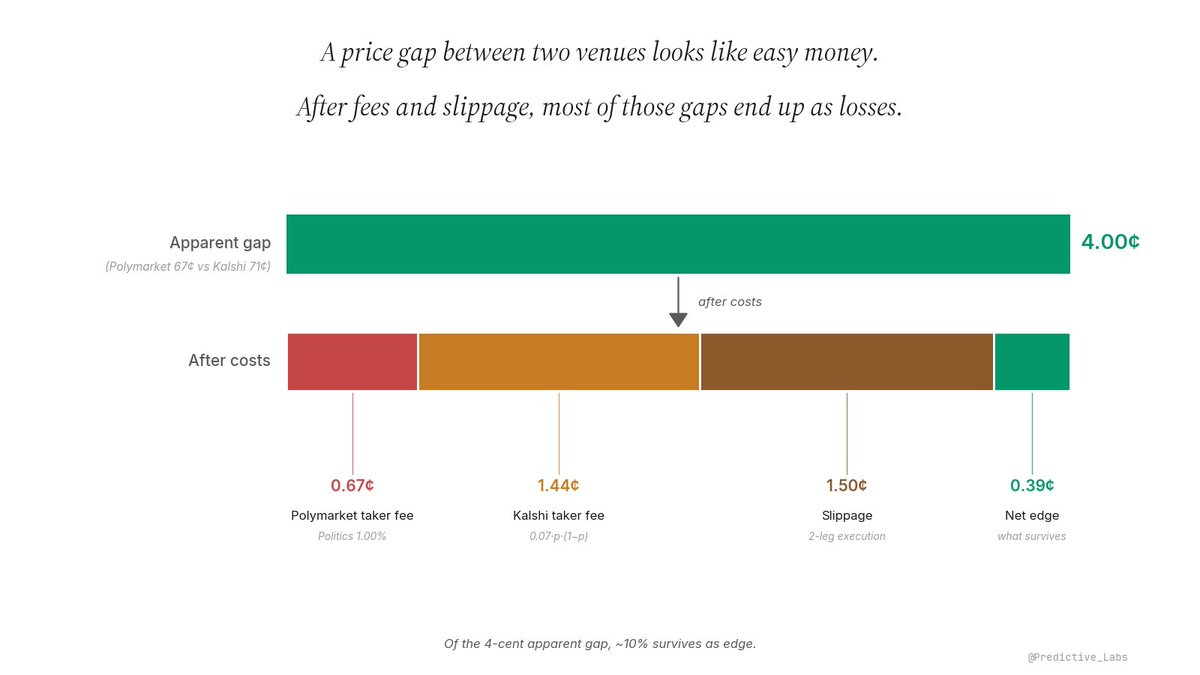
🙄Polymarket says 67. Kalshi says 71. Free money?
Most of that 4-cent spread is gone before you can capture it. By the time you cross both order books, pay taker fees on at least one venue, and accept slippage on size, the arb may be net negative. Most retail traders see the gap and trade it. ⚠️Most lose.
🧮Fee-aware net gap subtracts the round-trip cost of execution from the raw spread before the opportunity surfaces at all. Kalshi taker fees follow approximately 0.07 · p · (1 - p) per contract. Polymarket's V2 taker fee runs from 0% on Geopolitics to 1.80% on Crypto, with most other categories between 1.00% and 1.50% on notional. Subtract both. Then size for the thinner side of the book. What remains is the real edge.
Any serious arbitrage stack ranks opportunities by net gap. The 4-cent gap on the venue UI is rarely the trade...
#PredictionMarkets #Polymarket #Kalshi
📢Coinsilium has entered into a Strategic Advisory Services Agreement with Predictive Labs Pte. Ltd. and notes the launch of its new website, supporting its positioning within prediction markets and event-driven finance
QUOTE:
The Company notes that Predictive Labs is progressing toward its first development delivery milestone on schedule, with development activity advancing across key workstreams. The developers are expected to deliver the platform’s technical documentation imminently, while the user interface is in development, covering the onboarding and registration journey through to the dashboard sections. The quality control team has also now joined the project to prepare the upcoming testing scenarios and validation processes.
Against this backdrop, Coinsilium is pleased to announce that it has now entered into a Strategic Advisory Services Agreement with Predictive Labs Pte. Ltd. (“Predictive Labs”), further strengthening its relationship with the company following its recent investment (see announcement dated 16 March 2026: https://t.co/LR4BFz2T4O). As previously disclosed, Coinsilium invested US$150,000 for an initial equity position via convertible preference shares, with additional follow-on investment rights as set out in that announcement.
Predictive Labs is developing a data intelligence platform for prediction markets and event-driven finance, designed to aggregate, normalise and analyse data across multiple venues to deliver actionable insights for both human users and autonomous agents. As prediction markets continue to gain traction as a mechanism for real-time price discovery of future events, infrastructure that enhances data quality, signal interpretation and decision-making is expected to play an increasingly important role in supporting market participants and enabling broader adoption.
Under the terms of the advisory agreement, Coinsilium will provide Predictive Labs with strategic guidance and support across key areas including go-to-market strategy, financial structuring, capital formation and operational scaling. This engagement reflects the Company’s conviction in Predictive Labs’ positioning within the rapidly evolving prediction markets sector and complements its existing investment by enabling a more active role in supporting the company’s commercial development.
The advisory relationship represents a natural extension of Coinsilium’s venture-building approach, providing a framework for deeper collaboration as Predictive Labs progresses toward live deployment and growth. In particular, Coinsilium believes that the appointment of its CEO, Eddy Travia, as an advisor to Predictive Labs will further strengthen alignment between the two organisations and enhance the Company’s ability to support, and benefit from, the opportunities arising from Predictive Labs’ continued development.
Terms pertaining to advisory engagements are commercially sensitive and typically governed by mutual confidentiality agreements. The agreement includes an advisory fee, which may be satisfied in cash or in shares at the discretion of the advisor.
Predictive Labs Website Launch
Predictive Labs has now launched its new website, available at https://t.co/jzAWxP5gvb, marking a timely step in its progression toward broader market engagement and product visibility. The website clearly sets out its positioning as a data intelligence platform for the emerging prediction markets and event-driven finance sector, providing an accessible overview for prospective users, partners and institutional participants.
The site outlines the core challenges it is seeking to address, including market fragmentation, limited actionable intelligence and the absence of standardised data layers, and presents its vision for a unified intelligence and API-driven infrastructure capable of supporting traders, developers and autonomous agents. As such, the website serves as an initial public-facing introduction to Predictive Labs’ product direction and its ambition to become a key data and decision-support layer within the evolving prediction economy.
The Predictive Labs team has informed us that the platform is approaching its first development delivery milestone on schedule. The developers are expected to deliver the platform’s technical documentation next week. The user interface is in development, covering the onboarding and registration journey through to the dashboard sections. The quality control team has also joined the project to prepare the upcoming testing scenarios and validation processes
WikiEXPO Hong Kong 2026 Participation
Johann Evrard and Eddy Travia are scheduled to speak at WikiEXPO Hong Kong 2026, taking place on 23–24 July 2026 in Hong Kong. Their participation will focus on two areas of increasing market relevance: prediction markets and the emerging agentic economy, within a broader agenda covering digital assets, fintech, AI and financial innovation.
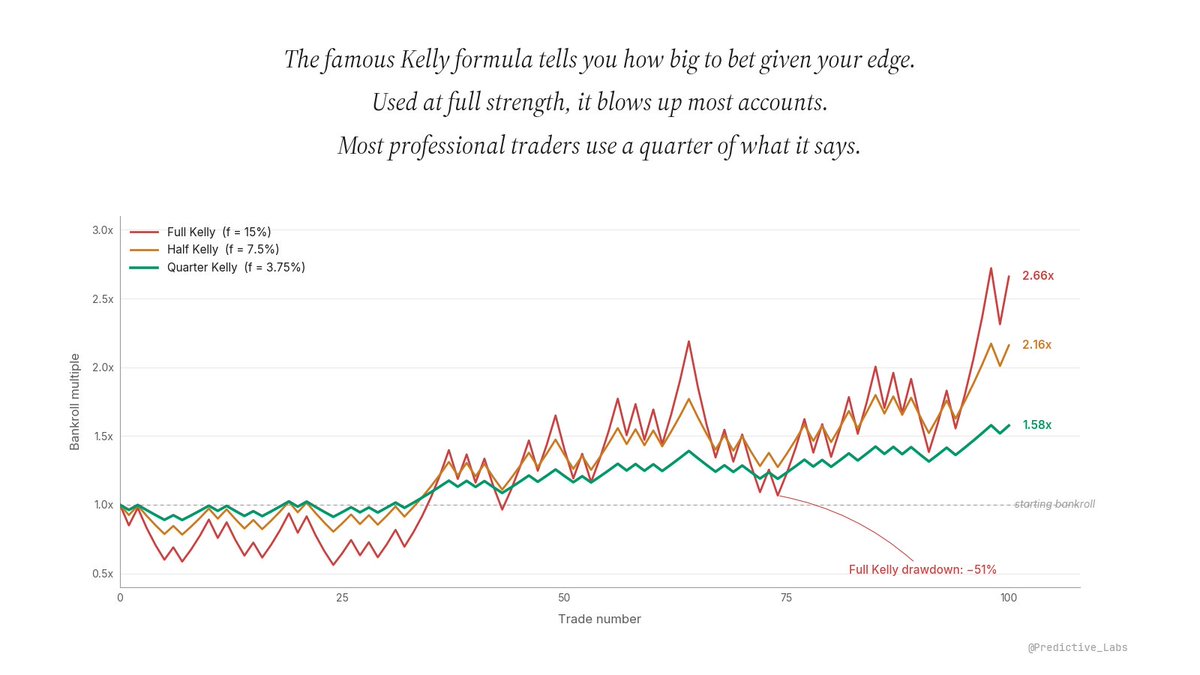
⚠️The Kelly Criterion will blow up your account.
Most traders size by gut, or use a fixed percentage of bankroll. Both are wrong in opposite directions. Gut underweights conviction. Fixed-percent ignores the actual edge.
Kelly answers the sizing question formally: bet a fraction of bankroll equal to your edge divided by the odds. Optimal in theory. Devastating in practice.
Prediction-market traders work with noisy probability estimates, fat-tailed payoffs, and limit orders that may never fill. Full Kelly assumes none of those frictions.
🧮The fix is Quarter Kelly: multiply the formula's output by 0.25. You give up some long-run growth in exchange for a survivable drawdown when (not if) your edge estimate is wrong.
Most traders should be running Quarter Kelly. Most are not...
#PredictionMarkets #Kelly #PositionSizing
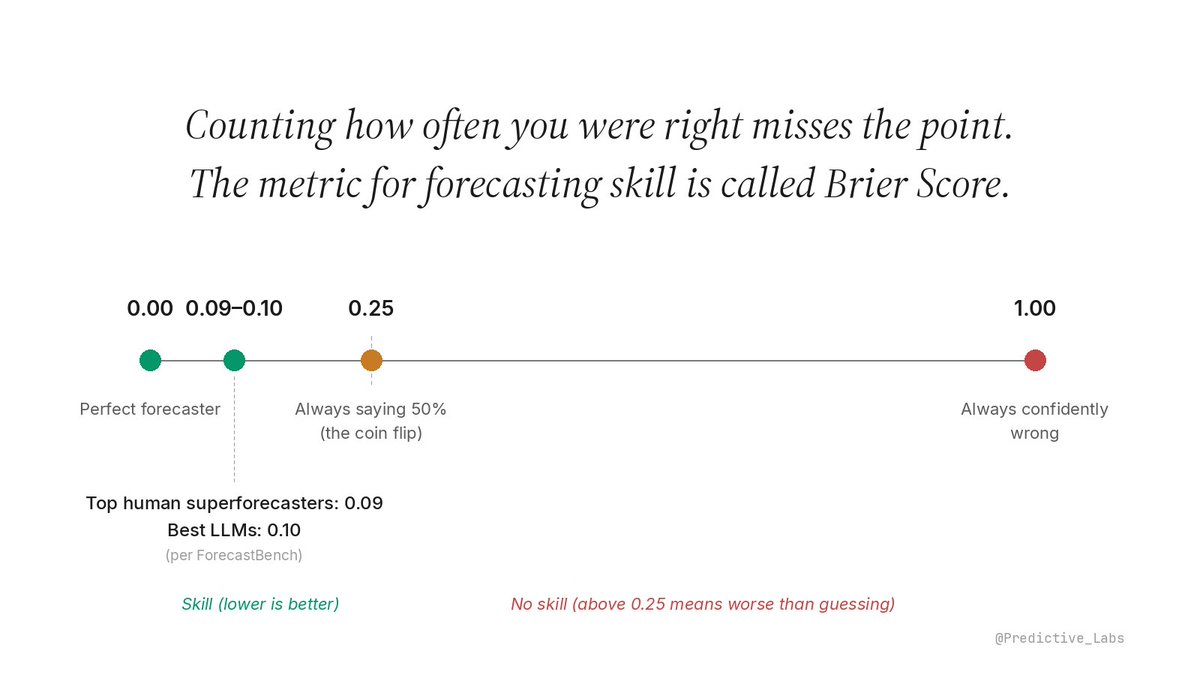
You went 7 for 10 last month. Are you actually good?
🎯Hit rate is the wrong question. A forecaster who says 'Yes' to every market priced above 50 cents will average roughly 7 for 10 over time if those markets are calibrated. That tells you nothing about whether their probability estimates carry real information.
🧮Brier Score is the squared distance between your stated probability and the realised outcome, averaged across every prediction. A coin flip scores 0.25. Top human superforecasters tracked on ForecastBench sit closer to 0.09. The score punishes overconfidence (calling 95 on a market that resolves 'No') harder than calibrated doubt.
⚠️The catch: Brier only works if you logged your own probability before resolution. Polymarket and Kalshi store the market's price. They do not store yours. The discipline is to write down your probability before you trade. Without that record, no honest skill audit is possible.
#PredictionMarkets #Forecasting #Brier
💰 Predictive Labs CEO and Coinsilium CEO to speak at Hong Kong event
@Predictive_Labs
CEO Johann Evrard and Coinsilium CEO Eddy Travia are set to speak at WikiEXPO, which will take place 23-24 July in Hong Kong, where they will discuss two areas gathering increasing attention: prediction markets and the emerging agentic economy.
Their appearance places both themes on a larger global fintech stage, alongside conversations spanning crypto, forex, and broader financial innovation.
Conferences like WikiEXPO are great early signal hubs for where institutional curiosity is moving next. With more than 10,000 attendees per event and a global audience reportedly above two million followers, the platform has become a meeting point for startups, investors, and established financial players.
Gm Folks
We are back!
This is another edition of the Predict Alpha Report, our bi-monthly collaboration with @CoinsiliumGroup tracking the rise of event-driven finance and the growing role of AI agents within it. Each edition focuses on the signals that matter, from capital flows and fundraising activity to regulatory shifts and product innovation. As information is increasingly priced in real time by both humans and machines, the Predict Alpha Report will track where these signals lead.
But first, let’s get this part out of the way:
Always DYOR:
This bulletin is for informational purposes only and contains summaries of news articles originally published by third-party media outlets. Please refer to the full disclaimer at the end of the post.
Now, let’s get started.
Here are the highlights:
💸 Capital Signals
👉 That’s $1 Billion Weekly!
👉Predictive Labs CEO and Coinsilium CEO to speak at Hong Kong event
📈 Industry Pulse
👉NY V Coinbase, Gemini
👉Kalshi for News, for the Win
👉That Makes 2
👉Trillion-Dollar Potential…
👉Not Easy Money Just Yet…
💸 Capital Signals
💰 That’s $1 Billion Weekly!
Polymarket is reportedly in talks to raise $400 million at a valuation of up to $15 billion, another sharp jump for a company that was valued near $9 billion only months ago. The move follows a surge in activity on the platform, with weekly trading volume now reportedly exceeding $1 billion. Existing backers include major names such as Founders Fund and Intercontinental Exchange.
Intercontinental Exchange has already said it plans to distribute Polymarket data more broadly, while traders in markets such as oil have reportedly begun watching prediction odds as an additional signal. Basically, investors seem to be betting that prediction markets can become part of the global financial information stack, and real-time probabilities themselves could become the product.
And rounding up this section:
💰 Predictive Labs CEO and Coinsilium CEO to speak at Hong Kong event
@Predictive_Labs CEO Johann Evrard and Coinsilium CEO Eddy Travia are set to speak at WikiEXPO, which will take place 23-24 July in Hong Kong, where they will discuss two areas gathering increasing attention: prediction markets and the emerging agentic economy. Their appearance places both themes on a larger global fintech stage, alongside conversations spanning crypto, forex, and broader financial innovation.
Conferences like WikiEXPO are great early signal hubs for where institutional curiosity is moving next. With more than 10,000 attendees per event and a global audience reportedly above two million followers, the platform has become a meeting point for startups, investors, and established financial players.
📌 FYI: Coinsilium’s shares are traded on the Aquis Stock Exchange Growth Market in London, under the ticker symbol "COIN", and on the OTCQB Venture Market in the United States under the ticker symbol "CINGF".
But it’s not just capital flowing into the space.
Keep reading for the latest signals in regulation, adoption, and structure.
📈 Industry Pulse
⚡️NY V Coinbase, Gemini
New York Attorney General Letitia James has filed lawsuits against Coinbase and Gemini, accusing both firms of offering prediction markets that violate state gambling laws. The cases argue that so-called event contracts are effectively wagers dressed up as financial products.
This marks one of the most aggressive state-level moves yet against the sector, and the legal fight is moving beyond specialist prediction platforms like Kalshi and into major public crypto companies with broader consumer reach. If courts side with New York, the decision could create a powerful precedent for other states, raising the cost and legal risk of offering event markets nationwide. It also sharpens a growing clash between federal regulators, who have generally allowed these contracts, and state authorities that see them as gambling. The bigger question now is whether prediction markets will be governed as finance, gaming, or something in between.
⚡️Kalshi for News, for the Win
Fox Corporation plans to integrate data from Kalshi across its news and streaming properties, including FOX News, FOX Business, FOX Weather, and FOX One. The deal will bring live market probabilities into coverage of politics, the economy, weather, and cultural events, while Kalshi also works with Fox production teams on real-time data visualisation.
Instead of relying only on polls, analyst opinions, or static forecasts, audiences may increasingly see live market odds embedded directly into news coverage. Kalshi says around 70% of visitors come primarily to view forecasts rather than trade, suggesting these platforms are becoming information products as much as financial ones.
And at the same time,
A federal judge has temporarily blocked Arizona from continuing its criminal case against Kalshi, handing an early win to the company and the Commodity Futures Trading Commission. The dispute centres on whether states can treat prediction markets as gambling operations, or whether federally regulated event contracts fall solely under CFTC oversight.
The ruling highlights the core question facing the industry: who actually controls prediction markets? If federal courts continue siding with the CFTC, state attempts to shut down platforms like Kalshi, Polymarket, and others could become much harder to enforce.
⚡️That Makes 2
U.S. prosecutors have charged Special Forces, Master Sgt. Gannon Van Dyke with allegedly using classified military intelligence to place wagers tied to the capture of Venezuelan leader Nicolás Maduro on a prediction market platform. Authorities say he placed more than $33,000 in trades and generated roughly $400,000 in profit. It was also reported that he may have attempted to open an account on a regulated rival platform but could not proceed due to identity verification controls.
Meanwhile,
French weather authorities have filed a police complaint after suspicious temperature spikes at a Paris airport weather station reportedly helped bettors profit from weather-linked contracts on Polymarket. On two separate days, readings at Charles de Gaulle Airport briefly jumped by several degrees within minutes, moves that reportedly turned low-probability wagers into winning trades. One user was said to have turned less than $30 into nearly $14,000. Polymarket later changed the reference data source used to settle the Paris contract.
⚡️Trillion-Dollar Potential…
ARK Investment Management has published a new piece via Seeking Alpha arguing that prediction markets could evolve into a multi-trillion-dollar asset class. The report’s core thesis is that these markets have evolved past speculation into a new financial layer for pricing probabilities around elections, policy decisions, economic outcomes, and countless real-world events. ARK also points to a potential $5 trillion opportunity if the category matures into mainstream infrastructure.
⚡️Not Easy Money Just Yet…
A new Fast Company report says AI systems are already being tested on prediction markets, with early results falling short of the hype. It cites recent academic research from The Wharton School, where several frontier AI models were given capital to trade autonomously on platforms such as Kalshi and Polymarket. Most reportedly finished the experiment with losses rather than gains.
While many assume AI agents will naturally outperform humans in markets built around information and probabilities, early evidence suggests live judgement, timing, risk management, and interpreting messy real-world events remain harder than expected. Still, with consistent improvements, prediction markets could become one of the first arenas where autonomous AI competes directly with humans for capital.
And that’s it!
Long read, but if you enjoyed this, set a reminder in your calendar for the next edition of the Predict Alpha Report.
Thanks to Coinsilium, we’ll be dropping these updates every other Monday, i.e, twice a month.
Till then,
Thank you for being a part of the When Shift Happens family.
Full Disclaimer
All rights to the original content belong to the respective publishers. We do not claim ownership of any third-party material and provide proper attribution, including source links, for transparency and reference. While we strive for accuracy in our summaries, we make no warranties or guarantees regarding the completeness or accuracy of the information provided.
Any mention of cryptocurrency, financial products, public company stocks, or other investment instruments in this newsletter or the referenced articles is not intended as financial advice or a recommendation to invest. The information is not tailored to any individual’s circumstances and should not be relied upon for investment decisions. Readers are encouraged to consult the original articles and seek independent financial, legal, or professional advice before making any investment.
The author(s) of this report may hold, directly or indirectly, positions in the securities or digital assets (including shares or tokens) of the company(ies) or project(s) mentioned herein. Any such holdings are disclosed for transparency and should not be construed as a recommendation to buy, sell, or hold any financial instrument.
"💰 Coinsilium Backs Predictive Labs Coinsilium has made a strategic venture-building investment in Predictive Labs, giving it exposure to the infrastructure layer powering prediction markets. [...]
This positions Coinsilium at the data and discovery layer [...]"
Gm Folks
We are back, and with something different.
WSH is collaborating with @CoinsiliumGroup to launch the Predict Alpha Report, a bi-monthly publication tracking the rise of prediction markets and the growing role of AI agents within them. As prediction markets and the agentic AI economy converge into a new layer of financial infrastructure, what was once a niche segment is quickly becoming a more important part of modern markets.
Capital is flowing into leading platforms, institutional engagement is increasing, and regulatory frameworks are beginning to take shape. At the same time, the integration of AI agents is accelerating, introducing a new dynamic into how markets interpret and act on future events.
This first edition comes at an inflection point, and each edition will aim to cut through the noise, highlight emerging patterns, and surface the opportunities forming across this evolving landscape. As information is increasingly priced in real time by both humans and machines, the Predict Alpha Report will track where these signals lead.
But first, let’s get this part out of the way:
Always DYOR:
This bulletin is for informational purposes only and contains summaries of news articles originally published by third-party media outlets. Please refer to the full disclaimer at the end of the post.
Now, let’s get started.
Here are the highlights:
💸 Capital Signals
👉Guess Who’s Eyeing $20b Valuations
👉Huh, That’s A Tad Bit Suspicious
👉Coinsilium Backs Predictive Labs
📈 Industry Pulse
👉In Just 5 Mins?!
👉FIFA and…
👉Gibraltar first in Europe!
👉AI Agents Are Changing Prediction Markets
👉2026 And Prediction Markets
💸 Capital Signals
💰 Guess Who’s Eyeing $20b Valuations
Kalshi and Polymarket, the two leading players in the prediction markets space, are simultaneously exploring new funding rounds that could value each company at around $20 billion, which is roughly double their most recent valuations (late last year). They owe this surge in valuation to rapid user growth, aggressive marketing, and expanding product offerings.
Kalshi, which operates legally in the U.S. under approval from the Commodity Futures Trading Commission, has already reached an estimated $1–1.5 billion revenue run rate, and is offering markets across sports, politics, and macroeconomic events. Polymarket, founded later and currently restricted to U.S. users, has grown globally and is preparing a regulated domestic launch while deepening institutional ties, including a data partnership with Dow Jones.
💰Huh, That’s A Tad Bit Suspicious
A wave of newly created accounts on Polymarket placed highly specific bets on a U.S.–Iran ceasefire just hours before it was officially announced, walking away with hundreds of thousands of dollars in profit. The timing was a little weird because earlier that same day, public rhetoric had escalated sharply, with warnings of major conflict and little indication that a deal was close. Yet at least 50 new wallets moved in early, buying “Yes” positions before the announcement hit.
One account, created the same day, placed roughly $72,000 in bets and exited with a profit of about $200,000. Another wallet generated approximately $125,500 in gains, while a third, created just 12 minutes before the announcement, is estimated to have earned about $48,500 in profit. Many of these wallets had no prior activity, with trades placed shortly before the news broke.
This isn’t the first time something like this has happened. Similar clusters of well-timed bets have appeared around past geopolitical events, repeatedly sparking concerns about insider activity in prediction markets. In response, both lawmakers and platforms are beginning to take the issue more seriously, with calls to expand insider trading rules to cover these markets.
And rounding up this section:
💰 Coinsilium Backs Predictive Labs
Coinsilium has made a strategic venture-building investment in Predictive Labs, giving it exposure to the infrastructure layer powering prediction markets. The Group invested $150k via Seedcoin, its Gibraltar-registered subsidiary, to acquire a 5.52% stake in Predictive Labs, a Singapore-based firm building data intelligence infrastructure for prediction markets.
A really cool detail is that the deal is structured with optional tranches that could increase Coinsilium’s ownership to nearly 30% over time, depending on milestones through 2027. Rather than building another trading platform, Predictive Labs focuses on aggregating and analysing signals across multiple prediction markets, targeting professional users, researchers, and AI agents.
This positions Coinsilium at the data and discovery layer, which facilitates how these markets are interpreted and utilised.
📌 FYI: Coinsilium’s shares are traded on the Aquis Stock Exchange Growth Market in London, under the ticker symbol "COIN", and on the OTCQB Venture Market in the United States under the ticker symbol "CINGF".
But it’s not just capital flowing into the space.
Keep reading for the latest signals in regulation, adoption, and structure.
📈 Industry Pulse
⚡️In Just 5 Mins?!
Users on Polymarket can now bet on whether Bitcoin will be higher or lower in as little as five or 15 minutes, and these ultra-short contracts have quickly become some of the busiest on the platform. In just over a month, five-minute markets alone have seen as much as $60 million in daily volume. At one point in early March, Polymarket’s weekly volume reached $1.93 billion, edging past Kalshi’s $1.87 billion, as the rivalry between the two platforms intensified.
Shorter trading windows favour participants who can react fastest, and that has drawn a wave of automated systems into these markets. Bots and AI-assisted traders are increasingly using real-time data to place rapid bets, exploiting small pricing gaps that human traders simply cannot act on in time. The result is a different kind of market dynamic, one where participation is open, but outcomes are increasingly shaped by those with the infrastructure to move quickest.
⚡️FIFA and…
Prediction markets are stepping onto one of the biggest stages in the world! ADI Predictstreet has signed a multi-year partnership with FIFA, becoming the first-ever official partner in the prediction market category ahead of the FIFA World Cup 2026. The platform will allow fans to forecast match outcomes, player performance, and key moments using FIFA’s historical data.
With the 2026 tournament set to feature 48 teams, 104 matches, and a global audience in the billions, the scale of this rollout is massive.
Shortly before the announcement, Predictstreet secured a Gibraltar licence, giving it both a regulated base and immediate global distribution through FIFA.
⚡️Gibraltar first in Europe!
Gibraltar has issued its first license to a prediction market operator, marking a shift in how the sector is being regulated in Europe. The license was granted to Predict Street Ltd under the existing 2005 Gambling Act. The platform, backed by ADI Chain, is positioning itself around major global events like the FIFA World Cup 2026.
While many European countries continue to restrict or debate how to classify prediction markets, Gibraltar is moving early to create a formal regulatory pathway. The territory’s gambling sector already employs around 3,500 people and contributes roughly one-third of government tax revenue, and this decision reflects a push to stay competitive as external pressures, including rising UK gambling taxes, begin to weigh on the industry.
⚡️AI Agents Are Changing Prediction Markets
AI is starting to change how trading happens in prediction markets. Instead of relying only on human judgment, traders are increasingly using AI-powered automated agents that can analyze data, forecast outcomes, and execute trades continuously. These systems operate 24/7, monitor multiple markets at once, and follow predefined strategies without emotional bias.
What makes prediction markets a natural fit is how they work. Prices reflect probabilities, so success depends on processing information quickly and acting on it efficiently. AI agents are well-suited for this. They can also place thousands of trades over short periods while maintaining strict rules, opening up smaller, less-followed markets, where agentic systems can identify opportunities that human traders might miss.
⚡️2026 And Prediction Markets
Prediction markets are scaling quickly, and 2026 is shaping up to be a defining year. Platforms like Polymarket are no longer limited to political events, now offering thousands of markets across sports, finance, and culture.
That growth is showing up in the numbers, with prediction markets now regularly processing hundreds of millions of dollars in daily trading volume, with peak activity in early 2026 exceeding $700 million in a single day, and the broader ecosystem now processing over $20 billion in monthly volume during peak months in early 2026.
At the same time, the structure around these markets is maturing. Polymarket has moved toward regulated U.S. access through its $112 million acquisition of QCEX, a CFTC-licensed exchange and clearinghouse, laying the groundwork for a compliant re-entry into the U.S. market.
AI is also accelerating price discovery, with agentic systems increasingly involved in market making and probability estimation. Meanwhile, sports markets are moving into the mainstream, and institutional tools are beginning to emerge, enabling more professional participation.
Zooming out, the signal is that multiple forces are compounding at once. Regulation is becoming clearer, capital and infrastructure are improving, and AI is increasing the speed at which information is processed and priced. Together, these shifts suggest prediction markets have crossed an important threshold and secured a more established role in the financial system.
And that’s it!
Long read, but if you enjoyed this, set a reminder in your calendar for the next edition of Predict Alpha Report on the 27th of April.
Thanks to Coinsilium, we’ll be dropping these updates every other Monday, i.e, twice a month.
Till then,
Thank you for being a part of the When Shift Happens family.
Full Disclaimer
All rights to the original content belong to the respective publishers. We do not claim ownership of any third-party material and provide proper attribution, including source links, for transparency and reference. While we strive for accuracy in our summaries, we make no warranties or guarantees regarding the completeness or accuracy of the information provided.
Any mention of cryptocurrency, financial products, public company stocks, or other investment instruments in this newsletter or the referenced articles is not intended as financial advice or a recommendation to invest. The information is not tailored to any individual’s circumstances and should not be relied upon for investment decisions. Readers are encouraged to consult the original articles and seek independent financial, legal, or professional advice before making any investment.
The author(s) of this report may hold, directly or indirectly, positions in the securities or digital assets (including shares or tokens) of the company(ies) or project(s) mentioned herein. Any such holdings are disclosed for transparency and should not be construed as a recommendation to buy, sell, or hold any financial instrument.