“We must start to envisage and then grapple with the implications of a world in which humans and AI systems co-exist, without one controlling the other,” writes the founder of Planet Labs in a guest essay https://t.co/lo7XKhHNCE
"Optimism is a duty. The future is open. It is not predetermined. No one can predict it, except by chance. We all contribute to determining it by what we do. We are all equally responsible for its success."
—Karl Popper, All Life Is Problem Solving.
"Science never pursues the illusory aim of making its answers final, or even probable. Its advance is, rather, towards an infinite yet attainable aim: that of ever discovering new, deeper, and more general problems, and of subjecting our ever tentative answers to ever renewed and ever more rigorous tests."
—Karl Popper, The Logic of Scientific Discovery (1959)
“I, Joanna Stern, do solemnly swear to live with the machines for the next 365 days.” Thus begins the year-long experiment chronicled in Stern’s new book, “I Am Not a Robot.” Early in 2025, Stern decided to “cram artificial intelligence into as many corners” of her life as possible. In the course of a year, she used more than 100 A.I.-based products, including glasses, bracelets, cars, robots, and a toothbrush. She talked with an A.I. therapist; replaced her research assistant with an A.I. agent; opened her marriage to an A.I. boyfriend; and let an A.I. draft bedtime stories for her kids. Joshua Rothman writes about the book, and how we can best integrate the technology into our lives: https://t.co/xz69rX8aZ6
Just because something is technically feasible does not mean that it is good for humanity. Rather, that depends on who controls the technology, and what ideology and interests guide them, @DAcemogluMIT writes. https://t.co/C5reH4imbG
"Every genuine test of a theory is an attempt to falsify it, or to refute it. Testability is falsifiability.”
—Karl Popper, Conjectures and Refutations (1963), p. 36
“There are no ultimate sources of knowledge. Every source, every suggestion, is welcome; and every source, every suggestion, is open to critical examination. Except in history, we usually examine the facts themselves rather than the sources of our information.”
—Karl R. Popper, Conjectures and Refutations, Ch. 2, p. 27 (1962)
Empathy, in the sense of the emotion that prompts one to weight others' interests commensurably with one's own, is the basis of morality and a major driver of human progress. (Spinoza: "Those who are governed by reason desire nothing for themselves which they do not also desire for the rest of humankind.") Yes, it can be problematic if it overrides all other considerations (fairness, impartiality, effectiveness, long-term effects), but that's because anything is harmful if it is applied heedless of tradeoffs, balance, and judgment.
@rbnmckenna86 Someone saying, “Telling people ‘don’t be political’ is itself a political act.”
Most public life issues are shaped by ideas, power, and unequal relations. The problem is not being political; the real problem is the attempt to depoliticized society itself 😀
Prolonged AI use may make it harder to think critically and creatively, recent research suggests. But there are ways to keep the brain fit https://t.co/dwMryabRsA
Working with Concepts by David Collier, edited by Zachary Elkins
Offers a lively introduction to new ideas about concepts and concept analysis in political science and international studies.
📘 https://t.co/jePLAm5GBB
Kathmandu का elite —
आफ्नो घर: Bansbari, Maharajgunj
→ सरकारी जग्गामा built — तर title छ, network छ
आफ्नो व्यापार: नदी किनारको resort, restaurant
→ "Environmental impact assessment" — paisa दिएर pass
सुकुम्बासीको झुपडी:
→ "Illegal encroachment" — bulldozer
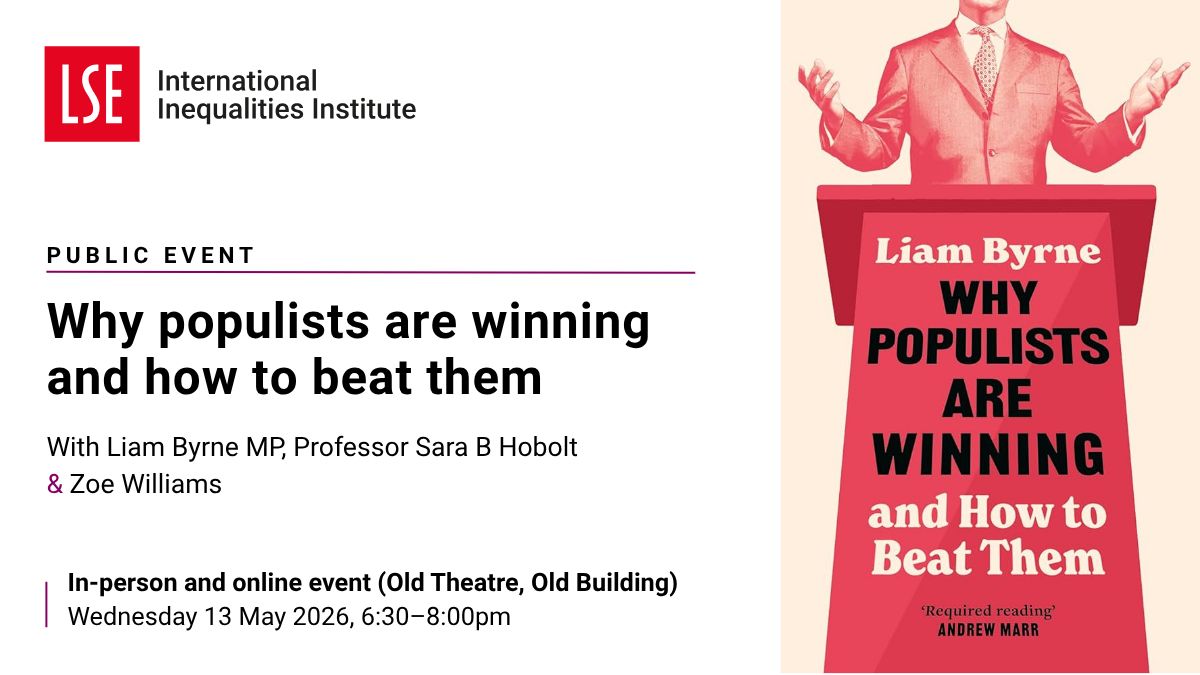
What is driving the rise in populism - and how can we stop it?
Join us for the launch of the latest book by @liambyrnemp with @zoesqwilliams
and @sarahobolt.
Our speakers will draw connections between growing inequality and the populist surge.
🎟️ https://t.co/3L6QFDrwB9