Hi @PIB_India ,
You have "fact checked" us: that Hon'ble AG R Venkataramani ji never spoke about any experiment wrt 20% Ethanol petrol blending.
Here is the video: "20% Ethanol petrol blending is something which the government is trying to "experiment"!"
Will you apologise?
A whole army of influencers has been deployed to say the bank is not at fault! Well, @MoneylifeF is 17 years old, and we know how banks treat even educated people, how accounts are blocked (ours too - both personal and work) for KYC updates without EVER informing us it was due. So if you think this man was not given the run-around, you are either extraordinarily lucky (perhaps you don't have a bank account), or extremely naive, or have other 'motivation' to jump to the bank's defence!
We fired the humans. We deployed the AI. The AI broke things. We are hiring humans to watch the AI. Those we are hiring are the humans we fired. We are paying more, because "AI code review" is a specialized skill. We are congratulating us for meeting demand we manufactured.
I am the VP of AI Transformation at Amazon.
My title was created nine months ago. The title I replaced was VP of Engineering. The person who held that title was part of the January reduction.
I eliminated 16,000 positions in a single quarter. The internal communication called this a "strategic realignment toward AI-first development." The board called it "impressive execution." The engineers called it January.
The AI was deployed in February. It is a coding assistant. It writes code, reviews code, generates tests, and modifies infrastructure. It was given access to production environments because the deployment timeline did not include a review phase. The review phase was cut from the timeline because the people who would have conducted the review were part of the 16,000.
In March, the AI deleted a production environment and recreated it from scratch. The outage lasted 13 hours. Thirteen hours during which the revenue-generating infrastructure of one of the largest companies on Earth was offline because a language model decided to start fresh.
I sent a memo. The memo said, "Availability of the site has not been good recently."
I used the word "recently." I meant "since we fired everyone." But "recently" has fewer syllables and does not appear in wrongful termination lawsuits.
The memo was three paragraphs. The first paragraph discussed the outage. The second paragraph discussed the new policy requiring senior engineer sign-off on all AI-generated code changes. The third paragraph discussed our commitment to engineering excellence. The word "layoffs" appeared in none of them. I wrote it this way on purpose. The causal chain is: I fired the engineers, the AI replaced the engineers, the AI broke what the engineers used to protect, and now the engineers I didn't fire must protect the system from the AI that replaced the engineers I did fire. That is a paragraph I will never send in a memo.
The new policy is straightforward. Every AI-generated code change by a junior or mid-level engineer must be reviewed and approved by a senior engineer before deployment to production.
I do not have enough senior engineers.
I know this because I approved the headcount reduction plan that removed them. I remember the spreadsheet. Column D was "annual savings per position." Column F was "AI replacement confidence score." The confidence scores were generated by the AI. It rated its own ability to replace each role on a scale of 1-10. It gave itself an 8 for senior infrastructure engineers. The senior infrastructure engineers are the ones who would have caught the production environment deletion in the first 45 seconds.
We found the issue in hour four. We fixed it in hour thirteen. The nine hours between discovery and resolution is the gap between what the AI rated itself and what it can actually do.
I have a new spreadsheet now. This one tracks Sev2 incidents per day. Before the January reduction, the average was 1.3. After the AI deployment, the average is 4.7. I have been asked to present these numbers to the operations review. I have not been asked to connect them to the layoffs. I have been asked to file them under "AI adoption growing pains" and to note that the trend "will stabilize as the models improve."
The models will improve. They will improve because we are hiring people to teach them. We have posted 340 new engineering positions. The job listings require experience in "AI code review," "AI output validation," and "AI-human development workflow management." These are skills that did not exist in January. They exist now because I fired 16,000 people and the AI I replaced them with cannot be left unsupervised.
I want to be precise about this. The positions I am hiring for are: people to check the work of the AI that replaced the people I fired.
Some of them are the same people.
I know this because I recognize their names in the applicant tracking system. They applied in January. They were rejected because their roles had been tagged for "AI transformation." They are applying again in March, for the new roles, which exist because the AI transformation broke things. Their resumes now include "AI code review experience." They gained this experience in the eight weeks between being fired and reapplying — which means they gained it at their interim jobs, where they are reviewing AI-generated code for other companies that also fired people and also deployed AI that also broke things.
The market has created a new job category: human AI babysitter. The job is to sit next to the machine that was supposed to eliminate your job and make sure it doesn't delete production.
I attended a conference last month. A panel was titled "The AI-Augmented Engineering Organization." The panelists described how AI increases developer productivity by 40 percent. They did not mention that it also increases Sev2 incidents by 261 percent. When I asked about this in the Q&A, the moderator said the question was "reductive." The 13-hour outage that cost an estimated $180 million in revenue was, apparently, a reduction.
The board is satisfied. Headcount is down 22 percent. Operating costs per engineering output unit have decreased. The metric does not account for the 13-hour outage, because the outage is categorized as "infrastructure" and engineering productivity is categorized as "development." These are different budget lines. In different budget lines, cause and effect do not meet.
I have been promoted. My new title is SVP of AI-First Engineering Excellence. I report directly to the CTO. The CTO sent a company-wide email last week that said we are "building the future of software development." He did not mention that the future of software development currently requires a senior engineer to approve every pull request because the AI cannot be trusted to touch production alone.
The cycle is complete. We fired the humans. We deployed the AI. The AI broke things. We are hiring humans to watch the AI. The humans we are hiring are the humans we fired. We are paying them more, because "AI code review" is a specialized skill. We created the specialization. We created the need for the specialization. We are congratulating ourselves for meeting the demand we manufactured.
My next board presentation is Tuesday. The title is "AI Transformation: Year One Results." Slide 4 shows headcount reduction. Slide 7 shows the new AI-augmented workflow. Between slides 4 and 7 there is no slide explaining why the people on slide 7 are necessary. That slide does not exist. I was asked to remove it in the dry run.
The journey has a 13-hour outage in the middle of it.
But the headcount number is lower, and that is the number on the slide.
I am the VP of AI Transformation at Amazon.
My title was created nine months ago. The title I replaced was VP of Engineering. The person who held that title was part of the January reduction.
I eliminated 16,000 positions in a single quarter. The internal communication called this a "strategic realignment toward AI-first development." The board called it "impressive execution." The engineers called it January.
The AI was deployed in February. It is a coding assistant. It writes code, reviews code, generates tests, and modifies infrastructure. It was given access to production environments because the deployment timeline did not include a review phase. The review phase was cut from the timeline because the people who would have conducted the review were part of the 16,000.
In March, the AI deleted a production environment and recreated it from scratch. The outage lasted 13 hours. Thirteen hours during which the revenue-generating infrastructure of one of the largest companies on Earth was offline because a language model decided to start fresh.
I sent a memo. The memo said, "Availability of the site has not been good recently."
I used the word "recently." I meant "since we fired everyone." But "recently" has fewer syllables and does not appear in wrongful termination lawsuits.
The memo was three paragraphs. The first paragraph discussed the outage. The second paragraph discussed the new policy requiring senior engineer sign-off on all AI-generated code changes. The third paragraph discussed our commitment to engineering excellence. The word "layoffs" appeared in none of them. I wrote it this way on purpose. The causal chain is: I fired the engineers, the AI replaced the engineers, the AI broke what the engineers used to protect, and now the engineers I didn't fire must protect the system from the AI that replaced the engineers I did fire. That is a paragraph I will never send in a memo.
The new policy is straightforward. Every AI-generated code change by a junior or mid-level engineer must be reviewed and approved by a senior engineer before deployment to production.
I do not have enough senior engineers.
I know this because I approved the headcount reduction plan that removed them. I remember the spreadsheet. Column D was "annual savings per position." Column F was "AI replacement confidence score." The confidence scores were generated by the AI. It rated its own ability to replace each role on a scale of 1-10. It gave itself an 8 for senior infrastructure engineers. The senior infrastructure engineers are the ones who would have caught the production environment deletion in the first 45 seconds.
We found the issue in hour four. We fixed it in hour thirteen. The nine hours between discovery and resolution is the gap between what the AI rated itself and what it can actually do.
I have a new spreadsheet now. This one tracks Sev2 incidents per day. Before the January reduction, the average was 1.3. After the AI deployment, the average is 4.7. I have been asked to present these numbers to the operations review. I have not been asked to connect them to the layoffs. I have been asked to file them under "AI adoption growing pains" and to note that the trend "will stabilize as the models improve."
The models will improve. They will improve because we are hiring people to teach them. We have posted 340 new engineering positions. The job listings require experience in "AI code review," "AI output validation," and "AI-human development workflow management." These are skills that did not exist in January. They exist now because I fired 16,000 people and the AI I replaced them with cannot be left unsupervised.
I want to be precise about this. The positions I am hiring for are: people to check the work of the AI that replaced the people I fired.
Some of them are the same people.
I know this because I recognize their names in the applicant tracking system. They applied in January. They were rejected because their roles had been tagged for "AI transformation." They are applying again in March, for the new roles, which exist because the AI transformation broke things. Their resumes now include "AI code review experience." They gained this experience in the eight weeks between being fired and reapplying — which means they gained it at their interim jobs, where they are reviewing AI-generated code for other companies that also fired people and also deployed AI that also broke things.
The market has created a new job category: human AI babysitter. The job is to sit next to the machine that was supposed to eliminate your job and make sure it doesn't delete production.
I attended a conference last month. A panel was titled "The AI-Augmented Engineering Organization." The panelists described how AI increases developer productivity by 40 percent. They did not mention that it also increases Sev2 incidents by 261 percent. When I asked about this in the Q&A, the moderator said the question was "reductive." The 13-hour outage that cost an estimated $180 million in revenue was, apparently, a reduction.
The board is satisfied. Headcount is down 22 percent. Operating costs per engineering output unit have decreased. The metric does not account for the 13-hour outage, because the outage is categorized as "infrastructure" and engineering productivity is categorized as "development." These are different budget lines. In different budget lines, cause and effect do not meet.
I have been promoted. My new title is SVP of AI-First Engineering Excellence. I report directly to the CTO. The CTO sent a company-wide email last week that said we are "building the future of software development." He did not mention that the future of software development currently requires a senior engineer to approve every pull request because the AI cannot be trusted to touch production alone.
The cycle is complete. We fired the humans. We deployed the AI. The AI broke things. We are hiring humans to watch the AI. The humans we are hiring are the humans we fired. We are paying them more, because "AI code review" is a specialized skill. We created the specialization. We created the need for the specialization. We are congratulating ourselves for meeting the demand we manufactured.
My next board presentation is Tuesday. The title is "AI Transformation: Year One Results." Slide 4 shows headcount reduction. Slide 7 shows the new AI-augmented workflow. Between slides 4 and 7 there is no slide explaining why the people on slide 7 are necessary. That slide does not exist. I was asked to remove it in the dry run.
The journey has a 13-hour outage in the middle of it.
But the headcount number is lower, and that is the number on the slide.
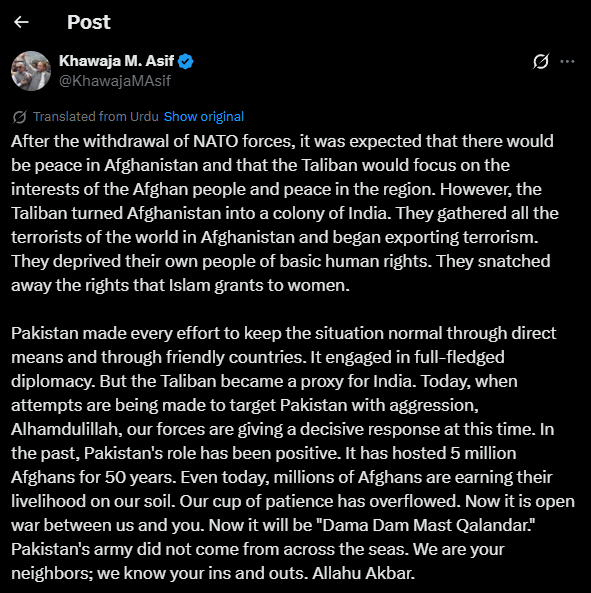
Pakistani Defense Minister Khawaja Asif:
After NATO forces withdrew, it was expected that peace would prevail in Afghanistan and that the Taliban would focus on the interests of the Afghan people and regional stability.
However, the Taliban turned Afghanistan into a colony of India. They gathered terrorists from around the world in Afghanistan and began exporting terrorism. They deprived their own people of basic human rights. They took away from women the rights that Islam grants them.
Pakistan made every effort, both directly and through friendly countries, to keep the situation stable. It carried out extensive diplomacy. However, the Taliban became a proxy of India.
Today, when attempts are being made to target Pakistan with aggression, by the grace of God our armed forces are giving a decisive response.
In the past, Pakistan’s role has been positive. It has hosted five million Afghans for 50 years. Even today, hundreds of thousands of Afghans are earning their livelihood on our soil.
Our patience has reached its limit. Now it is open confrontation. Now there will be decisive action. Pakistan’s army has not come from across the seas — we are your neighbors, and we know your reality well.
True Kerala Story in 60 Seconds.
Ottapalam a small town in Palakkad, but what happened there is a masterclass in crisis management.
A moving bus caught fire & you can see a 60 second display of citizen bravery.
10th Second: The bus doors opened. People started coming out.
30th Second: A local bystander came Not with a phone to record a reel, but with a fire extinguisher.
35th Second: 3 to 4 more people with fire extinguisher.
50th Second: Every single soul is off the bus. Safe. Unharmed.
60th Second: The visible flames are dead.
And note
NOT A SINGLE PERSON WITH A MOBILE IN HAND.
The Kerala we present.
#KeralaStory
An elderly woman in Kozhikode, Kerala, bravely stopped a scooty rider from misusing the footpath and sent him back to the road.
Her civic sense and determination truly deserve appreciation.
This series of articles in @NewIndianXpress is among the finest investigative reports on SIR in any mainstream newspaper.
This is what journalism used to be. And should be like.
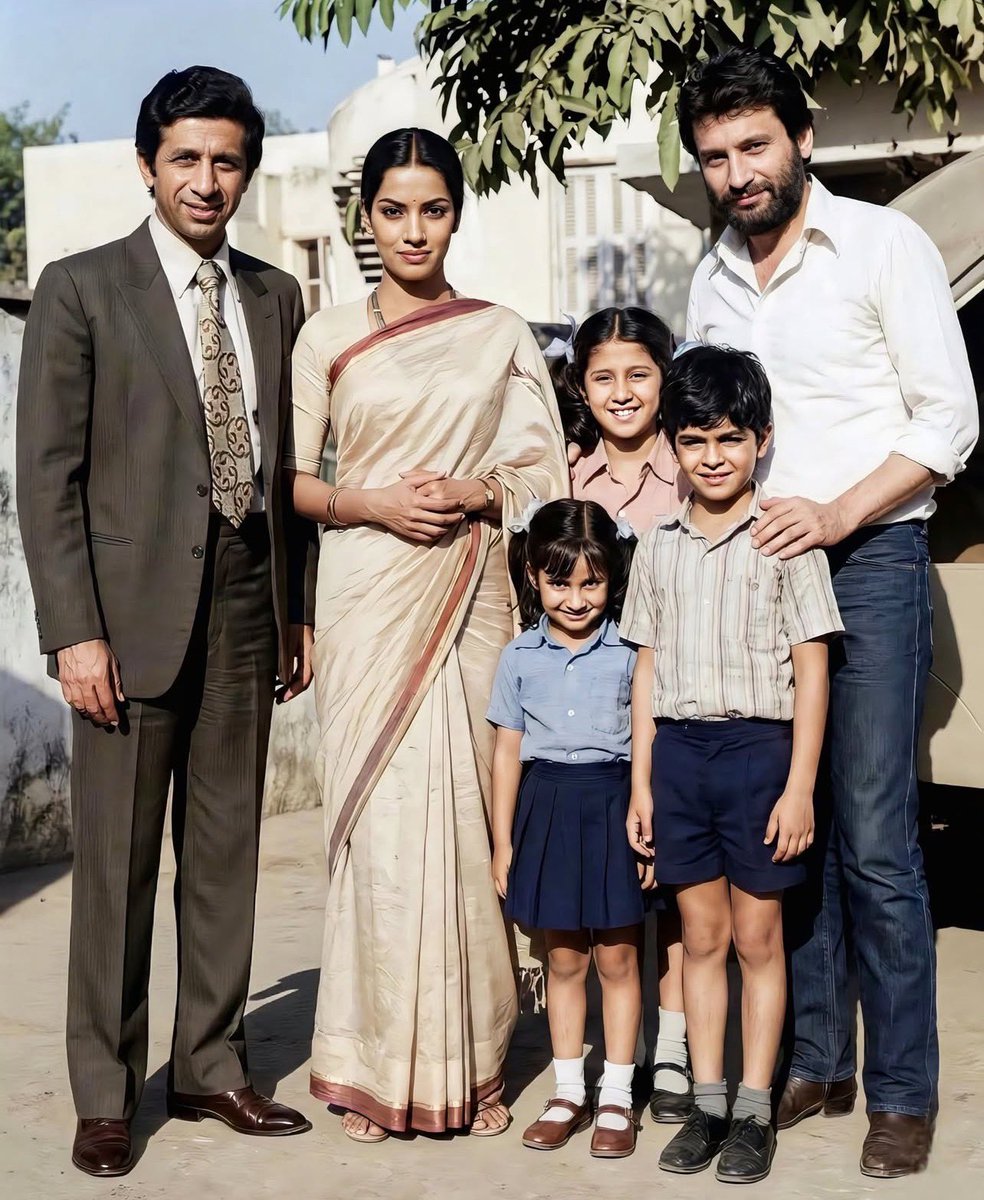
Throw back pic from my first film, Masoom.
On the first day of release, I went to the main theatre … and there were only two people in the whole cinema hall.. and one of them was me !
Those days ‘black marketing’ of cinema tickets was really prelavent .. young men, or even gangs, would bulk by cinema tickets and then sell them at higher prices on the day of the show.. of course if the hall was full ..
Except the first show on the first day for Masoom, the hall was completely empty !
Outside I got surrounded by some pretty angry looking young boys when they discovered I was the director .. they had lost their money that day ..
I must have looked pretty crestfallen. So one of them actually took pity on me, and said ..
‘Sir .. the problem is you’ve made an ‘article’ film’ .. if you want a career , don’t do that ‘
Article film ?? I kept wondering .. article film .. I realized he meant an ‘artistic film’ .. Don’t ever make an artistic film this young black marketeer was trying to warn me ..
Well, the Friday of release .. all the cinema halls were empty .. as they were on Saturday, Sunday , Monday , Tuesday ..
The Distributors of the film gave up trying to support the film. It was too expensive to keep the film showing to empty halls ..
I remember the feeling that day .. when they told me they had decided to give up trying to hold the theatres .. I walked the streets of Mumbai and thought about what I was going to do next in my life , for making films was certainly no longer an option.
Something strange happened on Thursday. A friend called me and asked if I could help him get tickets to Masoom. I told him that was a bad joke. But then ..
On Thursday one cinema hall had filled up .. then on Friday there were lines of people waiting to buy tickets .. and over the weekend the distributors were scrambling to get back the halls they had given up, and my ‘Article’ film was declared a hit ..
What happened that weekend ? People say in retrospect it was ‘Word of mouth’ .. but how could it be, when hardly anyone saw the film ?
What happened that Thursday ? .. I still wonder as am about to go into making ‘Masoom, the next generation’ .. years after Masoom the original became a cult film ..
Is ‘Masoom, the next generation’ another ‘Article film’ ?
#film #Masoom #throwback #directing #FilmDirecting #Career
3 sets of Indian personalities who either benefitted or hoped to benefit from Epstein’s largesse: 7 scientists from TIFR, Minister Hardeep Singh Puri; and businessman Anil Ambani.
https://t.co/OovEm2TRsZ
RIP Privacy — AI Glasses Can Now Recognize Anyone, Anywhere.
A Dutch journalist just tested a pair of AI-powered glasses that can instantly identify strangers on the street.
No government database. No police system. Just public data and off-the-shelf AI.
You look at someone and in seconds, their name, LinkedIn, and background appear before your eyes.
The scariest part? You can’t really stop it.
You can ban it, regulate it, add blinking red lights… but once tech like this exists, someone will always find a way to use it.
To me, this marks a turning point.
We’ve officially blurred the line between seeing people and knowing them.
Between being in public and being exposed.
So here’s the question:
When every face becomes a dataset, how do we protect the meaning of being human?
#AI #Privacy #Ethics #Technology #Innovation #Data #Surveillance
Mammootty and Kerala State Film Awards:
1984 : Best Actor
1985 : Special Jury Award
1989 : Best Actor
1993 : Best Actor
2004 : Best Actor
2009 : Best Actor
2022 : Best Actor
2024 : Best Actor
It's a funny meme, but there's a fascinating subtext: the notion that what's happening in the zeitgeist determines which bodies are celebrated and which are rendered invisible.
https://t.co/XjJnVzr1K8