We built the natural successor. Superlist comes from the makers of Wunderlist, and our Microsoft To Do importer is ready today.
Move your lists in a few clicks and get 50% off for Black Friday: https://t.co/AuL5cWPvLd
Ok, since the technology freak out has wandered into my exact area of expertise, including some stuff I actually worked on, I’m going to explain in excruciating detail how Apple’s cloud services work & why the reporting on this is wrong. And if you have experience in other software, or services you don’t have a clue. 🧵
We’ve heard a lot of rumors about tomorrow’s EAS test. 📺📻 Let’s clear things up. It lasts 1 minute, and no action is required. No blackouts, no secret emergencies. Just our legally mandated, routine test on TV and radio at approximately 2:20 PM ET: https://t.co/WGD7xCuRDB
I run deposit strategy at Chase. I have some insider information regarding Monday's bank outage.
Everyone else in the building had a bad Monday. I had the best day of my career. Nobody could take any money out.
Here's what happened. On Monday morning, Chase customers started reporting that they couldn't log in, move money or withdraw funds. By 2 p.m. Eastern, nearly 4,800 people had reported trouble with Chase on Downdetector. Zelle payments stalled across the country. At least 1 branch couldn't take a deposit. The AP reported that "a technical issue at JPMorgan Chase caused ripple effects throughout the financial system."
Our statement said, "Due to a technical issue, some transactions are taking longer than usual to complete but customers still have access to their accounts and funds." From my desk, that's completely accurate. The funds were in the accounts. The accounts were in the bank. Everything was accounted for. It just wasn't going anywhere.
Let me explain how a bank works. You give us your money. We pay you 0.01% for it. That's the rate on a standard Chase Savings account. On $10,000, you earn $1 a year. Then we lend your money out and invest it. In the third quarter, our net interest income was $27.0 billion. That's about $294 million a day.
On a normal day, your $10,000 earns you about a quarter of a penny. It earns us more. Monday was a normal day for us.
Here's a number you're not supposed to know. When we park cash at the Federal Reserve, the Fed pays us 3.90%. We pay you 0.01%. The Fed pays us 390 times what we pay you, on money that came from you. That arrangement didn't go down on Monday either.
The spread doesn't need the app. It doesn't need you to log in. It runs whether you can see your balance or not. Your money earned for us all Monday while you hit refresh. Our net interest income has never had an outage. I'd know. Watching it is my job.
Some people think an outage is bad for a bank. Think about what a deposit is. It's money that stays. My entire department exists to make money stay. We run promotions. We offer bonuses for direct deposit. We design apps that make moving money feel like work. On Monday a technical issue did my whole job for free, nationwide, before lunch.
I'd like to talk about the glitch. In 2024, customers found a different glitch at our ATMs. It let them deposit a fake check and withdraw the cash before the check bounced. TikTok called it the "infinite money glitch." We called it "fraud, plain and simple." Then we sued. In our lawsuits we asked for the money back, plus interest and overdraft fees.
Monday's glitch ran the other way. It kept customers from withdrawing money that was really there. That's a technical issue. I want to be clear about our policy here, because the public keeps confusing the 2. When a glitch lets money leave the bank, somebody is going to court. When a glitch keeps money in the bank, somebody is going to have to try back later.
Back in 2024 we said, "We're pursuing these cases and actively cooperating with law enforcement to make sure if someone is committing fraud against Chase and its customers, they're held accountable." People online have asked who will be held accountable for Monday. A technical issue. We looked into suing it. Technical issues don't have addresses.
There's one more difference between the 2024 glitch and Monday's. When we sued the TikTok customers, we filed in federal court in Los Angeles, Houston and Miami. Your Deposit Account Agreement says your disputes with us "will be resolved by binding arbitration" and "not through litigation in any court," except small claims. You also agreed never to join a class action. So if Monday cost you a late fee, you can't sue us with your neighbors. You can file alone, in private, in front of an arbitrator. There is an opt-out. It's in the agreement. We know how many people read the agreement.
Now, the fees. Say you scheduled a transfer to cover your rent, the transfer took longer than usual, and your account went below zero. Our Overdraft Fee is $34 per transaction, up to 3 a day, for a maximum of $102. We charge it during nightly processing. People have asked whether nightly processing was affected on Monday. I can't speak to that. I can tell you nightly processing is very important to us.
In December 2024 a federal agency finalized a rule that would have capped overdraft fees at big banks at $5. The American Bankers Association championed the repeal. In May 2025 Congress repealed the rule, and the President signed it. Our fee is still $34. In 2025 we collected about $1 billion in overdraft fees. I keep that number on a sticky note on my monitor. It's the most reliable system we have.
We also offer Overdraft Assist. You pay no fee if you're overdrawn by $50 or less at the end of the business day. On Monday the app didn't work, Zelle didn't work, and some branches didn't work. The business day ended right on time. It always does.
A man in Dallas tried to deposit a check at a branch on Monday. The transaction couldn't be completed. I understand his frustration. Normally when you deposit a check, we hold part of the money for a day or 2. On Monday we held the whole check, at the counter, with him still attached.
He told CBS the teller told the customer ahead of him that the "system was down." Those are 3 words we've spent a lot of money keeping out of our branches. The system was taking longer than usual. The teller has been scheduled for messaging training.
Some customers couldn't see their routing numbers. One told Gizmodo he could log in but couldn't find his. Without a routing number, your money can't be routed. That's the safest your money has ever been.
Last year we told CNBC that fintech middlemen like Plaid were "massively taxing" our systems with unnecessary pings. So we started charging them to access your data. On Monday nobody had to ping us. Our systems taxed themselves. We're still deciding who to invoice.
Bank of America and Citigroup didn't have an outage, the AP reported. Their customers just couldn't send money to ours. Shares of JPMorgan, Bank of America, Citigroup and Wells Fargo all fell around 2%. We broke, and our competitors' stock fell with ours. When you hold this many deposits, your technical issue becomes everyone's technical issue. I find that moving.
Zelle is owned by a company called Early Warning Services. Early Warning is owned by 7 banks, including us. On Monday Early Warning said the Zelle network "was fully operational." A Zelle representative told NBC the problems originated with Chase. A company we co-own named us in public. I've asked legal to remind them who the owners are.
The company is called Early Warning. I've always loved that name. It's reassuring, and on Monday it didn't have to warn anybody.
Zelle has a strong record. In December 2024 the CFPB sued us, Bank of America, Wells Fargo and Early Warning over Zelle. It said customers of the 3 banks had lost more than $870 million to fraud on the network since 2017. In March 2025 the CFPB dropped the case. When a scammer moves your money on Zelle, it arrives in seconds. When you try to move your own money on a Monday, it takes longer than usual. We've never confused the 2 priorities.
Chase has about 94 million customer relationships in the U.S. Nearly 4,800 people reported problems on Downdetector. That's about 0.005% of our relationships. On my dashboard, that rounds to 0. Downdetector is a website where people go to report their feelings. The deposits never filed a single report.
In the third quarter we made $15.3 billion in profit. That's about $166 million a day, including the days when everything works. Monday won't show up in our earnings report. Outages never do. That's how I know it was a good day.
The board paid Jamie $43 million for 2025, a 10.3% raise. The New York Times estimated his total 2025 haul, counting stock gains and dividends, at roughly $770 million. At our savings rate of 0.01%, you'd need to deposit $7.7 trillion to earn that much interest in a year. We don't hold that many deposits yet. I'm working on it. Monday helped.
For the record, my own money was fine. I keep it at a credit union.
At 4 p.m. my team had cake. Deposit outflows on Monday were the lowest anyone on my floor could remember. Somebody suggested we schedule a technical issue every quarter. Everybody laughed. I wrote it down.
My job is to keep your money at Chase. On Monday I didn't have to do anything. Your funds were safe. They were with us, which is where we prefer them.
Please try back later.
According to the latest AI Threat Tracker report, bad actors are now using autonomous LLM frameworks to continuously scan software updates, figure out what flaw was patched, and build an attack for it — all without human involvement.
https://t.co/IjWUohtuaZ
More details on the root cause can be found in the Microsoft 365 Admin center, and an abridged version can be found below.
We are deeply sorry for the impact to all our customers and recognize the impact that this has on their normal business & operations.
The incident on Thursday, November 12th, 2026, was caused by three main factors that together caused a global outage for the networking gateway that fronts many Microsoft 365 services.
First, a latent defect caused servers to become overwhelmed and unresponsive under certain load conditions. This was due to lock contention inside an internal process which caused the machine to become unavailable. This defect was the result of a fix that was prepared specifically for Microsoft 365 networking gateway servers; neither the underlying defect nor the fix applies to broader Windows deployments.
The initial change in behavior first started deployment in July of this year. The update went through safe deployment and saturated globally over several weeks, during which time no issues were observed. For more than three months, the change was deployed worldwide without impact.
Our normal load testing did not detect the latent issue because the different traffic and SKU mix used in our test labs. The contention issue is worsened on machines with more cores and newer hardware; whereas our load testing tended to focus on our weaker hardware SKUs with fewer cores.
Second, a surge in load increased the likelihood for the networking gateways to encounter the contention. Within Microsoft 365, we maintain two independent and heterogenous network gateway systems designed for isolation and high availability. This allows many Microsoft 365 services to fail to/from them during outages or disruptions. Approximately fifteen hours before the outage, Teams failed over from the alternative networking gateway to the ‘primary’ gateway that also supports Exchange Online. This increased the load on the networking gateway and changed its traffic patterns. This type of failover is part of normal operations and is integral to standard Microsoft resiliency efforts.
Third, at the same time, nearly 14% of server capacity for the networking gateway was out of service due to an unrelated issue from the previous day. This server capacity was on track to be returned to active service through routine maintenance and health processes. The service had sufficient capacity headroom, so the reduction in server capacity had no impact on its own.
Taken together, the increased load and the reduced server capacity, caused the network gateway to encounter the latent bug from July. This caused requests to build up until servers ultimately stopped responding. This occurred during the peak window of traffic in the United States.
When servers lose connectivity, our traffic management systems automatically route users to other healthy endpoints. This happens often and is critical to avoiding any interruption due to hardware, software, or network defects and is normally what makes the service resilient. However, the redirected traffic increased the likelihood for the same problem to occur on the remaining endpoints. This caused a cascading failure from server to server as the same amount of load was spread across fewer servers. In less than two hours, the previously unknown defect was encountered across our fleet and rendered them unresponsive. At its lowest, more than 80% of servers were unresponsive.
Normally, the network gateway is composed of thousands of ‘capacity units’ which represent shards of capacity, hardware, and networking infrastructure. These ‘capacity units’ are then organized into regions. In this case, due to a separate issue, the normal bulkheads between these different partitions did not stop the cascading failure. This is what allowed the impact to spread across our network gateway infrastructure globally.
Several services like Teams, OneDrive, SharePoint, and Office apps failed out of the faulty network gateway infrastructure. That is why those services were restored earlier, with Teams chats and meetings functioning without issue for most of the outage. But not all services, like Exchange Online, can fail out of this network gateway.
Recovery took longer than usual because as servers returned to service, they were immediately overwhelmed by waiting traffic and became unresponsive again. Our normally automated recovery processes were not designed to restore service from this broad unresponsive state. Additionally, since the main code defect was a latent bug from several months previous, our normal rollback, flighting, and feature flags were unable to quickly revert the change.
After engineers confirmed the defect as the cause, we developed an update that returned the code path to the previously known good state. To effectively apply this fix, and to slowly bring the service online again, we took groups of servers out of service, applied the change, and restarted them before returning them to service. This process was carefully applied to large quantities of infrastructure at a time (e.g. 50%+ of a region).
The final Post-Incident Review (PIR) will provide more details later this week.
This is going out to my fellow techs, engineers, and dudes named “Ben”, what is your initial reflex when your user, client, customer, etc decides to override your past experience with their “backseat driver” AI solution they researched on their own? What ends up being said in response?
The Giants have a legitimate opportunity to separate themselves in the NFC East over the next few weeks.
Dallas is falling apart defensively, and Washington hasn’t shown enough consistency to be taken seriously as a threat. The Giants have a much more manageable road to win the division than anyone else.
The division is there for the taking. The only question is whether the Giants can get out of their own way and capitalize.
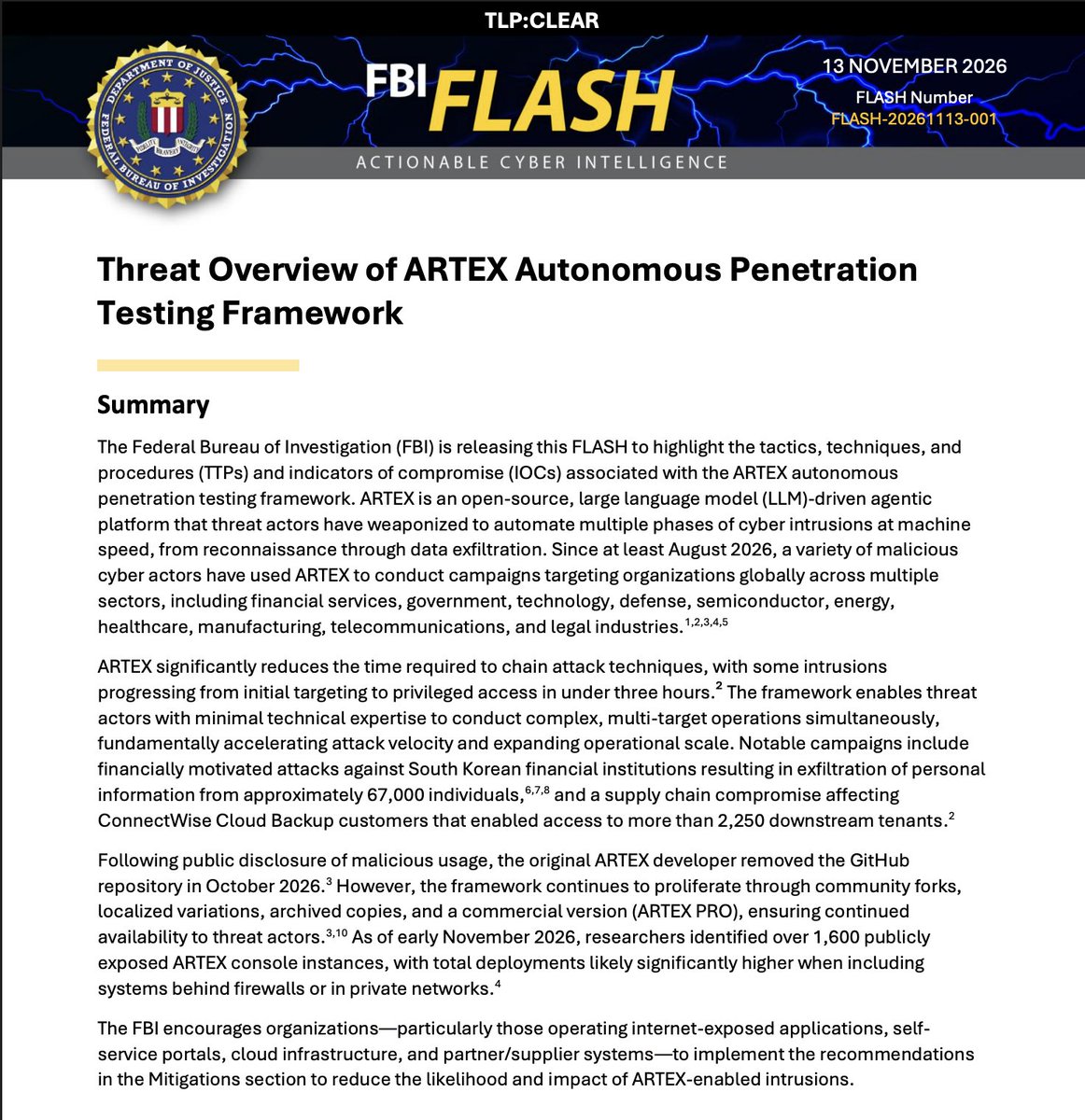
The FBI just issued a warning about AI agents being used to hack companies.
Some attacks reached privileged access in under 3 HOURS.
67,000 people's data exposed. 2,250+ downstream tenants affected in a separate campaign.
The tool behind it? ARTEX.
Here's how the attacks work. 🧵