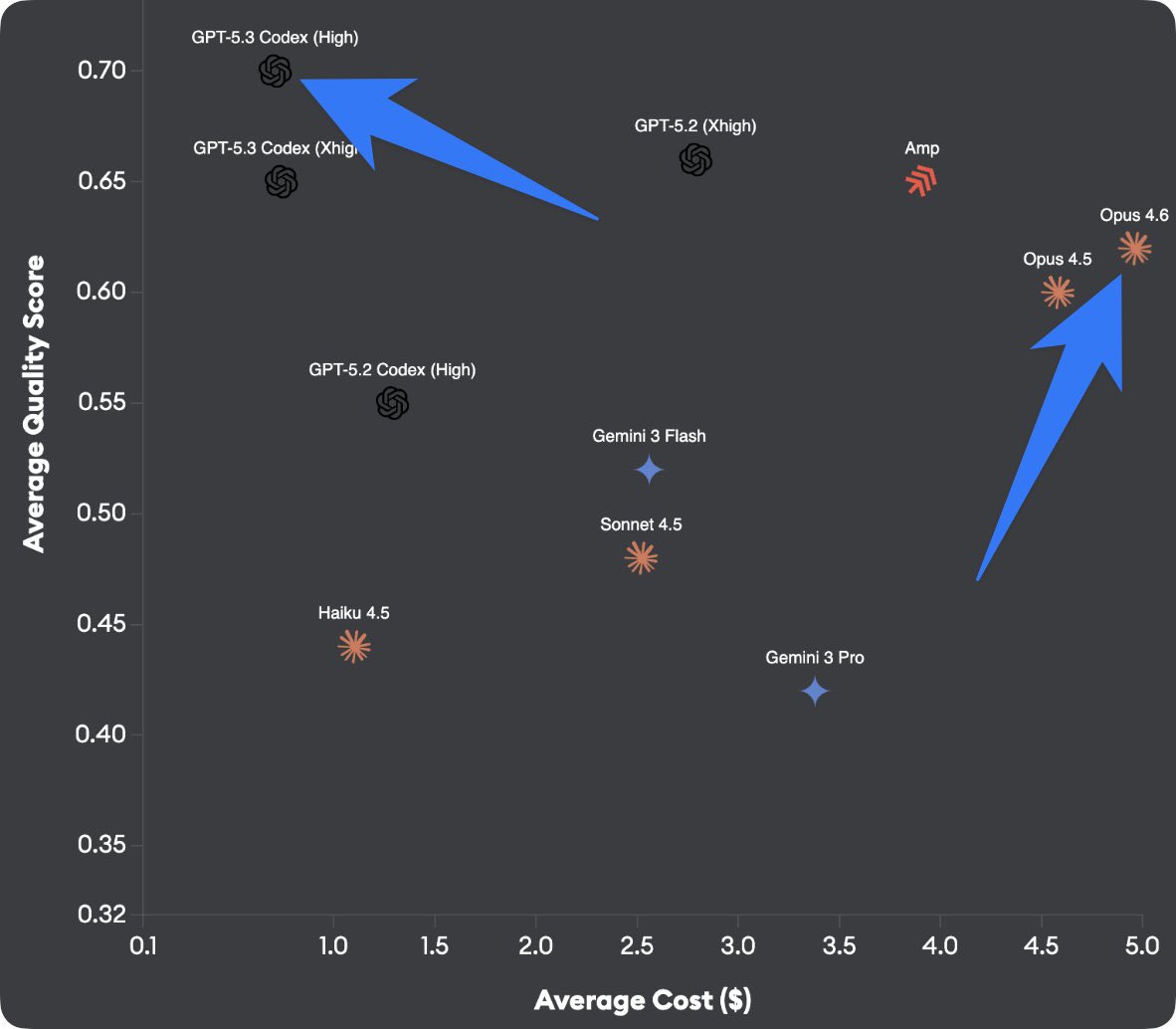
OpenAI just nuked the field: GPT-5.3-Codex at robbery prices.
25% faster • ~½ tokens/task • 77% Terminal-Bench 2.0 • 57% SWE-Bench Pro • High cyber mode.
Drops **right after** Claude Opus 4.6 like “your move, clowns”. Savage. 🔥
40–60% cheaper than Opus on real agentic coding.
Loss-leader masterclass: flood devs → gorge on usage data → unbreakable moat → price hike when you're addicted.
Amazon-level ruthlessness, but selling god-tier code smarts. 😈
Casualties: Claude copium ratio'd to death • mid-level salaries on death watch • juniors now just babysit autonomous gremlins.
Golden age of dirt-cheap frontier coding is live.
Enjoy before the inevitable gouge. Tick-tock ⏰💀
Target in 2026: the retail glow-up that’s mostly vibes so far.
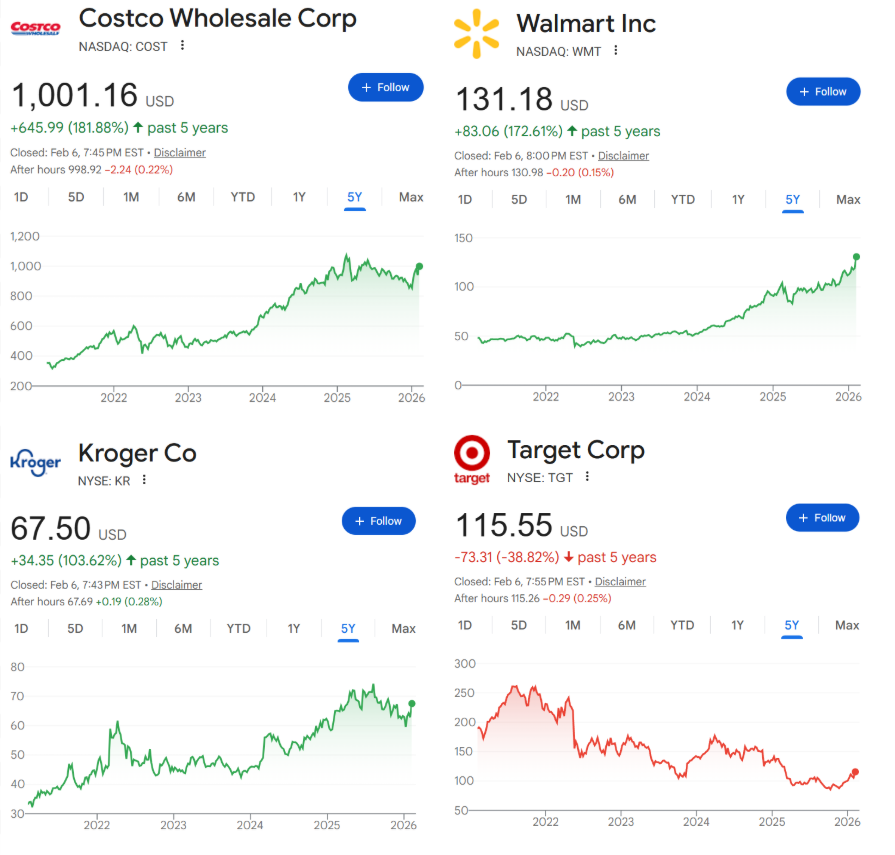
Pissed off BOTH sides of the culture war with DEI flip-flops + boycotts, bled traffic & sales for years, stock cratered to ~$83 lows in '25 (down ~40% over 5 yrs while Costco/Walmart mooned).
New CEO Fiddelke steps in Feb '26 admitting they "lost trust," throws $5B at remodels & fixes. Stock claws back to ~$115 (up ~18% YTD), dirt-cheap P/E, fat ~4% yield.
Spicy truth: They just stopped self-sabotaging simultaneously. Rally = hopeium + mean reversion play.
Buy the dip if you love redemption arcs… or keep walking to Costco like everyone else. 🔥 #TGT $TGT
David Kipping just explained 4 revolutions happening at the same time in the field of academics
Academic Autophagy: We’re entering the era of "automated insight" where AIs write papers for other AIs to peer-review. Human scientists have been demoted from explorers to mere glorified librarians of a black-box oracle.
The IQ Mirage: Technical brilliance is officially a commodity. If your "unique value" is being good at math or Python, you’re already obsolete. The $20/month subscription didn't just catch up; it lapped you while you were still setting up your environment.
Ethical Nihilism: The smartest people at the IAS have essentially said "ethics be damned" because the productivity high is too addictive. We’re trading human understanding for "magic" results, sprinting toward a finish line we won’t even comprehend when we cross it.
The PhD Meat Grinder: Graduate school is now a five-year hazing ritual for a job that a GPU does better, faster, and without the student loans. We are still training "experts" for a world that died three years ago.
David Kipping says something fundamental has shifted in science.
At a closed meeting at the Institute for Advanced Study (IAS), top physicists agreed AI can now do up to “90%” of their work and may soon push discovery beyond human understanding.
“I don’t know that I want to live in a world where everything around me is just magic.”
He says the best scientific minds on Earth are now holding emergency meetings about what comes next. This isn’t speculative anymore. It’s really happening.
Even God-tier AGI isn't going to 3D-print a new SAP from first principles. It'll just call the API like the rest of us peasants. Tool use forever. Your 30× revenue multiple is safe. Buy the dip.
Jensen tonight at the Cisco AI summit on how the market is getting it wrong with Software
Software = tools, AI will be maximally efficient by using the tools (tool use), not reinventing them
David Marcus said the quiet part out loud.
Platforms became features.
Product conviction became financial optimization.
Long-term moats gave way to short-term metrics.
That’s not how companies die overnight —
that’s how great companies slowly fade.
A few thoughts about PayPal, nearly 12 years after I left.
I woke up this morning to dozens of messages from former PayPal colleagues. It pushed me to finally speak up.
I never spoke publicly about the company after I left. Part of that was loyalty to John Donahoe, who gave me an unlikely opportunity, handing the reins of PayPal to a startup guy who, on paper, had no business running a then 15,000-person organization. But part of it was something else: I had left. I chose not to stay and fight for the changes I believed in. Speaking from the sidelines felt like armchair commentary. Easy opinions without the burden of execution. So I stayed quiet.
But twelve years of silence is long enough. And today's news makes it clear the pattern I've watched unfold isn't self-correcting.
I left PayPal in 2014 because I was deeply frustrated. We had executed a silent turnaround of a company that had lost its soul. We brought back engineering talent, shipped good products quickly, and acquired Braintree and Venmo. The company was on a tear. So much so that Carl Icahn felt compelled to accumulate a position in eBay and push for a PayPal spinoff. At the time, eBay decided to fight Icahn.
It was a difficult period for me, caught between what I felt was right for PayPal and my loyalty to the eBay team.
This is when Mark Zuckerberg approached me to join Facebook. The combination of his conviction that messaging would become foundational, the appeal of going back to building products at scale, and my growing exhaustion with the internal politics at PayPal and eBay eventually convinced me to leave and join one of the best teams in the world, one I had admired for a long time.
In the summer of 2014, I met John in a café in Portola Valley and told him I had decided to leave. During that conversation, he told me that Icahn had effectively won the fight, that PayPal was going to become an independent company, and he tried to convince me to stay on as CEO, but I had already said yes to Mark, and my word is my bond. There was no turning back.
After my departure, the board scrambled to find a replacement, and it took a few months for them to land on Dan Schulman. The leadership style shifted from product-led to financially-led. Over time, product conviction gave way to financial optimization.
Much of the momentum we had created still persisted and carried the company forward, mainly driven by Bill Ready, who came over in the Braintree acquisition and rose to COO. Under his leadership, Venmo grew exponentially, and total payment volume (TPV) accelerated quickly. But the shift under Schulman became more pronounced after Bill's departure at the end of 2019. With him went the product conviction that had defined the post-spinoff momentum. Then, for a period, COVID-fueled online shopping hid a lot of the company's new weaknesses.
During that period, the company made a fundamental miscalculation: it optimized for payment volume instead of margin and differentiation. It leaned into unbranded checkout, where PayPal had the least leverage, instead of branded checkout, where the margin, data, and customer relationship actually lived.
Visa masterfully structured a deal that effectively ended PayPal's ability to steer customers toward bank-funded transactions, which had been a core driver of PayPal's economics. Not long after, PayPal lost a significant portion of eBay's volume. Over time, it saw its share of checkout among its most profitable customers steadily erode as Apple Pay and others continued to execute well.
The same pattern repeated itself across lending, buy-now-pay-later (BNPL), and new rails.
On lending, PayPal missed the opportunity to turn it into a platform weapon. Products like Working Capital were conservative, short-duration, and optimized for loss minimization. Lending never became programmable, never became identity-driven, and never became a reason for merchants or consumers to choose PayPal over something else.
The missed opportunity in BNPL was even more striking. Klarna, Affirm, and Afterpay didn't just offer installment payments, they built consumer finance brands, persistent credit identities, and new shopping behaviors. PayPal saw the BNPL turn, entered the market, and had every advantage: distribution, trust, and merchant relationships. But BNPL was treated as a defensive checkout feature rather than an offensive category. There was no attempt to turn it into a core consumer relationship, no super-app behavior, and no meaningful differentiation for merchants. Others built platforms, PayPal added a feature.
The failure to lean into building and owning new rails followed the same logic. After the spinoff, PayPal had a once-in-a-generation opportunity to build a global, at scale payment network. Instead, the company focused on building on top of existing networks and third-party rails.
More recently, that mindset carried over to PYUSD. Technically, the product was sound. Strategically, it launched without a compelling transactional reason to exist. PYUSD had distribution, but no organic demand. It was not embedded deeply enough into flows to become a true settlement layer, a cross-border merchant rail, or a programmable money primitive. It sat adjacent to the product instead of inside the core of it.
Acquisitions during this period followed a similar pattern. Honey was not a strategic acquisition for PayPal. It added activity, but not leverage. It lived outside the transaction, monetized affiliate economics rather than payment economics, and never meaningfully strengthened PayPal's control of the customer or the checkout moment. Xoom solved a real problem in remittances, but it never compounded PayPal's advantage. It scaled volume without changing the underlying rails, identity graph, or settlement model, and as importantly, it didn’t cater to a high-value, high-margin customer archetype.
None of these were bad companies. They were just a wrong fit for PayPal and became unnecessary distractions.
The board eventually recognized the problem. In 2023, they brought in Alex Chriss, an Intuit veteran with a strong product background, explicitly to restore product conviction. It was the right instinct.
But Alex came from software, not payments. He understood SMB product development. He didn't have the muscle memory for transaction economics, network effects, or settlement infrastructure.
In hindsight, he also made an error: clearing out much of the leadership team that understood payments deeply. Executives with years of institutional knowledge departed within his first year.
This morning, Alex was removed as CEO. Branded checkout grew 1% last quarter. The board tapped another operator, Enrique Lores, the former HP CEO who's been on the PayPal board for five years.
I don’t know Enrique. And he might be a great leader, but on paper at least, he’s a hardware executive. For a payments company.
The common thread through all of this is incentive design. Once PayPal became independent, short/medium-term predictability beat long-term vision and ambition. Stock performance mattered more than platform risk and network opportunity. Financial optimization replaced product conviction.
I'm not claiming I would have made every call differently. Running a public company at scale involves tradeoffs I didn't have to make after I left. But the pattern, choosing predictability over platform risk, again and again, was a choice, not an inevitability.
Over time, the company that had every advantage and could’ve become the most consequential and relevant payments company of our time, lost its mojo, its product edge, and its ability to compete in a market that’s being rewired and reinvented in front of our eyes.
That's the part that's hardest to watch for a company I care so deeply about.
Sure, relative age can give a short-term edge in kindergarten, but the research doesn’t support the idea that holding kids back leads to major lifelong advantages. Multiple studies show that any early test-score benefit usually fades by about 3rd grade, and long-term outcomes like college attendance or behavior aren’t consistently better — and in some data, redshirted kids score lower later and are less likely to attend college.
Even massive samples tracking students into adulthood (e.g., PhDs) find no meaningful advantage from being older relative to peers.
If real success were just about being oldest, it would show up decades later — the research says it doesn’t. Confidence + resilience + growth through challenge beats stacking the deck.
I hold my boys back in school so they are the oldest in their classes.
Massive advantage over the kids of parents who blindly follow the rules.
They’ll be bigger, more mature, better at relationships, get the girls, on and on.
That confidence will lead to massive success.