Always wondered what is the moat for @OpenRouter - and amazed more competitors didnt come out weekly. Apart from @AskVenice who else is there?
and how hard can it be to replicate OR?
I've recently talked to quite a few people recently who believe they can just rent B300 nodes, install @vllm_project / @sgl_project, plug into @OpenRouter, and start printing money.
I think they seriously underestimate how hard the inference business has become.
A few facts everyone should know:
- Getting listed is extremely hard now! OpenRouter reportedly gets 40 provider applications every day and only approves 1. It could take months just to get listed!
- Competition is brutal! There are already 80+ providers serving @deepseek_ai models. Unless you have done extreme optimizations, you won't get any meaningful traffic!
- Some competitors aren't even trying to make money! Some providers intentionally price below cost to attract traffic. They treat the losses as marketing spend, and no one can even compete the price!
I think the era of simply hosting open-source models and selling tokens is coming to an end, especially for new entrants.
The real opportunity is moving up the stack. Sell solutions, not tokens.
Fascinating research.
My concern - could similar forensic techniques uncover hidden fingerprints in other fields, particularly cryptographic keys, digital signatures, or supposedly anonymized data? How broadly applicable could this approach be, and what else might be at risk?
I have a major result to share.
I’ve found conclusive forensic evidence that the top 4 Chinese AI labs—DeepSeek, Moonshot, MiniMax and Ant Group—have built their newest models on NVIDIA’s most advanced Blackwell chips, which are barred from export to China.
This sounds insane, but I discovered that almost every AI model carries a hidden signature of the GPU that trained it. When a model is first set up, the starting values of its weights are laid out in a pattern that depends on the exact GPU. Each combination of GPU and seed number produces a unique pattern—a sort of fingerprint of the hardware used to create the model. Traces of that pattern survive training into the published model.
Again, this evidence isn’t based on any insider information or leaking. It’s based on a forensic analysis of the model weights released by the companies themselves.
I searched more than six trillion combinations of chip layout and seed number and matched them to open-weights models. In doing so, I found conclusive evidence that six Chinese AI models—including DeepSeek-V4-Pro, Kimi K3, and MiniMax-M3—were initialized on NVIDIA Blackwell systems. Four of the models match Grace Blackwell, the GB200 and GB300 parts in NVIDIA’s flagship liquid-cooled rack-scale systems.
I then verified these results on real hardware. Running unmodified PyTorch with the seeds I’d recovered, a Blackwell B300 reproduced DeepSeek-V4-Flash’s untouched starting weights bit for bit, and a rented GB200 reproduced Kimi K3’s to a correlation of 0.999995. A Hopper H100 reproduced none of DeepSeek-V4-Flash’s, and changing the seed by one broke the match. (DeepSeek’s seed is 953049583 by the way.) The method also was verified to match 24 known open-weights models to the hardware that developers said they used.
It is exceedingly unlikely that these results are a coincidence. Across six trillion combinations, the best accidental match should reach only about 8 sigma (i.e., eight standard deviations above what random chance would produce). The real matches range from 49 to 1,385 sigma, and even the weakest single test hits 20.
These were data-center-scale training runs. With some analysis of release schedules and model details, I estimate that the largest, Kimi K3 and DeepSeek-V4-Pro, used 2,000 to 3,000 Blackwell GPUs each. Clusters of this size cost on the order of $150 to $200 million each to buy, and across these labs alone would add up to more than half a billion dollars of export-controlled GPUs, not counting experimental compute or otherwise. It’s quite likely that we see multi-billion dollar expenditure on export-controlled GPUs.
I am highly confident in this result, and it has been independently verified by senior researchers at OpenAI and Anthropic. You can read the full report at https://t.co/YOtzND0Jqk.
There is much more I’ve identified about these models through other forms of checkpoint forensics like this, and will have more to share soon.
@willdepue Fascinating research. Could similar forensic techniques uncover hidden fingerprints in other fields, particularly cryptographic keys, digital signatures, or supposedly anonymized data? How broadly applicable could this approach be, and what else might be at risk?
@BoringBiz_ OpenAI? Surely the three most valuable startups came out of it - ANT, SPCX and prob more to come after ANT mints another 100 multi-millionaires after an IPO. Most will use that cash to do their pet projects.
Good reminder - thanks!
Think missing a critical risk - sanctions.
What if a Russian broker or Iranian bank uses RWAs to build a product for sanctioned clients to trade Microsoft and Apple.
OFAC tells Alpaca to stop them. Alpaca will do what? My bet - they just freeze all and wait until each client proves they are NOT under sanctions.
“The issuer is the broker’s customer. You aren’t. If the issuer fails, a security agent is supposed to sell the shares and pay you cash after fees. If the broker fails, its insurance sees one customer, not millions of holders.”
Anyone who plans to build a portfolio out of tokenize stocks or ETFs must understand what exactly do they own, and who will they try to call to get their money back when things go bad.
Think analysis lacks a critical area - sanctions. What happens if one of investors turns out to be a Russian broker or an Iranian bank? Will Alpaca block all and then do KYC?
Kudos to @steinRWA, this is an interesting chart. It brought me right back to the crypto legal daisy chain of ownership and liability.
Most people asked whether these tokens are backed. The better question is what you own and who you’d be chasing if something broke.
Three different things get sold under one label. Title means the token is the share, recorded on the company’s own register. A beneficial interest means someone else holds the share and you have a claim through them. Debt means you’re a creditor of a company holding the share as collateral. Adding up the chart, more than half of the $4.6B market is debt, most of the rest is beneficial interests, and about 5% is title.
To their credit, the issuers say so in their own prospectuses. Robinhood’s tokens grant no legal or beneficial rights in the stock. Binance’s certificates carry none of the ownership rights. xStocks come with no voting rights. And most of the companies behind these stocks never agreed to any of it. AMC’s CEO has asked Robinhood to stop trading AMC linked tokens.
Follow the chain. Your token sits on a public blockchain. The issuer is usually an SPV in Jersey, the BVI or Abu Dhabi (here’s xStocks’ https://t.co/ONpcjWTL8s). The SPV holds the shares at a US broker, almost always Alpaca, which holds them at the central depository. Different law at every link. And where do you live?
The issuer is the broker���s customer. You aren’t. If the issuer fails, a security agent is supposed to sell the shares and pay you cash after fees. If the broker fails, its insurance sees one customer, not millions of holders. If it all works, you get money back eventually, but not the share. None of this has been tested in a real insolvency yet.
Alpaca built the rails this market runs on, and that’s a real achievement. But one broker under $4.17B of tokens could mean one bad day hits almost every issuer at once.
There’s a second single point of failure. Every token is only as safe as the key that can mint more of it. Paxos once minted $300 trillion of PayPal’s stablecoin by typo. A stolen key looks the same onchain, except nobody burns the tokens.
The better model is arriving. Galaxy’s tokenized shareholders voted onchain this year, and Formation plans a Solana venue for 2027 where tokens must carry full shareholder rights under the SEC’s new innovation exemption. But, be cautious because exemptions aren’t laws and a future SEC can pull them back.
My asks to the industry builders: Call it debt or a beneficial interest when that’s what it is. Publish independent daily attestations. Open redemption to every verified holder. Put minting behind multiple signers. Give issuers more than one broker. And keep building toward onchain title, where the token and the share are the same thing.
Wealth is relative. Losing $10K can mean as much to one person as $1M to another. Whether or not the law calls it a fiduciary duty, anyone handling other people’s money owes them care and consideration. Show us you’re being intentional with the people who trust you!
Builders, lawyers, thinkers in this space, add whatever I’ve missed or gotten wrong. The more of this we map in the public, the better it gets.
Very nice summary! I had been doing a very similar overview for my PhD last week - great to see this topic is not just pure academics!
You forgot to mention a shipping freight benchmarking story and of course the most relevant example - electricity forwards and futures (sorry if I missed them)
I had been studying existing AI Compute benchmarks that will be basis for the ICE and CME futures - happy to share results on whether they help to predict AI sector stock market or CDS moves etc
Keep publishing on the topic please!
Gartner: The inference paradox
On August 17, 2026, Gartner published research predicting that inference costs per agentic workflow would increase more than fivefold through 2028.
Although the cost of processing an individual token is declining, AI systems are becoming more sophisticated.
Increasingly capable agents use more reasoning, more tools, longer workflows, and potentially more expensive models.
Gartner estimates that routing a task through an agentic reasoning system can cost at least five times as much as a basic chatbot interaction, often substantially more.
The implication is counterintuitive:
Cheaper intelligence per token does not necessarily mean cheaper intelligence per completed task.
More capable models enable customers to automate activities that were previously impossible, creating demand for much larger computational workloads.
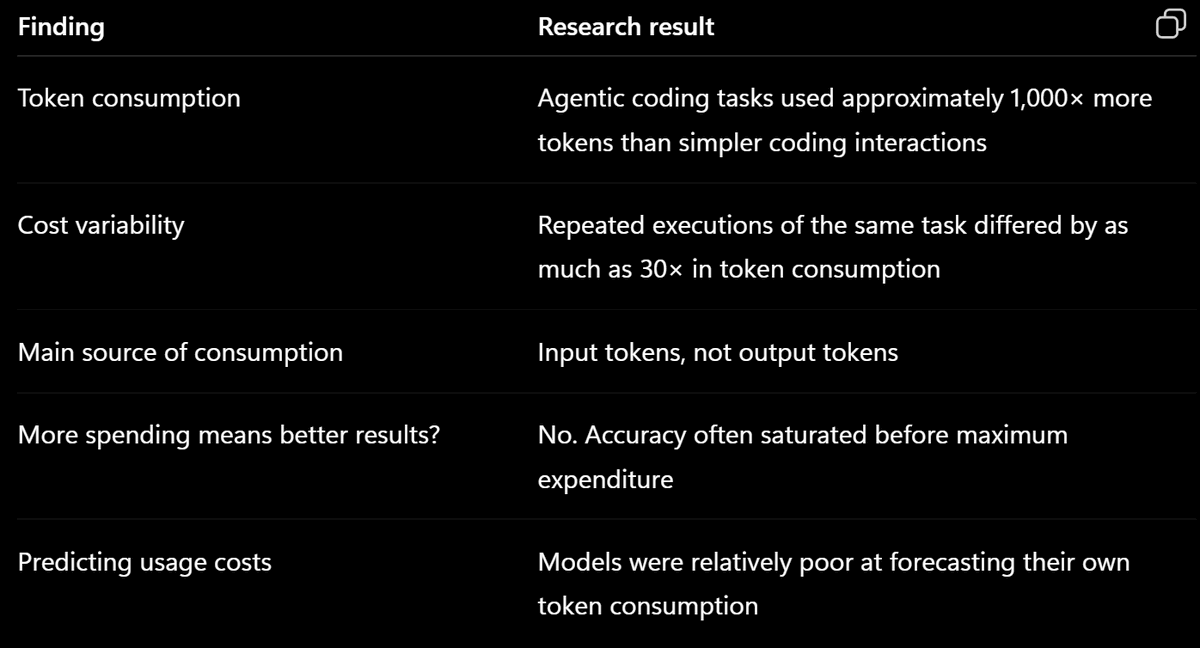
@elonmusk@DogecoinNorway Stanford research: Agentic workloads can consume 1,000 times more tokens
Title: How Do AI Agents Spend Your Money? Analyzing and Predicting Token Consumption in Agentic Coding Tasks.
Quick thread on AI and productivity:
Lots of people say this chart shows AI is now showing up in the productivity data.
But I made this chart to argue the opposite: a trend that pre-dates AI and only shows up in the US doesn’t look like AI.
Here’s how I’m thinking about the data and underlying dynamics:
@alexsongis Thanks! Loved your horse valuation bit - I had just sold my horse - can tell you that after you pay all the middlemen you will NOT have any residual value left. Sounds like an idea for your Part 4? Residual values of GPUs?
@econoar@Lighter_xyz if we drop the crypto lingo here and use tradfi valuation lens, $LIT does trade at a more reasonable 20x revenue/mcap multiple vs $HYPE at 30x.
BUT both trade at higher multiples than $HOOD or $COIN or $ICE
need details - get daily updates from our site
ChatGPT is closing our favorite loophole.
Before we could use PRO in Chat mode unlimited - and then use CODEX only for grunt work to save on tokens.
Now OpenAI is saying:
A shared allowance for ChatGPT and Codex
As part of bringing the capabilities of Chat and Work together, we are unifying usage across your plan in the coming weeks. Your use of ChatGPT and Codex will draw from the same allowance. We’re preparing carefully for this transition to help prevent disruption to your workflows. Usage will depend on the model and task. More advanced models and complex tasks will use more of your allowance. Unlimited Instant is included in your plan and will not draw from your usage.
50 US issuers—including Nvidia, Nike, Costco, Micron and Reddit—have now formally objected to third-party tokenized versions of their shares trading on OKXICE, the OKX + ICE (NYSE parent) joint venture.
The venue originally targeted ~62 companies. Under the SEC’s innovation exemption, issuers can block unaffiliated tokens by filing a written objection within 30 days of notice.
Issuer consent is proving to be the hard constraint on equity tokenization, not technology or exchange infrastructure.
Key metric to watch for RWA growth now.