91% of all tokenized stocks lead back to one broker.
Tokenized stocks total $4.60B today and $4.17B of that is backed by real shares held at a single US broker called Alpaca Securities.
- 7 issuers use it - Binance bStocks, Ondo, xStocks, Robinhood, Reality, Coinbase and Dinari.
- Alpaca holds those shares at DTC, the central US securities depository. On the company's books, the owner is Cede & Co., and not you.
- Securitize and Backpack take a different path, through RQD Clearing but still ends at DTC.
- Superstate and Securitize’s ISTs are the only one that skips both. The shares sit on the company's own register, with no broker and no DTC.
In total, that’s 4.7M token holders across those 7 issuers, and one broker between all of them and the real shares.
Now you know.
Robinhood and xStocks fight over the same traders, but if either one collapses tomorrow, the same company shows up to deal with it.
It's not Robinhood or Kraken, and it’s not a bank you've heard of.
It's Security Agent Services AG, a firm at Baarerstrasse 75 in Zug, Switzerland.
Here's what a security agent does.
Most tokenized stocks are not shares, they’re only a claim on real shares sitting at a broker. The security agent holds that claim for you.
So, if the issuer goes bust tomorrow. This is what they will do.
- they will take control of the shares.
- sell them.
- will take their own fees.
- then you guys get whatever is left.
For Robinhood stocks, they have a second job of checking that the shares are really there.
The infographic shows what happens with the rest.
You buy a tokenized stock in one tap, but behind that tap is a six-layer stack most holders have never seen.
1️⃣ The real market
Every share starts on @NYSE or @Nasdaq and sits at DTC, registered to Cede & Co.
2️⃣ Brokers
Issuers don't hold shares themselves. A broker does it for them.
↳ @AlpacaHQ holds the shares behind ~91% of tokenized stocks (like I showed earlier).
↳ RQD Clearing handles @Backpack and @Securitize's CET stocks.
3️⃣ Issuers
They wrap those shares into tokens with about $4.89B of them in total now.
↳ Binance @bstocksfinance - $1.51B ↳ @Ondo - $1.40B ↳ @xStocksFi - $1.11B ↳ @RobinhoodApp - $175M ↳ @RealityFi_xyz - $168M
and others.
4️⃣ Chains and DEXs
The tokens are minted onto chains, where they trade. ↳ @RobinhoodApp Chain - 26% of DEX trading ↳ @BNBCHAIN- 26% ↳ @base - 24% ↳ @solana - 20%
5️⃣ Apps and wallets
@binance, @krakenfx, @Bybit_Official, @bitget, @okx, @RobinhoodApp, @coinbase, @Backpack, @JupiterExchange, @phantom, @MetaMask.
6️⃣ Holders
5.66M wallets.
The infographic explains it all.
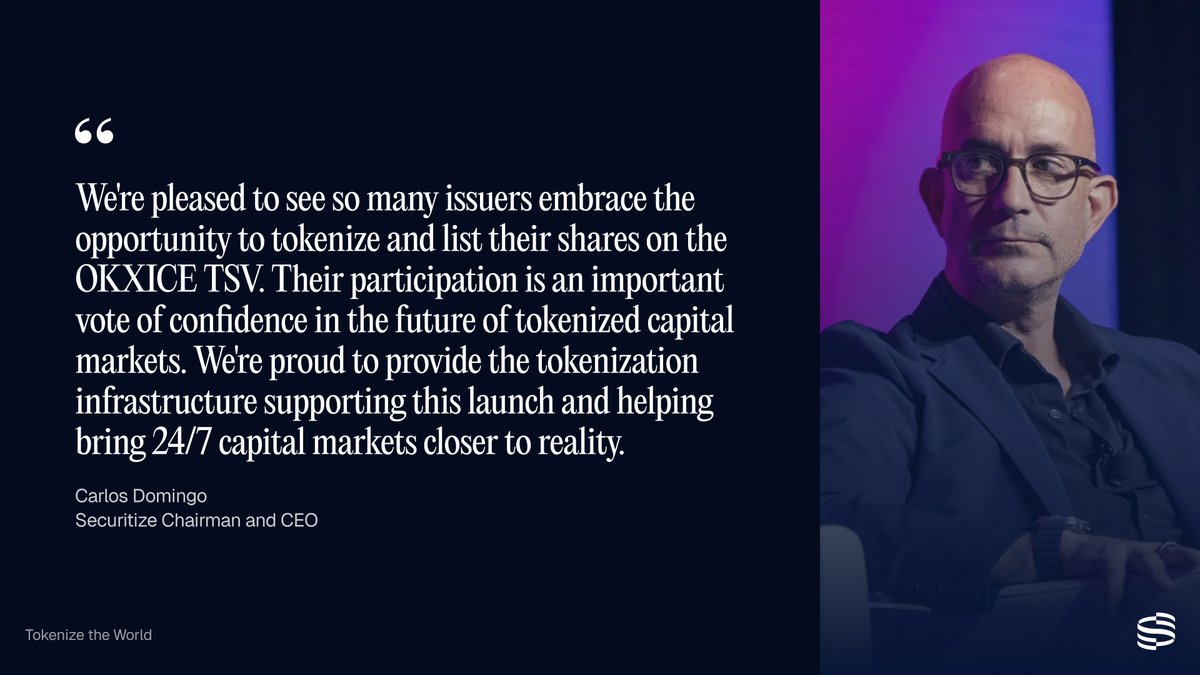
We're proud to be the tokenization provider for the OKXICE Tokenized Securities Venue from @okx and @ICE_Markets, launching November 23.
More than 70 assets will trade onchain around the clock, each backed 1:1 by an underlying U.S. share.
Tokenize the World.
Real shares, backed 1:1, held in your own wallet and tradeable 24/7.
The OKXICE Tokenized Securities Venue is bringing America’s capital markets onchain on November 23.
Read the full blog: https://t.co/kD1vfYQo3h
Why is Morgan Stanley buying a transfer agent? 👀
That's one of five stories in The Wire #2, plus @Joris_DLN's edito on why tokenization "arrived as a trade".
Grab a coffee and read it here 👉 https://t.co/fOL1OmsTH0
Robinhood and xStocks fight over the same traders, but if either one collapses tomorrow, the same company shows up to deal with it.
It's not Robinhood or Kraken, and it’s not a bank you've heard of.
It's Security Agent Services AG, a firm at Baarerstrasse 75 in Zug, Switzerland.
Here's what a security agent does.
Most tokenized stocks are not shares, they’re only a claim on real shares sitting at a broker. The security agent holds that claim for you.
So, if the issuer goes bust tomorrow. This is what they will do.
- they will take control of the shares.
- sell them.
- will take their own fees.
- then you guys get whatever is left.
For Robinhood stocks, they have a second job of checking that the shares are really there.
The infographic shows what happens with the rest.
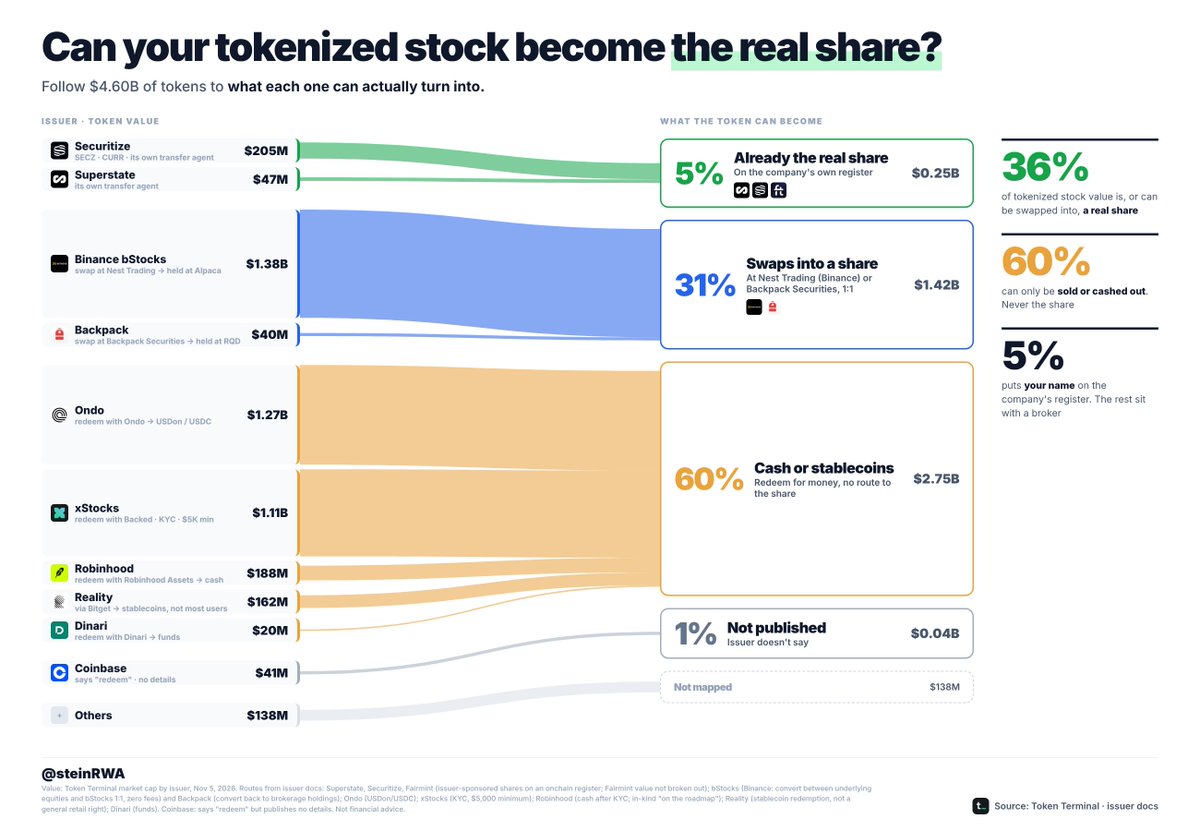
Kudos to @steinRWA, this is an interesting chart. It brought me right back to the crypto legal daisy chain of ownership and liability.
Most people asked whether these tokens are backed. The better question is what you own and who you’d be chasing if something broke.
Three different things get sold under one label. Title means the token is the share, recorded on the company’s own register. A beneficial interest means someone else holds the share and you have a claim through them. Debt means you’re a creditor of a company holding the share as collateral. Adding up the chart, more than half of the $4.6B market is debt, most of the rest is beneficial interests, and about 5% is title.
To their credit, the issuers say so in their own prospectuses. Robinhood’s tokens grant no legal or beneficial rights in the stock. Binance’s certificates carry none of the ownership rights. xStocks come with no voting rights. And most of the companies behind these stocks never agreed to any of it. AMC’s CEO has asked Robinhood to stop trading AMC linked tokens.
Follow the chain. Your token sits on a public blockchain. The issuer is usually an SPV in Jersey, the BVI or Abu Dhabi (here’s xStocks’ https://t.co/ONpcjWTL8s). The SPV holds the shares at a US broker, almost always Alpaca, which holds them at the central depository. Different law at every link. And where do you live?
The issuer is the broker’s customer. You aren’t. If the issuer fails, a security agent is supposed to sell the shares and pay you cash after fees. If the broker fails, its insurance sees one customer, not millions of holders. If it all works, you get money back eventually, but not the share. None of this has been tested in a real insolvency yet.
Alpaca built the rails this market runs on, and that’s a real achievement. But one broker under $4.17B of tokens could mean one bad day hits almost every issuer at once.
There’s a second single point of failure. Every token is only as safe as the key that can mint more of it. Paxos once minted $300 trillion of PayPal’s stablecoin by typo. A stolen key looks the same onchain, except nobody burns the tokens.
The better model is arriving. Galaxy’s tokenized shareholders voted onchain this year, and Formation plans a Solana venue for 2027 where tokens must carry full shareholder rights under the SEC’s new innovation exemption. But, be cautious because exemptions aren’t laws and a future SEC can pull them back.
My asks to the industry builders: Call it debt or a beneficial interest when that’s what it is. Publish independent daily attestations. Open redemption to every verified holder. Put minting behind multiple signers. Give issuers more than one broker. And keep building toward onchain title, where the token and the share are the same thing.
Wealth is relative. Losing $10K can mean as much to one person as $1M to another. Whether or not the law calls it a fiduciary duty, anyone handling other people’s money owes them care and consideration. Show us you’re being intentional with the people who trust you!
Builders, lawyers, thinkers in this space, add whatever I’ve missed or gotten wrong. The more of this we map in the public, the better it gets.
Can your tokenized stock become the real share?
You’ll find out here.
- About 5% is already the real share. I mean stocks issued by @SuperstateInc, @Securitize ($SECZ) and @fairmint. The token is the share, on the company's own register, kept by an onchain transfer agent.
- About 31% can swap into a share.
> @bstocksfinance can swap at Nest Trading. The share is held at @AlpacaHQ and only for eligible non-US users, inside Binance.
> @Backpack: swap at Backpack Securities into an entitlement. The share is held at RQD and you get a share at a broker, not your name on the register.
- About 60% can only become cash.
> @Ondo: redeem for USDon or USDC > @xStocksFi: redeem with Backed, KYC, $5K minimum > @RobinhoodApp: redeem for cash. > @RealityFi_xyz: stablecoins, but not for most users. > @DinariGlobal: redeem for funds.
- @coinbase says redeem but hasn't published how.
So, 36% can be, or become, a real share, 5% puts your name on the company's register, and 60% can only be sold or cashed out.
Owning the token isn't the same as owning the share.
Grok doesn’t know, but I know.
Here is the reason.
- securitize’s third quarter earnings call revealed that they hit their second-highest quarterly total revenue.
- $50M buyback planned for SECZ shares (not a promise)
- they acquired River One
Hey @grok, I hope you’ve learnt sth.
Cheers.🍻
Securitize’s third quarter results for 2026 just dropped, and apart from the acquisition of River One, they have also scheduled a buy back of SECZ shares.
The board has approved spending up to $50M of the company’s cash to buy SECZ shares from the market.
Here are some of the key details.
- it was approved Nov 6, 2026.
- it runs until Dec 31, 2027.
- the buy back will be paid from cash on hand. Securitize had $298.9M in cash and no debt at Sept 30, so the buyback uses about 17% of that cash.
- $50M buys roughly 7.2 million shares which is about 4% of the company.
Good work so far from first company, and the first tokenization platform to tokenize its own stock on the day it went public.