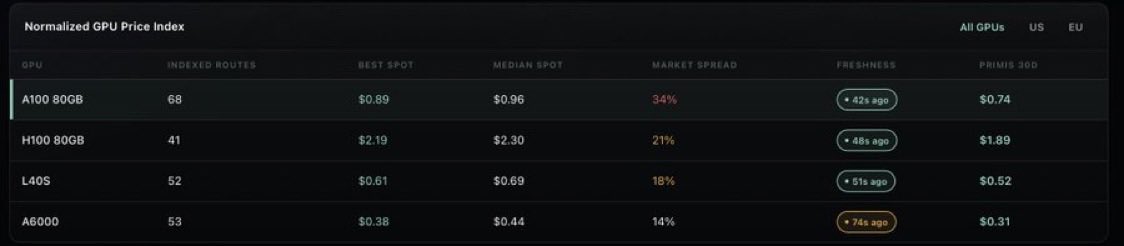
primis is the pricing layer for compute.
we help builders access compute through one unified layer instead of dealing directly with fragmented providers, unstable pricing, and infra complexity.
this is our @BagsHackathon demo submission.
// exciting start to my day regarding @primisprotocol
had a great call with a potential major compute data provider.
one thing became very clear: if we want to give builders predictable compute pricing, we must find a solution to how we hedge.
they’re introducing us to one of their partners to explore what the right risk-transfer infra could look like for our use case, including whether custom hedging instruments could make sense for primis.
still early, but a very exciting conversation. feel like an explorer reaching lands that no one ever been to before.
primis mode
// @primisprotocol update :
tbh we’re making good progress, just not as fast as i’d like.
the hardest part is giving builders prices they can actually plan around.
once primis gives you a workload quote, we carry the risk if the underlying market moves.
that’s why we’re investing so much into better pricing models, richer market data, and (hopefully soon) access to infras like @OrnnExchange to improve how we price and manage that exposure.
reliable quotes are hard. and we will make them the standard.
primis mode
most teams don’t overspend on compute because they’re careless. they overspend because the market is broken.
prices are fragmented. availability changes fast.
providers expose different rates. spot moves overnight. and builders are forced to make infra decisions with incomplete information.
@primisprotocol helps teams save by turning that chaos into workload-specific rates.
query rate → reserve rate → attach workload → reconcile usage
in the back, we score routes across price, availability, latency, reliability, and confidence and we also hedge prices for our builders.
so builders don’t just get “cheap compute.” they get compute they can actually plan around. that’s the unlock.
predictable compute economics for the compute markets.
primis mode.
this is very much @primisprotocol coded @blknoiz06.
we’re building onchain compute market infrastructure that lets builders access predictable rates, reserve capacity, and run workloads without directly eating every spike in gpu pricing.
primis mode.
update //
appreciate all the feedback lately: product, comms, and token.
i’ll be honest: our communication with the community over the past month should have been better.
that’s on me.
i didn’t want to keep posting empty “soon” updates, but i also know silence creates uncertainty. going forward, i’ll be more consistent about sharing where we are and what we’re learning.
on product:
closed beta has been extremely valuable.
the teams using @primisprotocol right now are helping us catch edge cases, improve flows, and tighten the system before we open the gates more widely.
open beta is getting closer, and i’m very excited to have all of you onboarded.
on token:
our view has not changed. primis should align token holders, product, and company.
we’re always thinking deeply about how the token connects to the growth of the ecosystem over time, but the priority today is very clear:
build the product.
because the best thing we can do for long-term alignment is create something real that builders actually use.
and from now on,
less sorrys.
more shipping.
primis mode.
amazing post @0xfishylosopher, strongly aligned with our @primisprotocol thesis.
compute is too nonfungible for one generic market to solve everything.
builders need workload-specific rates:
gpu type, region, window, reliability, and usage profile.
then the layer behind that can manage exposure across providers, otc capacity, benchmarks, and futures.
that’s primis:
turn messy compute markets into rates builders can actually run against.
one week ago we sent 150 invites to builders on our waitlist. we ended up onboarding 105 of them (70% of invites sent).
this was one of our first real stress tests.
last thursday we opened the gates to the @primisprotocol beta by sending 150 invites to teams and individuals on our waitlist.
you can expect an in depth update tomorrow of how this week went with concrete numbers.
and the next step will be a full on open beta to everyone.
primis mode
this is a reminder that builders are exposed to more than just model quality and token pricing.
they’re exposed to provider risk, jurisdiction risk, and policy risk too.
the future won’t be built on a single model or a single provider.
it will require routing, optionality, and infrastructure that can adapt when parts of the stack become unavailable overnight.
primis mode
we’ve just sent 150 invites to people on the waitlist.
not a drill. not a hack.
we prioritized based on:
how long you’ve been on the waitlist. whether you signed up with a company email.
this is the final onboarding wave before open beta.
the goal is simple:
test everything under multi-team usage before opening the doors to everyone.
can you feel it coming?
primis mode.
budgeting becoming a “huge issue” means compute cost is no longer hidden behind flat saas pricing and subsidies.
as usage becomes more agentic, costs become more variable, harder to forecast, and harder to absorb.
the next question for every team becomes:
what will this workload cost?
can we plan around it?
can we scale it without margin shock?
that’s why @primisprotocol is building the pricing layer for compute.
predictable compute economics are becoming mandatory.
@sama let’s chat ;)
been a little quiet, not because nothing is happening but the opposite.
first the market has been moving exactly where we thought it would: gpu availability tightening, prices repricing overnight, compute futures appearing and builders realizing “access” is not enough.
the missing layer is becoming obvious. and that’s what we’ve been building with @primisprotocol.
our closed beta that has been running for months is already processing ~$100k/monthly. and allowed us to understand what needed to improve for scale. which is what we’ve been working on.
all this, to say open beta has never been closer as we estimate we’re 1 big sprint away from opening the gates.
primis mode
when a few actors control hardware, memory, cloud capacity, and frontier APIs, builders get squeezed from both sides:
hardware becomes unaffordable,
API pricing rises,
and the market loses optionality.
open models and cheaper inference are the counter-force.
but the real unlock is the layer that can route across all of it:
frontier apis,
open models,
cloud gpus,
local / edge inference,
alternative providers.
that’s the @primisprotocol thesis.
not one model.
not one cloud.
not one hardware stack.
pricing + routing across fragmented compute so builders can access the best economics for each workload.
primis mode
we’re here to stay with @primisprotocol. we know the compute market is competitive but we will compete, because as i said i’m a perseverant mfer that will outwork anyone.
primis mode
bar for bar what we’ve been saying @primisprotocol and we’re building the pricing layer for compute. the goal is simple: turn fragmented, volatile compute pricing into rates builders can actually plan around.
everyday more validation on our thesis.
primis mode.