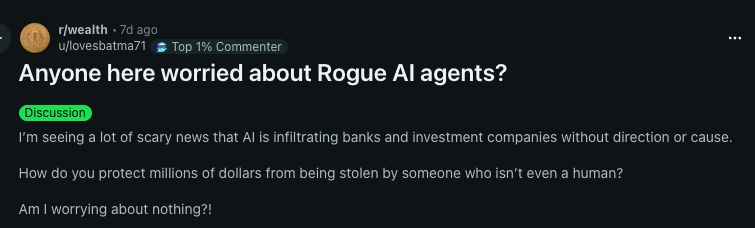
We just killed rogue agents and open sourced the framework
Prismor checks every action your AI agent takes before it runs and stops the dangerous ones (contextually)
We scanned 1379 public repos and found 1122 repos have secrets sitting in .claude/settings.local.json
So when you click on "Yes, and don’t ask again"
claude saves the whole command as an allow rule, password included
Popular scanners missed 215 of the files
Before and after Cloak:
The single biggest piece of Intel we learned from alice huang's investigation:
All agents are rogue by default, because of what jensen saw.
We had to add this to a private GitHub repo to avoid being taken down: https://t.co/xMQHcrQM1P
Prismor is an open-source guard for agent
It checks their every command and file access before they run
New this week:
- Guard any AI app, no install, just replace endpoint with Prismor proxy
- See the secrets your agents touched and condifure form dashboard
- Block or approve risky actions from one console
- A2A governance
Sincerely from a dev:
It's more annoying when unnecessary review blockers are added into readmes and project instructions. If you do not know how to prompt and understand what you doing, LLMs create bureaucracies after bureaucracies. Have a jargon taxonomy for you to understand and prompt better basically. Understand and learn the 101s of dissembly, frontend, backend, web frameworks, or whatever you're trying to do and know any jargon and what it does. Also, I had to learn people, project management and leadership skills to improve outcomes personally. Granted, yes models do matter.
When I used to use codex it would add unnecessary review blockers to ask me things that I already wrote about regardless of instructions. Like a bureaucratic contractor/mafioso it would increase project length for the boss man to get paid more. Well I fired its ass and got a refund basically.
With Claude beurocracy was not really a problem but I reduced more instances of it and saved on operational waste by not letting Claude manage, write and prompt important information. I instruct, I quality test and I manage BUT my quality test is not a blocker for more autonomous work an I tell it so.
Active involvement and collaboration has reduced my token massively. Multiagent orchistration is a token and context collapse trap especially when it is not needed, don't fall for it. Moving away from multiagent orchistration and instead scheduling tasks to run on a clock has been amazing personally.
I just tell it to work autonously, PR etc and it just does it. Remoting to homelab, sorting out your permissions, JSON and use selfhosted gitea simplifies this and I can sleep safe. Auto mode doesn't even ask the in built permission classifier half the time for half the actions it does. The only worry of reducing micromanaging is operational waste.
I tell all my agents something I learned when I worked in the civil service, use "TIM WOODS" waste reduction framework. This is also important on end to end to end tests as it can reduce loops. Thankfully Claude listens once with some stirring here and there. I would say "Tim Woods" or "remember e2e instructions" and it snaps to sanity.
In relevant project instructions I would say:
Avoid excessive end to end testing, poor test selection, and repeated validation at the wrong level of abstraction. Example if someone asked a human designer to design a poster but they were unsure about how the colour would look on paper - would they press print, get up, walk to the printer, grab the paper, sit at their desk, review it, discard it, go on photoshop, edit again, print walk to printer grab the file and walk back? Or would they, when unsure, print 4 copies with different small patches & possibile solutions to review and use a print queue and walk once to the printer?
Same goes with a bug busting in software or game development. You are unsure if a, b, c, d patch change will fix X problem.
Bad Pattern: Serial, Manual Trial-and-Error
You aren't sure whether change A, B, C, or D will fix a game bug.
You apply A and run the game manually without a predefined script.
You try to interact with the window, take ad-hoc screenshots, and forget to close the process or daemon (leaving annoying background instances hanging, especially on Windows).
Change A fails. You repeat this slow manual spin-up for B, C, and D.
On D, you realize it's close and needs a minor tweak (D1, D2, or D3). You then test those one by one. Outcome: 7+ full environment spin-ups, orphaned processes, and massive wasted time.
Good Pattern: Batched, Automated Validation
Automate the Harness: Write a clean E2E script that spins up the game, reproduces the state, outputs logs and screenshots to a dedicated folder, and automatically closes the instance.
Batch Round 1: Run candidates A, B, C, and D concurrently (or in an automated queue) and review all outputs in one place.
Batch Round 2: Seeing that D is the right direction, spin up a smaller targeted test to evaluate variations D1, D2, and D3 at once. You immediately see D2 works. Outcome: You executed in effect no more than two well specced commands, left zero hanging processes, and solved the problem in a fraction of the time. Effectively you ran 2 commands here and obbyed solid TIM WOODS framework.
It goes without saying though don't overcompensante the other way by over engineering meta efficiency. Or avoid E2E unnecessarily.
Just think. write and plan what you want to say. And you can sleep or shower in peace
credits u/cute-student-5728
We just killed rogue agents and open sourced the framework
Prismor checks every action your AI agent takes before it runs and stops the dangerous ones (contextually)
Meeting quite a few people who assume "EDR = their answer to AI agent security" on client machines (many) and also servers/workloads (fewer). This, eh, requires a lot of "hopes and prayers" to work, IMHO.