🏆 Win a share of the $500 $PGPT Community Week reward pool
The $PGPT Hold Race is now live on TaskOn for holders trading on MEXC.
💰 Reward pool
- $500 total reward pool
- $100 USDT distributed in each round
🗓 Campaign format
- 5 daily rounds
- Each round lasts 24 hours and resets at 15:00 UTC
✅ How to qualify
- Join the Hold Race on TaskOn
- Bind your MEXC API key
- Hold an average of at least 3,500 $PGPT during the round
- Keep a non-zero balance in at least 50% of the 20 randomized snapshots
Join the campaign and track your position: https://t.co/7nJNGZkb26
Not financial advice. Please do your own research before making any trading decisions.
🔥 Community Week is live!
Over the past week, new buyers have entered $PGPT and activity around the community has picked up.
➡️ We started Community Week by distributing 50,000 $PGPT in bonuses to holders who have supported PrivateAI for more than one year.
Have you been holding $PGPT long-term? Let us know in the replies 👇
For questions about the rewards, join the official Telegram chat and contact the team: https://t.co/HrO9Fgs8Xl
🤖 Your agent found the trade. Who presses buy?
At 10:14, trading volume around a token starts climbing. An agent notices the change, finds the announcement behind it and opens the relevant market in TheThing core terminal.
It could prepare a limit order, enter the amount and set proposed TP/SL levels. But the order would remain a draft.
The trader would see the selected wallet, expected output, slippage and every parameter suggested by the agent. They could change the order, leave it for later or discard it completely. Nothing would move forward until they confirmed it.
This is one of the directions we are considering for future releases of the trading terminal. 👉 An agent could handle the search and preparation without receiving permission to make the final decision.
Finding a trade and approving it should remain two separate actions.
⭐ PrivateAI ecosystem is powered by $PGPT
🔗 https://t.co/Kyuo3dBzOm
🗓 Weekly Recap | Sept 7 — Sept 13
🟠What we mean by privacy
→ https://t.co/ol4gOC84Lm
🟠A first look at the terminal built to connect research, decision-making, and execution
→ https://t.co/8jY8bgHcJn
🟠PrivateAI is moving to Telegram
→ https://t.co/glc5YB3Icc
🟠An agent finds a listing announcement — here’s what happens between the signal and the signed transaction
→ https://t.co/oIEmUn0LGo
⭐ PrivateAI ecosystem is powered by $PGPT
🔗 https://t.co/Kyuo3dBzOm
📢 The official $PGPT community is moving to Telegram
From now on, Telegram will be our only official community channel.
The PrivateAI Discord is being deactivated, and all community discussions and updates will continue here:
https://t.co/PsHzx0dz6f
A new chapter is also coming: the PrivateAI rebrand will be revealed soon.
Please use the official link above and be careful with unofficial groups or accounts claiming to represent $PGPT.
🧠 An agent finds a listing announcement. What happens next?
PrivateAI has already faced this question while developing the Research Agent.
Several articles may describe the same event using different names. One mentions the company, another names its product, and a third refers only to the market or research area. The agent needs to understand that these texts belong to the same story.
❗️This is what the Semantic Layer helps with.
In simple terms, the Semantic Layer sits between the documents and the agent. It helps the agent select relevant information and connect references that describe the same company, product or event.
A future trading agent would need similar context. If it finds a post about an upcoming listing, it must identify the correct token, trace the post back to its source, distinguish a new announcement from an old repost and check whether the market has already reacted.
PrivateAI already uses this approach to process information with the Research Agent. In future releases, we can explore how the same context could support agents working with TheThing core terminal.
⭐ PrivateAI ecosystem is powered by $PGPT
🔗 https://t.co/Kyuo3dB1YO
👀 First look at TheThing core terminal
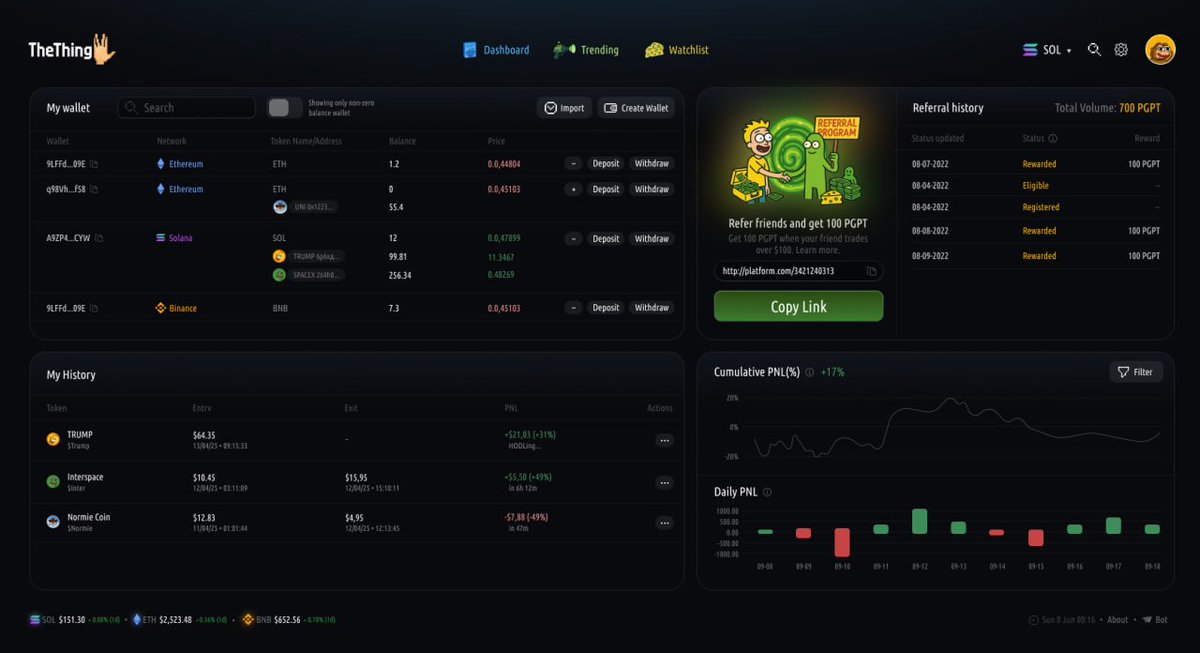
TheThing brings token discovery, volume tracking, watchlists, wallet balances, trade history, route review and live PnL into one interface.
Traders can find an asset, check the market conditions, prepare the transaction and follow the result without moving the trade between separate tools.
TheThing core terminal is coming...
⭐ PrivateAI ecosystem is powered by $PGPT
🔗 https://t.co/Kyuo3dB1YO
📢 The official $PGPT community is moving to Telegram
From now on, Telegram will be our only official community channel.
The PrivateAI Discord is being deactivated, and all community discussions and updates will continue here:
https://t.co/PsHzx0dz6f
A new chapter is also coming: the PrivateAI rebrand will be revealed soon.
Please use the official link above and be careful with unofficial groups or accounts claiming to represent $PGPT.
🛡 A cross-chain trade begins before anything appears on-chain
First, a trader searches for a token, compares routes, checks liquidity, sets slippage and prepares the wallet action. When this happens across separate tools, each service receives a different part of the planned trade.
For PrivateAI, privacy begins at this stage. TheThing brings token data, route options, fees, liquidity, slippage and wallet actions into one terminal, where the trade can be reviewed before signing.
We are not claiming invisible transactions or anonymous wallets. Once a transaction is sent on-chain, it becomes public. The goal is to involve fewer external services during preparation and give the trader control over when the transaction becomes public.
⭐ PrivateAI ecosystem is powered by $PGPT
🔗 https://t.co/Kyuo3dB1YO
✍️ What exactly are you confirming in your wallet?
In The Thing, the wallet confirmation comes after the trade review.
The terminal shows:
— the asset and amount being sent
— the source and destination networks
— the DEX and route used for execution
— network and route fees
— expected slippage
— available liquidity
— the amount expected at the destination
For example, if liquidity in the selected pool falls, The Thing recalculates the route. The trader can see that expected slippage has increased from 0.3% to 0.9% and that the expected output is now lower.
At this point, the trader can continue with the updated conditions, check another route or cancel the transaction before anything is signed.
⭐ PrivateAI ecosystem is powered by $PGPT
🔗 https://t.co/Kyuo3dB1YO
👀 A token in your Watchlist starts to look interesting. What can you do next?
Open it in The Thing and check the current quote, available liquidity, expected slippage, route and estimated output for your trade amount.
There is no need to search for the token again on a DEX or check the conditions across several services. The trade setup opens from the same token page.
If the conditions work for you, review the wallet action and sign. If they do not, return to the Watchlist and keep tracking the token.
The Watchlist keeps the assets you follow connected to the terminal where you can trade them.
⭐ PrivateAI ecosystem is powered by $PGPT
🔗 https://t.co/Kyuo3dBzOm
🔀 Two routes for the same trade. Which one do you take?
Suppose the terminal finds two routes for the same trade.
Route A
— Higher network fee
— Deeper liquidity
— Lower expected slippage
— One bridge and one swap
Route B
— Lower network fee
— Less liquidity
— Higher expected slippage
— An extra approval and an intermediate swap
For a small order, the first route may be cheaper. For a larger order, the additional price impact can exceed what you saved on fees.
The Thing shows both options before you sign: fees, slippage, liquidity and every action in the route. Sometimes the lower fee wins. Sometimes the deeper pool does. You see the difference before confirming the trade.
⭐ PrivateAI ecosystem is powered by $PGPT
🔗 https://t.co/Kyuo3dBzOm
🔎 A volume spike tells you that something happened. It does not tell you whether the trade makes sense
The trader still needs to check which token is moving, when the volume appeared, which network it is on, whether there is enough liquidity and what execution route is available.
PrivateAI structures this context inside The Thing:
— Dashboard surfaces active tokens across supported networks
— Trend shows how volume changes over shorter intervals
— Token Details brings together the asset data and available trading actions
— route planning adds fees, slippage, liquidity and expected output
Instead of leaving the trader with separate charts and links, the terminal connects the market signal to the conditions under which the trade can be executed.
It does not decide what to trade. It organizes the information needed to make that decision.
⭐ PrivateAI ecosystem is powered by $PGPT
🔗 https://t.co/Kyuo3dB1YO
🔎 What does The Thing show before wallet confirmation?
Select the tokens, enter the amount and open the route. The terminal shows:
— the current quote
— network and route fees
— expected slippage
— available liquidity
— the amount expected at the destination
If the liquidity is too low for the selected amount or the slippage is higher than you accept, you can change the amount or choose another route before opening the wallet.
The full calculation stays on the confirmation screen, next to the action you are about to sign.
⭐ PrivateAI ecosystem is powered by $PGPT
🔗 https://t.co/Kyuo3dB1YO
🧐 Suppose a cross-chain trade shows an expected output of $10,000
The route includes an $18 bridge fee and $12 in gas. The destination pool adds 0.4% price impact, reducing the result by another $40. While the assets move between chains, the token price changes by 0.25%, removing another $25.
The expected $10,000 becomes $9,905:
— $18 bridge fee;
— $12 gas;
— $40 price impact;
— $25 price movement.
Instead of comparing routes by the initial quote alone, The Thing lets the trader check the amount expected after bridge fees, gas, price impact and slippage. A route with a lower headline quote may leave more at the destination if it uses a deeper pool or requires fewer paid steps.
⭐ PrivateAI ecosystem is powered by $PGPT
🔗 https://t.co/Kyuo3dB1YO
🛡Privacy in PrivateAI is focused on what happens before a trade reaches the blockchain
To prepare a cross-chain trade, a trader may use a token tracker for research, a bridge to compare routes, a DEX to check liquidity, a separate tool for gas and slippage, and a wallet for approvals. Each interaction creates another place where the trader’s activity can be observed.
The Thing brings token data, route planning, quotes, gas, slippage and wallet actions into one trading terminal. The trader can compare the available route, check its expected cost and review the wallet action before signing.
The transaction becomes public when it goes on-chain. The Thing does not make it anonymous; it reduces how widely the trader’s intent is exposed while the trade is being prepared.
⭐ PrivateAI ecosystem is powered by $PGPT
🔗 https://t.co/Kyuo3dBzOm