You're either helping to end the pandemic or you're contributing to extending it, and if you're not helping to end it, I don't care if I hurt your feelings. #GetVaxxed💉 #WearAMask
MicroStrategy Discovers the Infinite Money Glitch (Again)
The new $42 billion masterplan:
1. Issue $21 billion in perpetual preferred stock, legally committing to pay a $2.4 BILLION annual dividend.
2. Use the cash to buy Bitcoin. A pristine asset, but one that generates absolutely no native yield.
3. Acknowledge that the underlying software business generates nowhere near enough cash to cover these massive new dividend obligations.
4. Pay the old investors their yield using fresh capital raised by selling more stock to new investors.
Funding existing backers entirely with money from new backers. Charles Ponzi would shed a tear of pure pride at the mechanics of it.
TRUMP JUST PROPOSED A DEFENSE BUDGET SO LARGE IT MAKES THE ENTIRE WAR ON TERROR LOOK CHEAP.
Look at that chart. Twenty-five years of defense spending. The post-9/11 surge. The Iraq War peak. The Obama drawdown. The slow climb back up. Then a vertical red line that makes every previous wartime budget look like a rounding error.
$1.5 trillion. A 69% increase in a single year. The largest jump since the Korean War.
Last year the budget was $886 billion. The year before, $842 billion. This isn't a gradual escalation. This is a government telling you in plain numbers that the Iran war is not winding down.
You don't request the biggest military budget increase in 70 years because you're planning for peace.
$1.15 trillion base budget. $350 billion through reconciliation. $185 billion for the "Golden Dome" missile shield.
Plus the Pentagon is reportedly asking for $200 billion in supplemental funding to replenish munitions already used in Iran.
Precision weapons and interceptors are being consumed faster than the industrial base can replace them.
Meanwhile manufacturing employment has dropped 89,000 jobs. The deficit already hit $1 trillion in the first five months of this fiscal year. National debt is at $39 trillion.
Interest payments alone are crossing $1 trillion annually for the first time in history. And the CRFB estimates this defense hike alone will add $6.9 trillion to the national debt over the next decade when you include interest.
So where does the money come from?
Tariff revenue was supposed to cover it. But the Supreme Court struck down half the tariffs. The remaining revenue covers about 15% of the cost. The rest gets borrowed. And when you borrow $7 trillion over a decade at current interest rates, the interest alone becomes a line item larger than most countries' entire budgets.
Every war is a spending event. Every spending event the government can't fund becomes a borrowing event. Every borrowing event eventually becomes a printing event. And every printing event becomes an inflation event that shows up in your grocery bill, your rent, and the purchasing power of every dollar you've saved.
They never ask how we pay for war. They only ask how we pay for everything else.
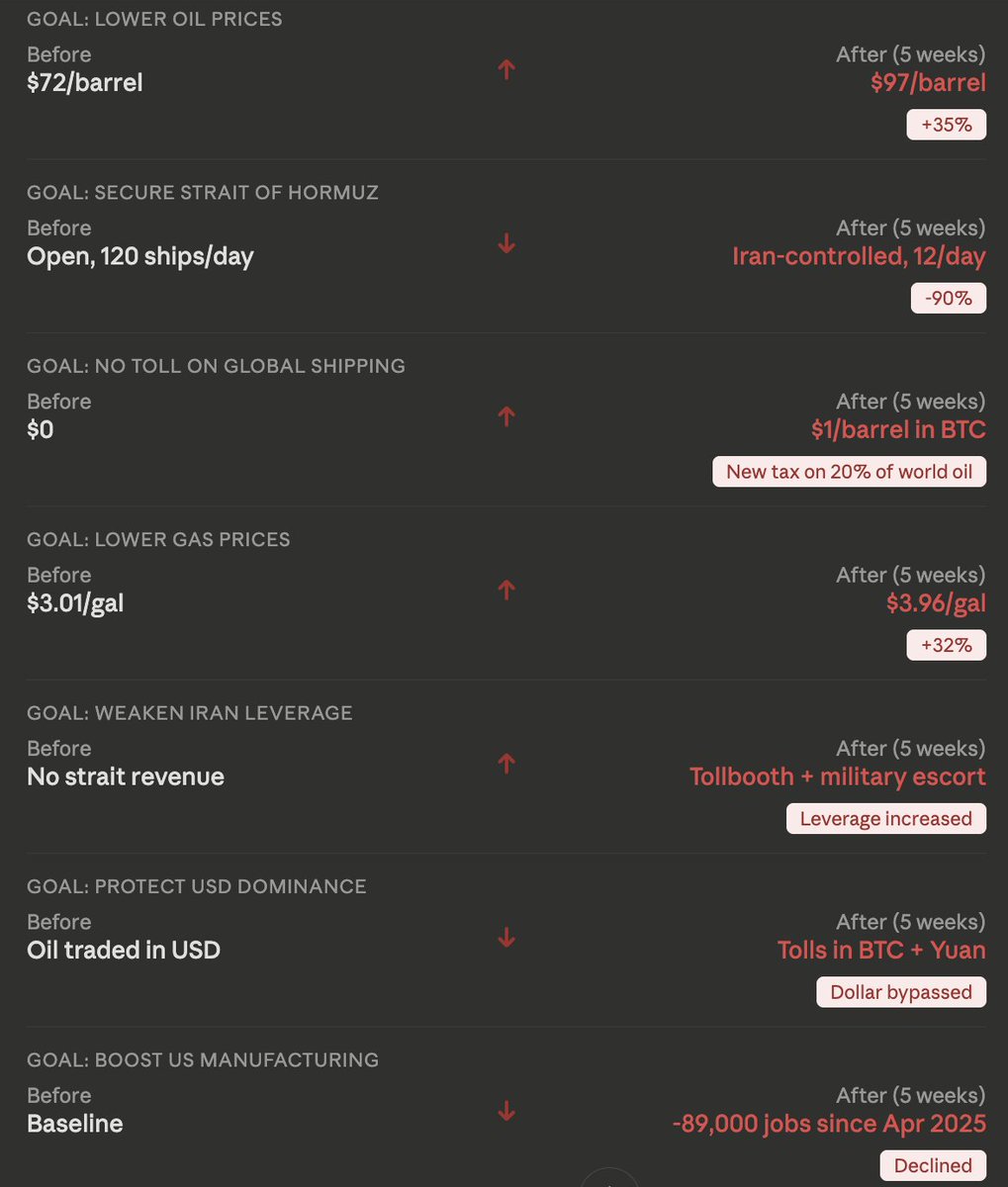
0 OUT OF 7 GOALS ACHIEVED. THEY BOMBED IRAN TO LOWER OIL PRICES AND SECURE THE STRAIT OF HORMUZ. NOW IRAN CONTROLS THE STRAIT, CHARGES $1 PER BARREL IN BITCOIN, AND OIL IS UP 40%. EVERY STATED GOAL ACHIEVED THE EXACT OPPOSITE RESULT.
Before February 28, 2026: Oil was $72 a barrel. The Strait of Hormuz was open. 100 to 120 ships passed through it daily. No country charged a toll. 20% of the world's oil flowed freely. Gas was $3.01 a gallon.
Five weeks of airstrikes and 13,000 sorties later: Oil hit $118 a barrel. The strait was shut. Tanker traffic dropped 97%. Gas hit $3.96. Diesel hit $5.45. Fertilizer up 40%. And the Fed went from pricing rate cuts to pricing the first rate hike since 2023.
Now here is the ceasefire deal.
Iran reopens the strait. But on THEIR terms. $1 per barrel toll on every tanker. Paid in Bitcoin or Yuan. Not dollars. Ships must email Tehran their cargo details. Iran inspects each vessel. The IRGC escorts them through. And they've capped traffic to 12 ships per day when 120 used to pass.
Before the war, Iran had zero control over strait traffic. Zero revenue from it. Zero leverage over global shipping. Now they have a tollbooth on 20% of the world's oil supply, paid in currencies that bypass the US dollar entirely, codified into Iranian law, with military escort authority.
And Trump is calling it "a beautiful thing" and floating a joint venture.
The stated goals were to eliminate Iran's nuclear threat, degrade their military, and secure energy flows.
The actual result is Iran now has more leverage over global energy than at any point in its history, Russia is collecting billions in windfall oil revenue from redirected demand, and the US consumer is paying for all of it at the pump, the grocery store, and eventually through the next wave of printed money needed to cover a $1.5 trillion defense budget the government can't fund.
Manufacturing jobs: down 89,000 since April 2025. Oil companies rerouting around the strait at massive cost. Shipping insurance premiums through the roof. Supply chains repricing in real time.
Every single outcome is the opposite of what was promised. Either this is the most catastrophic strategic failure in modern American foreign policy, or the goals were never what they told you they were.
Either way, you're paying for it.
20,000 PEOPLE ARE BEING HELD HOSTAGE IN THE MIDDLE OF A WAR ZONE RIGHT NOW AND THE ENTIRE WORLD IS LOOKING THE OTHER WAY.
There are 2,000 ships sitting in the Persian Gulf right now that cannot leave.
On those ships are 20,000 human beings. Sailors. From the Philippines, India, Sri Lanka, Bangladesh. Working class people who left their families to crew oil tankers and cargo vessels for a few hundred dollars a month.
They are the invisible workforce that keeps global trade moving.
They have been trapped for 45 days.
They watch missiles fly over their heads at night. They stay on deck because sleeping below feels like a coffin. 21 attacks on commercial vessels since this started. 10 sailors killed. An oil tanker hit by a sea drone 500 miles from the strait. A tugboat sunk by two missiles, three crew still missing.
"We don't sleep at night. We stay up on deck because you never know what might happen next."
That is a 28-year-old Indian sailor speaking to NBC from Iraqi waters minutes after an airstrike landed a few miles away.
The United Nations says there is no precedent for this situation since World War Two. The IMO declared a humanitarian emergency. The Secretary-General addressed 40 foreign ministers about it.
And here is what changed: nothing.
Before this war, 150 ships passed through the Strait of Hormuz every day. Now it is 4 or 5. The strait is mined. Iran lost track of some of its own mines.
The US Navy is running clearance operations while Iran threatens to fire on those same ships. Two militaries operating in a 21-mile-wide waterway during a "ceasefire" that collapsed within six days.
And as of this morning, Trump declared a full naval blockade of the strait. Iran's Revolutionary Guard responded that any military vessel approaching will be "met with severe force."
Those 20,000 sailors are now caught between two blockades. Iran on the north side. The US Navy on the south. Trapped in a body of water that has become the most dangerous place on earth for a civilian to be, while the governments doing the blockading both claim they want the strait open.
The cruise passengers were evacuated. 15,000 of them got off six luxury liners weeks ago. The headlines covered that. Nobody covered the 20,000 who stayed because they are crew, not customers. They don't get evacuated. They get resupplied with food and water from Saudi Arabia and told to wait.
During COVID, these same sailors were confined to ships for months because of border restrictions. During the Red Sea crisis, they were attacked by Houthis. Nine killed. Eleven held captive for five months. Each time, the world forgot about them the moment the headlines moved on.
The pattern repeats because these people are invisible by design. They deliver the oil that heats your house and the goods that fill your shelves, and nobody thinks about them until the supply chain breaks.
Today, 20,000 of them are sitting in a war zone, between two navies, on top of sea mines, watching rockets at night, and the world is debating toll prices.
Remember them.
$290M just EVAPORATED from DeFi and most people have no idea what actually happened.
Step 1: attacker exploits KelpDAO's LayerZero bridge. Mints 116,500 rsETH out of thin air.
Step 2: deposits the unbacked rsETH on Aave V3 as collateral.
Step 3: borrows $236M in WETH against it.
Step 4: rsETH loses its peg. Positions become unliquidatable. Protocol is left holding the bag.
Now watch what's happening everywhere else.
ETH pool: 100% utilization. Lenders can't withdraw.
USDC pool: 100% utilization.
USDT pool: 100% utilization.
Why? Because everyone with rsETH exposure is scrambling. They're borrowing stables against whatever healthy collateral they have left, rotating out of ETH exposure, prepping to repay loans before liquidation cascades hit.
It's a bank run in reverse. Draw down the credit line before the pool freezes.
Aave has options. The Umbrella backstop can absorb the deficit. Governance can vote to socialise losses across suppliers. The DAO treasury can cover part of the shortfall. Recovery negotiations with the attacker are on the table. None of these are fun, but the protocol has been here before and survived.
This is the cost of DeFi composability. One bridge breaks, and the shockwave moves through every protocol that whitelisted the asset. No circuit breakers. No grace period. No committee to call.
That's the tradeoff. Permissionless markets mean permissionless risk.
Know what you're holding. Know what it's backed by. Know what happens when it isn't.
IS DEFI ACTUALLY DECENTRALIZED? OR HAVE WE ALL BEEN LYING TO OURSELVES?
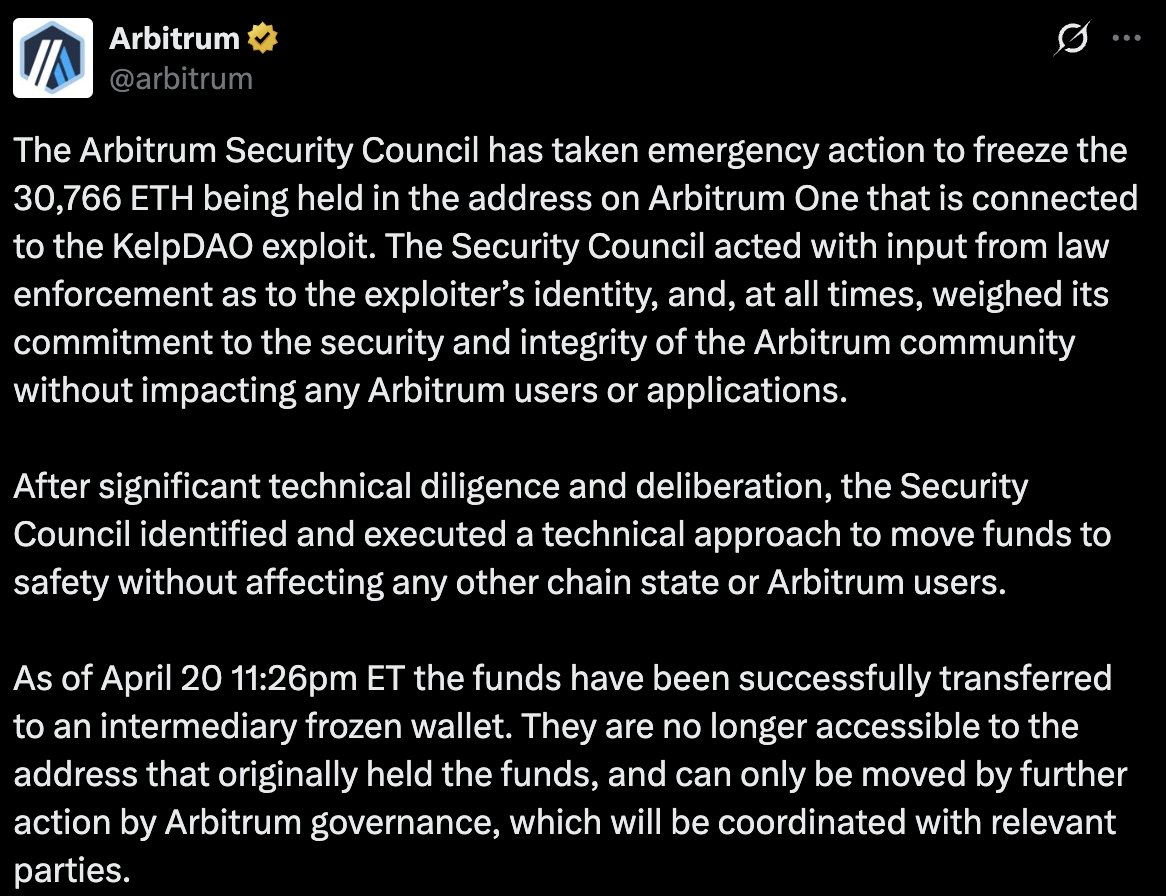
Arbitrum just froze the funds of rsETH exploit attackers.
Aave's Guardian froze rsETH markets across 11 deployments in under an hour. Then froze WETH borrowing on 6 more.
One multisig. One emergency council. Billions in assets moved, locked, protected, by a small group of signers with a big red button.
Now ask yourself the question no one wants to ask.
Would you rather:
A) A chain that can freeze a hacker's funds, claw back stolen money, and protect users with a single multisig call
B) A chain that cannot freeze anything, not for hackers, not for anyone, and your only protection is your own vigilance
Because you cannot have both.
Every freeze button that saves you from an exploit today is the same button that can freeze your wallet tomorrow, if the wrong government, the wrong court order, or the wrong compromised signer decides you are the problem.
Arbitrum can freeze funds. Aave can freeze markets. Ethereum validators can reorg under pressure. Tornado Cash developers went to prison. USDC has a blacklist function. USDT has a blacklist function. Most "decentralized" stablecoins do.
The machinery exists. It gets used. And every time it gets used to save users, the precedent grows that it can be used at all.
So what are we actually building?
Is decentralization a destination or a direction?
Is a protocol decentralized if 9 signers can pause it?
Is a chain decentralized if its sequencer is run by one company?
Is a stablecoin decentralized if the issuer can freeze you?
These questions do not have clean answers. Anyone who tells you otherwise is selling something.
The honest version is this. DeFi sits on a spectrum. Some parts are more censorship resistant than others. Some parts rely on trusted actors who have mostly behaved well so far. Some parts are functionally centralized with decentralized branding.
The rsETH exploit is forcing everyone to confront which side of that spectrum they actually want.
So I'll stop talking and ask you directly.
When a multisig saves users from a hacker, is that decentralization working as intended or is that centralization with good PR?
I genuinely want to know what you think.
Are these the people you want "shaping Bitcoin's future"?
The FBI Director. The Acting AG. The SEC Chair. The CFTC Chair.
Bitcoin was literally invented to route around these people.
Now they're the keynote speakers.
$126 OIL.
$8 GAS.
$39 TRILLION DEBT.
$1 TRILLION ANNUAL INTEREST.
$25 BILLION WAR BILL.
60 DAYS OF BLOCKADE.
0 PATHS OUT.
The U.S. is running out of moves.
Brent crude touched $126 yesterday. Highest in four years. Gas at $8 a gallon in Los Angeles. Trump's blockade of Iranian ports is now in its third month, with the White House openly discussing extending it for "months if needed."
Iran's parliament speaker is taunting them on Twitter. "Next stop: 140."
Look at the bigger picture:
US national debt: $39 trillion.
Annual interest payments: $1 trillion. More than the entire defense budget.
Weekly interest: $22 billion.
Daily interest: $3 billion.
The US government pays more in interest every single week than the war has cost in total military spending so far this year.
And every dollar of oil price increase makes it worse. Higher oil = higher inflation = higher rates = higher interest payments on a debt that already eats every dollar of defense spending.
The Fed cannot cut rates. The IMF said so two weeks ago. Energy passthrough kills any easing path.
So the US is now in a position where:
It cannot afford to keep the blockade going. Oil shock, inflation, recession risk.
It cannot afford to lift the blockade. Iran nuclear concession, political loss.
It cannot cut rates. Inflation.
It cannot stop borrowing. The deficit is structural. $1.9 trillion this year alone.
It cannot raise taxes enough to close the gap. Politically dead.
It cannot grow its way out. CBO sees 1.8% long run.
This is what cornered looks like.
The bond market is already showing it. Three weak Treasury auctions in March. Primary dealers absorbing twice their normal share because foreigners aren't buying. The 10-year yield refusing to fall despite the slowdown.
Every previous superpower that ran simultaneous wars, currency debasement, and a debt-to-GDP ratio above 100% reached the same fork.
Inflate or default.
The US doesn't default.
So what asset would you want to own when the largest debtor in human history is forced to print its way out of a war it cannot win?
DeFi DOESN'T EXIST? The proof might be in a Manhattan courtroom right now.
Quick recap of the rsETH hack:
April 18, a hacker forged a cross-chain bridge message, minted unbacked rsETH, used it as collateral on Aave, and drained roughly $230M of user funds.
Arbitrum's "Security Council" intercepted $71M and froze it, planning to return it to the Aave users it was stolen from.
Then victims of North Korean terror attacks with default judgments against NK showed up.
They claim the hacker was Lazarus Group.
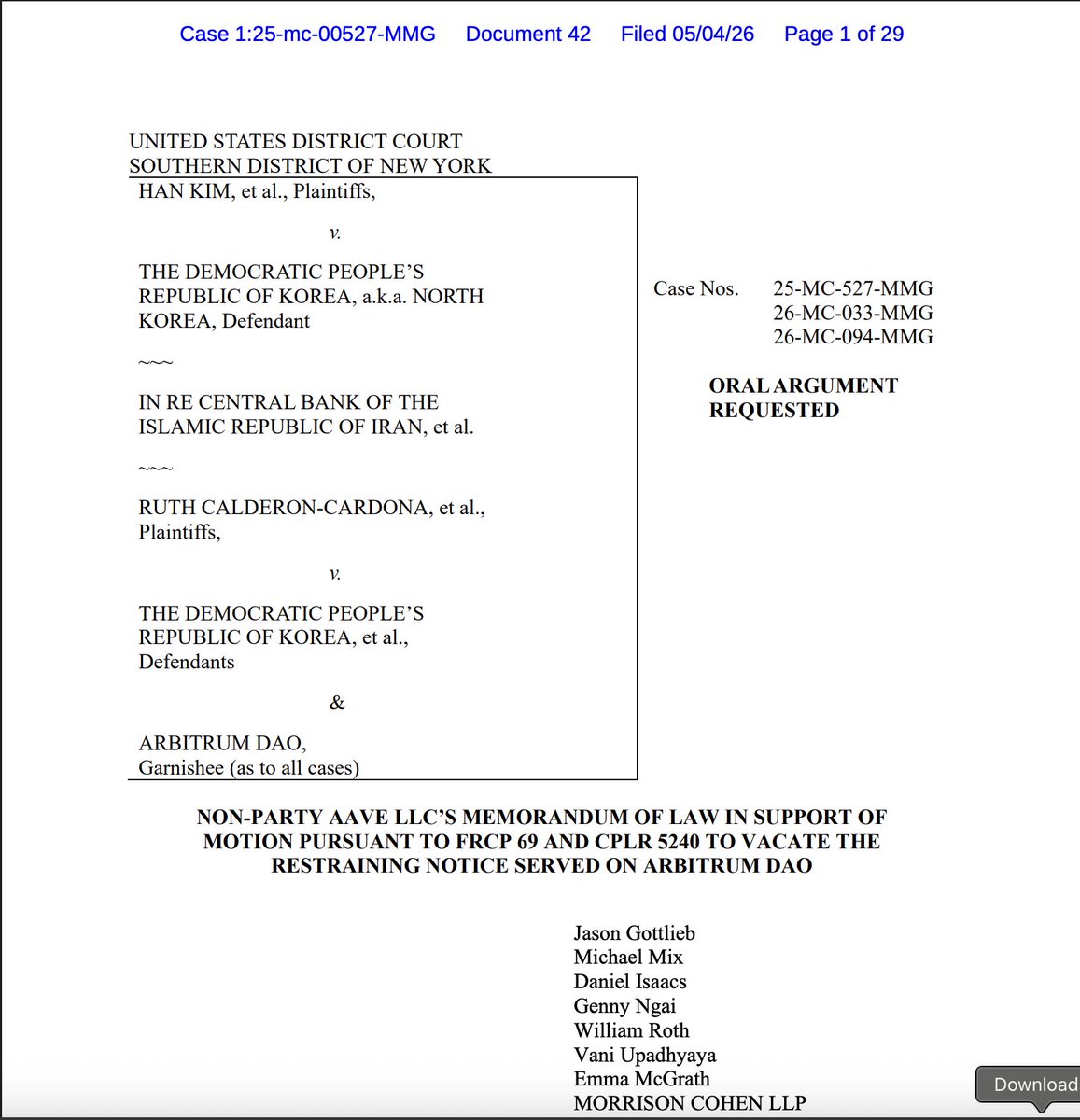
They got a federal judge to serve a Restraining Notice on Arbitrum DAO and tried to seize the $71M as "North Korean property."
Aave LLC has now hired a Manhattan law firm to fight it in federal court.
Every party in the room is centralized.
The protocol has an LLC.
The L2 has a Security Council that can freeze funds at will.
The DAO can be served with court papers.
The judge has the final word.
The lawyers bill by the hour.
If a federal judge in New York can freeze and unfreeze your "decentralized" protocol, that protocol was never decentralized.
PCE: 3.8% (EXP 3.8%) GDP: 1.6% (EXP 2%)
April PCE inflation, the Fed's preferred inflation measure, rises to 3.8%, the highest since May 2023, while GDP (growth) is BELOW expectations.
$37T in federal debt rolling at these yields is a disaster that the United States cannot tackle without cutting rates. They needed the cuts six months ago.
They're slowing the economy on purpose. They let the labour market soften, pushed a disinflation narrative and rode it straight into rate cuts that were always going to happen, while telling you it was the economy's fault.
June FOMC is two and a half weeks away. Watch what they do.
Inflation never went away, they just adjusted how they measure it and how they portray it. The dollar keeps losing purchasing power every quarter.
Everyone's staring at the Middle East.
Almost nobody is watching the two men just brought into the Federal Reserve.
New Chair Kevin Warsh made his first hires. Both tell you exactly where this is going.
Paul Winfree wrote the Federal Reserve chapter of Project 2025. Daniel Heil is a Hoover Institution fellow, the same place Warsh came from.
Temporary contractors on policy for now. The direction is permanent.
So what do these people actually believe? This is the part that matters.
Kill the employment mandate.
Right now the Fed has a DUAL mandate. Maximum employment and stable prices. Their agenda is to strip it down to inflation only. Translation: in the next recession, the Fed would not cut rates to save jobs. Rising unemployment stops being its problem.
Rules over discretion.
Instead of a committee deciding case by case, policy follows a fixed formula. Sounds disciplined. In practice it removes the "Fed put," the reflex to rescue markets every time something cracks. Less flexibility, less bailout, more rigidity.
A gold or commodity anchor.
Tying the dollar to gold would make money printing almost impossible. No QE. No 2008 style flood, no 2020 style flood. A hard deflationary leash on the entire system.
Slim the staff.
The Fed runs on hundreds of independent PhD economists. Cut them and you cut the institution's ability to push back. Fewer experts in the room means more power sitting with the Chair and his hand picked loyalists.
Now connect the dots.
Each idea on its own looks like restraint. Stack them together and you get something else. A narrower mission, a rigid framework chosen at the top, and an internal staff too thin to say no. That is not a smaller Fed. That is a more controllable one.
And here's the contradiction nobody is pricing in.
Trump wants rate cuts. The Iran oil shock is pushing inflation back UP. A true inflation only, rules based Fed would HOLD or HIKE into that. So either this reform agenda is about long term control rather than short term obedience, or the "rules" bend the second they become inconvenient.
First FOMC under Warsh is June 16 and 17.
An institution born in secret on Jekyll Island in 1910, sold to the public as independent, is being handed to people loyal to a project rather than the place itself.
This isn't reform. It's consolidation.
The same machine, fewer hands on the controls, and almost no one left inside willing to argue.
Illinois just became the first state in America to tax you for MOVING Bitcoin.
0.2% on every trade, transfer, and custody. No profit required.
Stocks? $0.
Bonds? $0.
Bitcoin? Pay the state.
But the small details are IMPORTANT.
The tax lands on the exchanges and custodians holding your coins, then gets passed straight to you.
Hold your own keys, move your own coins, and there's nothing for Illinois to touch.
Not your keys, not your crypto.
It's never been more literal.
Starting my first of many Ozone Therapy treatments today! Walking in the footsteps of @sircryptotips as I optimize my health. Excited for the journey ahead