Who is Advent International, one of the largest PE firms you've probably never heard of? Below we cover Advent's history, how it invests, its best and worst deals, its returns, and where it sits among the handful of firms raising $20bn+ funds. https://t.co/BT1eUkAAja
@PadraicMcC I'd add that banked vs. proprietary opportunities are rarely as black and white as people think and the best investors can both build proprietary relationships and play a banked process
Some creativity from BDC land today: $BCIC (trading at ~50% of NAV) is merging with $ICMB (trading at ~22% of NAV), valuing ICMB at 90% of NAV but paying in BCIC shares valued at 100% of NAV. At market, ICMB holders get ~$1.38/sh, roughly half of NAV, but still a 126% premium to where the stock traded.
BDCs trading below NAV can’t grow and typically end up acquired or shrinking over time via buybacks and deleveraging.
In this deal, BCIC could benefit from cost savings, ICMB holders get a premium to the current share price, BC Partners grows its fee base, and Investcorp gets an underperforming BDC off its plate.
Agree, can always go LMM once you have a few years of experience (if you still want to stay in the industry). IMO WLB is more binary based on if you stay vs leave for something else.
Another idea is going to the MM/LMM fund of a larger org. Many well performing funds have these or are starting them (most recently KKR and GTCR IIRK). Might be a more entrepreneurial environment but you have the safety of larger org.
@jaredccohen Biz ops seems to have become one of the most common junior exits from finance in recent years. Folks like the title and are excited to work in tech/startup, but often sounds like it’s really a rebranded FP&A analyst role.
Chief of Staff is another tricky one - very hit or miss
@IlliquidInsight Junior folks sometimes look down on sourcing without realizing it’s the most important part of a senior investment professional’s role. Better to build that muscle early than be caught flat footed as a VP/principal that’s now expected to be originating new opportunities
I agree LMM can be better than MF in certain cases but a few additional considerations I’d flag for OP:
- First year asso shouldn’t be worrying about odds of VP promo; multiple years before that decision gets made and IMO there’s a lot more self selection than folks realize. Can always switch firms after senior asso too (if you want to stay in industry)
- IMO PE WLB is more binary that folks would like to think. If you are part of a growing, well performing fund, expect to continue working very hard. The WLB decision is usually leaving PE vs moving funds.
Amid all the talk of a DPI drought, $KKR expects to return a record $40bn+ to clients in 2026, driven by a number of landmark exits (second snip from Aug-26)
Brad Jacobs might be the world’s most prolific rollup investor. He just launched his seventh company with a $1bn investment into CKX Lands ($CKX), for a rollup in an industry “to be determined.”
He’s done ~500 deals over the course of his career:
- Started in oil brokerage (Amerex) and oil trading (Hamilton Resources)
- United Waste -> Waste rollup, sold for ~$2.5bn in 1997
- United Rentals -> Equipment rental rollup. Jacobs left as chairman in 2007. Now worth ~$70bn
- XPO -> Transportation and logistics rollup, broken up in 2021-22 into XPO (~$22bn), GXO (~$6bn) and RXO (~$5bn)
- QXO -> Building products distribution rollup, started in 2024 with $1bn into SilverSun. Now worth ~$14bn
- CKX -> TBD
Brad Jacobs is nearing a deal to lead a $1 billion investment in CKX Lands, with the small-cap company set to become a new investment vehicle for the billionaire serial entrepreneur, according to sources https://t.co/CyfIfXo9xG
In defense of “venture needs more money”: AI round sizes have changed, and traditional venture funds aren’t built to keep up, even on their own pro rata.
Menlo Ventures first invested in Anthropic in 2023 out of Fund XV, a $500mm fund. By August 2025 it had put $625mm into the company through funds and SPVs, more than the whole fund.
In 2025 it launched Select I, a $400mm vehicle to take the allocation its main funds couldn’t. Per New Mexico’s SIC, just under half is going to Anthropic.
In June 2026 Menlo raised the cap to $600mm to put more into Anthropic.
I don’t agree. More money in private markets means more TAM and value created in private markets.
I just don’t understand zero sum thinking for VCs. Isn’t the entire belief structure that innovative tech creates net new value?
$SGRY optimizing for speed and certainty over price.
- 10/23: Signs with Bon Secours’ HealthSpan at $23.50
- 11/3: Unnamed third party makes an unsolicited proposal, updated to $28 on 11/8
- 11/8: HealthSpan increases its bid to $25, plus a 10% ticking fee if closing slips past 3/1. The board sticks with HealthSpan
The special committee’s reasons: the $28 bid would take materially longer to close or might not close, carried more regulatory risk, and lacked the contractual protections it wanted.
Speed and certainty win deals, sometimes even at a lower price.
From the proxy for CD&R and $MCK's $5.8bn take-private of $OPCH:
- A rival consortium indicated $30-34/share in September.
- CD&R/McKesson refused to match. They came back at $32.05 “best and final”, on condition of immediate exclusivity.
- The rival then sent a letter at $34. The board signed at $32.05 anyway.
Why? The winning group had held 8 management meetings and asked ~220 diligence questions. The rival had one intro call, ~15 questions, no named advisors and no committed financing. A higher price only matters if the bidder can close.
Speed and certainty win deals, sometimes even at a lower price.
From the proxy for CD&R and $MCK's $5.8bn take-private of $OPCH:
- A rival consortium indicated $30-34/share in September.
- CD&R/McKesson refused to match. They came back at $32.05 “best and final”, on condition of immediate exclusivity.
- The rival then sent a letter at $34. The board signed at $32.05 anyway.
Why? The winning group had held 8 management meetings and asked ~220 diligence questions. The rival had one intro call, ~15 questions, no named advisors and no committed financing. A higher price only matters if the bidder can close.
$CG Q3 earnings show how hard it is to call alt manager businesses quarter to quarter:
- Management fee catch-ups: LPs in later closes pay fees back to the first close. They’re lumpy, so they distort year-over-year comps.
- Carry reversal: funds near the hurdle sit in the GP catch-up zone, where accrued carry swings far more than fund value.
- Realizations shrink fee-earning AUM. Returning capital is good, but it can mean lower fees until new funds replace it.
- New fee-earning AUM is lumpy too. Fees from CP IX don’t start until its first close.
- Unexplained marks: infra and natural resources were up 32% LTM with no commentary. Possibly energy prices, but Carlyle didn’t say.
- New fund economics: CP IX is reportedly offering early-LP fee discounts and seeding ~$5bn via a structured vehicle. Fees per dollar may not match prior funds.
Interesting idea. Lots of smaller, private managers that could get them a multi-strat platform for a smaller check (if you convince them to sell).
But also, why not the reverse, either via normal acquisition or reverse merger? It’s clear some of the big VC names are looking to play the AUM game with intentions to go public, this could save them that step.
This article makes absolutely no sense.
Firstly, there’s a list of complaints and criticisms about PE which clearly apply at least as well to modern venture.
(Poor performance, weak liquidity, sloppy markup practices, etc.)
It makes a spurious case about VC outperforming buyout by using the power law as a smokescreen — ignoring the totally different distribution of returns.
An equally spurious case about persistence of performance, ignoring the fact that multistage firms have changed substantially over the last decade.
The idea that VC marks are more rational than PE marks is also comical. PE is far more rigorous about valuation — a term that few VCs even understand.
It makes no sense that a16z would choose to lash out at a more mature, better performing strategy in a way that highlights all of their own flaws so clearly.
The obvious explanation is that they want to consume a bigger chunk of PE allocation as they move further away from VC, and they’re making this move before the AI trade implodes.
Interesting argument from a16z... but declaring the demise of buyouts while celebrating the top 5% of venture feels a bit premature. I've been investing for three decades and have seen this movie before. Every technology disruption creates winners and losers across asset classes. The real scoreboard isn't paper marks or theoretical returns. It's cash returned to investors.
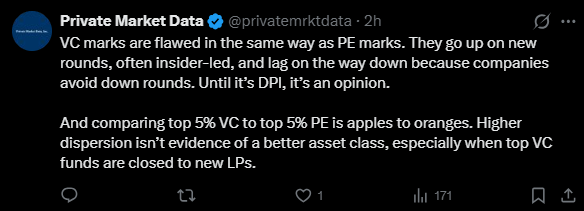
VC marks are flawed in the same way as PE marks. They go up on new rounds, often insider-led, and lag on the way down because companies avoid down rounds. Until it’s DPI, it’s an opinion.
And comparing top 5% VC to top 5% PE is apples to oranges. Higher dispersion isn’t evidence of a better asset class, especially when top VC funds are closed to new LPs.