Associate Professor at University of Illinois Urbana-Champaign, interested in characterization of materials. Affiliated with @CEEatIllinois @uofigrainger
Introducing UR2: Reducing Testing Time from 7 Days to 5 Minutes
Since 1824, Portland cement has been the primary binder in concrete—the world’s second-most consumed material after water. Alongside cement, Supplementary Cementitious Materials (SCMs) have long improved concrete’s strength, durability, and cost-effectiveness.
Today, two parallel trends are driving the hunt for new SCMs:
1. Supply Constraints: Traditional SCMs like coal fly ash are in short supply in the Western world due to the shutdown of coal power plants.
2. Sustainability Goals: Increasing efforts to reduce concrete’s CO₂ footprint push for higher cement replacement levels—from ~20–30% to 40–50% or more.
Calcined clays are emerging as a promising candidate, especially as LC3 (Limestone Calcined Clay Cement) systems, which can replace up to 50% of traditional cement.
As is true for any new material, we as a society require testing, testing, and some more testing before deployment (as we should). However, the gold standard here - Strength Activity Index test (ASTM C311) takes 28 days. In the late 20th century, faster tests such as the Chapelle test and Frattini test were introduced but they never gained sufficient traction.
In 2016, researchers introduced the R3 test (Rapid, Relevant, Reliable) which shortened the testing time from 28 days to 7 days (incorporated as ASTM C1897 in 2020). While this has been a landmark improvement and has gained tremendous traction, 7 days is still not fast enough if producers want real-time QC/QA.
Today, in 2025, we introduce the UR2 (Ultra-Rapid Reactivity) Test. Our new method predicts 7-day R3 performance in a mere 5 minutes by aggressively dissolving the clays. UR2 shows a strong correlation (R² = 0.92) with the 7-day R3 cumulative heat test across 47 diverse clays worldwide.
• Paper: https://t.co/4oWYHck4B4
• Press Release: https://t.co/PY1J5m9HfG
Novelty:
The idea of using dissolution to predict reactivity has been around but we now identify the optimal dissolution conditions (alkalinity and temperature) to combine dissolved Si and Al into a single “5-minute” dissolution index. Secondly, this test, in principle, can be conducted via off-the-shelf $30 cameras, potentially paving the way for low-cost, widespread deployment.
Call for Collaboration:
We invite industrial SCM producers and users to try this new test on their samples. Academic researchers are welcome to verify our approach and assess precision across labs. We’re also seeking OEM partners to automate UR2 into a single device for commercial use. If you know someone, let us know!
Congratulations to my postdoc, Dr. Yujia Min, and co-authors Hossein Kabir (@Hossein__Kabir), Chirayu Kothari (@Chirayu1998), and Farjad Iqbal (@farjad_iqbal) for executing this massive study. We are thankful to our industrial partners and the two anonymous reviewers for their helpful comments.
@CEEatIllinois@uofigrainger
Bayesian Optimization (BO) meets Concrete --> BOxCrete.
Partnership is with @JuliusKusuma at @Meta_Engineers and folks at @amrize.
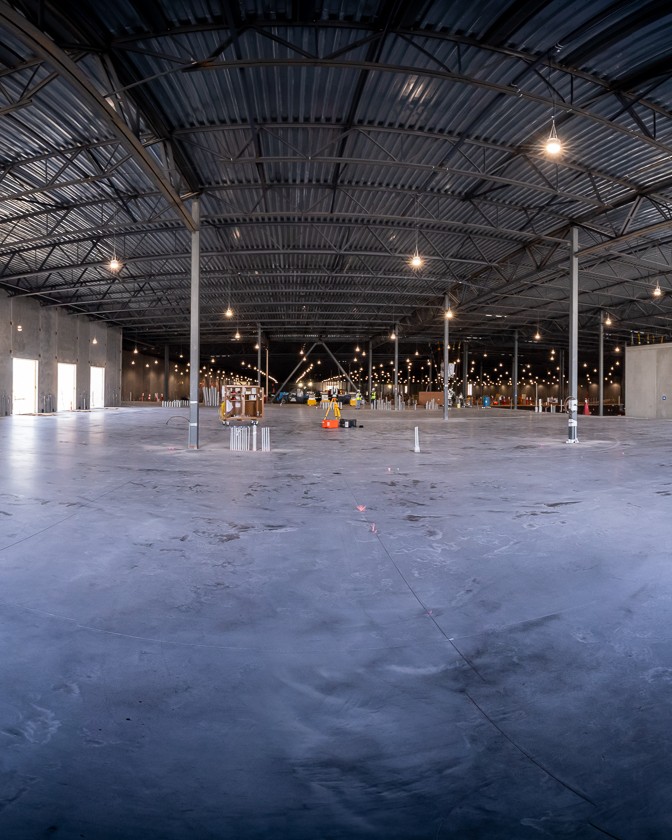
Our AI-optimized concrete mix was deployed in Meta's Rosemount, Minnesota datacenter last year.
Now, we've open-sourced the AI model + dataset.
We're open-sourcing BOxCrete, a new AI model for the construction industry.
Using Bayesian optimization, BOxCrete helps producers rapidly design concrete mixes with domestic materials, bypassing months of lab work.
The results from our data center build in Rosemount, MN:
🚀 43% faster time to full structural strength
🛠️ 10% reduction in cracking risk
🇺🇸 100% domestic material usage
We are open-sourcing the model and the foundational data to empower producers everywhere. Check out the full technical deep dive on our Engineering blog: https://t.co/voV8yMLZFa
I was in Atlanta for the ASTM week talking about our 5-minute ultra-rapid methods for testing SCMs as well as our work on Raman Imaging.
4/5 of my downtown @Uber rides turned out to be @Waymo rides. This was my first time and it was quite fun. I wanna try Tesla next.
This is quite impressive. Founded in 2022, the company is just 3 years old. Their blog post mentions that they plan to make ~100,000 robots over the next 4 years.
What’s more Meta than an AI data center built using AI?
#ICYMI: We partnered with @Meta and @UofIllinois to create a new AI-optimized concrete mix that is:
✅ 43% faster in early strength
✅ 35% lower carbon
✅ Similar cost
Learn more: https://t.co/QgXAskXiwE
📷 Photos: @Meta
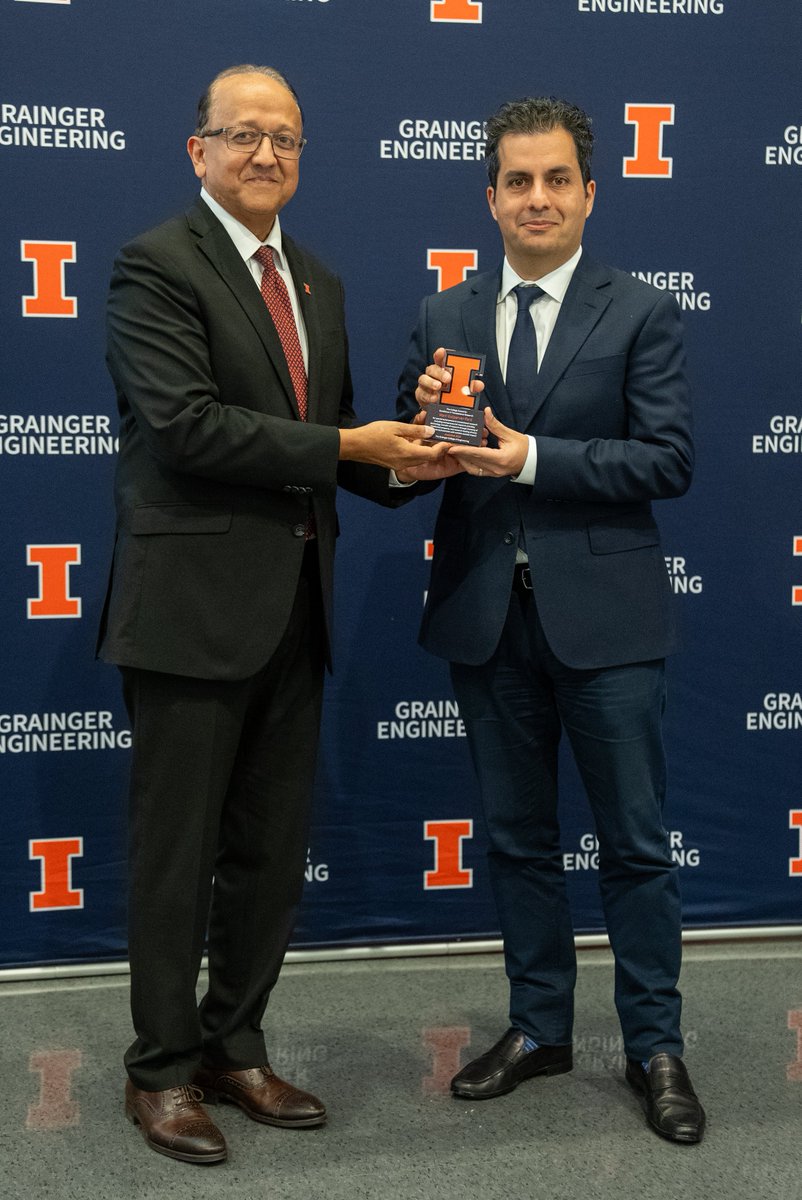
Over the weekend, five of our faculty members were honored with College Faculty Awards from @uofigrainger
Congrats to @prof_garg_, @XShellyZhang, Mani Golparvar-Fard, Jeffery Roesler & Imad Al-Qadi!
Read more about the awards⬇️
https://t.co/wUnxdS5Azn
Concrete is fascinating!
At the American Concrete Institute Spring Convention, took a tour of the University of Toronto campus. Among many impressive things, saw an immersive and colorful exhibition of concrete petrography.
What a beautiful way to celebrate concrete.
We need more of these at each convention.
@UofT@ConcreteACI
Founders who were PhD or post-doc in my lab at Berkeley, **largely funded by NSF / DoD grants**, start-up, market cap (collected by OpenAI Deep Research)
I saw the demo video from Manus AI - who are building a general AI agent (here's a screenshot from their video). I like their idea of automatically analyzing multiple CVs and ranking candidates.
If one could run such a model offline - on locally stored data, say thousands of grad school applications, it could save time for professors evaluating or screening MS/PhD candidates for interviews.
I also receive dozens of CVs on a weekly basis and I never have enough time to review them. Once in a while, I may miss out on stellar candidates because I don't have time to go through every email.
But if someone can build a tool that can extract PDFs from a mailbox or an internal database, analyze them, maybe even conduct a short virtual interview to gauge interest/skillset and identify the final few candidates for a real interview - that could make hiring a little more efficient.
Will need rigorous testing for real-world validation, but worth a shot!
Any researchers or hiring managers who spend a ton of time browsing hundreds of CVs annually? What do you think?
#ILLINOIS engineers developed a new test that predicts the performance of a new class of sustainable cementitious construction materials in five minutes. ▶️ https://t.co/FNyo49VvpV
What I find fascinating about Deepseek's r1 model is that it shows the entire chain-of-thought before giving the response.
After testing it on a few technical prompts (it does okay compared to OpenAI's o1 model), I decided to push it to write a 10,000 word novel integrating romance with Raman imaging.
It first gave me just an outline. But I told it I needed the full novel. Then, it produced the first chapter (which was interesting).
But I still asked it to give me the whole thing immediately at once. Interestingly, the model "thought" about it carefully, and it agreed to give me the novel chapter by chapter as individual responses.
The thought process shows it is trying to carefully handle the delicate issue of managing customer expectations while still being nice and helpful.
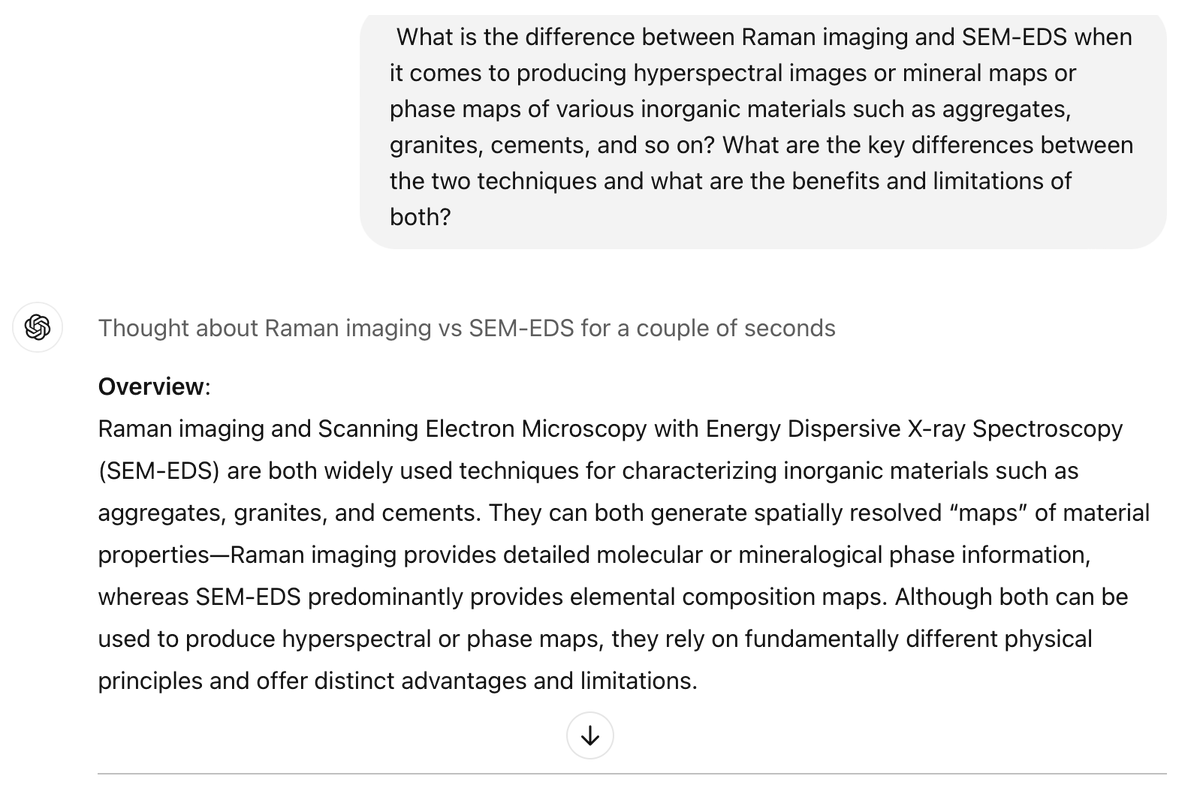
I'm at a conference, and yesterday I presented our Raman imaging work on construction materials. Someone in the audience asked me what's the difference between Raman and SEM-EDS based hyperspectral maps.
This is a standard question we receive all the time, and it is straightforward to answer. We get mineral maps from Raman as opposed to elemental maps from SEM-EDS, which are fundamentally different but highly complementary and useful when obtained together on the same sample.
Today I thought, let's see how OpenAI's latest o1 model responds to some of these questions. So I entered the audience questions into ChatGPT:
https://t.co/m5L9W8SqdT
Interestingly, it does a decent job and makes all the right arguments.
Essentially, the next generation of students (high-schoolers, undergrads, maybe grads too) now have access to unlimited coaching from low-cost tutors - it is very likely we'll see an explosion of extremely smart and curious individuals pop up everywhere in the world.
I can't comment about other fields but the education industry is certainly in for a dramatic change over the next decade.
Armed with two $30 cameras bought on Amazon, the Garg lab, has re-envisioned standard procedures for measuring water absorption in concrete.
Read more about their work below!
https://t.co/7H0mJlAqMw
@prof_garg_ | @uofigrainger
When we build any structure from concrete, we build it to last. However, there are a host of degradation mechanisms that can result in deterioration and long-term damage. Herein, the ingress of water is often a key driver.
To measure water ingress, there is an ASTM standard (C1585) which essentially involves exposing a concrete specimen to water and measuring the mass of the sample over time as it absorbs water. While the test is straightforward and very practical in obtaining ‘sorptivity’ of samples, it is a bit tedious and time-consuming. To address some of these challenges, my PhD student Hossein (@Hossein__Kabir) has been working since 2020 in the lab to explore alternate test methods for measuring concrete durability.
Last year, in 2023, we introduced the droplet test where we could predict the 6-hour initial sorptivity in a matter of few seconds (https://t.co/yxr8T1h0NP). Simultaneously, we also introduced a lab-made, low-cost goniometer (https://t.co/sKwFM0Qlsx), which could perform the contact angle goniometry for our droplet test at a low-cost (<$200). While these were exciting advances, the test is currently limited to paste samples. It still needs to be modified and adapted to work on mortar and concrete samples (work is ongoing).
One day, when we were looking at the videos from the droplet test, we thought, “Why not track the moving waterfront in the sample and use that instead to predict sorptivity?”
So today, in 2024, we introduce an automated, computer vision-based approach to predict sorptivity. We take a series of paste, mortar, and concrete samples – and subject them to the traditional ASTM test as well as our dual camera, vision-based method, where the water ingress is tracked and quantified in real-time. By training the model on >6,000 images and >1,400 unique data points, we can predict both initial and secondary sorptivity with an R2 > 0.9.
We do want to acknowledge that many state-of-the-art imaging, tomography, and radiography techniques can visualize water ingress in 3D. In contrast, our vision-based test is mostly in 2D. That being said, all of this is done using two $30 USB cameras ordered from Amazon, so one can essentially predict sorptivity and visualize the water ingress at a low-cost (~$60), anywhere in the world. This low-cost accessibility becomes relevant for labs which don’t have access to expensive imaging equipment.
If anyone would like to try and/or implement this new test in their lab, please let us know. We’re more than happy to help set you up. As developers of this test, we look forward to getting your feedback and insights as you run it on your samples. Broadly speaking, if we can automate and accelerate the performance testing of construction materials, we can significantly increase the development and deployment of new materials in the field.
Congratulations to Hossein and co-authors Jordan Wu, Sunav Dahal (@sunav_d), Tony Joo who executed this massive work.
➡️ Paper Link -> https://t.co/DuV5pE0AD7
#Cement #Concrete #Durability #Sorptivity #ComputerVision #Automation #ConstructionMaterials #BuildingMaterials #ConcreteTechnology
"Any sufficiently advanced engineering is indistinguishable from magic"
Inspiring feat from @elonmusk and @SpaceX
The day is not far when civil engineers will build the first city on Mars.
Back in 2018, when I started the research group at Illinois, one of my ideas was to explore the potential of Raman Imaging for the characterization of cements. Characterizing and quantifying the phases present in a cement is the first step towards quality control and predicting its performance. This step is important because cement is the key ingredient of concrete – the most used construction material in the world.
In 2021, my PhD student Krishna @KCPolavaram (now Dr. Krishna!) reported the first breakthrough in this area (https://t.co/qg765139Fr). We were able to quantify clinker phases in a variety of Portland cements by stitching together high-resolution Raman images and analyzing statistically significant large areas (~250k pixels per image of 5x5 mm). While this was an exciting advance, there were limitations. The quantification algorithm was sensitive to various parameters that we hadn’t fully explored, and it required some time to acquire a representative Raman image – nearly 8 hours per scan!
Now, in 2024, my PhD student Chirayu @Chirayu1998 reports another significant advance to the current state-of-the-art (SOTA) results. In our latest work, we outline a new algorithm for the phase quantification in Portland cement via Raman Imaging and conduct a detailed investigation into the role of analysis parameters for both Raman Imaging and XRD Rietveld analysis. We found that these two techniques are highly complementary and, when applied to the same sample, provide reliable results for 1) phase identification and 2) subsequent phase quantification. Even better, while achieving comparable results to SOTA, we optimized scan areas and managed to reduce the Raman scan time by 2.5x to around 3 hours per scan.
Finally, we have also validated this approach on other cement systems, such as Calcium Sulfoaluminate (CSA) cements, which we’ve detailed in a separate paper. Both papers are linked below:
➡️ Paper 1 : https://t.co/f1qV9SfJRZ
➡️ Paper 2 : https://t.co/7lMYe8NJPW
P.S. This is just the beginning; there’s a lot more work to be done. We hope our colleagues in the research community will pick up some of these ideas and take them even further. Let us know if you have suggestions for interesting (and complex!) systems with phases we could analyze and quantify.
As many startups in the cement and concrete industry are blooming and developing new & sustainable clinker chemistries, this combined ‘Raman Imaging + XRD’ approach could play a useful role in mineral phase identification, size and shape analysis, and subsequent quantification. Feel free to reach out if you’re interested to collaborate!
#CementResearch #RamanImaging #PhaseQuantification #MaterialsScience #PortlandCement #ConcreteTechnology #SustainableConstruction #XRDAnalysis #CementIndustry #BuildingMaterials #ClinkerPhases #ConstructionMaterials
Introducing...
The #1 civil engineering graduate program in the nation.
The #4 environmental engineering graduate program in the nation.
Here's to continuing our legacy of excellence!
https://t.co/Sd0oNEp9LM
@uofigrainger@UofIllinois
From the cover of ACS ES&T Engineering: A multistep treatment transforms the nonreadily removable chlorides in #WTE ash to chlorellestadite which reduces heavy metals volatilization, Pb mobility and chloride release. @prof_garg @CEEatIllinois
Read more: https://t.co/LO0h7yyqZs