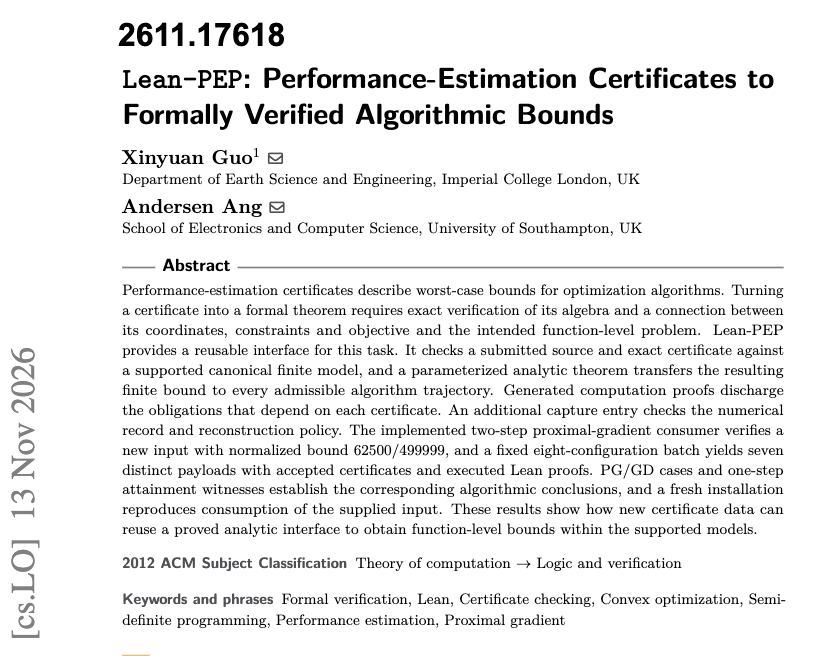
I supervised my undergrad CS year3 student (now Imperial) project to turn
PEP worst-case numerical bound for optimization algo
to Lean-verified auto-gen proof
e.g. 2-step proximal gradient
F(x)−F*≤LR² 62500/499999 Lean-verified
I'm very glad we had engaged reviewers who were actively looking to improve the paper and push us to fill in the gaps in our story.
Our peer review system is what we make of it. I am not sure if similar upsides can happen in "fast" conference systems rather than "slow" journals
Appeared in the Journal of Complexity. Peer review worked perfectly, challenging and maturing our work. The paper came out distinctly better than it started. I wanted to share a bit about how the work grew.
My student Thabo Samakhoana and I have been obsessed with smoothings lately. The softmax/logSumExp smoothing seems to be the standard everywhere in ML and optimization.
So, in what sense is this choice "optimal"?
We found some "elementary" answers, both good and bad news (1/4)
(2) We had previously shown LogSumExp is strictly suboptimal for d=2,3. Reviewers reasonably wanted some resolution in any dimension
The same trick worked. We articulated a parameterized family of smoothings containing LogSumExp. Our strict improved smoothing optimizes over them
Join us in advancing data science and AI research! The Johns Hopkins Data Science and AI Institute Postdoctoral Fellowship Program is now accepting applications for the 2027–2028 academic year. Apply now! Deadline: Dec. 11, 2026.
Details and apply: https://t.co/0MG7JyP3JJ
Big smiles, big accomplishments! 🏆
Assistant professors Luhao Zhang and Jincheng Yang celebrated receiving the 2026 @INFORMS Optimization Society Young Researchers Prize at yesterday’s ceremony, with fellow AMS faculty joining in on the excitement! #JohnsHopkins
publication in mathematics may soon align with the humanities: the unit of progress is the definitive book -- not articles, not proofs -- but a comprehensive framing of and advance in a specific area of mathematics, the reading of which would be a slow educational journey.
@XYHan_ This rings true to me. United has had (multiple) flights for me that never took off, and yet I still show up for future flights. Now, once they fail to land my plane...
(1/9)We are pleased to announce the Optimization × AI Forum, a new online seminar series on how AI is changing the way optimization research is done.
Progress in AI for mathematics and science is now so rapid that workshops, conferences and arXiv postings can no longer keep pace.
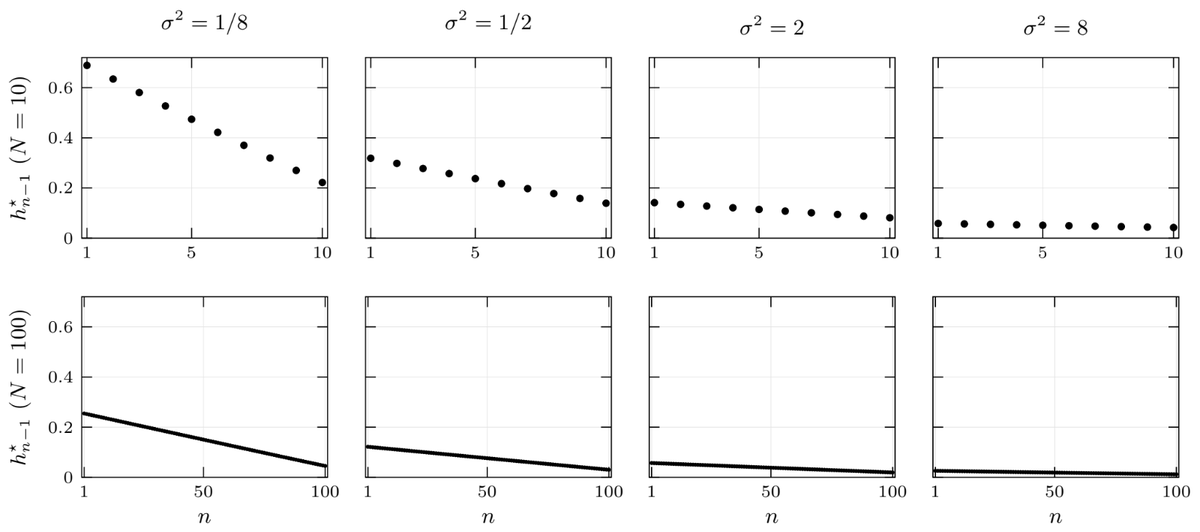
Just appeared on arXiv, we derived exact theory and minimax optimal stepsizes for Stochastic Gradient Descent (SGD)'s last iterate.
For smooth convex minimization, our theory comes with exactly matching lower bounds proving no further progress is possible.
Current optimistic feeling on the future of my research:
(1) Theory at its best can lead practice,
(2) Theory is strapped to an exponential rocket in AI,
(1+2) Now is the best time to meaningfully work in theory
(At least in my domain of mathematical optimization)
@ytdeepia I don't know. Our results are derived using PEP (of which Adrian is a leading pioneer). Relative smoothness has some ability to fit in PEP but seems notably harder in several respects. I don't see an easy generalization but it's a good question :)
Exact Theory and Optimal Stepsizes for Stochastic Gradient Descent i...
arXiv:2610.42048
Stochastic Rayleigh-Ritz Ascent: Global Linear Convergence under a S...
arXiv:2610.42071
Below are the unique optimal, nearly linear stepsize schedules for smooth convex stochastic optimization. Our Corollary 1.2 gives the formal result.
For those interested in reading more, please see the link to arxiv below :)