Assistant Professor of Philosophy, Smith Institute for Political Economy and Philosophy. Soon to be @UFhamilton 🐊 Generalist/Fox. Plato-obsessed Aristotelian.
Tell me higher ed is conformist and risk-averse without telling me..
“Let’s all shorten our degrees *together* so no university has to risk being left behind.”
This is a bid for collective cover in lowering the bar.
3-year degrees are gaining momentum.
NYU President Linda Mills:
“Universities are due for another evolution: offering 90-credit, three-year bachelor’s degrees in fields that demand immediate workforce development.”
“Four years of college is not an inviolable standard.”
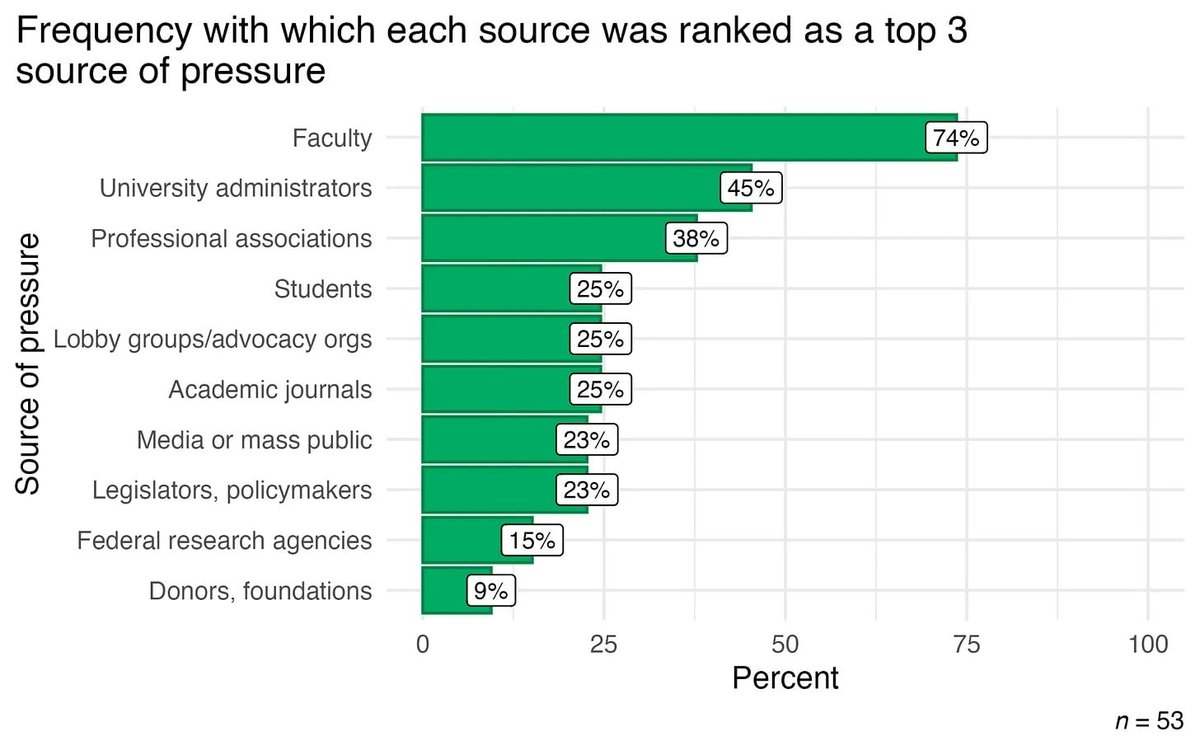
I wonder if the faculty actually teaching some of the controversial topics have different rankings of these sources of pressure than the faculty not teaching them.
I guess the question is: Do the brave ones have a different perception of the risks?
I wonder if the faculty actually teaching some of the controversial topics have different rankings of these sources of pressure than the faculty not teaching them.
I guess the question is: Do the brave ones have a different perception of the risks?
🔎 Where does the pressure on professors to avoid "controversial" topics come from?
In a new survey of HxA members, many gave the same answer: other professors.
In collaboration with @Hartz_PhD and @epkaufm, this new survey identifies which topics feel off-limits on campus and why.
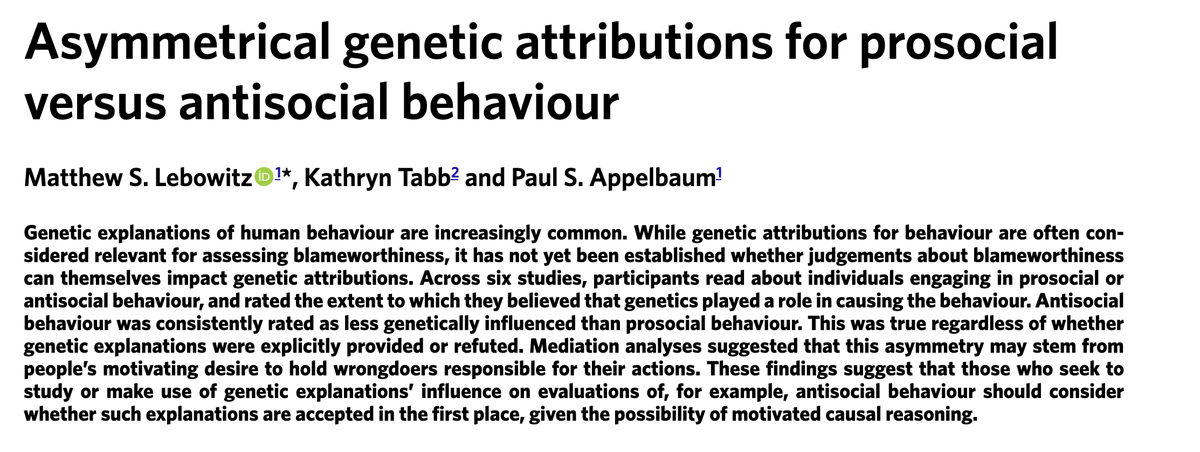
There hasn't been enough attention to this amazing result, and I'd love to hear ideas about how to explain it
Participants are given a story about a morally bad behavior that it is due to genetics. Then they are asked the simplest possible question: Is it due to genetics?
Jen is obviously right here. The R1 model aims at the production of knowledge through research. The humanistic disciplines have always fit strangely into this framework, because traditionally they aim at producing a certain kind of person through teaching.
@jon_stewartmill They flipped a coin. Heads = murder each other; tails = get Greta into the marriage. It came up tails, so they didn't murder. I think she misspelled polygamous as 'duogamous'. Otherwise, it's flawless from an editor's point of view.
@vmayerriquelme@jennfrey That conclusion isn't obvious to me. Are the humanities saved through increasing or maintaining humanities PhD production? It seems like most discourse around the value of the humanities in higher ed focuses on its role in an undergraduate education.
@MaxSkjonsberg@LawLiberty I explored that Smith passage in my recent talk at the Chase Center conference on civic thought! I so much look forward to sharing mores ideas like this soon.