Inflation isn’t cooling down yet. New data shows consumer inflation came in hotter than expected, and wholesale inflation has just hit levels not seen since 2022, driven largely by surging fuel and wholesale food costs.
Why does money have a price? Who sets it? Financial markets are just auction houses for capital. Chapter 6 of FIN 3400 — markets and institutions, explained plainly:
https://t.co/JzmwVs618Y
#FinancialMarkets#Finance
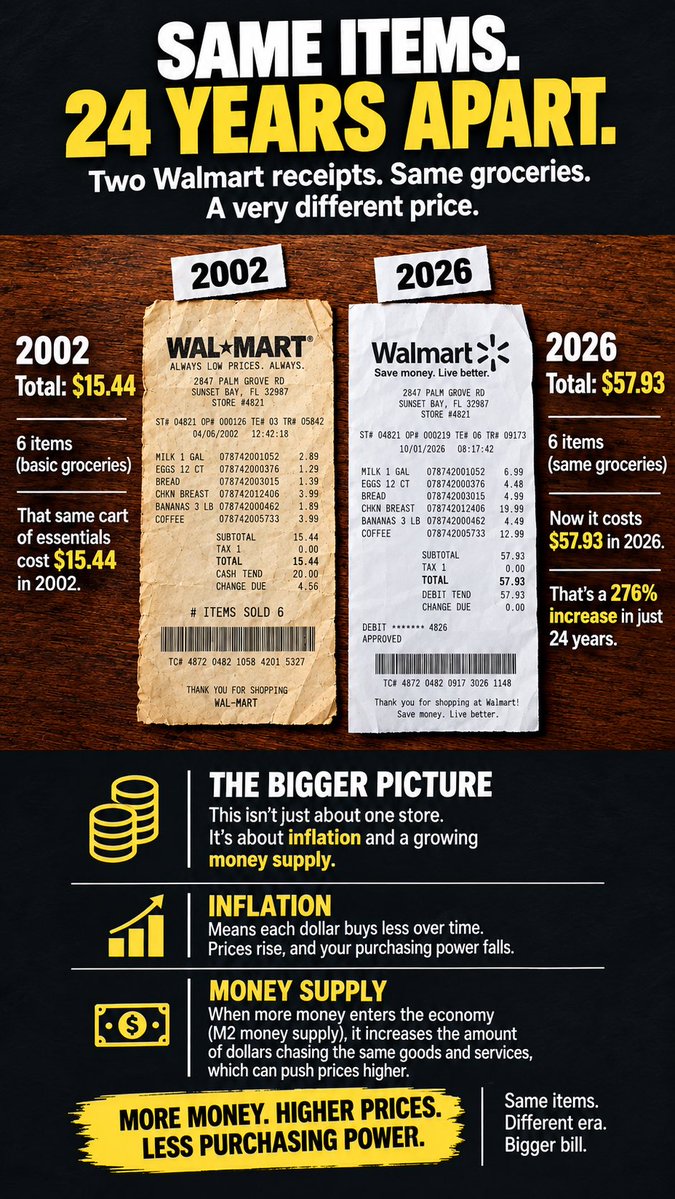
Six grocery items.
2002: $15.44
2026: $57.93
That’s a 275% increase on these receipts.
Inflation erodes purchasing power. Expanding the money supply can contribute to price pressures, especially when money and demand outpace productive capacity.
Save $10 per paycheck.
Build a $500 emergency fund.
Cut expenses that aren’t serving you.
Find ways to increase income.
Stop adding new debt.
You don’t have to fix everything today.
You just need to stop moving backward.
Financial freedom starts with one small win.
Being broke isn’t always a spending problem.
Sometimes it’s an income problem.
But you need a plan either way.
Cover food, housing, utilities, and transportation.
Then…
#PersonalFinance#CostOfLiving
Taxes will be the biggest line item of your entire life. Tax evasion is a crime — tax avoidance is a sport with published rules. Week 7 of FIN 2100:
https://t.co/N2SX1TeaLS
#TaxTips#PersonalFinance
The paycheck-to-paycheck cycle works:
You get paid. You pay bills. Something breaks. You use a credit card. You pay the credit card. You’re broke again.
The way out isn’t a motivational quote.
It’s a $500 emergency fund and eventually more income.
#DebtFree#FinancialLiteracy
Your mortgage, your car payment, your retirement drawdown — all annuities. Chapter 5 of FIN 3400 teaches the math that prices every one of them:
https://t.co/Zn26nFYSCx
#Annuities#FinanceEducation
High salaries mean little when housing, food, utilities, and transportation consume nearly everything you earn.
The real measure of financial security isn’t what you make. It’s what you have left.
across parts of the South and West, while the Northeast and Midwest show lower prevalence in Bank of America’s analysis.
The biggest factor isn’t income alone. It’s the relationship between income and the cost of living.
Where in America are people most likely to live paycheck to paycheck?
State-level data from Bank of America and GOBankingRates reveal a striking pattern.
New York: 16.19% of median pay remains after essential expenses.
Oregon: 16.43%
Massachusetts: 16.95%
California: 19.44%
Maine: 21.17%
Montana: 24.03%
By comparison, residents in these states retain a much larger share:
Wyoming: 44.90%
Minnesota: 44.52%
Texas: 44.22%
New Hampshire: 42.65%
New Jersey: 42.21%
Virginia: 42.02%
Regional data also points to greater paycheck-to-paycheck pressure
How much do you need to earn to live comfortably in America’s most expensive cities?
SmartAsset’s 2026 study uses the 50/30/20 budget rule: 50% for necessities, 30% for wants, and 20% for savings and debt repayment. These are estimated annual salaries, not just basic survival
Top 25 cities by annual salary needed for a single adult:
New York, NY: $158,954
San Jose, CA: $158,080
Irvine, CA: $151,965
Boston, MA: $139,776
San Diego, CA: $136,781
San Francisco, CA: $134,950
Oakland, CA: $134,410
Honolulu, HI: $128,253
Seattle, WA: $127,296