THE QUESTION NOBODY WANTS TO ANSWER
Something curious is happening in Westminster.
Keir Starmer lists achievements that critics said were impossible.
The economy stabilising.
Waiting lists falling.
Migration coming down.
Britain rebuilding relationships abroad.
Yet the conversation is not about whether those achievements matter.
It is about who should inherit them.
That should give us pause.
Because there are two very different arguments.
One says Starmer has failed.
The other says Burnham won a by-election.
Those are not the same thing.
One is a verdict on government.
The other is an opportunity spotted by ambitious people.
And perhaps the greatest irony of all is this:
The louder the talk of a "calm", "dignified" and "consensual" handover becomes, the less it sounds like unity and the more it sounds like power.
Politics is full of people who want the crown.
Britain needs people willing to carry the burden.
Keir Starmer inherited a country that was broken.
He rebuilt the party.
He won the mandate.
Now he is doing the difficult work of rebuilding the nation.
That is not a reason to replace him.
It is a reason to let him finish the job.
#Labour #KeirStarmer #UKPolitics
This is what happens when you have an ‘FOH’ culture.
Here I’m saying my last goodbye to my beautiful daughter. I closed the door to that room and drove home with an empty car seat to an empty nursery. Never to see or touch her again.
Just like many other families in Nottingham.
#panorama #NottsMatScandal #accountability @jamesmurray_ldn
I repeat.
If you are vocal about nurses being replaced by lesser qualified staff- and don't bring the same energy when doctors are being replaced by lesser qualified staff?
You lack consistency
That could be due to hubris.
It could be due to professional jealousy
It could be due to politics
Either way?
You either believe in qualified people doing the designated roles
Or you don't.
Thanks for coming to my (1st) TED talk of 2026.
'Mentoring strengthens not only individuals, but the whole profession.'
RCGP Chair @KamilaRCGP thanks all mentors across the GP community for their time, guidance and encouragement.
To become a mentor or mentee, visit our website. ⤵️
https://t.co/QVjoE7WOI2
#RCGP#Mentorship #GPCommunity
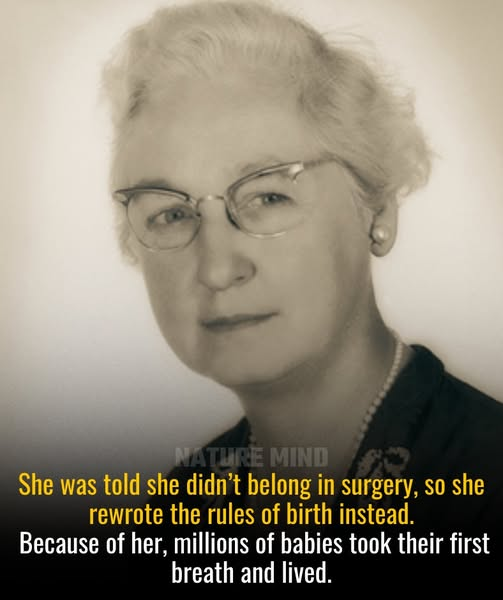
In 1952, inside a New York City delivery room, a baby was born blue and silent. Doctors hesitated, unsure whether to keep trying. Then a calm voice broke through the panic.
“Let’s score the baby,” said Dr. Virginia Apgar.
That moment changed medicine forever.
Apgar had once dreamed of being a surgeon, but in the 1940s few women were allowed into the operating room. Told that no hospital would hire her, she turned to anesthesiology instead — a decision that would save millions of lives.
Working in Columbia-Presbyterian’s maternity ward, she saw newborns die within minutes of birth because doctors had no system to judge which babies needed help first. So one morning in 1952, she grabbed a pen and paper and designed a five-point test measuring heart rate, breathing, muscle tone, reflex response, and skin color. She called it the Apgar Score.
The idea spread faster than anyone expected. Within a decade, almost every hospital in America was using it. Infant mortality fell sharply. Doctors finally had a language for newborn care — and babies once thought lost were suddenly being saved.
Apgar never stopped pushing forward. She earned a public health degree, joined the March of Dimes, and became a global voice for mothers and infants. When asked how she had thrived in a man’s world, she laughed, “Women are like tea bags — they don’t know how strong they are until they’re in hot water.”
Dr. Virginia Apgar passed away in 1974, but her test still guides every delivery room on Earth. Every two seconds, somewhere in the world, a baby takes its first breath — and someone quietly calls out a number that honors the woman who refused to give up on newborns or on herself.
I’d like to see a Wales where everyone can afford to heat their own home rather than sticking plasters like warm hubs, already locking out so many who aren’t able to get to them
The Welsh NHS structure is immensely convoluted.
This makes driving system wide change challenging.
Let me explain just how complex the NHS in a country of 3m is...
[Thread]
@RuthWalker_ I am so sad to hear of Ruth’s death. Ruth was especially kind to me when I came to Cardiff. She took time to meet with me and supported me as we worked through our shared challenges. She was a very special person and a true leader. A powerful advocate for nursing and midwifery.
*Information for Public*
"PAs are not doctors, & cannot & must not replace doctors
They are not independent medical practitioners and must be supervised appropriately by doctors
Patients must always receive clear & accurate information about who is treating them"
#FactsOnly