MESP Director. Assistant Professor @ElliottSchoolGW -Author: "Iran & the Bomb: United States, Iran&the Nuclear Question." PhD- Tweets &RT≠E. Personal Views here
“Iran and the Bomb, the United States, Iran and the Nuclear Question” is the culmination of my research and writings on one of the most pressing issues of US national security since 1975.
It is now available on Amazon for pre-order.
https://t.co/kCZX4i544p
This week's episode of "At the Boundary" digs into the 70-year history of the Iranian nuclear program, dating back to the 1950s, when the U.S. and Iran were on friendlier terms. Dr. Sina Azodi (@ProfSAzodi) is the author of a new book on the topic and our special guest this week, as he discusses "Iran and the Bomb: The United States, Iran, and the Nuclear Question." Azodi is a globally-acclaimed expert on Iran and the Director of the Middle East Studies MA Program at The George Washington University (@ElliottSchoolGW).
He sits down with GNSI Non-Resident Senior Fellow Manolis Priniotakis to explore the history of Iran's nuclear program and how their national identity, regional dynamics and global security concerns have heavily influenced the country's nuclear decision-making.
Listen to the full episode here:
https://t.co/wVhkJtmEoo
#IranAndTheBomb #MiddleEastStudies #IranNuclearProgram #USF #GNSI
What really strike me the most is the role of U.S. and Trump administration in the recent clash between Iran and Israel. It was clear to me that Trump was concerned about the resumption of hostilities and decided to distance himself and the U.S. from the conflict. This is why it seems both Iran and Israel have decided to show restrain at this point.
This region is on edge as hostilities escalate and test the already fragile ceasefire. @ProfSAzodi explains to me why he thinks the exchange of strikes between Iran and Israel will continue and what that means for peace talks:
Attacking nuclear power plants is a taboo. It is a no-go.
I told the @IAEAorg Board of Governors that whether it is Bushehr, Barakah, Kursk or Zaporizhzhya, this cannot continue. We are playing with fire.
https://t.co/aGF0avZvha
I would add to that this all came when US and Iran are deadlocked on MoU. This along with exchange in Persian Gulf is Iran putting pressure on US by signaling willingness to escalate and return to war when U.S. said war is over. The pressure is for Trump to move on the MoU.
This region is on edge as hostilities escalate and test the already fragile ceasefire. @ProfSAzodi explains to me why he thinks the exchange of strikes between Iran and Israel will continue and what that means for peace talks:
After Months of War, Iranians Sink Into Disillusionment and Despair. An imploding economy is causing hopelessness among both pro- and anti-government Iranians. And for those who wished for regime change, the letdown is palpable.
https://t.co/CR8v8FVoWH
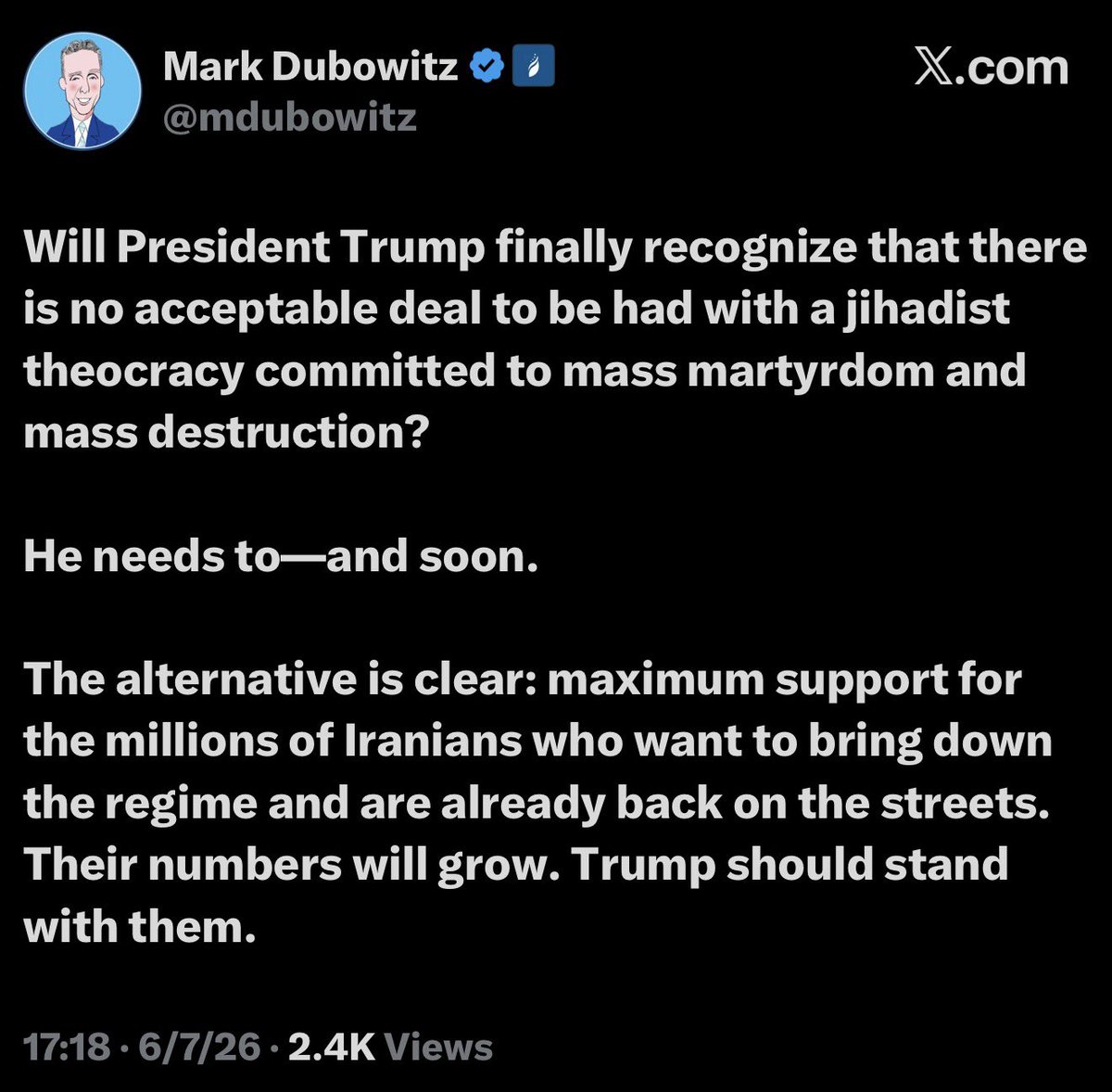
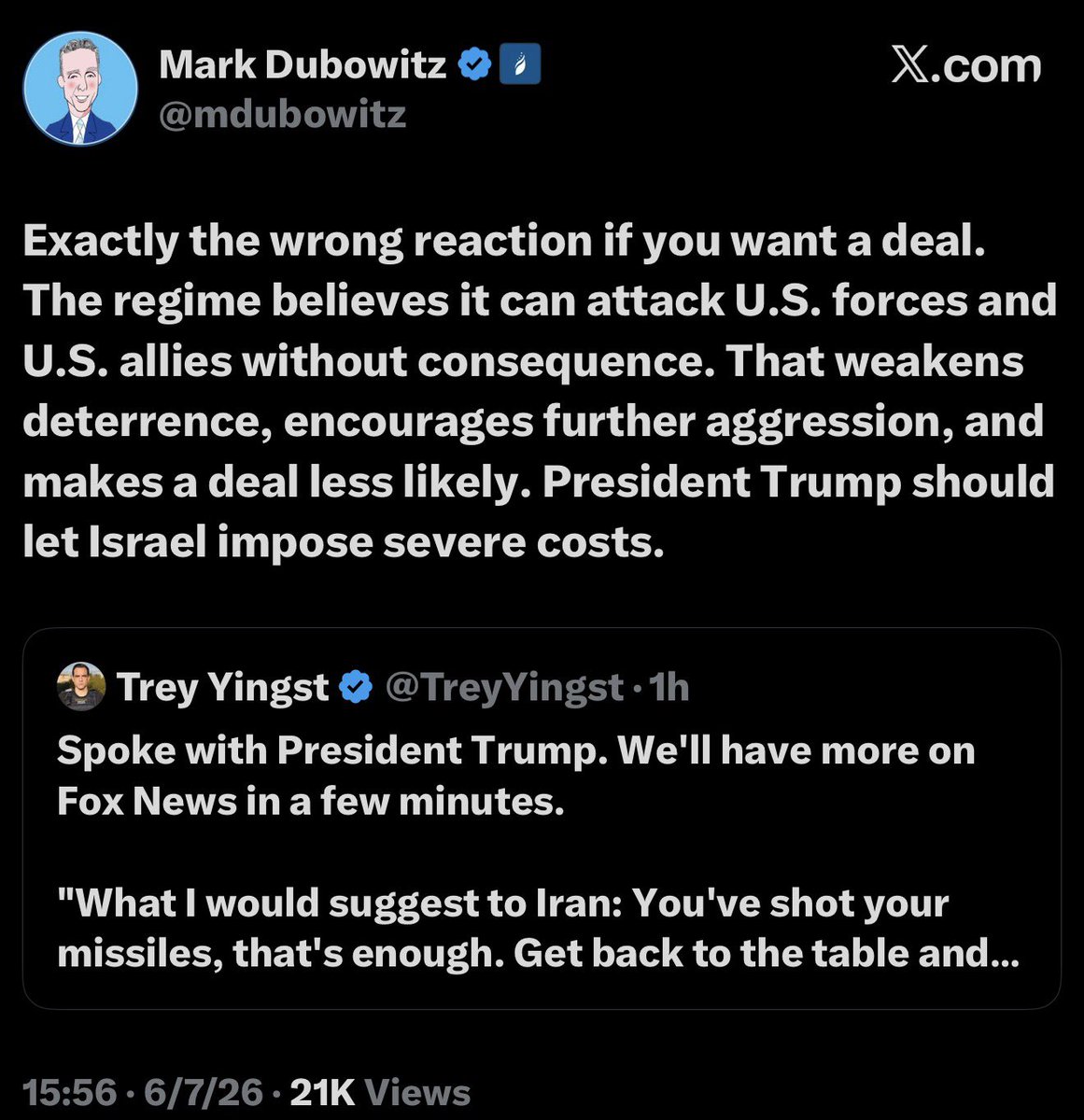
Pivots from “just trying to help get a better deal!” to “no deal is ever acceptable btw! surprise” in literally under 90 minutes.
Would be stunning but he’s been doing this for over a decade. Why is this taken at all seriously in Washington?
Iranian state TV releases footage of the ballistic missiles it launched at northern Israel. A total of 10 missiles launched in three barrages, all were intercepted.
🇺🇸🇮🇱🇮🇷President Trump told Israeli Prime Minister Netanyahu in a phone call on Sunday not to retaliate against Iran's missile attack & allow more time for diplomacy, according to a U.S. official & an Israeli source briefed on the call. My story on @axios
https://t.co/dXJ7UUoQ4s
The missile attacks from Iran against Israel clearly reflect the depth of Iran’s commitment to Hezbollah and to the concept of the “unification of the fronts,” as well as Tehran’s self-confidence and its assessment that the U.S. is not interested in resuming hostilities with Iran.
At the same time, Iran’s efforts to prevent Israeli strikes in Beirut highlight even more sharply the transformation that has taken place in its proxy doctrine: instead of its regional proxies—most notably Hezbollah—protecting Iran, Iran is now compelled to protect them.
🚨🚨More quotes from my phone call with president Trump: “The Iranian strikes didn’t hurt anybody. Hopefully Israel is not going to retaliate. If Bibi strikes them back it’s just gonna keep going like the last 47 years, or the last 3000 years"
🚨🚨Trump added: "We are very close to a final deal with Iran. It is going to be a good deal. I don’t want it to blow up because of what is happening now"
🚨🚨Trump stressed: "I am going to call Bibi right now and tell him not to retaliate. Each of them had their fun. Israel had its strike and Iran had its strike. We don't need another one"
Returning back to war?
From Tehran's perspective, the United States and Israel are pursuing a coordinated strategy aimed at weakening both Iran and the broader Axis of Resistance.
This perception, combined with President Trump's continued insistence that no meaningful economic relief will be granted to Iran, reinforces the Iranian leadership's belief that it must take action rather than remain passive.
This dynamic is closely linked to a simple reality: as long as there is no agreement between Washington and Tehran, spoilers on all sides will continue to drive escalation.
The absence of an agreement means there is no sustainable status quo to preserve. Given the profound gaps between the Iranian and American positions on key issues, including uranium enrichment and the future of regional proxy networks, the potential for escalation can only be contained for so long.
If President Trump genuinely seeks a deal with Iran, he will need to create diplomatic space for negotiations. That would require pressuring Israel to halt its military operations in Lebanon and approving at least limited economic relief during the initial phase of negotiations. Without such steps, the likelihood of dangerous escalation remains significantly higher than the prospects for a negotiated settlement.
Above all, it is increasingly clear that Iran is far from being deterred. In fact, the opposite appears to be true. After 39 days of conflict, Tehran is behaving as though it emerged from the confrontation in a stronger strategic position. Rather than projecting caution or restraint, Iranian leaders continue to signal confidence, emphasizing their resilience, their ability to absorb pressure, and their determination to maintain their regional posture.
Whether this perception reflects reality is almost beside the point. What matters is that Iran does not appear to view itself as a defeated or intimidated actor. As long as Tehran believes it can withstand military, economic, and political pressure, the prospects for coercing major concessions through pressure alone remain limited. This reality increases the risk of further escalation and complicates efforts to reach a diplomatic settlement.
The coming hours are likely to be critical in determining whether the current escalation can be contained. With tensions running high and all sides seeking to shape perceptions of deterrence and resolve, the risk of miscalculation remains significant. Decisions made in the immediate future both in Tehran and Washington / Jerusalem, as well as by regional actors, could determine whether the crisis moves toward de-escalation or enters a far more dangerous phase.
#IranWar
Why didn't Biden revive the JCPOA — particularly since he criticized Trump for pulling out of the deal? I asked Obama's former Deputy National Security Adviser @brhodes in part 2 of our conversation: