What if the next medical breakthrough isn’t a new drug but a new use for an old one? On #ConsiderThis I ask @ProfSKrishna & @DrYolandaAugus1 from the International Affordable Diagnostics and Therapeutics Alliance (IA-DATA) about Malaysia's potential as a hub for drug repurposing.
Artesunate–pyronaridine–atovaquone–proguanil and artesunate–fosmidomycin–clindamycin compared with standard artesunate–pyronaridine for uncomplicated malaria (MultiMal): a randomised, controlled, clinical, phase 2 trial in Gabon and Ghana https://t.co/YThrOBj2F1
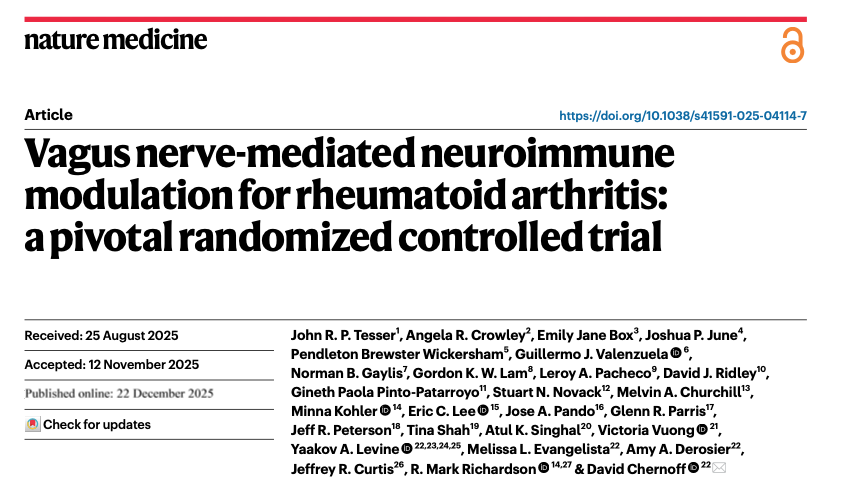
Congrats to @SetPointMed for this landmark study in @NatureMedicine that led to FDA approval for targeting the vagus nerve inflammatory reflex to treat rheumatoid arthritis. https://t.co/7ke5SK3xMP.
Recently, the FDA approved the first vagus nerve neuroimmune modulation device for treatment of rheumatoid arthritis. Today @NatureMedicine the pivotal randomized trial, sham- controlled is published
https://t.co/RUYOpWO8Sf
Research for impact - a long haul that develops new possibilities for treating AML using old drugs - repurposing with mechanisms & harking back to SERCA3 as a target for artemisinins https://t.co/zq2j8zPxbu
Our immune system is an evolutionary masterpiece. Every day it protects us from the thousands of different viruses, bacteria and other microbes that attempt to invade our bodies. Without a functioning immune system, we would not survive.
One of the immune system’s marvels is its ability to identify pathogens and differentiate them from the body’s own cells. The microbes that threaten our health do not wear a uniform – they all have different appearances. Many have also developed similarities to human cells, as a form of camouflage. So how does the immune system keep track of what to attack and what to protect? Why doesn’t the immune system attack our bodies more frequently?
Researchers long believed they knew the answer to these questions: that immune cells mature through a process called central immune tolerance (see image). However, our immune system turned out to be more complex than they believed. Mary Brunkow, Fred Ramsdell and Shimon Sakaguchi have been awarded the 2025 Nobel Prize in Physiology or Medicine for their discoveries concerning peripheral immune tolerance.
Restoring Public-Sector Capacity Where It Counts by Mariana Mazzucato, et al @ProSyn?referral=80fe5e https://t.co/o2b0VkrjIR 'Key to the transformation is changing how civil servants are trained"
This is bad news. This is very bad news.
The US government has stopped the funding of PubMed, the most comprehensive database of biomedical literature.
Why would you do this? This database it literally a matter of life and death.
Today is #SnakeBite Awareness Day.
Q: What should I do if someone is bitten by a venomous snake 🐍?
A:
⏱️ Time is essential - seek medical care without delay
💉 Get antivenom within 4-6 hours after bite
‼️ Immobilize the bitten person and keep them from moving around at all
🫁 If possible place them on their side to help protect their airway and breathing
https://t.co/vuv8Quunfu
We’re proud to welcome @uksciencechief Prof Dame Angela McLean as an Honorary Fellow to the Academy ✨
At our New Fellows’ Admissions Day, Prof McLean shared what joining the Fellowship means to her as well as her advice for women seeking a career in life sciences 👩🔬🌍