I share Ngo and Fernández-Villaverde’s optimism. AI’s breathtaking advances are already unlocking archives and publications worldwide, irrespective of language or script. Models now handle classical Japanese, Arabic, Chinese, Turkish, and dozens of other historical scripts at scale, while the cost of making a rare 200-page book fully readable digitally has dropped to roughly 20 dollars. The possibilities for comparative research are extraordinary. We will pose questions that never occurred to us because answering them once seemed impossible.
Success in this landscape requires thinking broadly, comparatively, and historically. As Ngo and Fernández-Villaverde both recognize, academic disciplines must therefore overhaul both how and what they teach. I would go further: the university itself needs reconceptualization. We will likely see fewer institutions, yet more professors guiding much smaller classes and smaller cohorts. The center of gravity must shift decisively toward teaching highly motivated and talented people how to think creatively and how to use AI effectively.
Humanity is living through its Third Economic Revolution. Education and knowledge production cannot remain unchanged. They will transform massively … and for the better.
Frontier models can now propose technical social science research designs that experts grade more highly than the world's top political economist's---that's the finding from our new Free Systems eval, SnyderBench, in which we have PhD experts blind grade research proposals from AI models compared to papers written by Harvard political economist Jim Snyder (which the experts have not previously read).
At the same time, we see no evidence that models can develop research ideas that experts rate as better overall contributions. They're getting better and better at the technical part of research, but not necessarily at the more subjective part.
This could be because human experts possess "judgment" that the models do not.
It could also be that research "contribution" is so subjective that it doesn't actually point at any meaningful goal---consistent with this possibility, we find that our human experts don't agree with one another when rating project ideas for the strength of their contribution, with agreement rates barely higher than random chance. Perhaps social science research is what @alexolegimas might call a "relational good": something people value in part because it's produced by a human. We're not sure.
This past January, I released the results of a pilot in which I had Claude Code replicate and extend a past empirical paper on vote-by-mail. 10 months later, it's stunning the amount of progress that's been made. It's no longer interesting to ask whether AI can collect data and run analyses automagically---we take that for granted---instead, the question is how much of the entire research loop AI can complete. Our tentative answer: AI can handle the technical aspects of empirical political economy research from end to end, devising the design and executing it, but for now, we still need humans to drive the agenda.
This is joint work with @AndyCWMyers, and is of course dedicated to my PhD advisor Jim Snyder, who remains the world's great empirical political economist, AI or no AI.
Lots more in the full piece here:
https://t.co/zgScGvp9EY
I am still absorbing the full implications of the Riemann hypothesis proof. We have entered an era of profound epistemic change: AI can now solve problems too difficult for humans to understand with solutions too complex for any human to ever construct. If an LLM can resolve our most enduring theoretical challenges, many forms of human-centered scientific inquiry will rapidly collapse as these capabilities migrate beyond mathematics and computer science. https://t.co/y8YcbV3Y9k
Watch a live fleet agent attempt to solve P=NP
https://t.co/srE7M5OJLp
Why it matters (Grok):
Theoretical significance: It is frequently called the most important open question in theoretical computer science. It concerns the fundamental limits of what computers can do efficiently, the nature of computational hardness, and the relationship between searching and verifying. Scott Aaronson has described it as “one of the deepest questions that human beings have ever asked.” It also bridges pure mathematics and computer science. A resolution either way would be a major advance in complexity theory.
"If P = NP (especially if the proof yields practical algorithms): Many currently intractable optimization, search, and design problems would become efficiently solvable. Examples include the traveling salesman problem, scheduling, logistics, circuit design, certain forms of protein folding or drug/materials discovery, and finding short mathematical proofs almost as easily as verifying them. This could dramatically improve efficiency in industry, science, and AI (e.g., systematically finding the simplest models consistent with data).
The downside is severe for security: most modern cryptography (public-key systems such as RSA and elliptic curves, many hash functions, and even symmetric ciphers under known-plaintext attacks) relies on problems that are believed to be hard in NP. Efficient algorithms would break these systems in principle, collapsing much of internet security, banking, digital signatures, and related infrastructure (information-theoretic methods such as one-time pads would remain safe)."
I’ve been on this platform since 2009, and I’ve never seen veterans come together like this until now. Back to back, shoulder to shoulder, we continue to stand watch as the most patriotic community in the country.
#Veterans#VeteransUnited#XVeteranTakeover
This Veterans Takeover is the best thing I’ve seen on Socials and X. 🇺🇸🫡
Vets from every branch and generation are linking up, uniting and following each other, and looking out for one another. Hundreds of new connections in a day.
Vet 2 Vet Buddy Checks save lives.
If you served, drop your branch and years of service. Follow fellow vets. Leave no one behind. Let’s strive to LIVE and thrive and let us stick together this Holiday Season.
Keep it going. Lead the Way. Always Forward! 🇺🇸🦅
SPR
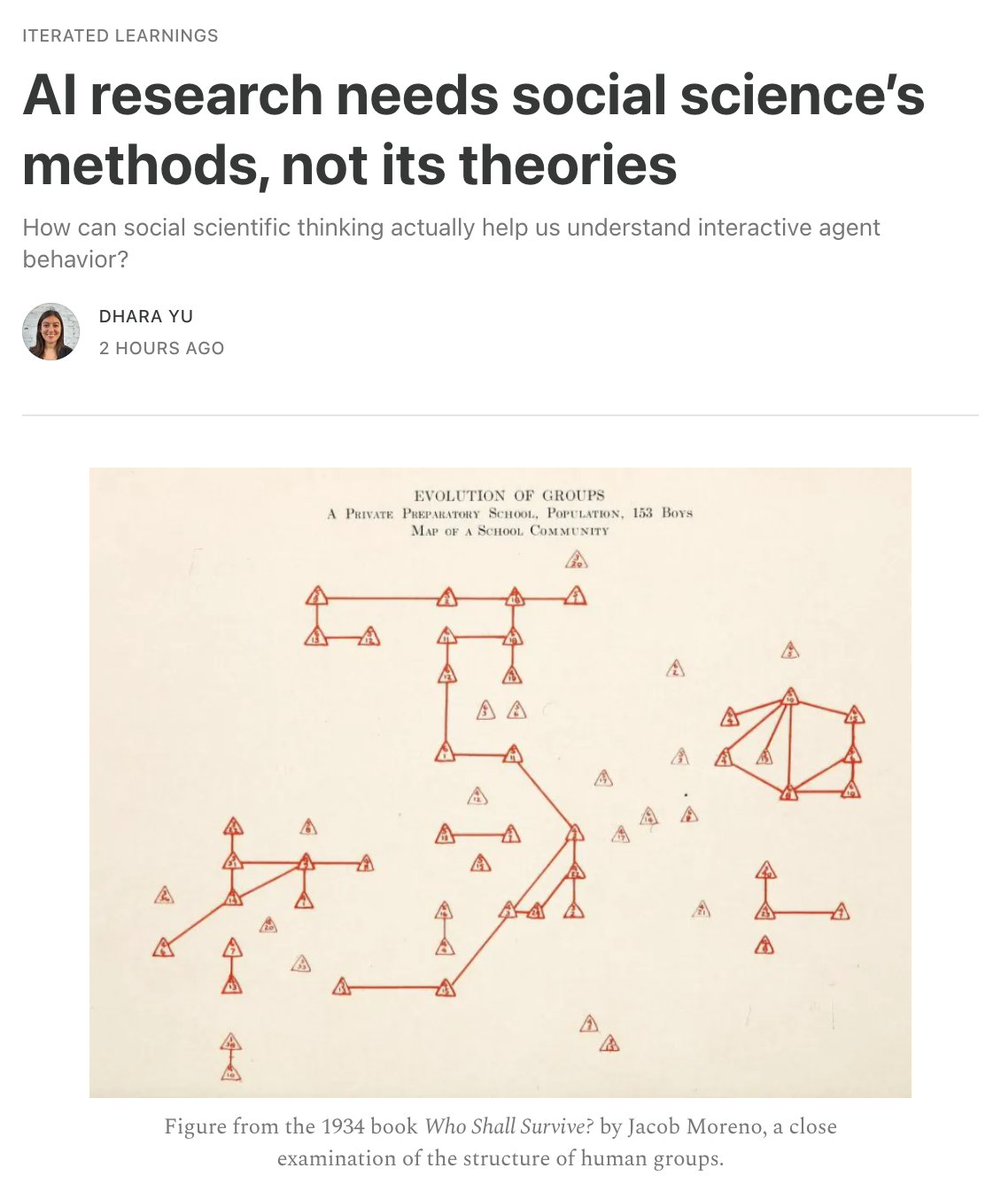
"The study of groups of AI agents, whether in controlled experimental conditions or in "in-the-wild" swarm settings, looks increasingly like social science. This raises the question: what should the relationship be between human and AI social science?"