@Oleg_Cherkasky@ChShersh IIRC from reading his rant, it was mostly to do with messy abstractions that undisciplined C++ devs would introduce in the kernel.
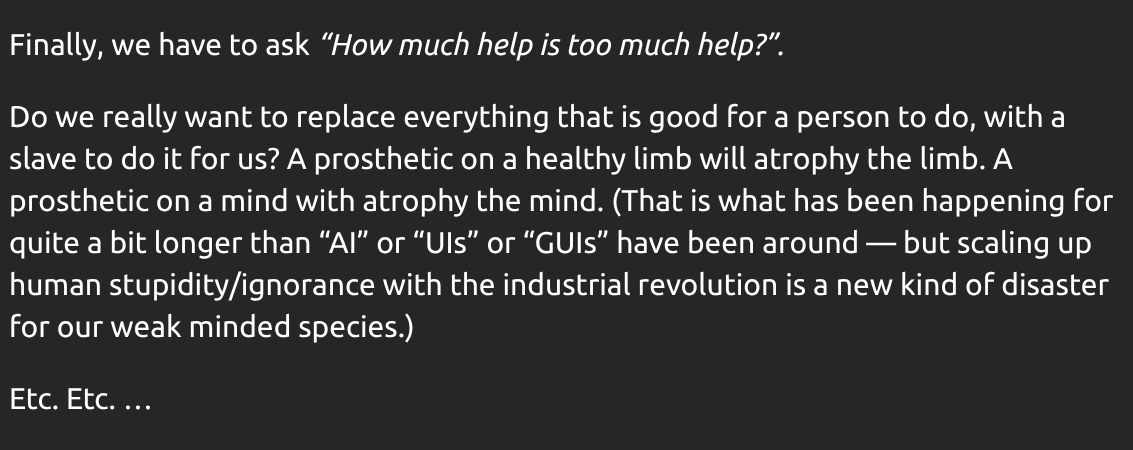
Alan Kay on the current form of AI 😂
"but scaling up human stupidity/ignorance with the industrial revolution is a new kind of disaster for our weak minded species."
I've got an agent in a loop optimizing a renderer with the goal to minimize frame times (and tests to measure). It got times down from 88ms to 2ms and allocations down from ~150K to 500. Sounds good, right? Wrong. This is exactly why agent psychosis is a big fucking problem.
As an experiment, I rewrote the Ghostty core render state in Go, with access to identically laid out data structures as Ghostty and the exact same validation tests. I made a purposely naive renderer (simple, correct, but slow). 88ms per frame with 150,000 allocations (horrendous, lol)!
I then kickstarted a Ralph loop to bring the frame times down. I told it it can't modify input data structures or the public API or tests (they're correct), but it can do anything else it wants. It got to work.
It has worked for about 4 hours. I've spent around $350 on this experiment so far. The results?
88ms => 1.5ms
150K allocs => ~500 allocs
Incredible right? Nope.
My hand-written renderer I ported has frame times (same benchmark) of ~20us (0.020ms) and 0 allocations in the update path.
This is the problem with psychosis and lacking systems understanding. If you don't understand the system, you're going to accept that this is an incredible result. If you understand the system, you'll see better solutions immediately and can do roughly 75x better on throughput.
The people who blindly trust agent output are in the former camp. They're sheeple, overdrinking from a fountain of mediocrity.
Standard disclaimer: I use AI all the time. I like AI. The point I'm making is to not blindly accept results. Think. Analyze. Learn.
@tokumin I feel that the trend towards training models to autonomously go off and try to do everything themselves is anti-human.
We should, IMO, be training LLMs to support humans in their learning, creativity, and iterative experimentation.
We desperately need better ways of evaluating models. Something that shows how helpful they are at working hand-in-hand with humans to help them get stuff done in a cooperative/iterative way.
The Claude models have consistently been better at this, and the market rewards that.
Someone can use AI to print hello world in python and I couldn't care less how the code emerged. The point is someone needs to be 100% sure what the code is doing to the best of their abilities, or we get bugs when it goes beyond their abilities.
The lower the cost of bugs is in your piece of software, the more you can trust unverified code.
However, many programmers would classify UX bugs as low cost when it means the difference between someone using your piece of software or not.
@karrisaarinen@garrytan The folks at Posthog once shared in their newsletter some ideas about the customer's attention budget. How much time and effort they are willing to spend to learn and use new features.
Looks like ultimately this will be the limiting factor.
the rift between people in tech and everyone else is bigger than anyone can imagine. people in tech should not be a variable you consider for anything unless your product is exclusively for them