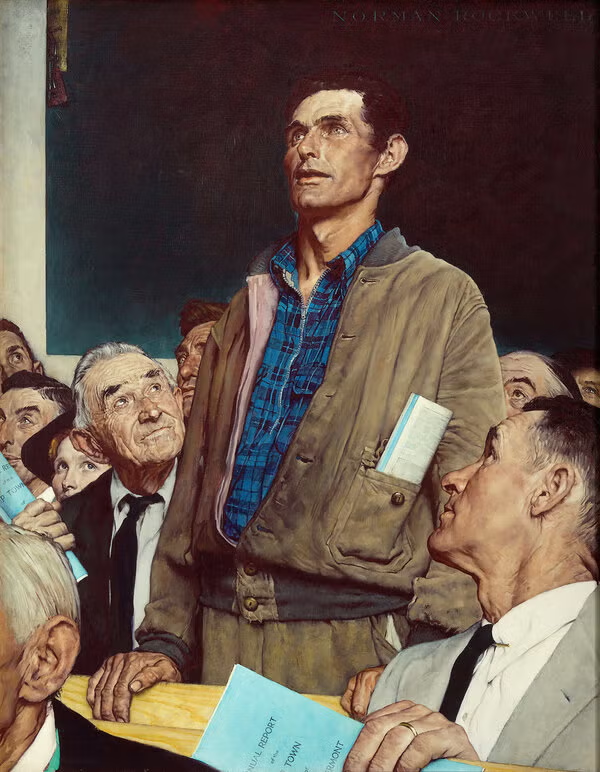
100 years ago this is what many classrooms in BC looked like
You cannot deny this province has been incredibly diverse since its founding
Even our first governor James Douglas was half black and his wife was Metis
In these classes are Ukrainian, Sikh, Chinese, Scottish, and Japanese Canadian students on Vancouver Island
they all lived in one little logging community together
Local indigenous people lived along side them all too, but i think their kids did not go to this school
Cool pictures 🇨🇦
Feel free to correct me with a counterexample…
…but I believe that the 2026 North Carolina Senate election is the most unfair legislative outcome of any election with ‘one person, one vote’ to take place anywhere in the world at any point in history.
D+15.9 | R majority
It is entirely fair to criticize Prime Minister Mark Carney for the way his government has presented Canada's immigration levels for 2027. By emphasizing its target of 380,000 permanent residents, while excluding additional admissions contemplated through one-time initiatives and time-limited measures, the government has created a misleading impression of how many people may actually become permanent residents. When these additional measures are included, the potential total could reach approximately 662,000.
What is considerably less reasonable is the suggestion that these additional admissions demonstrate that Carney has somehow lost control of Canada's immigration system. Such criticism ignores the situation his government inherited and the choices available to address it.
Over the past decade, Canada admitted millions of temporary residents, many of whom were encouraged, explicitly or implicitly, to view temporary residence as a pathway to permanent residence. Hundreds of thousands subsequently applied, only to find themselves caught between annual admissions caps and enormous processing backlogs.
Carney did not create this imbalance. It developed over many years, particularly toward the end of the Trudeau government's term, when temporary resident numbers expanded dramatically without a corresponding increase in permanent residence capacity.
Faced with this situation, the Carney government essentially had three choices:
It could maintain existing permanent residence targets and leave applicants waiting, potentially for decades, renewing temporary permits and living with uncertainty.
It could dramatically expand immigration enforcement and deport large numbers of temporary residents who can no longer maintain their status, requiring something resembling the U.S. Immigration and Customs Enforcement model.
Or, it could facilitate the transition to permanent residence for eligible individuals already in Canada.
Consider the tens of thousands of Hong Kong residents and Ukrainians who came to Canada under special immigration policies. Many established careers, enrolled their children in schools and applied for permanent residence. If critics believe these individuals should continue renewing work permits for decades or be required to leave Canada, they should clearly say so.
There is also an important distinction between granting permanent residence to someone already in Canada and admitting someone from abroad. A family that has lived in Vancouver for four years does not suddenly need another home when its permanent residence application is approved. Its children do not suddenly start attending school. They are already here.
Equally important, temporary resident admissions remain constrained by targets and restrictions, well below the extraordinary levels associated with the expansion during and after the pandemic. The Carney government is restricting new temporary immigration while facilitating the transition to permanent residence for people already here. Higher permanent residence admissions therefore do not necessarily mean a comparable increase in Canada's population.
None of this places the government beyond criticism. Canadians deserve transparent numbers and consistent eligibility criteria.
But criticism should confront the actual choices facing the government. Those who oppose these regularization measures should explain what they would do instead. Until they address the choices faced by the government and the reduction in people moving to Canada, claims that Carney has lost control come across as political rhetoric designed for social media clips rather than serious immigration policy discussion.
Maybe Lula, by not being a fucking slopulist like some other left-wing politicians, understands that welfare policies, progressivism, and defending sovereignty and democracy have to be combined with fiscal responsibility.
Maybe that's why he's one of the greatest left-wing politicians in history, rather than just spending his time lecturing everyone from the sidelines about ideological purity.
The radical left, as always, needs to reflect.
“republicans are right on the things that most people support them on, but they are insanely corrupt just look at NVDA” will get you 500 electoral votes and a mandate of god for Jon Ossoff to govern if you run on that message in 2028
Quebec separatists have always been a problem for Canada, with both bad policy for Quebec and via the federal government, for the rest of Canada. They are narrow ethno-nationalists uninterested in the wider world and learning anything from it, and bathed in a permanent grievance culture. Pierre Trudeau understood this which is why he castigated them time and again (and is about the only thing Trudeau was correct on).
As for the Plains of Abraham forward, British colonies be they Canada, Hong Kong, Singapore, Australia, New Zealand and others thrived in history because of the rule of law, separation of powers, anti-corruption efforts and a light-touch free enterprise economic philosophy. French colonies sank because of top-down, state-led policies which suffocate entrepreneurial activity among other poor outcomes.
I wouldn't expect a Quebec separatist leader to acknowledge any of the above but the rest of us don't need to play along with his anti-monarchical, anti-Canada petulance or ever give into what will inevitably be a new round of separatist demands. It's time for the rest of Canada, as a judge just did, to just say no.
Pour eux c'est :
Université d'Oxford,
London School of Economics,
Université de Cambridge,
Université Concordia.
Mais pour nos enfants :
« Tu étudieras uniquement en français et tu diras merci. »
#polcan#polqc#assnat#polmtl
Despite recent attempts to cement a narrative that immigration in Canada is surging, the facts show the opposite:
“IRCC figures show that Canada recorded approximately 252,200 regular permanent resident admissions between January and September 2026, compared with an annual central target of 380,000.
That leaves about 127,800 regular admissions needed in October, November and December alone.
Meeting the central target would require an average of 42,600 admissions per month in the final quarter—approximately 52% above the January-to-September average and about 20% above September, the strongest month of 2026 so far.”
https://t.co/eGFcMoCw3n
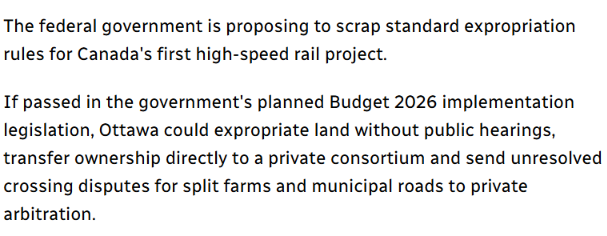
I’m developing increased optimism that the Feds know what it will take to actually build high speed rail and project Alto.
This is exactly the kind of seriousness we need to overcome the death-by-process approach we take to building infrastructure.