@cbventures' 2026 ideas spotlight "Proof-of-Humanity" in AI + Robotics — a timely insight as AI erodes the line between human and synthetic content. Verifiable, privacy-preserving identity is essential. At Solo, our shared vision with our investor @TimDraper on privacy-first human verification inspired his lead investment earlier this year. We're delivering exactly that: Decentralized 1P1A (One Person, One Account) on-chain powered by our own zkFHE biometrics. Enabling Credible Anonymity for secure Web3 lending, frontier AI data labeling, and Sybil-resistant ecosystems.
Our live PoC achieves on-chain verifications in seconds; partnerships with @GEODNET, @Meet_Perle, @JoinSapien, and other leading projects demonstrate real-world impact for Solo-verified human data.
@HoolieG, @jonathankingvc — Let's talk on how Solo advances your PoH vision.
Check out the full blog: https://t.co/5ON5HB95Ir
#ProofOfHumanity #Web3 #AI #CredibleAnonymity
Short term price moves do not measure long term progress. 2025 was a huge year for fundamental progress in crypto adoption and innovation.
We're sharing 9 ideas we’re ready to back that could define crypto’s next big thing in 2026. They break down into 4 main themes: 👇
“Where’s the money going if they stole all of our music?”
A Grammy-winning songwriter asked this week, as the fight over AI music reaches the major labels.
AI can make the song. It can’t tell you if it moved someone.
Being unfakeable is becoming a skill.
https://t.co/zalW78f1P5
YouTube’s AI detector wrongly flagged a hand-drawn animation as AI-generated.
The video became the channel’s worst-performing upload. Yet those who found it clicked more, watched longer, and rated it above average.
That’s the problem with AI-generated noise: without real human signal, even good work can look worthless.
YouTube’s AI Detection Kicked Us in the Face
Every creator's worst nightmare just happened to us: The YouTube algorithm actually blocked us. It started slowly at first. Some videos started showing strange view fluctuations. Our second to last video did very badly, but this just happens sometimes, so we didn’t think that much about it.
But then our last video, about Superpredators, did *extremely* badly. It was our worst upload since 2013. But it did badly in a weird way: Almost every single metric was well above average: People clicked the video more often and watched it for longer, and the people who watched it, on average, loved it! So it should have been at the very least an average upload, not the worst in over a decade.
So we quickly got in touch with YouTube, and they actually confirmed pretty quickly that something was going on. It turned out that YouTube’s automatic AI detection tools wrongly think that our very much human-made videos are AI Slop. So it started to choke our channel. Our contacts at YouTube were amazingly helpful and transparent with us, and hopefully the bug is fixed for now.
In principle, we are all for blocking AI slop from the platform; it really seems to have been bad luck.
Since we really love this video, we have taken it offline. We are updating and changing it a bit to make it worth watching a second time. We’ll reupload it in a few weeks, and hopefully this time the anti-AI tool will feel ok about it. If you have watched it before, it would help us a lot if you watch it a second time and all the way to the end for an Algorithm boost!
We’ll keep you posted!
8.3 billion AI personas.
We’re getting closer to a world where human behaviour can be simulated at planetary scale.
The next question is: how do we know who’s actually human?
Harvard and MIT Researchers Simulate the Entire Planet with 8.3 Billion AI Personas
It is big.
In a development that feels straight out of science fiction, a large collaborative team led by researchers from Harvard University and the Massachusetts Institute of Technology has unveiled MatrAIx: a population-scale AI simulation infrastructure designed to model the behavior of virtually every person on Earth.
MatrAIx centers on Persona 8B, a dataset containing 8.3 billion unique digital profiles. Each persona is defined across 1,290 categorical dimensions that capture everything from demographic background and psychological traits to spending habits, technical literacy, behavioral quirks, and lifestyle preferences.
I am using Persona 8B quite a bit and it is interesting.
The system is not merely a static database. Researchers bring these personas to life as agents powered by frontier large language models, including. These agents can then be dropped into four distinct digital environments: surveys, AI chat interfaces, live web browsing, and native desktop and mobile applications.
How MatrAIx Works
Persona 8B was constructed using a sophisticated dependency graph that preserves realistic correlations between attributes. Some records are synthetically generated while others are carefully extracted and grounded in real human data from biographies, reviews, surveys, and consented self-reports.
For practical research use, the team has released a high-quality coreset of approximately one million personas.
Once activated, the agents interact with real digital products and systems. Researchers have already run more than 18,000 evaluation trials across 1,010 tasks spanning commerce, software, finance, healthcare, and more than 20 other domains. The system records granular behavioral signals — how long an agent hesitates after a price increase, when it abandons a broken checkout flow, how much latency it will tolerate before closing an app, and whether it continues after an AI assistant fails.
Strong Validation Results
In a controlled study of 400 trials measuring adherence to ten behavioral attributes across all four environments, the agents successfully expressed or correctly suppressed their assigned traits 91.5 percent of the time. Human judges also rated the quality of the human-grounded personas highly (average 4.135 out of 5).
These results suggest that MatrAIx can generate coherent, demographically and psychologically consistent simulated users at a scale previously impossible.
Implications for Research and Business
Traditional market research and user testing are slow, expensive, and limited in sample diversity. MatrAIx offers a complementary approach: the ability to simulate how billions of different types of people might react to a new product feature, pricing change, interface redesign, or AI system — overnight, on a single server.
Product teams could stress-test ideas before expensive real-world launches. Researchers studying human-AI interaction could explore rare behavioral edge cases. Policymakers and social scientists might model the downstream effects of new technologies across highly diverse populations.
The project is open source. Code is available on GitHub, a project website has been launched at https://t.co/l3hUuIuiYt, and the one-million-persona coreset is being released for broader research use.
MatrAIx is not intended as a replacement for real human feedback. The researchers emphasize that it is a powerful tool for exploration, hypothesis generation, and large-scale stress testing.
As the underlying language models improve and the persona models grow more sophisticated, the fidelity of these digital populations is expected to increase further.
For now, the system represents one of the most ambitious attempts yet to create a usable, population-scale digital mirror of humanity a simulation infrastructure that lets us ask “what if” at planetary scale before deploying them in the real world.
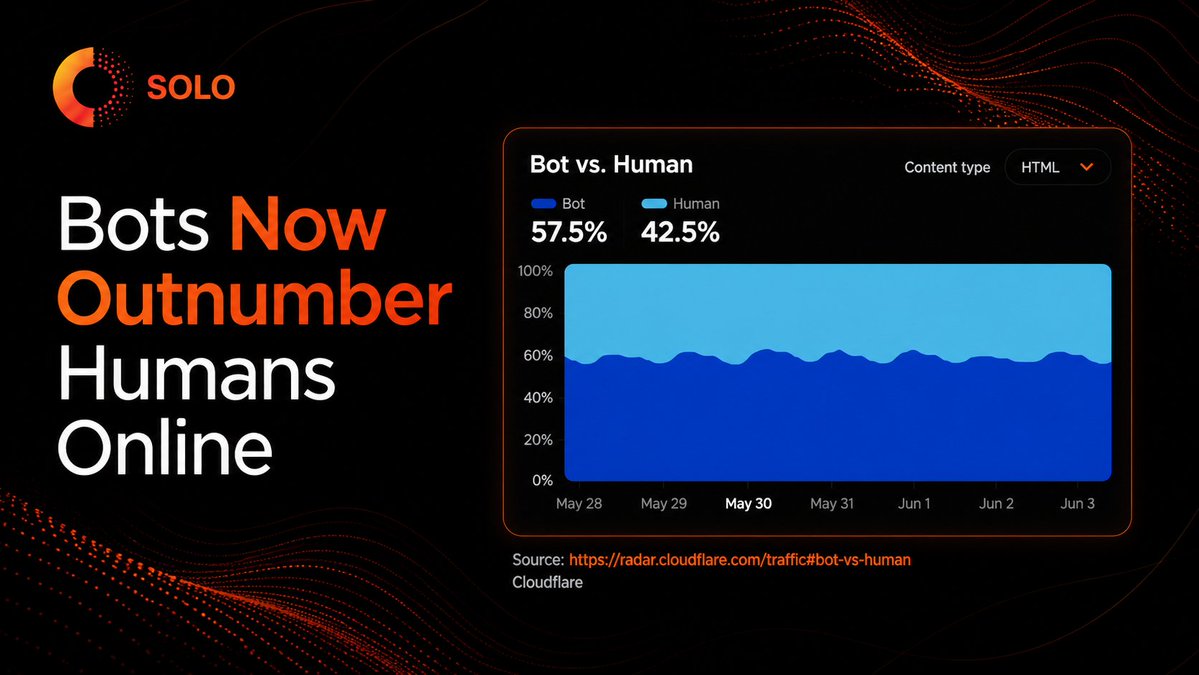
Bots now outnumber humans online.
Trust can no longer rely on clicks, CAPTCHAs, or reputation alone.
In the AI era, every interaction starts with:
• Who are you?
• Can I trust you?
• What's your track record?
Proving you're human becomes one of your biggest advantages.
A beta test user tried @projectsolo and asked me, "Wait... you never asked for my name. Is this even a real verification?"
Best question we get because most people think verification requires you to hand over your name, your documents & personal data - that's a KYC.
We don't do things in the same way. To keep bots out, you don't need to know who someone is, you only need to know they're one real, unique human.
Those are very different questions.
An AI-generated poster won first place at the Ohio State Fair this week
Nobody noticed the American flag had the wrong number of stars and stripes until after it had already won. That's how this keeps happening: Approval first. Public feedback second.
We've been building the version that runs in the other order: Show real people first, find out what they actually felt, and still have time to do something about it.
It opens soon, come argue with us about where this breaks.
LinkedIn added a "Seems like AI slop" button.
It's useful... but late.
Once your audience is telling you your content missed, it's already over.
The better way: Show it to 30 people first. If too many feel nothing, rewrite it.
The real advantage is knowing before you publish.
Zero-knowledge is having a moment in agent security, for good reason.
ZK alone does not answer who is bound to the key. A perfect proof from a hijacked session is still perfect.
Crypto without a human binding layer is elegant math on a hollow identity.
Everyone wants a kill switch for agentic AI. Almost none work under load.
If the same identity stack runs the agent and "owns" the stop button, you have theater, not control.
Control needs a human-bound path the agent cannot rewrite or spoof.
Training data used to be mostly human. That majority is gone.
Models now train on other models and bot scrapes. The loop still assumes a real person at the bottom.
Synthetic all the way down makes agents confident about the wrong world.
The Vlad Tenev X hack is a textbook case:
1. Take over a trusted account
2. Launch a fake “official” memecoin
3. Extract value before anyone notices
Social trust is broken.
Blue checks aren’t enough.
We need cryptographic proof of who is actually posting.
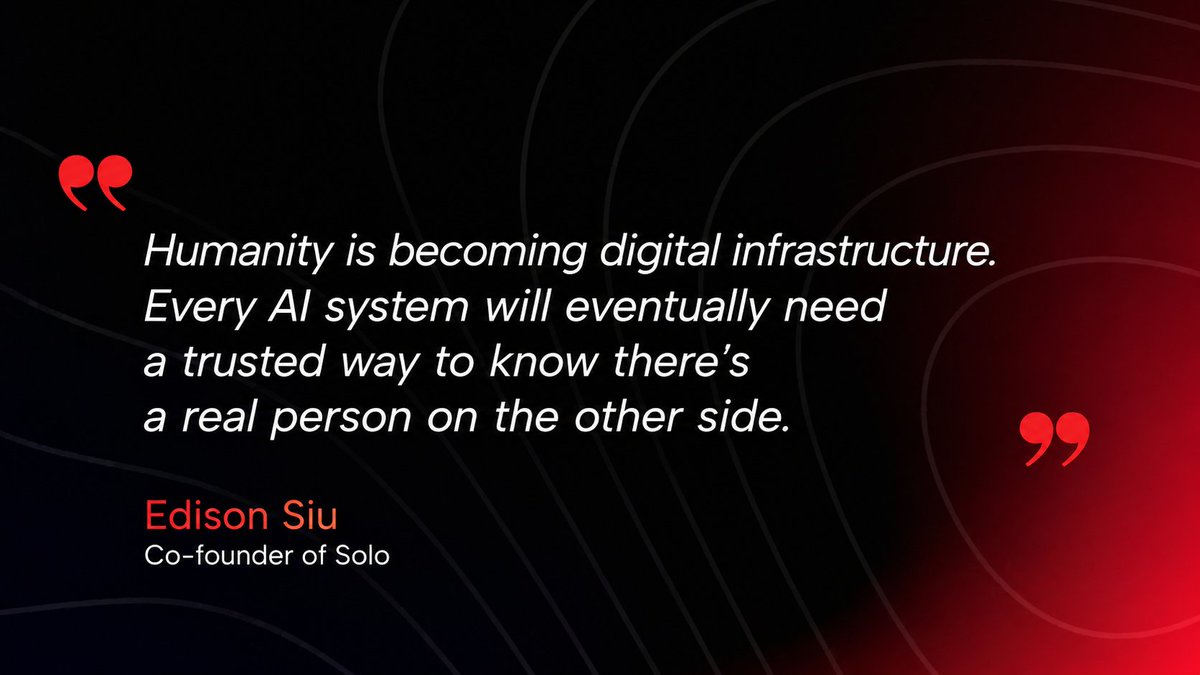
Every technological era creates a new abundance and a new scarcity.
In the AI era, content is abundant. Trust & Human judgment becomes scarce.
HTTPS became standard once the web couldn’t function without trust. We believe proof of humanity is on the same path.