The University of Chicago is home to one of the world's great collections for the study of South Asia. There are over 700,000 volumes related to Southern Asia there, covering all the languages and dialects of the region. How these vast collections came to be is a story not told often, perhaps because it’s unflattering, and involves an ironic twist of fate.
Once upon a time (in the early 1950s), after a series of bad monsoons, India was grappling with grain shortages so severe that the fledgling government feared a ghastly sequel to the Bengal famine of 1943. We needed grain, desperately. But there was no foreign exchange to buy it, even if it were available. The United States, due to a happy mix of historical and geographical circumstances, was awash in wheat, producing far more than it could consume or even sell.
Enter PL 480, or Public Law 480 of the 83rd Congress. Under this law, the United States provided wheat to India (and other nascent nations), in periodic shipments, accepting payment in local currency. Thus began what was disparagingly called the “ship-to-mouth” phase of our economy. It’s a phrase that is seared into our collective memory.
The arrival of these ships was breathlessly reported on the airwaves and made headline news. Their timely docking would defer the prospect of food riots by another shipping cycle.
Many commentators around that time claimed that the wheat sent to India was “fit enough only for pigs!” Large swathes of India had only rice eaters and despite repeated pleas, the U.S. grudgingly offered only a small quantity of rice. Resulantly, the South Indian diet, rooted in a tradition of rice, had to make way for foreign wheat.
The payment in local currency, charmingly called “interest payable by the Government of India on the wheat loan of 1951”, was parked in a special RBI account. A large part of the said rupees was earmarked by the United States for “cultural exchange”. This phrase, dripping with diplomatic niceties, translated to buying Indian books for American libraries. The brief from the Library of Congress was to acquire every currently published monograph/book/periodical/journal/document/map etc. of research value. The grand idea was to trade mid-western wheat for anything and everything that was published on the Indian sub-continent, in any language.
By January 1962, the PL 480 library program for India was in full swing. A Library of Congress field office in New Delhi sprang into action, successfully channelling vast quantities of literature to U.S. research libraries at both public and private universities. The collections amassed under PL 480 now rank among the world’s largest in area studies literature. A total of 46 libraries, alongside the Library of Congress, reaped the benefits, with an additional 300 libraries receiving English-language publications. Among the chief beneficiaries was the University of Chicago, handpicked by the Library of Congress.
Policymakers also involved the CIA in PL 480 acquisitions, ostensibly to meet its need for foreign literature for intelligence analysis. A declassified memo from April 1962 revealed that the CIA was snapping up less than half the total literature and titles that PL 480 funds were procuring from India, Pakistan and the UAR (Egypt).
PL 480 was like a Trojan horse draped in diplomatic finery that went back and forth on a conveyor belt. Clearly, every librarian and field office employee wasn’t a pawn of imperialism or Cold War machinations. However, the fact that early proponents of the acquisitions program saw it as an instrument in the intellectual Cold War cannot be ignored.
So, the next time you find yourself in the hallowed halls and library stacks of an American university, remember this: the volumes of Indian thought and culture and history you see owe their existence to a clever little law and a wheat deal that swapped excess American grain for an incredible bounty from South Asia.
On the Ashoka WhatsApp group there is a discussion on the convocation speech and what kind of convocation speakers we should look for. Most people are posting videos of commencement speakers from US universities.
I posted the following message
👇
A random thought on convocation speeches.
We want a convocation speech that is slick. One that is delivered by a speaker in polished sophisticated English. With the right accent using the right words.
The convocation speaker in my graduating class at IIMA was V Krishnamurthy. Chairman of SAIL. He said all the right things but guess what - thirty four years out I don’t remember a word of what he said and I don’t think what he said made any difference to the lives of any of my classmates. That speech did not change anyone’s behaviour or influence any of the choices we made in our lives.
However I vividly remember remember the speech made by the chief guest at IIMA in the previous year. Being in the junior batch I was not invited to the event so along with several others from my class I watched the function from the first floor of the building on the side.
The chief guest was Dr Verghese Kurien Chairman NDDB.
He was not polite. He was downright rude. He was condescending. He was sarcastic. He was caustic. He was insulting. He spoke a few home truths to the graduating class. He taunted us.
He opened by congratulating the graduating class. He then said that this is not the Indian Institute of Management. This is the Indian Institute of Management for Shampoo Salesmen. And that the entire graduating class could now look forward to a life where they spend their time selling soap and shampoo. For that is the limit of our aspiration and ambition he said. We just wanted to work for Multinational Corporations peddling their wares to Indian consumers. Such a collosal waste of talent he called it. And throughout his speech he repeatedly used the term “shampoo salesmen” derisively to describe the graduates of IIMA.
He challenged us to do something more meaningful with our lives and try and make a difference.
But then he lamented that his words were going to fall on deaf ears and that we would take the safer option.
Now it requires some guts to go as a chief guest to a function and then make a 30 minute speech berating and insulting your hosts. But that was Dr. Verghese Kurien. In your face. Blunt. Calling a spade a spade.
By the end of it our ears were burning.
But guess which speech we remembered.
And Some of us did do something different.
The class of 1989 has produced the most number of entrepreneurs in the history of IIMA.
Sometimes warm fuzzy convocation speeches don’t make lasting impact.
@spoggioli1@NPR My first name is often misheard as your last. It’s the closest familiar sound for many. That’s how much of an icon you are.
Thanks for your wonderful reporting.
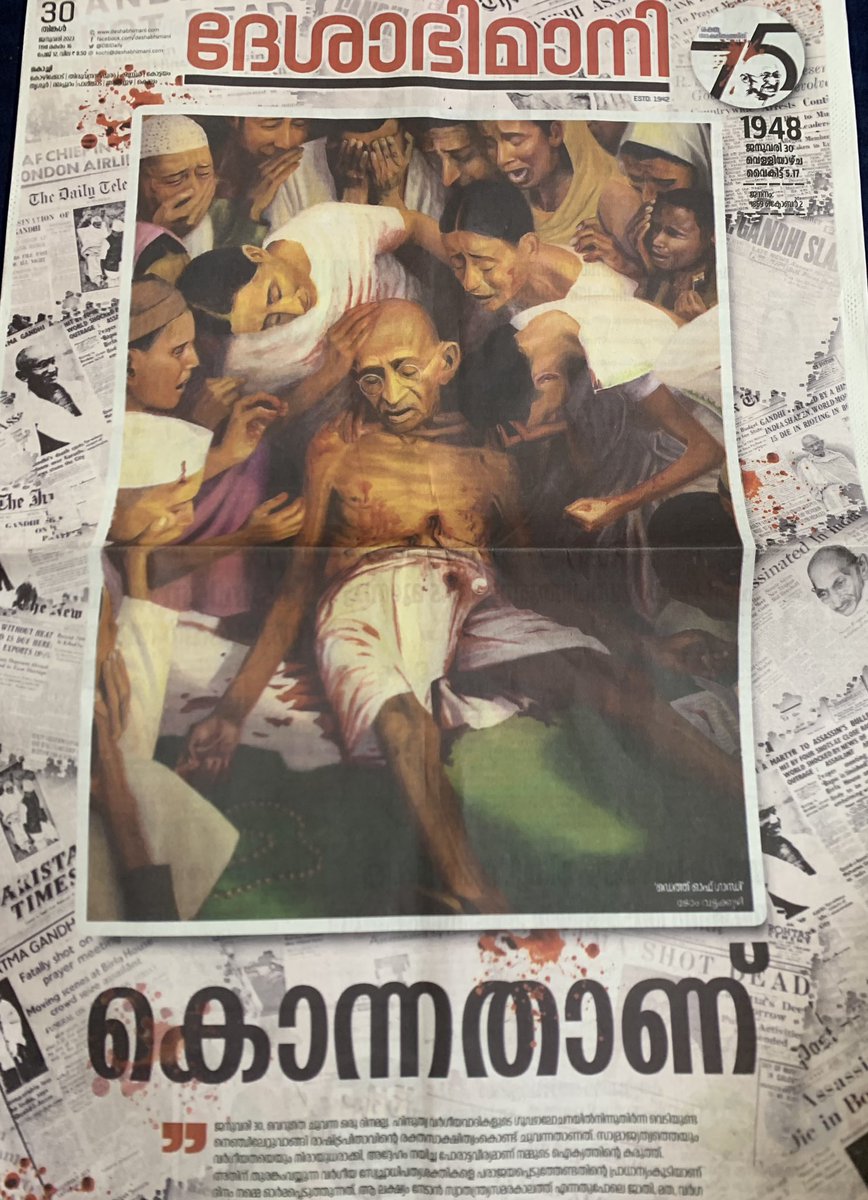
Patricide. The Death of Gandhi by the peerless Tom Vattakuzhy. Oil on canvas (9ft x 6ft). Stunningly rendered. On display at the @IndiaArtFair 9-12 Feb. @projjal
Today’s Deshabhimani has a stunning first page. ‘Killed him’ is the caption. Tom Vattakuzhy’s watercolour’Death of Gandhi’ is now at Icon Contemporary Gallery, New York. Will be exhibited in India during India Art Fair, New Delhi, starting from Feb 9th
Boss how can you claim vegetarianism as a default virtue in Hinduism when LITERALLY every single myth of ours involves folks hunting. Unless you think Ram or Shantanu were into taxidermy, what do you think they were hunting for? To eat!! That's the whole damn basis of Ramayana!
Former Lucknow Varsity VC Roop Rekha Verma. At the age of 79 she has volunteered to stand as surety to fulfill the court condition for release of Siddique Kappan in UAPA case. Bail condition required 2 UP natives but no one in Yogi land was willing.
मिलिए शर्मिला से।
कुछ साल पहले तक शर्मिला साइकिल चलाना भी नहीं जानती थी लेकिन आज वो दिल्ली सरकार द्वारा बस ड्राइविंग की ट्रेनिंग ले कर डीटीसी (@dtchq_delhi) की बसें चला रहीं हैं।
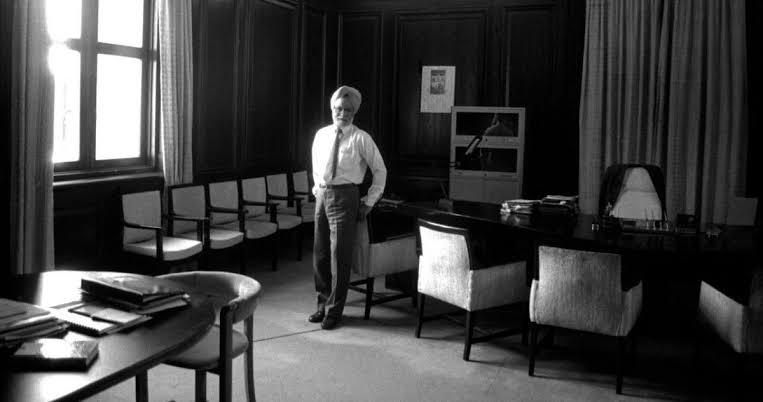
While in Delhi for a GST GoM etc, I was blessed w/ another meeting with the peerless Dr. Manmohan Singh. Though weak, his mind is still sharp, & it was joy to hear him chuckle😊
As a mark of respect, a picture of him in his office on his first day as Union FM (🙏 @ThePrintIndia)
Respect for religion has become a code phrase meaning 'fear of religion.'
Religions, like all other ideas, deserve criticism, satire, and, yes, our fearless disrespect.
-Salman Rushdie