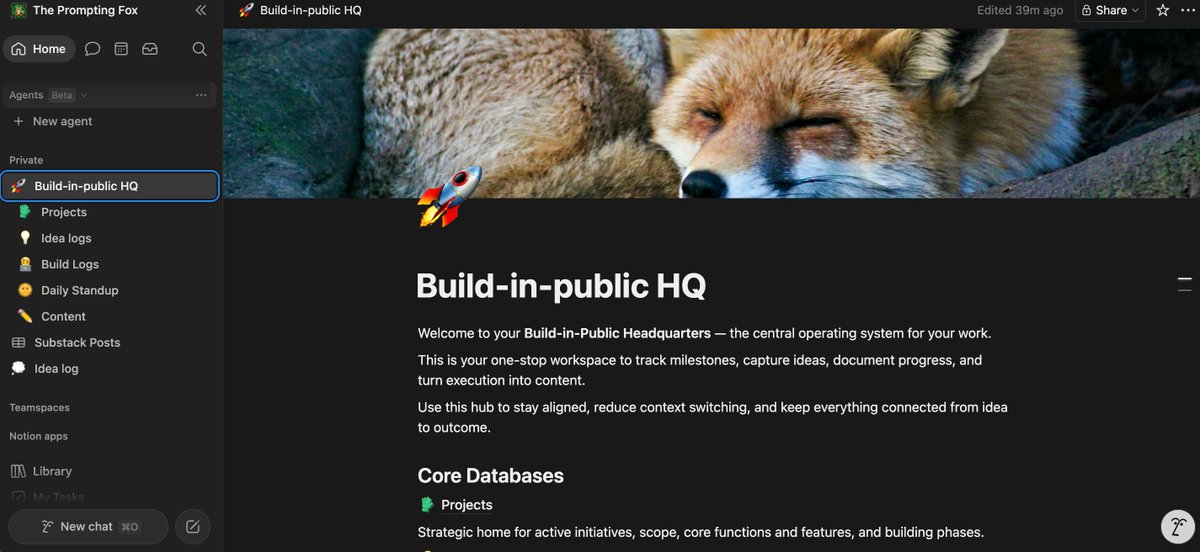
🧵1/ Launching Build-in-public Headquarters: AI + Notion = automated sharing of your progress and smartly planned todos.
I was building another project when I realized something: managing multiple projects and ideas as a solo founder is a different kind of chaos. Especially for me who has ADHD, ideas grow in my brain like an explosive web.
But ideas aren’t todos planned strategically.
Sometimes the problem isn’t coming up with ideas — it’s knowing which one to focus on. Other times, it’s forgetting ideas altogether, or how they connect back to your north star goal.
That disconnect kills momentum.
So I built Build-in-Public HQ — a simple, flexible, AI-enhanced notion dashboard to help solo founders and multitaskers like me orchestrate ideas, projects, and progress without drowning in complexity.
Here’s what it does:
🗂 Keeps all your projects, ideas, build logs, diary entries, and social posts in one place
💡 Logs every idea—even the random ones that don’t fit anywhere yet
🔗 Tracks your work automatically via synced GitHub releases, pushes, and commits (no more manual logs)
🤖 Generates AI-powered daily standups with strategic todos & learning suggestions based on your goals & blockers
📝 Auto-creates social media drafts from your recent builds and thoughts
Everything is notion-based: no reinventing the wheel; you control your data. Turn your chaos into a map, not a mess.
Github link: https://t.co/RbIU69cOnd
Key features below ⬇️:
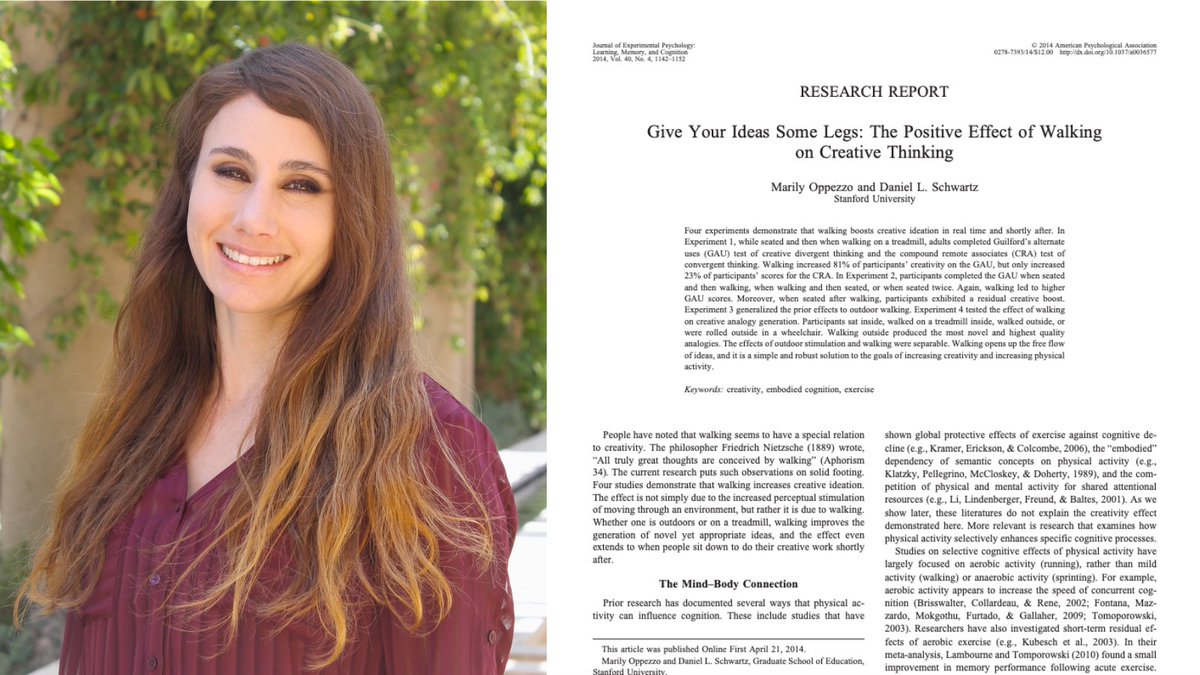
A Stanford psychologist spent 4 years proving that the simple act of walking generates 60% more creative ideas than sitting, and the experiment she designed to kill every alternative explanation is one of the most decisive findings in modern psychology.
Her name is Marily Oppezzo.
She got the idea for the study while walking with her advisor at Stanford to discuss her thesis topic, and the paper she eventually published in the Journal of Experimental Psychology in 2014 is sharp enough that it should have ended the seated meeting on the day it came out.
She ran 4 experiments on 176 people. Same person tested twice. Once sitting, once walking. The creativity tasks were the standard ones psychologists have used for decades to measure how good a brain is at generating novel useful ideas.
The result was almost too clean to publish.
81% of participants in the first experiment produced more creative ideas while walking than while sitting. In the second experiment, 88%. In the third, 100%. Every single person walked into a more creative version of themselves.
On average, people generated 60% more novel useful ideas the moment their legs started moving.
The skeptical question is the obvious one. Maybe it was the fresh air. Maybe it was the scenery passing by. Maybe it was the change of environment doing the work, not the walking itself.
Oppezzo killed every one of those explanations with one experimental decision.
She put people on a treadmill facing a blank wall. No scenery. No fresh air. No environmental change. Just legs moving in place while staring at white drywall. The 60% boost held.
Then she ran the experiment that closed the case completely. She took participants outside in two conditions. Half of them walked through a Stanford courtyard. The other half were pushed through the exact same courtyard in a wheelchair. Same outdoor stimulation. Same scenery passing at the same speed. The only difference was whether the legs were moving.
The walkers produced dramatically more novel high-quality ideas than the wheelchair group. The outdoors did almost nothing on its own. The walking did everything.
This is the part of the study that hit hardest when I read it the first time.
She also tested the opposite kind of thinking. Convergent thinking. The kind where there is one right answer and you have to narrow down to it.
Word puzzles where 3 words share a hidden fourth word that connects them. The seated participants did slightly better on these. Walkers got slightly worse.
Walking is not a general intelligence enhancer. It does one specific thing. It opens up the divergent search inside your brain. The part that generates options. The part that produces unexpected connections. The part that takes a problem and finds five ways into it instead of one.
When you need to converge on the single right answer, sit down. When you need to find the answer in the first place, get up.
The mechanism is now well understood. Walking selectively activates what neuroscientists call the default mode network, the system inside your brain that runs when you are not consciously focused on anything. The DMN is where mind-wandering happens. Where memories cross-reference each other. Where ideas that have been sitting in separate folders inside your head finally bump into each other.
When you sit at a desk and force yourself to concentrate, you suppress the DMN. When you walk at a natural pace, the executive part of your brain gets just busy enough handling the walking that the DMN comes online and starts doing the work that focus was blocking.
The most useful finding in the entire paper is the one almost nobody quotes.
The boost did not turn off the moment people stopped walking. Participants who walked first and then sat back down stayed elevated. Their next round of seated creativity work was still significantly better than people who had been sitting the whole time. The rest lingered for at least several minutes after the legs stopped moving.
You do not need to do creative work while walking. You need to walk before the creative work. The brain holds the state.
The history of this is the part that should haunt anyone who still does meetings in chairs.
Charles Darwin built a gravel loop behind his house in Kent called the Sandwalk and walked it 3 times a day for the rest of his life. The theory of evolution was developed one lap at a time on that path.
Nietzsche walked up to 10 hours a day during the years he wrote his most important books and openly said the work was conceived on his feet.
Beethoven composed for the morning and walked for 5 hours every afternoon with a pencil in his pocket for when something landed.
Kahneman said the best thinking of his Nobel Prize-winning career happened on leisurely walks with Amos Tversky. Steve Jobs refused to take important conversations sitting down. He held them on foot.
Every one of them was using the system Oppezzo would not measure until 2014. They just did not know what to call it.
The question worth sitting with is the one almost nobody asks.
Every meeting you have ever attended sitting around a table was a meeting held at a fraction of the brain power that was actually available to the people in the room. Every brainstorm that got stuck inside a conference room. Every problem you tried to solve at a desk and gave up on. Every idea you could not quite get to.
The intervention is the easiest one in modern science. No supplement. No app. No subscription. No training program. Just a pair of legs and 15 minutes.
The Stanford lab proved it. The philosophers knew it. The neuroscience explains it.
And almost everyone reading this is still trying to think their way out of problems sitting completely still.
“Food for thought” will quite literally become the food for our minds.
Like farmers feed our hunger, content will feed the mind. And creating content isn’t an easy job — it takes a lot of effort to nurture your mental and physical health to be able to generate good content that makes people feel something in their hearts.
In a sense, this is similar to how agriculture works: it takes the busy farming season and the off-season to grow the good stuff. Good content is born out of both productivity and generous, very generous idle time. (We can, of course, industrialize agriculture and grow all-weather food, but that’s exactly why organic, home-grown produce in the farmers’ market is becoming a premium)
https://t.co/5WHOoLQ2a5
I have a theory: Boredom is the new hunger. Content creators will become the new “farmers” in the age of AI and robotics.
Mankind’s physical needs will be largely satisfied by the productivity gains from AI and robotics (assuming UBI becomes a reality). You could argue that, even in abundance, there will still be manufactured scarcity (like luxury goods), but those are really forms of sensory consumption disguised as physical objects like bags and jewelry.
“Food for thought” will quite literally become the food for our minds. The content we consume doesn’t come from nowhere: gaming, videos, books, short-form content, etc. While much of this will initially be automated by AI, we’ll eventually grow bored with its aesthetics.
This will push content creators to grow new kinds of “food for thought” to satisfy that insatiable void in our minds—the craving for sensory and intellectual stimulation.
Just as farmers feed the body, content will feed the mind.
For example, sex can be (and probably will be) serviced by robots, but intimacy cannot. Food can be produced and served by robots, but the luxury fine dining experience and attention from the staff cannot.
Becoming a farmer probably won’t be AGI proof, but intentionally choosing an idyllic lifestyle that satisfies your spirit can (and perhaps, you make some vlogs that become a “food for thought” that inspires others)
The core theme/narrative extraction logic is a prompt engineering problem: https://t.co/D7tlHlkbHS
But this solves only 80% - 90% of the problem.
Sometimes, I do need to "manually" re-categorize certain things. But I track those changes and make AI learn that behavior over time.
One example is that LLM typically identifies "Iran", "Middle East", and "Strait of Hormuz" as three separate themes, but in today's reality, they refer to the same theme. So you can choose to group them into one theme manually, the system keeps a dictionary of the mapping between merged themes and the embedding of all its equivalents, and LLM compares future documents against the embedding of this grouped theme.
But the decision also kind of varies by analyst:
A macro trader may group "crude oil" into the bigger theme "middle east", but for a commodity trader, they probably want "crude oil" to be a standalone theme.
and by time:
"Iran" and "middle east" refer to one theme in today's environment, but "middle east" could be more related to "luxury sales", "investment" etc., in a more peaceful period of time and deserves to be its own theme.
But I think that's the point. Build a flexible system so it thinks like how you would think. I don't think there's an universal truth that works for everyone. And there will be some corner cases. But it'd still speedup 80% of the workflow.
I feel like I have 10 partime jobs and no fulltime job.
Everything says lifestyle entrepreneurship is the trendiest thing nowadays—I guess I’ll just make my very divergent thinking one into a career then.
I’ve been juggling ideas like fireworks for years—one thing leads to hundreds of other things like an explosive web in my head.
As an entrepreneur with ADHD, the problem wasn’t a lack of creativity. It was the chaos that came with it.
New ideas popped up faster than I could track, projects swirled around, and I’d bounce from one shiny thing to another. I never finish anything.
So while I was building something else, it hit me: this problem—managing the mess of ideas, projects, and actual progress—is more urgent than any single feature I was working on.
That’s how Build-in-Public HQ was born. (Thanks to AI, it took me one afternoon to build it)
It’s a Notion + AI workflow I designed not to force me into rigid task lists.
What I love about this setup is how it helps me break that cycle. Instead of piling on more unfinished ideas, I get a daily reality check.
AI-generated daily standup can tell me: “Hey, you’ve been coding nonstop—maybe it’s time to write that tweet or polish that demo.” It’s like having a strategic partner who understands my ADHD brain and the solo hustle.
And it writes a draft directly from my build logs and ideas so the content is genuinely me.
I do plan to wrap it into something that you can git clone and use (when I'm done procrastinating)
But hey, if you try it or have feedback, hit me up — early input helps shape what this becomes!!!!!!
🦊 Sending best vibes and wisdom to all of you guys.
https://t.co/kYjCygAnL5
3 weeks into the building-in-public thing, and someone on X reached out for a call. He founded a YC-backed company, read my 3000-word-long article, and thought my idea was interesting.
It works, guys …
If you complain about stalled learning or inability to fully realize your potential at your current career role, just create something for yourself. Small but interesting things will attract inspiring mentors and people from whom you can learn.
I just blindly trust that money will come eventually.🦊
I’ve been juggling ideas like fireworks for years—one thing leads to hundreds of other things like an explosive web in my head.
As an entrepreneur with ADHD, the problem wasn’t a lack of creativity. It was the chaos that came with it.
New ideas popped up faster than I could track, projects swirled around, and I’d bounce from one shiny thing to another. I never finish anything.
So while I was building something else, it hit me: this problem—managing the mess of ideas, projects, and actual progress—is more urgent than any single feature I was working on.
That’s how Build-in-Public HQ was born. (Thanks to AI, it took me one afternoon to build it)
It’s a Notion + AI workflow I designed not to force me into rigid task lists.
What I love about this setup is how it helps me break that cycle. Instead of piling on more unfinished ideas, I get a daily reality check.
AI-generated daily standup can tell me: “Hey, you’ve been coding nonstop—maybe it’s time to write that tweet or polish that demo.” It’s like having a strategic partner who understands my ADHD brain and the solo hustle.
And it writes a draft directly from my build logs and ideas so the content is genuinely me.
I do plan to wrap it into something that you can git clone and use (when I'm done procrastinating)
But hey, if you try it or have feedback, hit me up — early input helps shape what this becomes!!!!!!
🦊 Sending best vibes and wisdom to all of you guys.
https://t.co/kYjCygAnL5
HI Wil,
Thanks for your interest. I feel flattered when someone on the internet actually went through my long writing. I myself also don't use AI to make investment decisions, but you need some kind of impactful words like "second-brain" to stand out on the internet. I trust the value is in AI's ability to assist me such that I can process more information, so I can develop a better "hunch" feeling when actually making the investment decision (and free up mental capacity for other interesting stuff)
And to answer your question:
1/ I mostly search PDFs, newsletters/blogs, or make API calls. These are easier than open internet searching (which is a problem I haven't found a perfect solution for yet).
But frankly speaking, I find it less relevant for my scenario. I don't find that much valuable information on the open internet. Most stuff is just news, which I think is close to useless when it comes to investing.
But I am working on ways to improve "bespoke" searches (like looking for people's reaction toward Waymo vs Tesla on Reddit, tracing a particular datapoint somewhere on a pre-specified website, like the market cap of ETH)
2/ I extract key narratives from the source document and organize them into themes.
Themes are bigger ideas, such as a macro event, a region, an asset class, a new technology; narratives are what happens to those things: consequences, change of event, opinions toward these themes etc.
I track narratives per them per day. So overtime you know:
- what new themes are emerging
- what themes are losing steam
- within a theme: what are the new development
Do you have a LinkedIn profile or email that we can connect?
Mine: https://t.co/CozxGh0eaa
Building in public isn’t a straight line.
One day you’re coding like a maniac, the next you’re stuck staring at your idea log wondering what actually matters.
Keep showing up, even when your brain screams to jump to the next shiny thing.
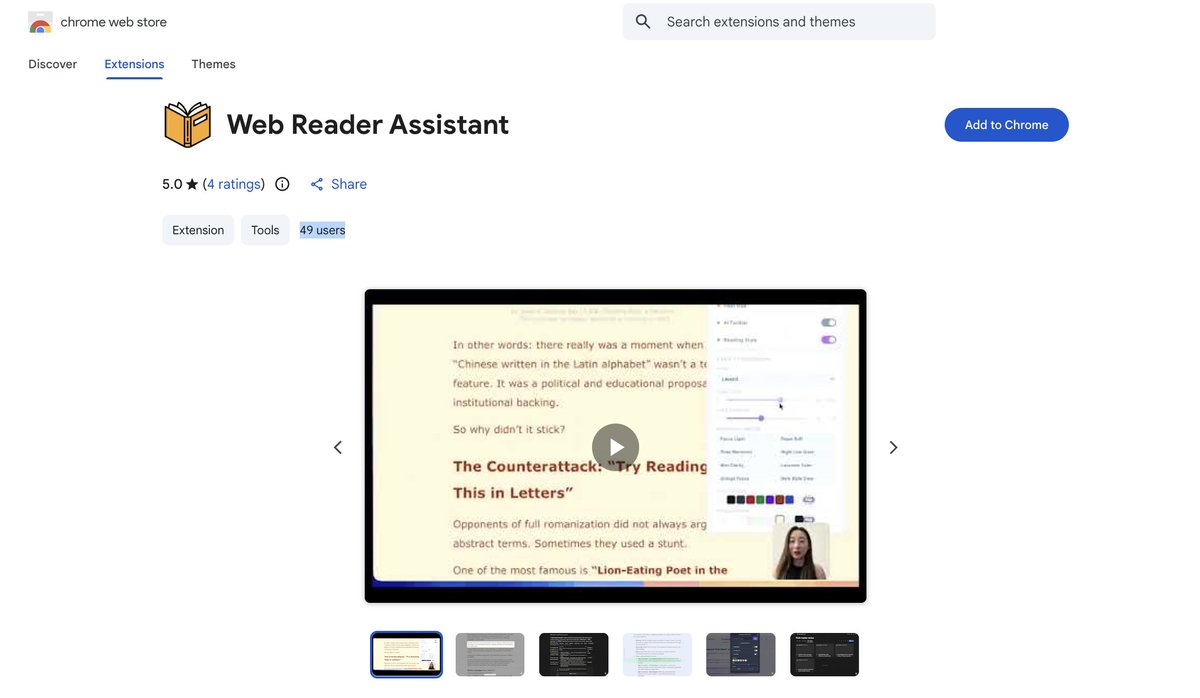
My chrome extension got 49 users and 4 ratings in just two weeks! This is beyond my expectation, as I put in 0 ads.
If you also have dyslexia, or find it difficult to read long article, please try it out! It's free!
🧵1/ Launching Build-in-public Headquarters: AI + Notion = automated sharing of your progress and smartly planned todos.
I was building another project when I realized something: managing multiple projects and ideas as a solo founder is a different kind of chaos. Especially for me who has ADHD, ideas grow in my brain like an explosive web.
But ideas aren’t todos planned strategically.
Sometimes the problem isn’t coming up with ideas — it’s knowing which one to focus on. Other times, it’s forgetting ideas altogether, or how they connect back to your north star goal.
That disconnect kills momentum.
So I built Build-in-Public HQ — a simple, flexible, AI-enhanced notion dashboard to help solo founders and multitaskers like me orchestrate ideas, projects, and progress without drowning in complexity.
Here’s what it does:
🗂 Keeps all your projects, ideas, build logs, diary entries, and social posts in one place
💡 Logs every idea—even the random ones that don’t fit anywhere yet
🔗 Tracks your work automatically via synced GitHub releases, pushes, and commits (no more manual logs)
🤖 Generates AI-powered daily standups with strategic todos & learning suggestions based on your goals & blockers
📝 Auto-creates social media drafts from your recent builds and thoughts
Everything is notion-based: no reinventing the wheel; you control your data. Turn your chaos into a map, not a mess.
Github link: https://t.co/RbIU69cOnd
Key features below ⬇️:
1/ build open-source, free products in public
2/ turn your ideas and values into content that speaks to someone and make them feel something in their hearts
3/ earn money from ads and stuff
Human are story telling animals.
We are gonna crave story like we crave food, luxury, and sex when cyberpunk arrives
7/ The "Orchestrator": Notion-based and user-owned
Everything lives in Notion. The AI simply orchestrates your thoughts—reading your history and inserting new pages. You can use Notion’s familiar interface to edit everything, create visuals, and refine AI-generated drafts.
Let’s face it: we need to apply our own judgment, not let an AI speak for us. This gives you "half-ready" content that you can polish without learning a new platform. You own your data, and you end up with a rich, personal diary of your entire product-building journey.
8/ The MVP & The Release
This is still an MVP, but it’s already a massive relief to have a space that respects how my brain works: messy, nonlinear, but full of potential.
I’m planning to wrap this into a release you can git clone over the next few days. It’ll set up the required Notion databases for you—you just bring your own API key to make it work.
I’d love your early feedback and ideas. What’s the hardest part about managing your projects and ideas right now?
Let’s stop building toys just for ourselves and actually get things done! 🚀
Github link: https://t.co/RbIU69cOnd
7/ The "Orchestrator": Notion-based and user-owned
Everything lives in Notion. The AI simply orchestrates your thoughts—reading your history and inserting new pages. You can use Notion’s familiar interface to edit everything, create visuals, and refine AI-generated drafts.
Let’s face it: we need to apply our own judgment, not let an AI speak for us. This gives you "half-ready" content that you can polish without learning a new platform. You own your data, and you end up with a rich, personal diary of your entire product-building journey.