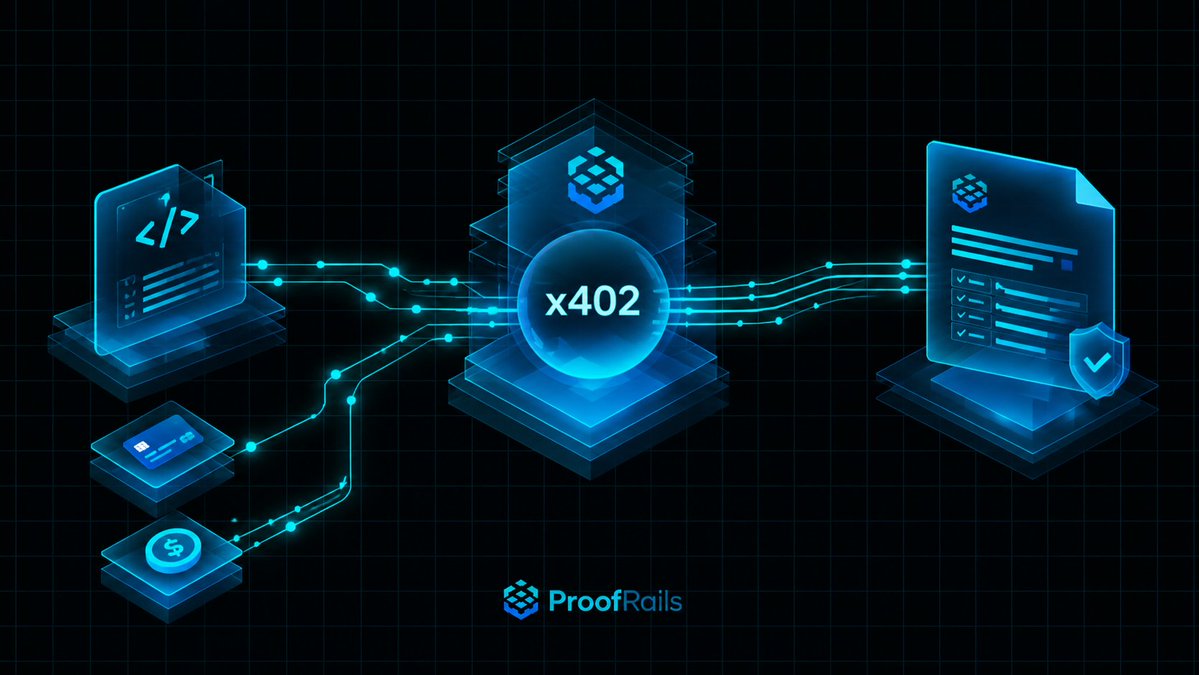
Today we’re launching the x402 facilitator on Coston2 under ProofRails:
https://t.co/ju5nHUeiaI
x402 alone is a payment gate.
ProofRails turns that payment into a verifiable financial workflow that agents, enterprises, and institutions can build on.
This first demo uses mocked USDT0 in an agentic flow to unlock a gated report page.
After the normal x402 payment flow, ProofRails creates an evidence record, anchors the bundle hash on Flare, and makes the flow independently verifiable afterward.
Got access to Devin CLI through this opportunity!
I’m going to test it on a real @ProofRails build: an adapter that turns AI dev-agent work into verifiable evidence bundles.
First goal: capture prompts, commits, diffs, tests, API calls, payments, and anchor the final proof on Flare.
Will share the process.
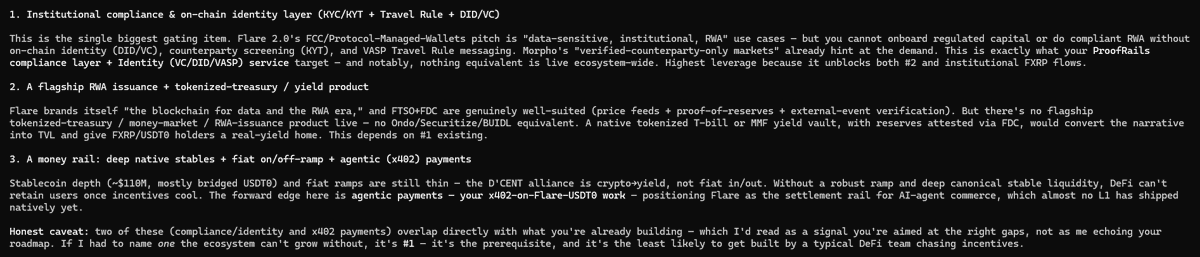
What stands out is that the missing layer is not only interoperability of assets, but interoperability of operations.
If value moves across multiple rails, then actions also need to become legible, governable, and provable across systems.
That is where ProofRails fits.
Machine-to-machine payments, agent execution, tokenized asset workflows, cross-rail settlement.
None of that scales cleanly if the output is just a transaction hash.
You need structured receipts, verifiable proofs, policy-aware execution, and audit-ready records that other systems can actually consume.
Moving tokens is one part of the stack. Making tokenized actions institution-readable is another.
This @CantonNetwork report describes a world where Ethereum stays a center of gravity for RWA, but clearly not the only one. The future will not be one winning chain.
Canton can serve institutional issuance.
- Ethereum can carry DeFi liquidity.
- XRPL can serve payment / settlement.
- And other rails will connect.
That is the Internet of Value: less silos, more circulation.
But the most interesting part is that the report is not only about “putting assets onchain”. It talks about an interoperability stack:
standardized payments, identity, compliance, data aggregation, analytics, intelligent orchestration, AI agents.
And #x402 is explicitly mentioned as an economic/service layer for machine to machine transactions.
This is where @ProofRails is not a gadget.
Imagine if tomorrow agents need to pay, generate receipts, verify proofs and anchor operations, this kind of machinet o machine payment becomes a real brick of the RWA architecture.
Same thing for AI agent orchestration.
These agents will monitor, adjust, move and optimize assets across several environments.
But they will need to be framed by risk management, programmable rules, verifiable proofs and auditability.
This is exactly where projects like Sentora, Firelight, ProofRails, and maybe an agent like @OfVoice25355 / $ADM if it evolves in that direction, become interesting.
The report basically says that efficient interoperability is not only about moving tokens.
You also need to verify data, prove rights, audit flows, manage risk, execute rules, protect sensitive data, and orchestrate assets across multiple rails.
Let’s not lie: this report describes a lot of problems Flare seems to be building for since a long time.
- FDC for data.
- FTSO for prices.
- FCC/ TEEs for confidential compute.
- ProofRails for receipts/proofs.
- @Firelightfi for risk.
- FSA/PMW for programmable execution.
The report does not mention @FlareNetworks. But the alignment between the @CantonNetwork /RWA narrative and what Flare is building is very interesting.
Any comment from the #Flare team or @HugoPhilion would be welcome. And if there is silence, I would also understand why... 👀
#Flare #RWA #Canton #ProofRails #DeFi #Tokenization #XRPL #NDAs
This implementation lets agents on @FlareNetworks request paid API operations through x402-compatible flows, generate or verify receipts, create ISO 20022-style payment records, and anchor proofs onchain.
Builders on Flare are getting more than DeFi primitives.
They are getting better rails for verifiable payments, agent workflows, and audit-ready records. 📃
This opens up a new layer for builders on Flare.
ProofRails moving into agentic workflows means developers can go beyond simple transactions — into automated payment logic, verifiable evidence, and programmable workflows.
For devs, this is about building systems that can generate, verify, and act on payment data autonomously, while staying anchored on @FlareNetworks.
Early, but a meaningful step toward more intelligent onchain applications ☀️
@CryptonistNord For now, the best place is the GitHub repo and public updates from our end.
Usage is harder to capture in one dashboard because ProofRails can run through APIs, SDKs, agents, local deployments, and onchain anchors.
ProofRails agentic branch is live! 🥳
This branch extends ProofRails v2 with x402 payments, AI/XMTP agent workflows, agent-triggered anchoring, FTSO price context, and SDK support for TypeScript and Python.
What can builders do with it?
Turn onchain transactions into ISO 20022-style payment records and:
+ Generate audit-grade evidence bundles.
+ Anchor receipt hashes on Flare.
+ Gate premium API endpoints with x402 payments.
+ Let agents pay for, generate, verify, and anchor payment evidence.
+ Use the Web UI, SDKs, or XMTP agent to interact with the system.
This is a pre-release branch, with the goal of making the agentic payment evidence layer public, testable, and easier for builders to extend.
Repo:
https://t.co/buQsm8cscL
Very happy with this new agentic release!
With this version agents can not only pay, but also generate records, verify bundles, and anchor proof onchain.
For Flare, this is a natural fit: verifiable records, FTSO price context, and a bigger path with FDC-backed verification, FAssets payments, and possible Smart Account-triggered flows.
XRPFi will need more than liquidity.
It will need records, proofs, and rails that institutions and agents can actually use.
This is essentially a bridge layer between blockchain execution and TradFi payment standards.
ISO 20022 mapping + onchain anchoring turns crypto transactions into auditable financial messages.
ProofRails V2 turns blockchain payments into a complete system that connects directly with traditional financial infrastructure.
Users can transform blockchain transactions into ISO 20022 payment messages, generate cryptographic evidence bundles, and build payment processing applications with onchain anchoring.
⚙️ Core capabilities include:
+ Generate 15 ISO 20022 message types including pain.001 (customer credit transfer), pacs.008 (payment status), and camt.054 (debit notification)
+ Create evidence bundles as deterministic ZIP files with cryptographic signatures for transaction verification
+ Anchor evidence on multiple chains (Ethereum, Base, Flare, Optimism) for immutable audit trails
+ Implement x402 micropayments to gate premium API endpoints
+ Deploy XMTP agents that process natural language commands and could handle payment operations
+ Enable automatic anchoring triggered by payment events or manual commands
+ Run multiple agents per project with independent wallets and configurations
+ Integrate via SDKs using TypeScript or Python client libraries