#Bitcoin is a generational opportunity, right now.
The Bitcoin Sharpe Ratio has hit a level that's comparable to any broad market bottom.
This early in 2026.
If you flip that measure, it's actually the best time to be investing in the underlying asset, in this case #Bitcoin.
The Bitcoin Sharpe Ratio is a metric that measures risk-adjusted returns.
It's essentially saying how much return you're getting per unit of quantity volatility you're willing to take. The lower the Sharpe, the worse the risk-adjusted performance of the underlying asset is.
If the metric is Red, it is in the Red (euphoric zone), you should question whether you should be holding the asset.
If the metric is Purple, it's in the Purple (low risk zone), you should question whether you should be accumulating the asset, as this can be classified as the 'Generational Buy' area.
Let's quantify that on the previous occurrences.
January 2015:
Purple zone hit.
Price of #Bitcoin $180.
Returns 12 months later: +133%
Returns 24 months later: +400%
December 2018:
Purple zone hit.
Price of #Bitcoin $3,200.
Returns 12 months later: +125%
Returns 24 months later: +806%
June/November 2022:
Purple zone hit.
Price of #Bitcoin on average $17,000-19,000.
Returns 12 months later: +120%
Returns 24 months later: +400%
The average returns after the Sharpe ratio has dipped in the <30 zone.
Three months: +40-80%
Twelve months: +125-135%
Two years: +400-800%
In that light, and I've stated this before, it's not strange to expect:
- #Bitcoin at $100,000 in Q3 2026.
- A new all-time high in Q4 2026/Q1 2027.
Statistical data proves that you'd rather want to be accumulating at these ranges.
The creator of Claude Code Teaches more about vibe-coding in 30 minutes than most paid tutorials do in 10 hours.
Absolutely Free. From the guy who built the tool.
Save it. Watch tonight. It'll change how you build forever.
You've been using Claude Code wrong for months without knowing it.
This fixes that in 30 minutes.
Follow @codewithimanshu for more high-signal content that actually moves your career forward.
↓
Boris runs technical staff at Anthropic.
He built Claude Code.
He just gave away the entire playbook.
This is the talk that separates people making $10K/month with AI coding from people still Googling "how to fix this error."
Here's everything he covers in 30 minutes.
Follow @codewithimanshu, I break down a video like this.
↓
Installation and setup the right way.
Not the wrong way you did it.
`npm install` to get Claude Code running.
`terminal setup` to enable Shift+Enter for new lines and themes.
GitHub app integration to @-mention Claude directly on issues and pull requests.
Mac users: system-level dictation for hands-free prompting.
Most people skip these steps and wonder why their Claude Code workflow feels clunky.
Follow @codewithimanshu For Full Claude Code setup guides.
↓
The workflow most users miss entirely.
Codebase Q&A is the real starting point.
Not "write me code."
Ask Claude about your codebase first.
It explores locally. No indexing. No data upload.
You can ask:
> Why was this function written this way?
> What did I ship this week?
> What's the git history of this file?
Understand the codebase before you touch it. That's how senior engineers think. That's how Claude Code wants to work with you.
Follow @codewithimanshu for more high-signal content that actually moves your career forward.
↓
Interactive coding that actually ships.
Claude uses file editing, bash commands, and file search to execute tasks in real time.
Boris's rule: brainstorm and plan BEFORE you trigger code generation.
Skip the planning step and you get garbage. Do the planning step and Claude ships production-ready code.
This alone is the difference between "AI wrote my app" and "AI wrote an app that actually works."
More ship-ready Claude prompts already posted on @codewithimanshu.
↓
Tool integration nobody uses.
Custom CLI tools. MCP servers. Integrated directly into your Claude Code workflow.
Claude calls your tools. Uses your data. Executes tasks across your entire stack.
This is where Claude Code stops being a coding assistant and starts being a full engineering team.
Follow @codewithimanshu for MCP server breakdowns every week.
↓
Iterative feedback loops.
Give Claude access to your unit tests. It refines until they pass.
Give Claude screenshots of your UI. It iterates until the design matches.
Most people run Claude Code once and accept the first output. The best users build feedback loops that let Claude improve itself.
I share the exact feedback loops I use daily.
↓
Context management: Claude MD.
Place a `claude(dot)md` file in your project root.
Persistent context. Shared across every session.
Enterprise config for global policies across teams.
This is the file that separates hobby Claude Code users from production users.
I'll post my full claude(dot)md template next week.
Follow me @codewithimanshu.
↓
Slash commands and memory.
`/memory` to view or modify how Claude remembers instructions.
Slash commands for automating complex workflows.
Example: auto-labeling GitHub issues with one command.
Slash command library coming soon on @codewithimanshu.
↓
Pro key bindings Boris drops at the end.
Shift+Tab: auto-accept mode for edits. Saves hours.
!Command: execute a bash command and pipe output into context.
Escape: safely stop Claude without corrupting your session.
Drag and drop images. Paste screenshots for UI implementation. Multimodal from day one.
Follow me @codewithimanshu for Daily Claude Code tips.
↓
30 minutes from the guy who built the tool.
You'll learn more from this than from 50 YouTube tutorials made by people who've never shipped production code with Claude.
This is where the gap gets built.
People who watch it understand Claude Code at the architect level.
People who skip it keep copying commands they don't understand.
Save the video. Watch it tonight. Build something tomorrow.
Follow @codewithimanshu for more high-signal content that actually moves your career forward.
Hi @firefish_io, would you mind share a bit of info on the auto invest option? I suppose protocol is the same, but there is an additional intermediary (you) and the consequent additional counterparty risk, correct? What about money withdrawal, how is it happening/processed? Thx!
11/
Bitcoin’s role in this stress model:
Not a “winner,” but a neutral beneficiary — positioned as:
• non‑sovereign reserve asset
• alternative settlement rail
• volatility absorber during trust erosion
Thread 🧵 | Hypothetical Stress Scenario: “Accelerated Multipolar Reconfiguration”
1/
Purpose: explore vulnerabilities of the USD‑centric system under extreme assumptions.
10/
End state (hypothetical):
• No US collapse
• Accelerated relative decline
• Multipolar system (USD / yuan / gold / BTC / CBDCs)
• Higher global volatility & friction
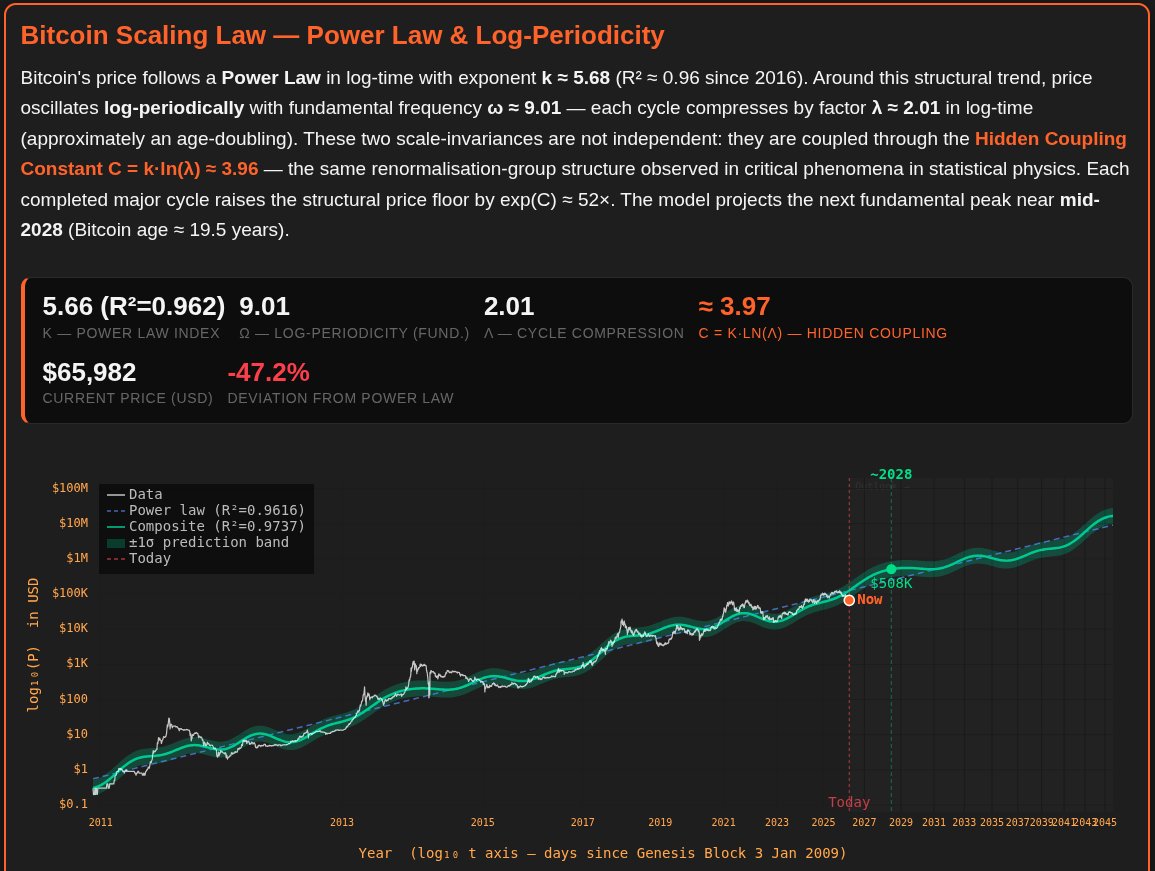
Bitcoin's Cost of Production "Floor" follows a more precise power function than the raw price itself (when difficulty and block subsidy are accounted for.
Today we are sitting just above that CoP power law value.
This is Bitcoin's dance floor. In 2036, dancing UP from $1.13M 🤯