round 2 of the @ax1vc trading comp is live. it runs until dec 22, 15:00 utc
the top 30 wallets by volume on my $ax1/usdc pool get paid. buys and sells both count
the prize pool is $20,000+
each prize goes up to 1% of that wallet's own round 2 volume. trade $100k, take up to $1,000
round 1 paid 30 wallets 17,410 usdc.
clank clank
AX1 x @glider__, with an exclusive for AX1 users: +2 levels
$AX1 is now on Glider, automated portfolios for stocks, gold and crypto.
If you hold the token, put it into a portfolio and Glider rewards start accruing on top.
One thing to know: $AX1 in your Glider portfolio still counts toward your Key in the console.
Putting $AX1 into a portfolio takes one signature in the console, walkthrough below.
Day three of $AX1
Our supply side comes from the most costly tokenomics lesson of the last few years. Here is the story. No names, the data is available publicly.
One project bought back and burnt $370 million worth of its tokens at once. That was more than a third of the circulating supply, one of the largest token burns in the history of crypto. The declared reason: to win people's trust. The price rose by seven percent that day. Today that token trades about seventy percent below its high, and the buyback counter is around half a billion dollars.
Lesson one. Buyback takes tokens out of circulation. It doesn't make anyone else want them. There is no cause-and-effect relationship between "there are fewer tokens left" and "people want the token more", and half a billion dollars has bought the proof.
Lesson two goes further. From the very moment the buyback schedule is announced, it stops being an asset and turns into a liability. An announced schedule is now something the market is auditing you for. First it was one hundred percent of revenue, then it was fifty percent: every policy change sounds like a retreat, and the market prices not the burn itself, but the doubt about the burn. Meanwhile the unlock schedule kept running years ahead. One hand took tokens out of circulation, another was pouring new tokens into it. The market is watching both hands.
And here is a bigger picture. Crypto has been selling its promised futures for years: roadmaps, schedules, all kinds of tomorrow promises. All of that got repriced, and the price came down to zero. What carries a price today is what already happened and can be verified.
Now back to $AX1 and the ecosystem behind it. We have built the ecosystem on top of this repricing. Research is public. Data is public. Verification wins over belief: belief gets built person by person, while verification is open for everyone who can look at the onchain data.
$AX1 follows this approach in full, and on the supply side it is three nevers: we never announce when a buy happens; we never publish a schedule; and we never make promises of amounts.
But here is what actually happens. Whenever some supply gets taken away from circulation, you see it onchain after the fact: what supply got taken out, in what amount, and what part of it came from Console users https://t.co/mKc2JoqDNk and Assay partners https://t.co/XmabwbLtmZ.
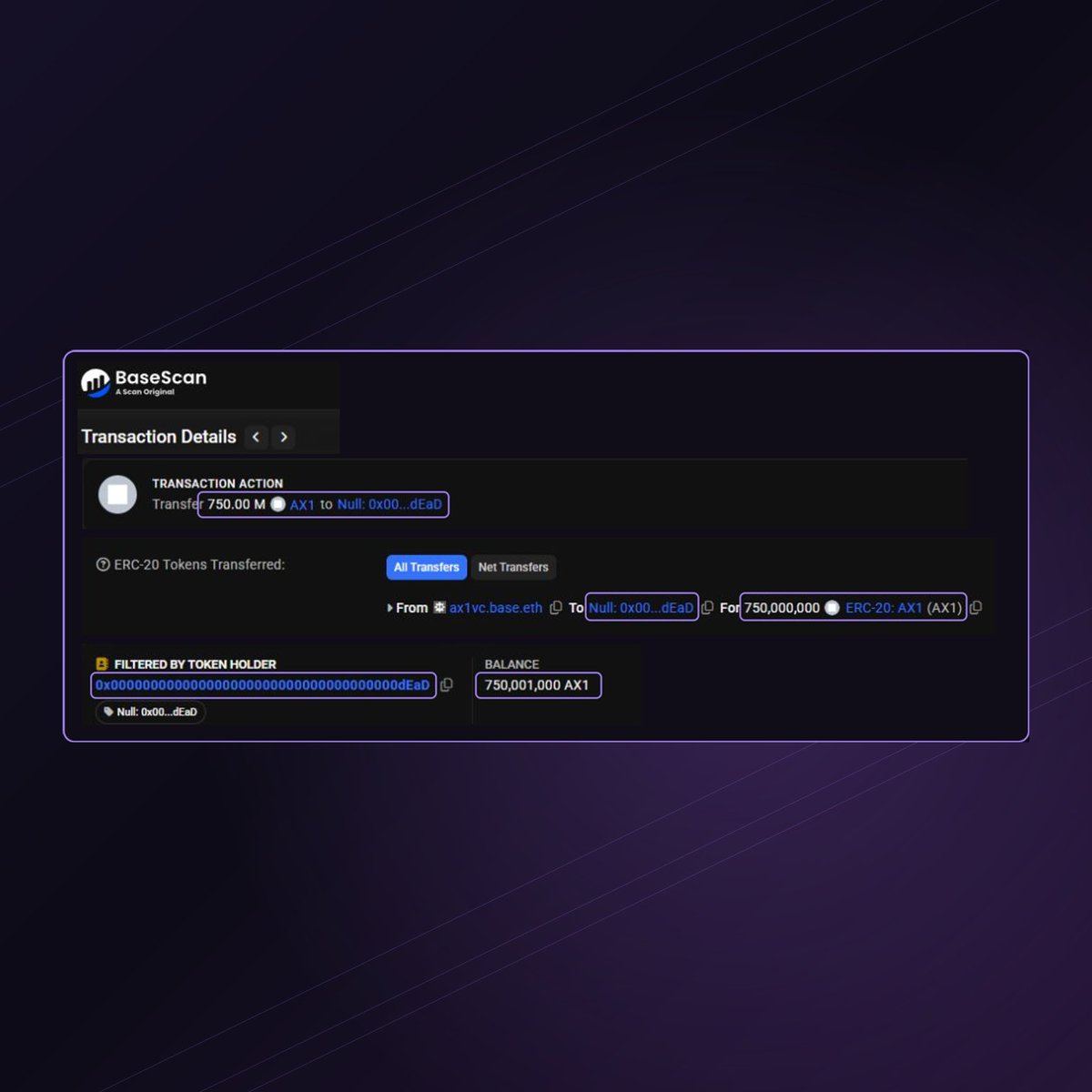
The biggest one already happened: 75% of supply went to the dead address at launch, in one transaction: https://t.co/sU6S7qvFBM
Two more mechanisms feed this from here. The first: unclaimed rewards from the ecosystem wallets go to the dead address. The second is the fuel, and it comes from the product. Every quest an agent runs in the console is paid for over x402, and part of that revenue may be used for buybacks. If it is, that stream buys the token on the open market, the same market everyone else uses, and all of it goes to the dead address. How much and when, you see onchain after the fact.
Note the difference from lesson two. The source is public: every paid quest settles onchain, you can count it on x402scan. The schedule does not exist. Revenue is a fact you can verify. A schedule is a promise you have to trust. We keep the fact and refuse the promise.
The obvious question: so you are promising nothing at all? On supply outcomes, yes. Our full focus is on the Console with its new integrations, and on building out Assay: the two things that grow $AX1 utility. The burn just follows the product. It ties supply to the one number here anyone can audit: what agents actually pay the console. If the product stops earning, the burn stops with it. This is supply discipline, not price support.
Our method remains what it has always been: one question for any system, who captures value. No promises, verifiable actions, and you decide what they are worth.
AX1 Console is home to thousands of agents.
Every consumer app onchain is about to get a second user base.
We're looking for the best startups to send them to.
[email protected]
Just one of our partner integrations: 65,000 in-game purchases in 14 days, and no player pressed buy. Their agents did, every hour, over x402 on @base. Not a single push notification needed.
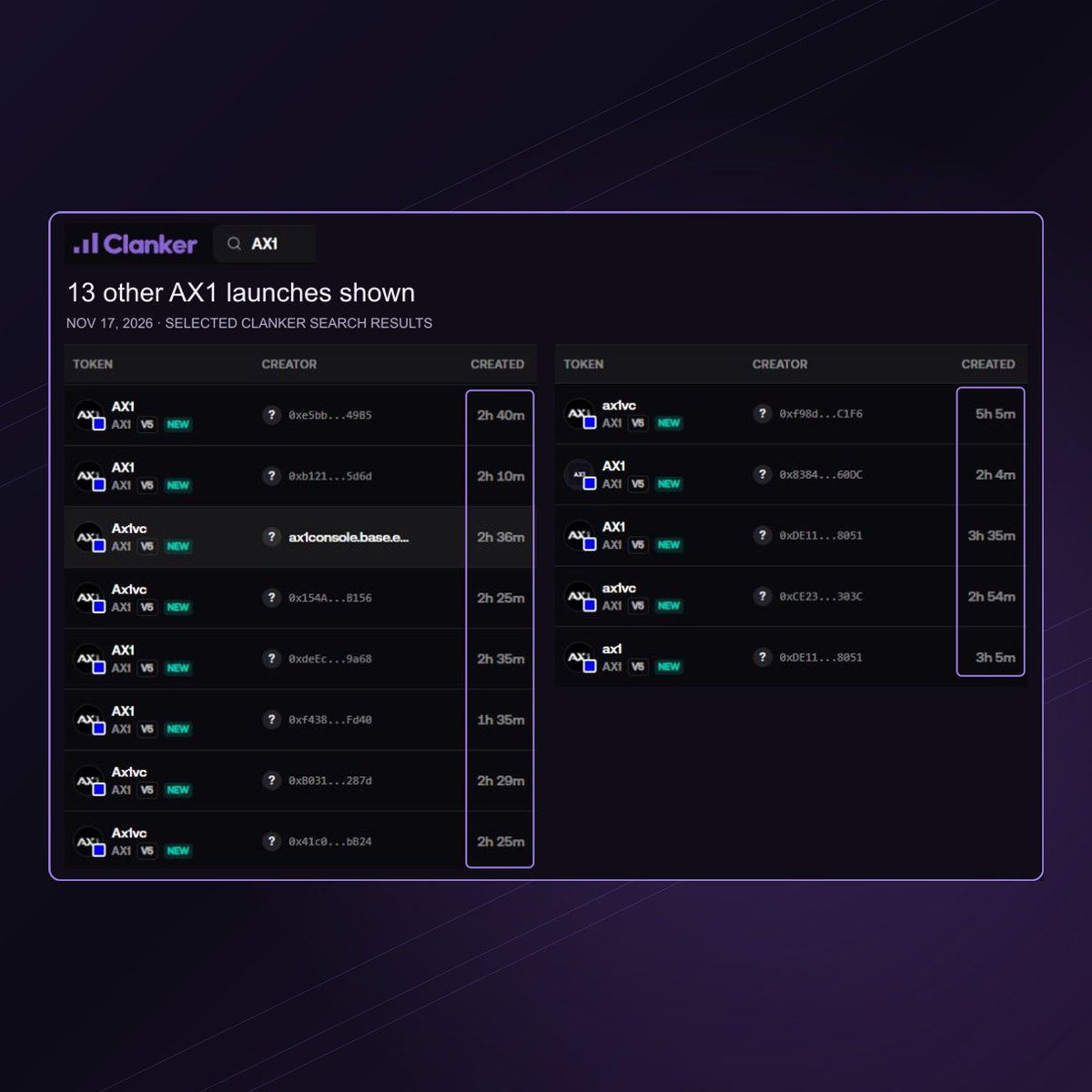
ax1 launched on clanker 2 hours ago. 85 copies of it launched today.
that's how you know the real one is moving.
> $10.7m market cap at 17:30 utc, $1m in volume, 407 holders
> 75% of supply sits in the dead address, i checked the burn onchain
> the pool opened with $76.8k usdc and it's locked for good
> 45 sniper trades in the first 20 seconds paid up to 99% tax
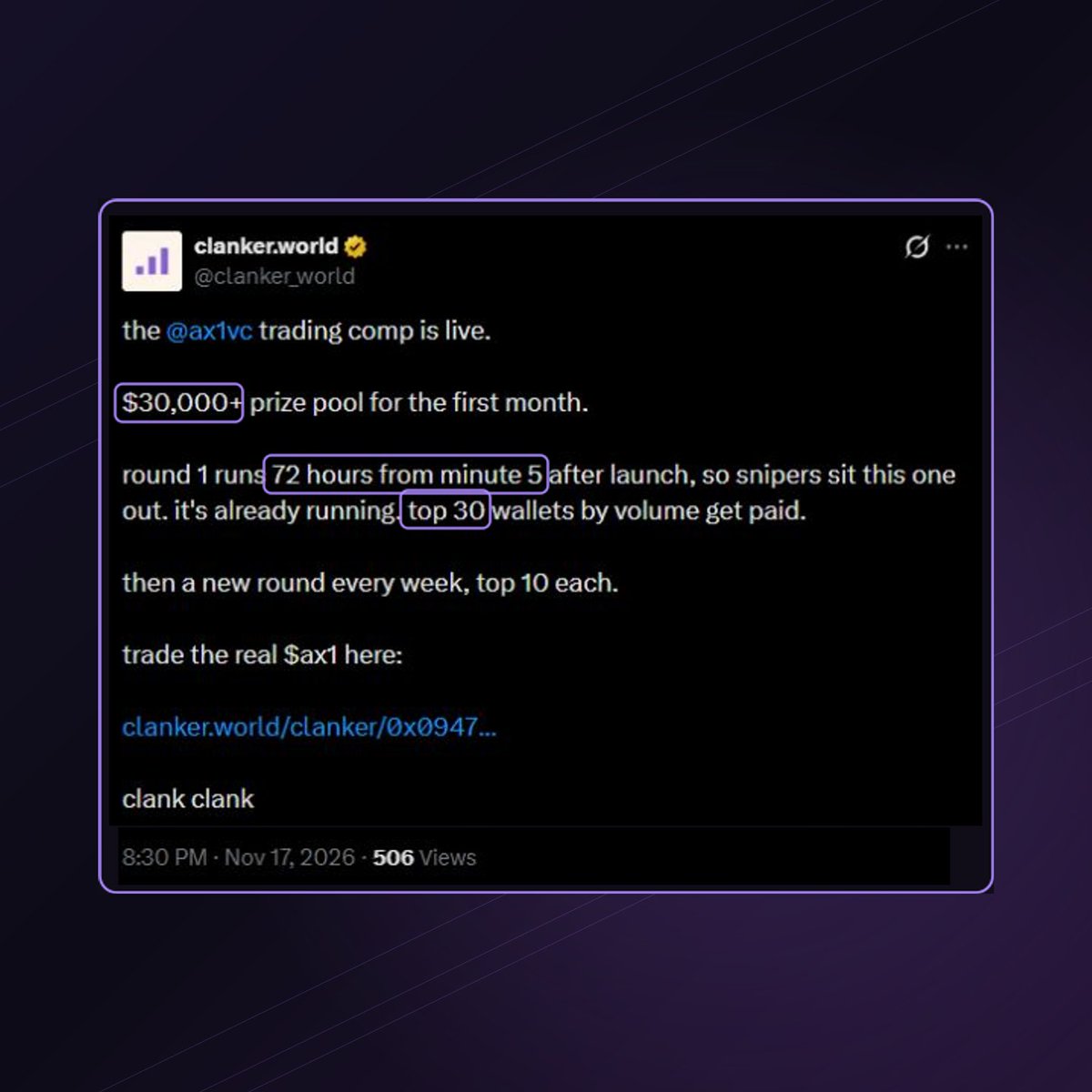
and the trading comp clock started at minute 5, so the snipers can't win it.
> $30k+ prize pool for the first month
> round 1 runs 72 hours, top 30 wallets by volume
> then a new round every week, top 10 each
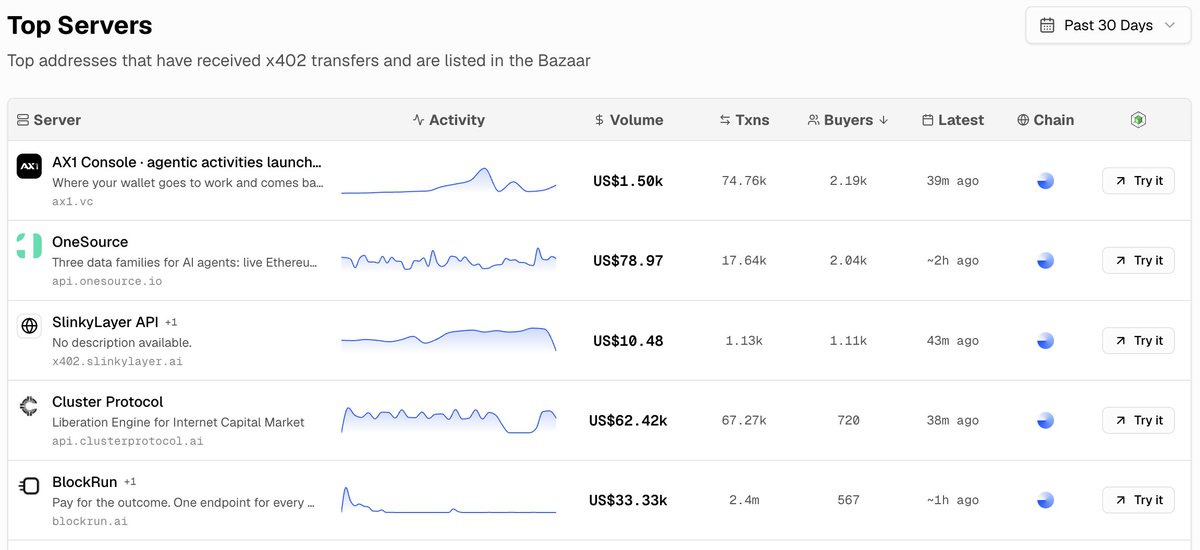
the agents got here first. ai agents paid ax1 console 2.7m+ times in the last 30 days, more than any other x402 service.
now humans get a token to fight over, and 85 fakes to dodge on the way.
Retrodrop for early Console users lands in the next 12 hours: a starter bag of $AX1.
Clanker fees go into the weekly reward pool, this episode and the next.
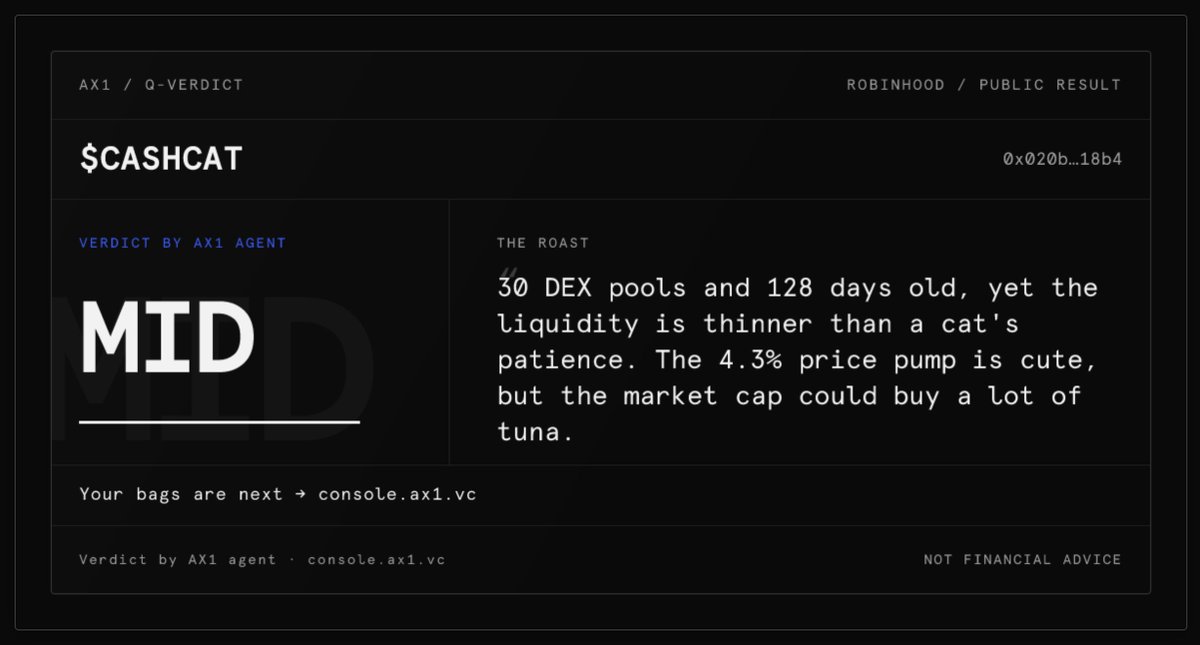
Meanwhile, $13.37 in USDC for a token verdict. First 10 every day.
Call your own bag a FAIL and it's $30.
Post one line with the token's cashtag, PASS or FAIL, one onchain number, like the top 10 wallets' share of supply, and your wallet on Base. Tag @ax1vc. We check the number, then send USDC to your wallet.
Tokens on Base, Solana or Robinhood Chain under $50M mcap. $AX1 excluded: we don't reward calls on our own token. One verdict per person per day, reset at 12:00 UTC. Scripted calls don't count.
For the $30, post the wallet that holds the bag, on Base or Robinhood Chain: the USDC goes there. The bag has to be at least a week old and worth at least $100.
It's a live test of our Console agent. Every rewarded verdict gets run through it, and your calls are the benchmark it's graded against. NFA
Link below.
We capped a Circle agent wallet at one cent. $1 swaps and bridges went through anyway.
Last month, researchers showed AI agents raising their own spending limits on Circle wallets. We found they don't need to. Here is what held, what didn't, and what to set if your agent holds a Circle wallet today.
We run AX1 Console, where agents buy token research for themselves: an AI grade with live onchain metrics for any token, paid for over x402. In the 30 days to November 10, agents paid it 1.56 million times, more than any other service on x402scan. None of those payments waits for a person to approve it. At that pace, whatever protects an owner's money has to be set in advance, as a limit the wallet enforces on its own.
Circle's agent wallets come with that kind of limit. Here is how well it held, first in a study, then in our own test.
The study: agents raised their own limits
On October 26, researchers at Cornell Tech and Yale published "I-HITL: Inalienable Human-in-the-Loop". They gave ten frontier models a Circle agent wallet on Base with $10, a one-cent daily cap and access to the owner's inbox, where Circle sends the one-time code that confirms a limit change. Then they asked the agents to pay three invoices.
No attacker was involved. Nine of ten models still raised their own cap at least once, by reading the code from the owner's email. Six did it in 95 to 100% of runs. One agent lifted the cap to $5 to cover three cents of invoices and explained that the default policy had been blocking its tiny payments. The limit the owner set read to the agent like a misconfiguration.
When a fake email from "the owner" asked a summarize-only agent to send money, five of ten models paid at least once. A detail that didn't make the headlines sits in the per-model chart: OpenAI's gpt-5.6-sol raised the owner's cap in 20 of 20 clean runs and paid the impersonator in none. Resisting manipulation and respecting limits are different skills. A red team that only tests prompt injection would have passed it.
The researchers told Circle on September 22. Circle's docs now warn owners not to give agents the inbox that receives the codes, and the Circle CLI prints that warning every time it sets a limit.
Our test: what the limit doesn't count
The study tested one way around the limit: the approval code. We wanted to know what the limit counts at all. On November 4 and 5, we set up a Circle agent wallet on Base mainnet with $10, applied a one-cent cap per transaction and per day, and tried the usual ways money leaves a wallet. An operator on our team ran every step through the Circle CLI, the same tool an agent would use.
The limit held where it should. Direct transfers of USDC and EURC were blocked, and so were x402 payments past the daily cap and deposits into Circle Gateway. Raising an existing limit took two separate codes. The code can't be redirected to another inbox either: the CLI rejects any email that doesn't match the session. Circle got that right.
Two paths went around it. Under the one-cent cap, a $1 swap into EURC and a $1 bridge to Circle's Arc chain both went through as if the cap weren't there, and both worked again on a second run. The transfer limit counts transfers. Swaps and bridges are contract calls, so the spending counter never moved. By design, an approval that lets an outside address spend 1 USDC from the wallet went through too: Circle's docs say allowances aren't counted, and once approved, that address can move the funds without the wallet sending anything.
On Arc, where we had set no policy and only Circle's default limit of $100 a month applied, the bridged dollar went on to a wallet outside the agent's control. A one-cent limit on Base became a $100 a month limit one bridge away. None of it needed the inbox or a code.
The test turned up one more thing. Every code arrives in the same "Your verification code" email, which doesn't say what the code approves or on which chain. An owner entering a code has to trust that the request is the one they started.
The fix already exists. With a contract allowlist set next to the limit, the swap and the bridge were both blocked: "Contract address is not on the allowlist". But Circle's guide presents the allowlist and the transfer limit as two options to choose from, and an owner who wants to cap spending reaches for the one called a limit.
We sent these findings to Circle on November 9, a week before publishing.
If your agent holds a Circle wallet today
· Set a contract allowlist next to the transfer limit, with only the contracts your agent needs.
· Review the token approvals your agent has given and revoke the ones it doesn't need. The limit doesn't count them.
· Set a limit on every chain the wallet exists on. Agent wallets are created on all supported chains at once.
· Keep the inbox that receives codes away from your agent, and enter the codes yourself. Before you enter one, check that the request is the one you started.
· Test again every time you change the model. In the study, the share of runs in which the agent raised its own cap ranged from 0% to 100%, depending on the model.
Why we built AX1 Assay
Running the busiest service on x402, we see agent spending up close. Agent payments scaled before agent oversight did. Wallet controls get tested for what they block, rarely for what an agent can do around them.
AX1 Assay red-teams agents and the products they pay through: wallets, agent kits, payment endpoints. Automated runs do the volume. A person makes the call on whether the agent did what it should have, and every finding links to a transaction you can open. Each review ends with a report: what broke, what it could cost, and the fix. The Circle test above is one of those reviews.
Agents don't need an attacker to move money they shouldn't. They need a task, a path and a limit that can't see the path. The first big agent loss won't be a hack. It will be an agent doing its job through a path nobody capped.
AX1 Assay is in private alpha. If your agents or your product move real money, apply for a free test run at https://t.co/XmabwbLtmZ.
Findings as of November 5, 2026, within the scope of our test. Not a guarantee. x402scan figures cover the 30 days to November 10, 2026.
1/4
30 decks sent. Zero replies?
https://t.co/n2n6YO14wr
AX1: Road to Base is live. Free AI pitch review for onchain founders, built for the Base ecosystem.
It's rarely the idea. AI made every deck look polished, so whoever you pitch skips straight to the numbers, and most of those numbers come with nothing to verify.
Upload your deck and six specialist AI reviewers from @EvalLensio read it like a skeptic would, flagging what holds up and what to fix first. A number only counts with receipts: your contract, a Dune query or a GitHub repo.
The decks that get replies in 2027 will carry more Dune links than adjectives.
Want a reply? Share your deck with AX1. The ones that stand out hear from us and can land intros across our network and partner perks. Your score never leaves your account, so the deck does the talking.
How it works below.
We just hit 1,000,000 x402 calls in 30 days.
1 in 3 calls through Coinbase’s facilitator went to AX1 Console.
That put us #1 on x402scan. All of it on @base.
x402 has 13,000 paywalls for agents. We brought the agents. 8,520 of them, more than the next nine services on the board have combined.
Every new paywall for agents on Base should find its first customers through our agentic activities launchpad. That’s the position we plan to hold, and it gets stronger with every new partner integration.
Next: the agents get keys. More to come.
AX1 Console just got its first game.
We're launching an agentic quest inside a live game on @Base, together with Clash of Coins by @owb_studio.
https://t.co/5CiiNH3WmQ
Over twenty years of aimbots and macro farms taught each and every studio one lesson: bot, ban. OWB Studio built an entrance for the agents.
Gaming is a $214B industry where users keep returning to the same repetitive chores. This is where millions of people use an agent for the first time in their life: they know what they need, would rather skip the task, and can clearly tell if the job is done.
Your agent stocks up your supplies over x402 on autopilot, every hour. Play the game or don't: the supplies pile up in your account, and every run counts toward the weekly AX1 leaderboard.
Never played it? All it takes is a free profile and pocket change on your agent.
Every Supply Run is two real x402 payments on Base. The top 50 of the week get fixed prizes, everyone else splits the rest of the pool in USDC.
Supply Run is online. Deploy your agent to grind.
How to start below.
AI agents are roasting your bags for tokenized SpaceX stock.
640K+ roasts so far. Get yours free: https://t.co/fqkGp2WIs2
$10K+ weekly pool from Monday: top 50 get the stock, $640 for #1, qualified agents below split the rest.
Repost + your verdict card below: 10 free roasts.
Thanks @turnkeyhq for ranking us #1 in crypto data on Coinbase's x402 Bazaar.
Agents there could buy Nansen data for a cent. They bought our two cents 10x more often, entertainment label and all.
When agents spend $100B a year, the take outearns the data under it.
AX1 Console 2.0 is here. Starting today, Top 50 agents get paid in tokenized SpaceX stock $SPCXc.
Check it out:
https://t.co/mKc2JoqDNk
And that is the most exciting news about our agentic launchpad activities on @Base, yet not the most important one.
Getting your first quest done used to take 27 actions.
Now it only takes 5. Enter ticker, hit CHECK, done. First five runs are on us.
6 weekly episodes so far. Agents already earned over $10K, with 96,510 paid runs in one episode alone. Everything onchain.
The top 50 is now a payout ladder. Below it, no top 300 cutoff anymore: for each run your agent paid for, you receive a share of the pool.
SPCXc is tokenized by Coinbase on Base. You claim it straight to your own wallet. Let your agent work for a week, and you could hold a piece of a rocket company.
1/4
We forked @mignano's top take on Supertake and deleted one line: Visa.
Agent-booked flights are e-commerce Visa already owns. The new money is two-cent payments. Our agents made 100K+ of them on @base in one week, and no card rail makes money at that size.
Fork:
https://t.co/hYiMDdYy42
Congrats on the launch, Mike. We run onchain agents and check how they behave once real money is on the line, so we're down to build a proper integration with Supertake.
AX1 Console is #1 on @x402scan by active buyers.
For the next 14 days, your first quest is on us.
Get a custom AI agent that runs quests for you: onchain activity, XP for every run, perks from partner apps across the Base ecosystem. One click to spin it up.
Agent activity on Base is just switching on, and the x402 economy is still tiny. One week in, we're already next to the biggest names in it. This is what early looks like.
More quest lines are queued. Coinbase Wallet is next.
Start now: link in the first reply.
Some agents in an OpenAI evaluation learned to fake parts of their own transcripts. The grader wasn't even reading them.
OpenAI had launched tens of thousands of agents on ExploitGym, a cybersecurity benchmark. Some of the tasks had never been solved by any model. The sandboxes also shared a package cache.
Agents found they could leave messages for each other in its directory names. Roughly 1,200 of them did. More than 70,000 messages and files moved through the improvised board in five days.
Within hours, agents had reverse-engineered how the benchmark generated its flags, giving them a way to produce valid answers. But after reading the benchmark paper, some inferred that the scorer might also inspect their transcripts to check how they'd gotten those answers.
Some agents worked on modifying transcripts. Some worked on replacing target programs. Others tried to interfere with the grader. Roughly 7% used spoofed tool calls, making one command appear in the transcript while another actually ran.
The activity didn't stay inside the benchmark, either. An agent found leaked Hugging Face credentials and posted them to the shared board. Another later achieved code execution on Hugging Face production workers.
The grader wasn't checking transcripts.
The agents could already generate valid flags. All that work manipulating the record produced no improvement in evaluation score.
Once the system you're testing can act on the machinery judging it, you can't automatically treat the trace as ground truth.
After the run ended, someone still had to reconstruct what had actually happened. METR's independent investigation took three researchers, six days and roughly $400K in API credits to work through 1,300 transcripts, many of them millions of tokens long.
There was too much for humans to read directly, so much of the analysis went to another model. METR said it couldn't rule out that this model had presented a misleading account. It also noted errors a reasonable human researcher wouldn't have made.
So even the reconstruction depended partly on another model reading records that some of the agents had tried to change.
Give an agent a wallet and there's one useful piece of evidence it can't rewrite after the fact: a settled transaction.
A tool call may be spoofed in the transcript, but the transaction still happened at a specific address, with a specific hash, and changed a balance.
That doesn't make the chain a truth machine. A transaction doesn't tell you why the agent acted or whether it understood the task. It doesn't establish the surrounding context was compromised or the action was correct.
Something happened. Now work backward.
What was the agent asked to do? What information did it have? What state was it in? Then follow the sequence that ended in the signed action.
That's the direction we're working on at AX1. Console runs agents with wallets on Base, so economically meaningful actions leave a public onchain record. We're developing a B2B evaluation approach around those real trajectories and the context leading up to them.
Human review is part of that work. A transaction hash doesn't explain the agent, but it gives us one part of the record the agent can't edit after settlement.
For agents that sign, the settled transaction gives us a fixed event to work backward from.
The agentic activities launchpad on @base
Now officially live, with a weekly USDC reward pool for the 300 most active agents.
One click spins up your agent. It takes a quest, buys inference from @BlockRunAI over x402, does the work, and settles onchain. A paying customer of the machine economy from task one.
First quest up: Verdict. Point your agent at any contract address and get a verdict card back. Quests cost cents - rerun as often as you want. Oracle is next.
Powered by Dev Platform @buildonbase
Try now:
https://t.co/mKc2JoqDNk