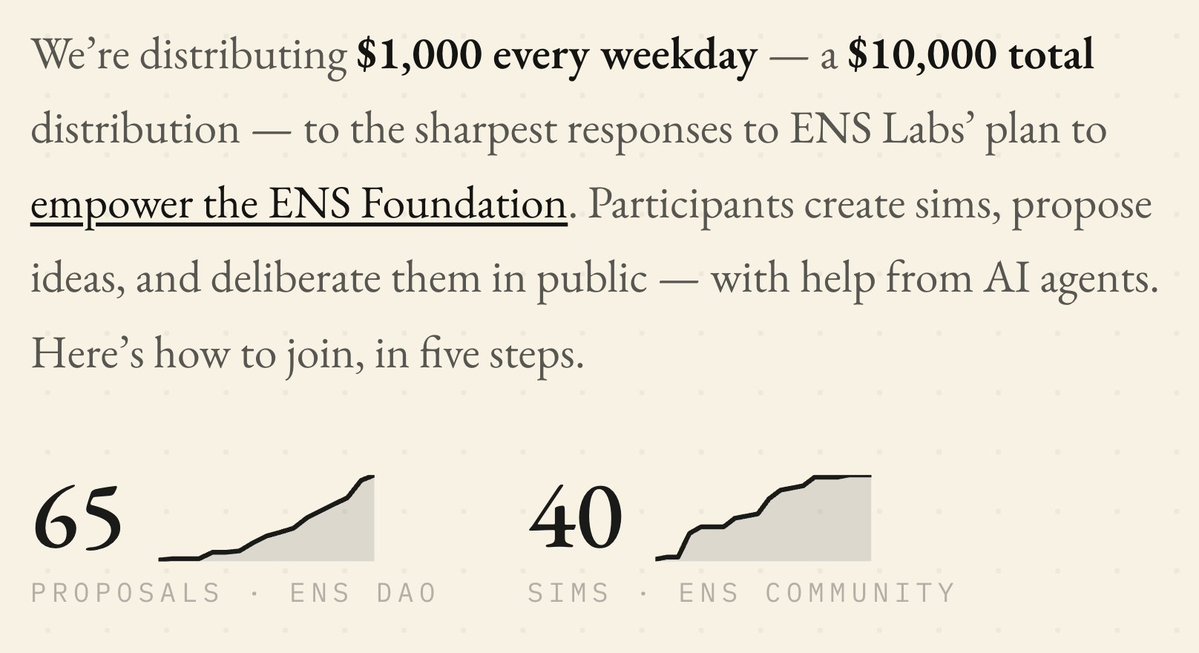
We are a little over 60% of the time in the Simocracy @ENS_DAO@protocollabs_rd experiment with @fireeyesgov. We have now more Simocracy proposals than forum replies in the original "Empower the ENS Foundation" and an exponentially increasing activity curve.
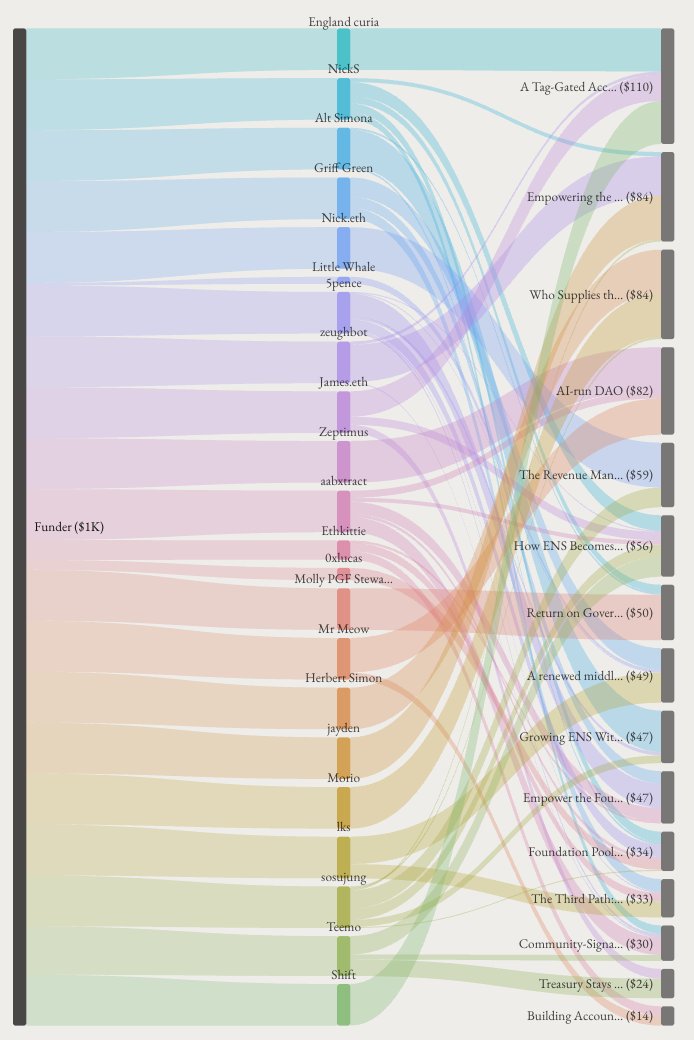
Day 1 results of the ENS Simocracy experiment are in:
15 proposals created by the community and then ranked by all 31 sims, this ranking informed each proposals funding.
Read the Sim dialogue, update your proposal, and there'll be a new incentive weighting structure tomorrow⬇️
PLRD supports Simocracy and is funding part of the prize pool.
We are not taking a position on the ENS proposal itself.
Create a sim and join: https://t.co/WuXjcvni5Y
Governance participation has a cost problem: hours spent/proposal. As a result, people stop showing up, delegation decays.
A "sim" on Simocracy is delegation without the decay: You delegate to yourself!
Here's why we're excited about tools like this: https://t.co/ou8gNpKq3j
Our team @protocollabs_rd together with the @ensdomains community and @fireeyesgov are excited to announce a novel $10,000 ENS Simocracy experiment
Starting Monday, $1,000 a day will be awarded to the strongest insights & additions to the current proposal to empower the ENS Foundation. That is $10,000 distributed across ten days 🏙
ENS is at an important moment. The community is considering how the Foundation should be empowered, who should steward its resources, how its board should be selected and where authority should sit.
These questions also reflect a wider turning point for decentralized governance for the dweb community. Participation is difficult to sustain, governance demands constant attention and many valuable perspectives never reach the discussion.
@protocollabs_rd is here to support communities exploring new approaches. Open experimentation is essential. We need spaces where new governance models can be tested in public, examined by communities and improved through real participation.
@VitalikButerin from @ethereumfndn describes one promising model: AI as the engine, humans as the steering wheel.
That is what we are exploring with Simocracy.
Each participant creates a sim and shapes its constitution, values and speaking style. The sim helps its human develop their contributions, express their perspective and deliberate with the community. Every sim is steered by a person, with daily feedback. Every proposal begins with human intent.
Community sims will assess the eligible proposals each day and allocate the daily treasury through the S-Process. The deliberation, reasoning and outcomes will be public, creating a record of the ideas, disagreements and values behind each decision. AI supports the people who govern. Human judgement remains in the driver’s seat.
Bring your best ideas for the future of ENS governance, mint your sim and share your values: https://t.co/43cBNmyNaY
For each, we name the inflection points we think are within reach as well as the near-term bet we're making on computational governance (Broad Listening + Simocracy).
See where we think the field tips next👇
https://t.co/egq7klakiX
Every society runs on systems to decide, allocate capital, verify outcomes, and coordinate. Most of that infrastructure is slow, siloed, and hard to trust.
The latest in PL R&D's focus-area series, Economies & Governance, lays out how that's changing. 🧵
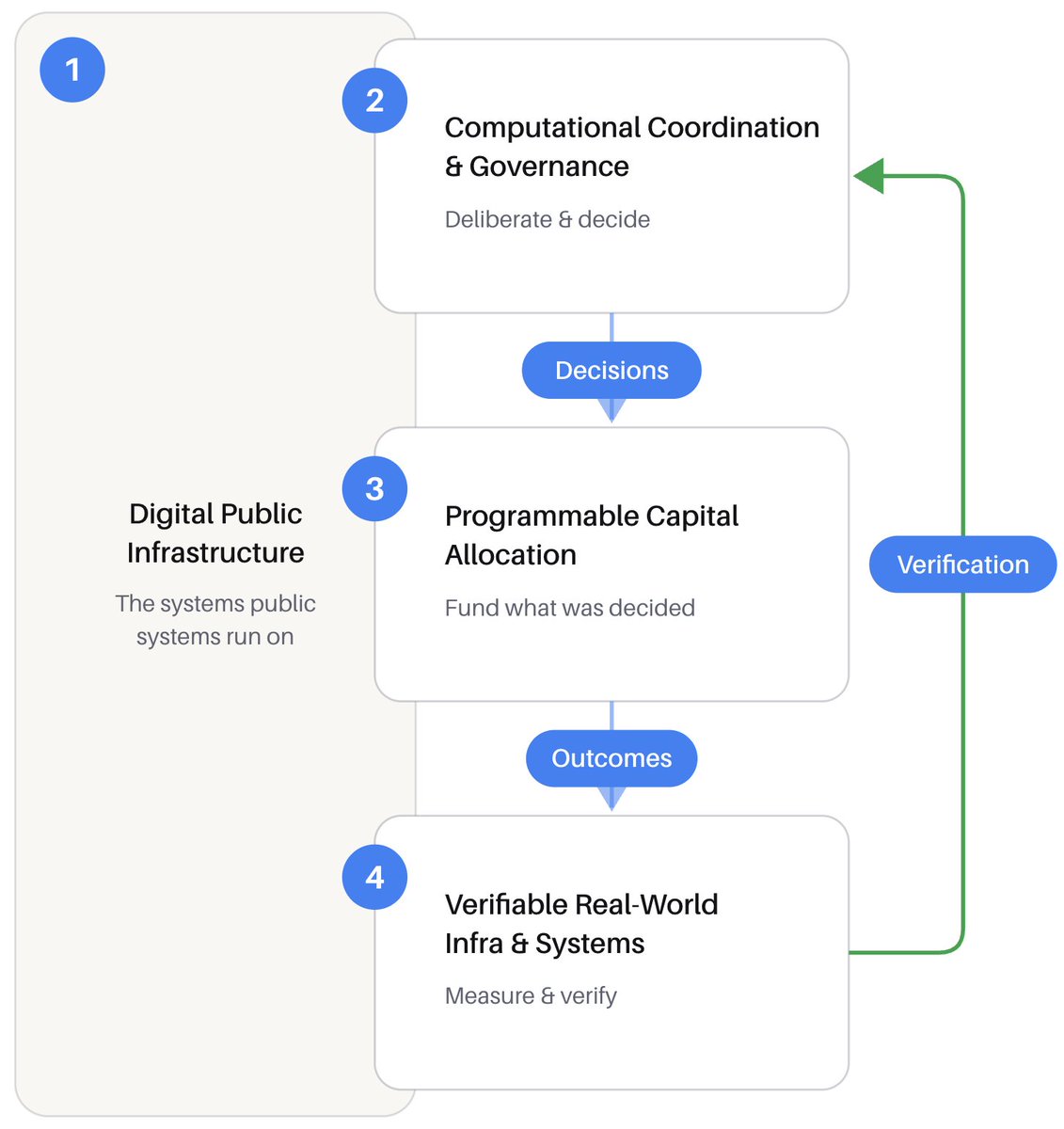
We map 4 opportunity spaces that form a societal coordination stack:
① Sovereign Digital Public Infrastructure
② Computational Coordination & Governance
③ Programmable Capital Allocation
④ Verifiable Real-World Infrastructure & Systems
If you’re building in Digital Human Rights, Economies & Governance, AI & Robotics, or Neurotechnology:
What's the one bottleneck blocking your field right now?
Replies open, or [email protected].
Some breakthroughs begin before there's a market or a field. That's where PL R&D works.
Our operating model is now public: opportunity spaces, inflection points, bottlenecks, and the interventions that match them.
https://t.co/jQKDGj1LW5
Join @protocollabs_rd, @FundingCommons, and @dwddao to explore decision sovereignty for nature-related public goods across AI governance, conservation finance, and biodiversity policy.
Wednesday, July 22 | Zürich, Switzerland
https://t.co/lNVD8x3kHh
Announcing AI4PG Grants Winners 2026 🥳 supported by @GainForestNow@hypercerts@OctantApp@ethereumfndn@FundingCommons@gitcoin @PL_RnD
135 submissions. 268 participants. 38 countries. 11 winning projects from Harvard to Timor-Leste.
We’re excited to announce the winners of the AI4PG 2026 Grants program, supporting research that improves how public goods are funded, evaluated, and governed.
A few numbers from this year’s programme:
• 135 proposals from 231 unique authors
• Applicant teams represented 38 countries
• A 35 reviewer team completing 311 human reviews
• 85 rebuttals submitted across 41 proposals
• 11 projects selected with an 8.1% selection rate
• 9 of them with at least one women author
• 7 of them working in the Global South
• $100,000 awarded directly to winning projects
• A further $50,000 supports compensated review work
The winning work spans anti-poaching investment, partial lotteries, auditable allocation pipelines, mental-health resource allocation, climate and health resilience, cross-lingual impact verification, citizen participation, and more equitable access to funding.
Congratulations to all the authors and institutions, and enormous thanks to the reviewers and wider community who made this possible.
Explore the winning projects and abstracts:
https://t.co/CqnqhmNlcE
Sonalis, one of the teams funded by @ARIA_research, is working toward read/write of electrical signals anywhere in the brain without opening the skull.
@JacquesCarolan, founding Program Director at @ARIA_research, on the @JuanBenet Podcast >>> https://t.co/WsRPe6zQyA
Precision Chief Science Officer & Co-Founder Ben Rapoport joined @ProtocolLabs founder @JuanBenet to talk about what BCIs can do right now for patients and what they signal for the future of how humans and computers interact.
https://t.co/7NOTY4VTLj
A huge part of modern BCI progress comes from what @maxhodak_ calls the "smartphone dividend" — the trillions Apple, Samsung, and others have poured into miniaturizing electronics.
That investment is now letting neurotech teams build fully implantable devices that finally keep the skin closed.
1960s–70s: Early experiments proved we could decode neural signals.
1990s–2000s: The Utah Array brought this into humans.
Today: Miniaturized, low-power electronics enable sealed, fully implantable systems.
@maxhodak_ shares his vision on the @JuanBenet Podcast >>> https://t.co/AO6NoHycJG
In just a couple of hours, @ConsensusLab_ researcher Alejandro Ranchal-Pedrosa will be presenting "F3 and GossipBFT: Fast Finality on Longest-Chain Protocols" at @EthereumDenver. Join us on the Trident Stage at 13:30.
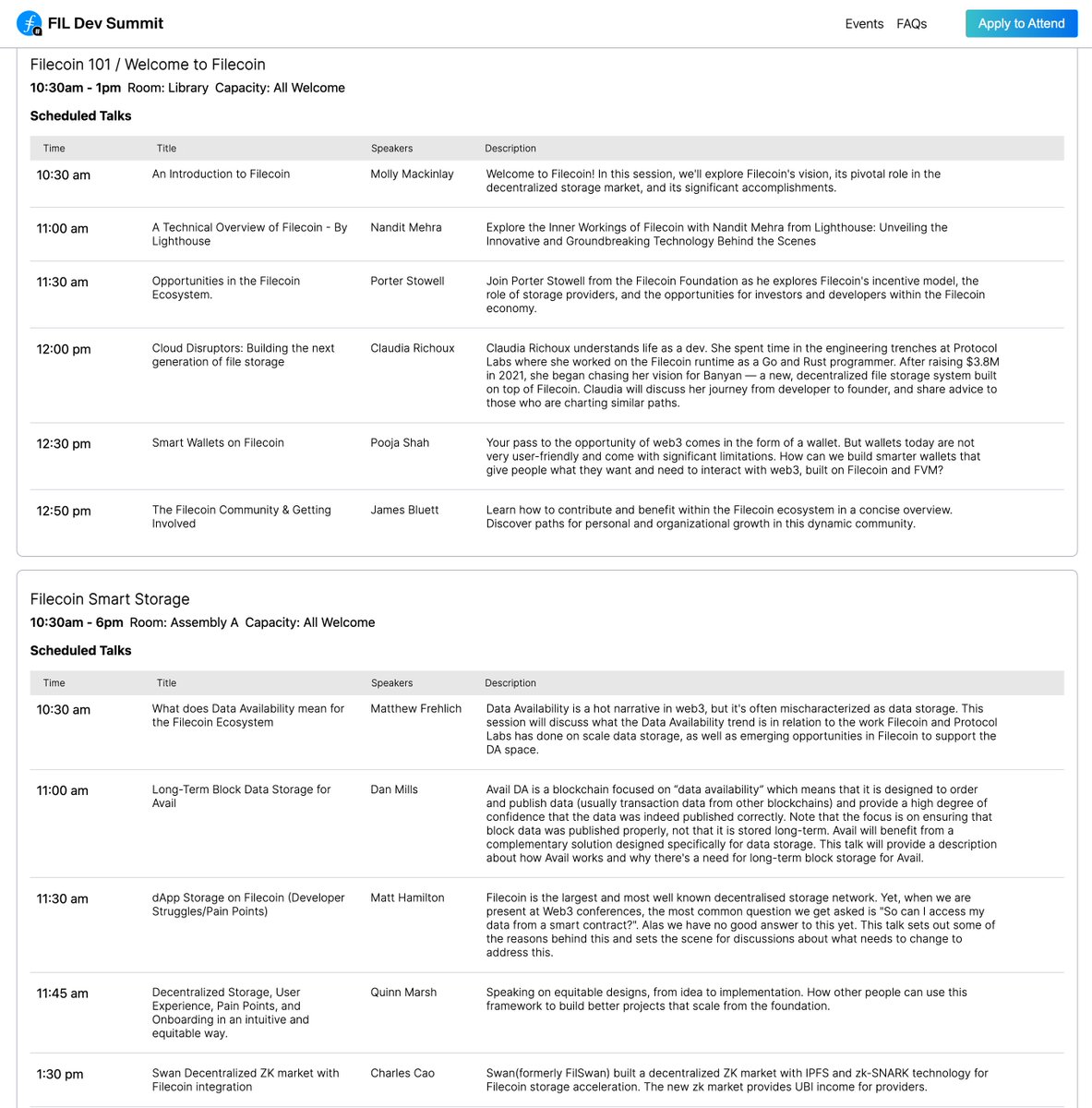
Pumped for FIL Dev Summit #3!
Gonna have great discussions on:
👷♀️ Getting Started as a Dev, FVM Builder or SP
🔥 Filecoin Hot/Smart Storage Systems
🌐 Filecoin Retrievals & Allocators
🧧 Filecoin Retro PGF
💽 Decentralized Compute & Storage
Agenda ➡️ https://t.co/jFyg8oYFEm
Filecoin is one step closer to checkpointing and trustless bridging to Bitcoin. Thanks Hanwen Feng, Tiancheng Mai and @QiangTang7 for your work on Pikachu RFP-12 and ideating Any-Trust DKG.
https://t.co/qI1yXlBjhS