Check out Protomology! My new Substack where I cultivate a space for curiosity by connecting language and linguistics with history, culture, literature, religion, philosophy, psychology, geocartography & more!
https://t.co/fiXNlGtwmL
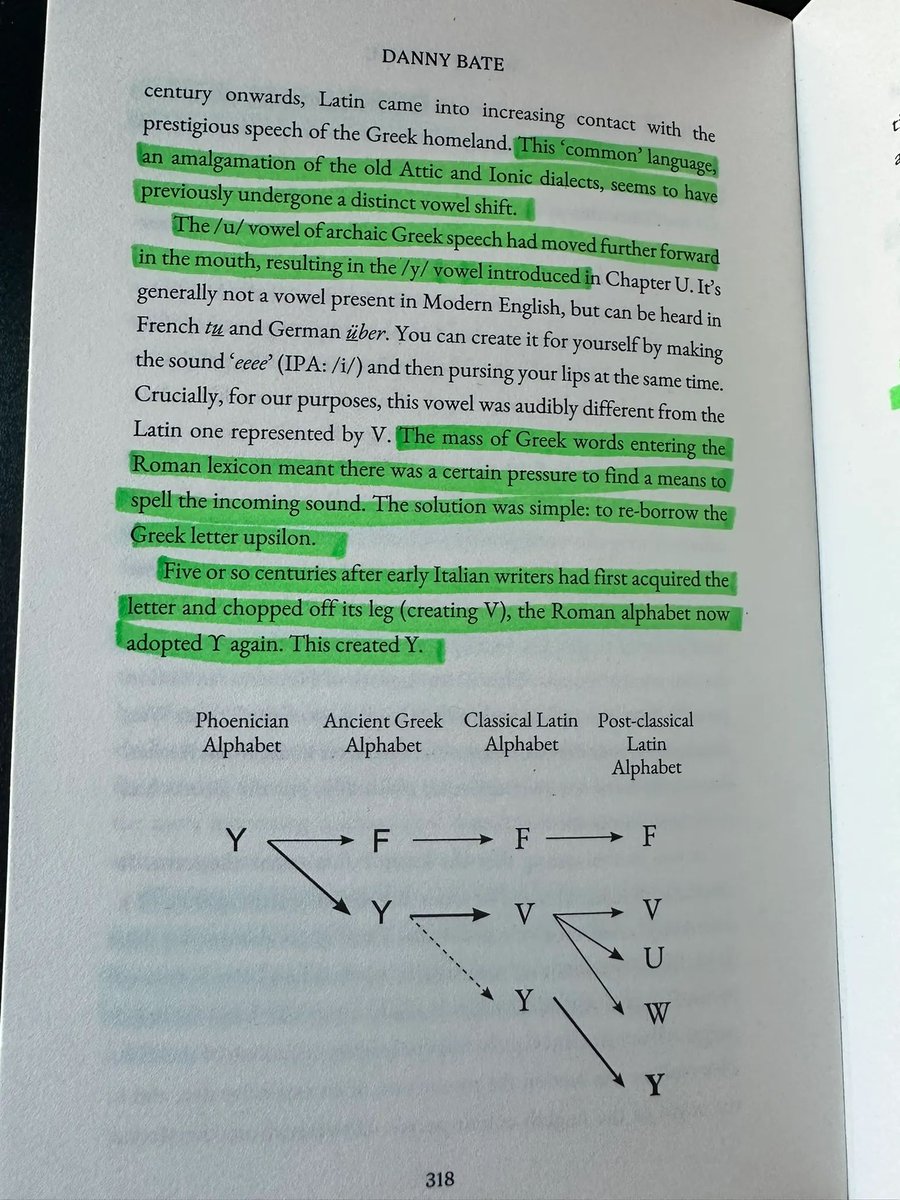
Just finished “Why Q needs U” by @DannyBate4 and chat, lemme tell you, this book is *phenomenal*. Who knew that the letter ⟨K⟩ was actually the comeback kid of the English alphabet?
Hello everyone!!!
It has been a couple of months since I last posted anything (mid-March I believe). When starting this Substack in December 2025, my intention was to post a lot, and I mean a lot (I have about 50 or so drafts in various stages of writing). I did not think about how hard it would be to consistently post several articles a week, and I didn’t do a good job in considering responsibilities outside of Substack, or real life things.
Since I last posted, I officially graduated from my MSEd. graduate program in TESOL-Applied Linguistics, my family visited for five weeks, I got engaged, moved from what has been my home in Japan for the last four years to another prefecture in Japan, and have spent most of my time outside of these events writing, editing, and preparing for my first official scientific journal publication as a linguist.
That being said, I still tried to read and follow mutuals and accounts that I follow here on Substack during the last couple months.
I will slowly begin to post again, but try to maintain balance between Substack, independent research/scientific publications, and real life obligations.
I recently wrote about virtual reality (VR) and its viability in research. There are aspects of VR, research, and real-world factors that need to be accounted for in order to offer ecological validity and experimental control in language research, but how about language assessment in virtual exchanges?
https://t.co/CN534DbVNW
Lee and Suaro (2021) were curious about this as well when they offered to “enhance Virtual Exchange (VE) practitioners’ language assessment literacy. One thing that is necessary when discussing language assessment literacy is first looking at assessment practices within VE.
This study highlights three approaches of VE assessment practices:
- evaluating learners’s language change over time
- using pre- and post-tests to assess learning outcomes
- relying on learners’ self-reporting and self-documentation of their learning
A challenge of VE and using it for language learning is that it can be a complex teaching approach where “providing sufficient, measurable, rigorous, and compelling evidence of learning for stakeholders including researchers, practitioners, and learners.”
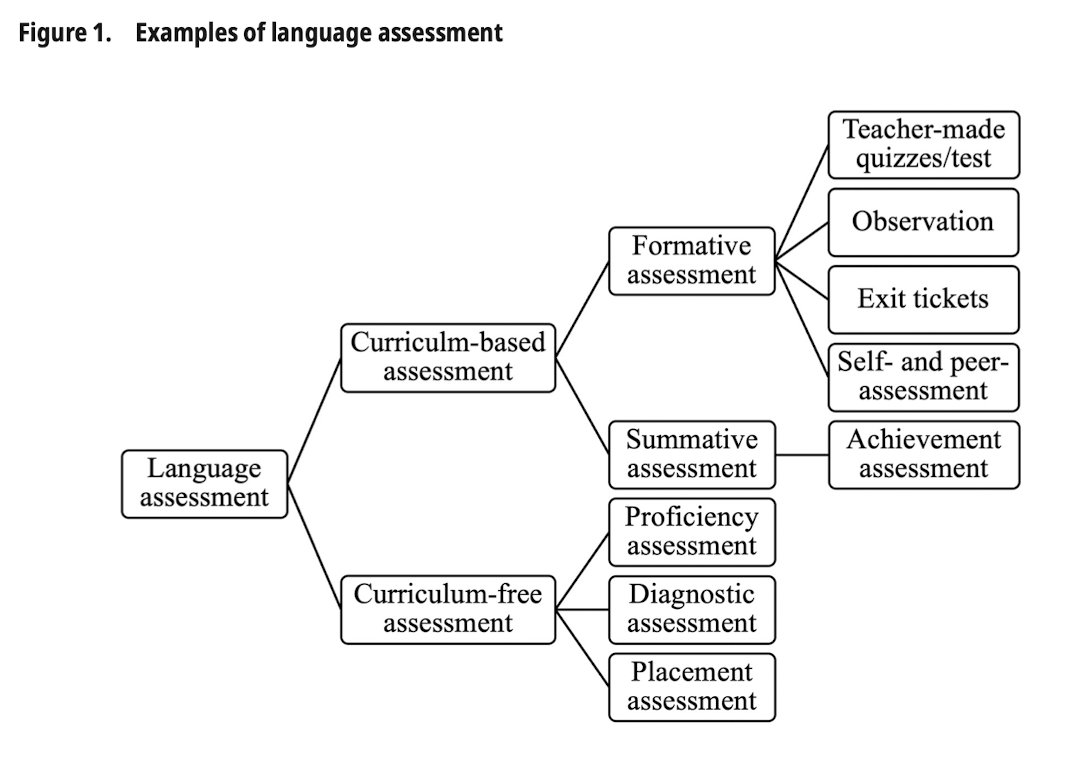
Many moving parts can affect the potential success in such complex teaching methods, with assessment of VE practices themselves, and the beliefs, knowledge, and behaviors of learners. To achieve this, different types of assessment may be needed to cover the entirety of VE and all within it that needs assessing. Below is a language assessment figure from Lee and Sauro (2021).
Virtual exchanges do not exist simply for their entertainment value, language learning is a major goal in VE, and identifying if this goal of language learning was accomplished is critical.
#protomology #language #linguistics #virtualreality #VR #languagetech
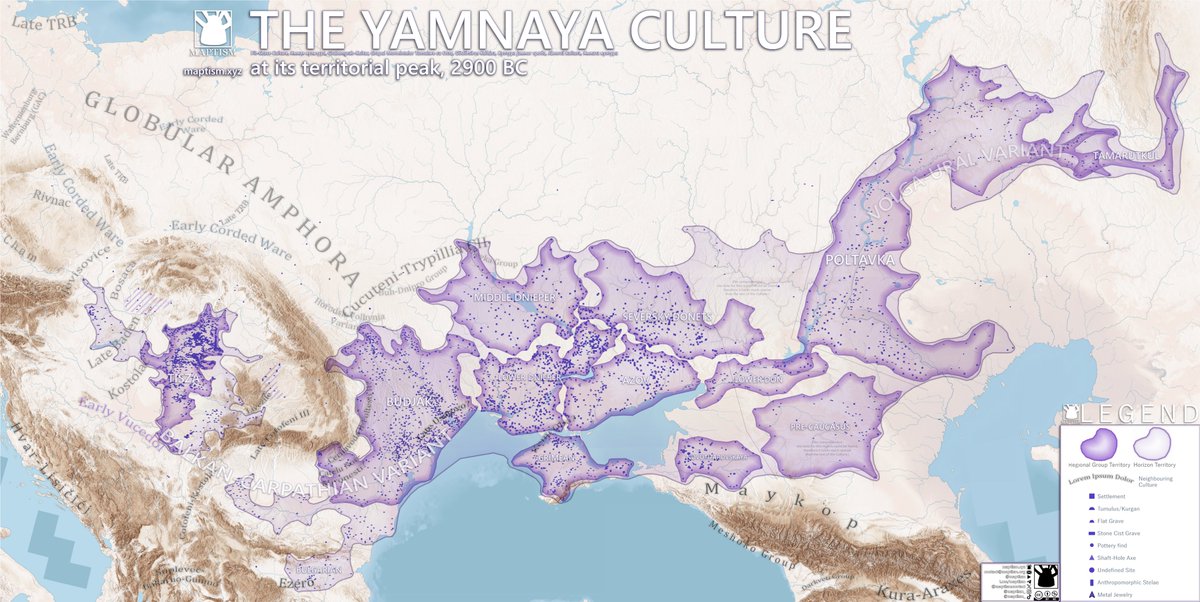
Complete Map of the Yamnaya Culture at its territorial peak in 2900bc
The Yamnaya Culture needs little introduction. This Culture is the archaeological manifestation of the Proto-Indo-Europeans on the Steppe.
It and its brother the Corded Ware Culture are the Ethnolinguistic Ancestors of all of the Indo European Languages still spoken today, and 3.4 billion Humans (Almost half of the Global Population!) speak Languages derived from their Tongue.
Noam Chomsky once called English spelling "a near optimal system."
You might think he was being ironic. Far from it.
The silent 'b' in "bomb" reappears in "bombard." The silent 'n' in "hymn" is pronounced once again in "hymnal." The silent 'g' in "sign" comes back in "signal."
English spelling keeps these words looking like the family they are, even when pronunciation pulls them apart.
The past tense ending "-ed" is pronounced three different ways (-t in "jumped," -d in "played," and -ed in "painted"), but spelled the same every time. One spelling, one meaning: something happened in the past.
English spelling is full of inconsistencies and silent letter because it’s not simply encoding how words sound.
If English spelling were aiming to represent sound alone, it would indeed be a total failure.
But that's not the kind of system English has. It encodes words' meaning and history as well.
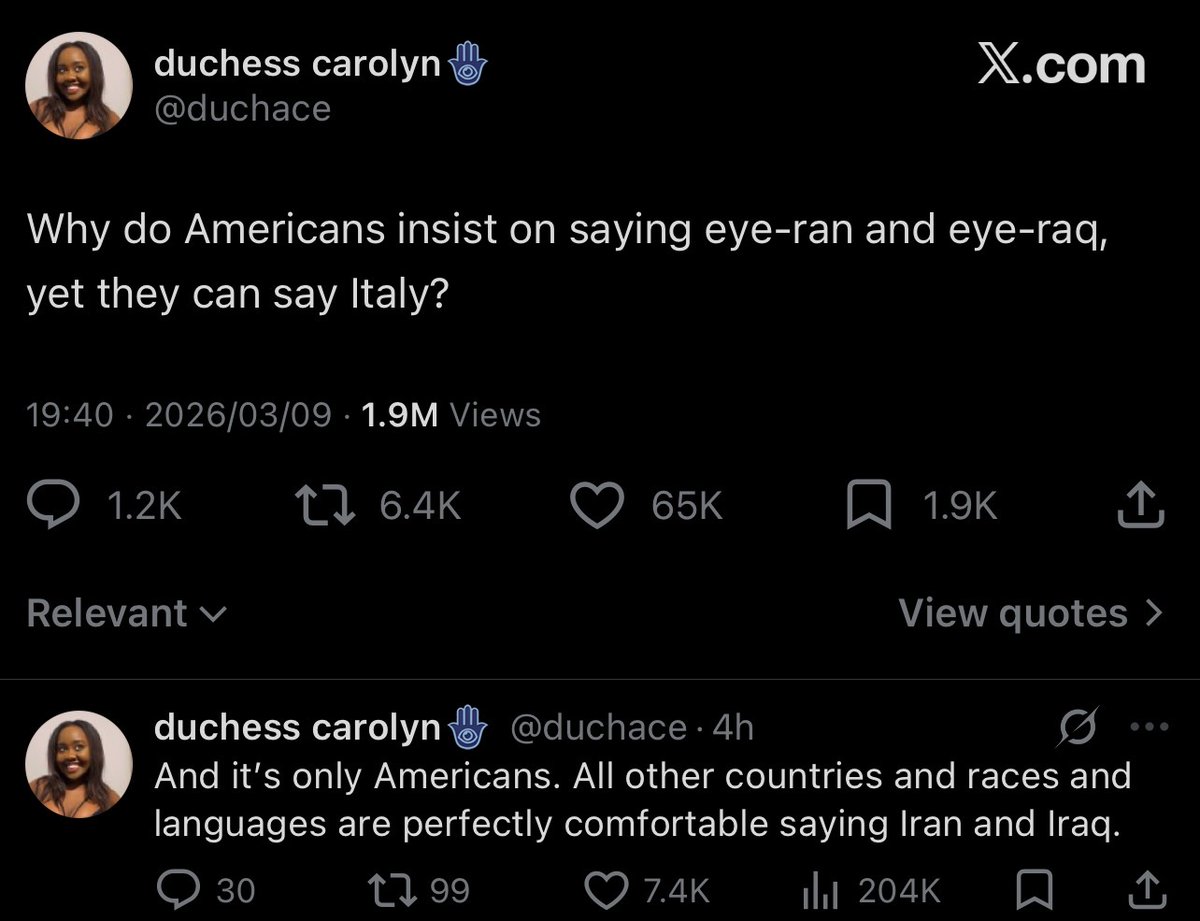
Why do Americans pronounce Iran as "eye-ran" and Iraq as "eye-raq"?
I would like to quickly respond to this post which garnered millions of views yesterday. However, the account is now private. Despite the fact that this post is rooted in American hate and hate for American vernacular English and its pronunciation -- criticizing her beliefs is not my domain, language is -- there is a legitimate answer as to why this occurs, and the answer lies in linguistics, or more specifically phonology and phonetics.
The "correct" way to pronounce Iran or Iraq comes from languages like Persian/Farsi (an Indo-European language but heavily influenced by Arabic) and Arabic (a Semitic language), however it is not fair to assume that pronunciation patterns and features between these languages and English is the same.
Thousands of years of language evolution, language contact, dialectical-geographic influence, and sound changes all have had, to some degree, rippling effects, changing bits and pieces of language over time.
Why does this happen?
Well, there are a few reasons. Some of them include differences in writing systems, each of which have their own unique sound-spelling correspondences, often leading to mispronunciations, or in this case the American pronunciation of Iran and Iraq. The countries of Iran and Iraq use an Arabic script or abjad, whereas English uses Latin script, or an alphabet.
When a word is borrowed between languages, especially distant ones like English and Persian/Farsi or Arabic, phonological and phonetic features of each language uniquely influence the pronunciation.
The /ay/ pronounced like "ai" in American English is a diphthong (complex vowel sound) and this occurs when when a vowel is followed by a semi-vowel (y or w). Diphthongs are seen in words like 'buy', 'bought', and 'toy'. These occur to certain degrees depending on the extent to which a vowel is pronounced in a tense or lax manner.
This classification is defined as the difference in muscle tension in the mouth when producing vowels. Those that are produced with more muscle tension are considered tense or long vowels whereas vowels produced without tension are lax or short vowels.
Arabic for example does have a contrast between long and short vowels, but Arabic speakers can have problems with the tense and lax distinction of English. Persian-Farsi also has a natural difference to the American English tense vs lax pronunciation of vowels, in fact this feature does not exist in Persian-Farsi as vowel sounds operate and exist between tense and lax.
Americans will look at the spellings for these countries and in correspondence with how vowels are treated and produced, will pronounce them accordingly, leaving an American to look at "Iran" or "Iraq" and connecting the visual orthographic form to a long or tense vowel pronunciation.
Because of this, Americans will pronounce Iran is "eye-ran" and Iraq as "eye-raq".
I'll leave you with this question. How do other countries pronounce America? Take a minute to answer this yourself, and then try and tell someone who is not a native English speaker that they are wrong.
#language #linguistics #Iran #Iraq
Aside from the fact that this account essentially copied another post no more than a few hours after my previous post (I’m sure it’s just engagement bait), I will again address this thinly disguised“linguistic inquiry”.
https://t.co/7zriUY2o5P
Why do Americans pronounce Iran as "eye-ran" and Iraq as "eye-raq"?
I would like to quickly respond to this post which garnered millions of views yesterday. However, the account is now private. Despite the fact that this post is rooted in American hate and hate for American vernacular English and its pronunciation -- criticizing her beliefs is not my domain, language is -- there is a legitimate answer as to why this occurs, and the answer lies in linguistics, or more specifically phonology and phonetics.
The "correct" way to pronounce Iran or Iraq comes from languages like Persian/Farsi (an Indo-European language but heavily influenced by Arabic) and Arabic (a Semitic language), however it is not fair to assume that pronunciation patterns and features between these languages and English is the same.
Thousands of years of language evolution, language contact, dialectical-geographic influence, and sound changes all have had, to some degree, rippling effects, changing bits and pieces of language over time.
Why does this happen?
Well, there are a few reasons. Some of them include differences in writing systems, each of which have their own unique sound-spelling correspondences, often leading to mispronunciations, or in this case the American pronunciation of Iran and Iraq. The countries of Iran and Iraq use an Arabic script or abjad, whereas English uses Latin script, or an alphabet.
When a word is borrowed between languages, especially distant ones like English and Persian/Farsi or Arabic, phonological and phonetic features of each language uniquely influence the pronunciation.
The /ay/ pronounced like "ai" in American English is a diphthong (complex vowel sound) and this occurs when when a vowel is followed by a semi-vowel (y or w). Diphthongs are seen in words like 'buy', 'bought', and 'toy'. These occur to certain degrees depending on the extent to which a vowel is pronounced in a tense or lax manner.
This classification is defined as the difference in muscle tension in the mouth when producing vowels. Those that are produced with more muscle tension are considered tense or long vowels whereas vowels produced without tension are lax or short vowels.
Arabic for example does have a contrast between long and short vowels, but Arabic speakers can have problems with the tense and lax distinction of English. Persian-Farsi also has a natural difference to the American English tense vs lax pronunciation of vowels, in fact this feature does not exist in Persian-Farsi as vowel sounds operate and exist between tense and lax.
Americans will look at the spellings for these countries and in correspondence with how vowels are treated and produced, will pronounce them accordingly, leaving an American to look at "Iran" or "Iraq" and connecting the visual orthographic form to a long or tense vowel pronunciation.
Because of this, Americans will pronounce Iran is "eye-ran" and Iraq as "eye-raq".
I'll leave you with this question. How do other countries pronounce America? Take a minute to answer this yourself, and then try and tell someone who is not a native English speaker that they are wrong.
#language #linguistics #Iran #Iraq
A recently-deciphered papyrus scroll reveals the location of Plato’s grave
The scroll is one of thousands of scrolls that had been scorched and buried by the eruption of Mt. Vesuvius at Herculaneum that scholars have recently used AI to read for the first time.
I always wondered how successful one would be if they adopted a learning approach and used research results dedicated to learning one language for another.
These tips come from Paul Nation, a king of second language vocabulary learning. Nation’s work is heavily rooted in Japanese native learners of English.
So I wonder, how successful you would be if, as an English native adopted these principles into your Japanese language learning (or any other language for that matter).
Have you wondered how native speakers grow their vocabulary?
Researchers offer a few main ways in which to do so for second language learners of English:
1. Learners need to be explicitly taught or deliberately learn any new words they wish to add to their lexical repertoire.
2. If you meet new or unknown words in context, or recognize previously seen/heard but unknown words, they can be learned. (This means you need to read or listen to a lot of material!)
3. By learning inflectional and derivational affixes, you can effectively improve your word-building skills, thus allowing you to learn unknown words that have known affixes attached. (This helps build word family knowledge!)
a. Inflectional Affixes - In English, these are all suffixes and do not change a word’s part of speech. These include: plural -s, -ed, -ing, 3rd person singular -s, possessive -s, comparative -er, and superlative -est.
b. Derivational Affixes - Most of the derivational suffixes and some derivational prefixes can change a word’s part of speech. These derivational affixes, especially the prefixes can also change the meaning of a word.
i. An example would be ‘happy’ (Adj.) —> then adding the suffix, -ness, you get ‘happiness’ (Noun).
ii. Another example would be ‘happy’ (Adj.) —> then adding the prefix, un-, you get ‘unhappy’ which changes the meaning, but not POS.
*A quick tip… The more you meet or come across a word you want to learn, the more likely you are to learn it and retain it. A safe bet is meeting a word a minimum of 12 times across different, but comprehensible contexts.
#protomology #language #linguistics #LanguageLearning #education
🧒🇯🇵 🇺🇸
Childers, J. B., Imai, M., Ohba, M., Perry, F., & Marsh, L. (2025). Examining children’s verb learning in the United States and Japan: Do comparisons help? Journal of Experimental Child Psychology, 251, Article 106129. https://t.co/g7S7IQPVlb
The Gothic Migration
Animation of the Spread of the Wielbark Culture from the shores of the baltic to the shores of the Black Sea.
This Culture, through historical account and genetic data, has been proven to correlate to the ancient Goths whom later conquered Western Rome.
The Gothic Migration
Animation of the Spread of the Wielbark Culture from the shores of the baltic to the shores of the Black Sea.
This Culture, through historical account and genetic data, has been proven to correlate to the ancient Goths whom later conquered Western Rome.