This woman’s story triggers something very deep in me.
Naona picha zake nalia Tu.
I have not written anything about her since her death.
Perhaps because I have been trying to find the words.
Chemu is many of these women.
She is many of women who loved with both their hearts and our pockets.
Women who gave everything they had to the people they loved.
Women whose first instinct, when they begin to succeed, is to make sure the people they love are okay.
When you are a giver, the first beneficiaries of your success are often the people you call family.
And sometimes, painfully, those same people become the ones who break you.
The people you love can carry you to the edge of yourself.
Chemu did not simply wake up one day and decide that she wanted to die.
She was carrying a weight that had become unbearable.
The weight of betrayal.
The weight of disappointment.
The weight of loving people who did not love her with the same tenderness.
She was trying to escape pain.
And when someone is drowning in pain, they are not always thinking about tomorrow.
They are not always thinking clearly about the people they will leave behind.
Sometimes, even the people you are trying so desperately to protect become tangled in the pain you are trying to escape from.
That is what makes suicide so devastating.
It is not always about wanting life to end.
Sometimes, it is about wanting the pain to end.
And I am so sad.
So deeply sad.
Because as we continue to write about Chemu, I hope we remember the many women whose generosity becomes the very thing that destroys them.
The women who gave until there was nothing left to give.
The women who carried families, lovers, children, friends and forgot that they, too, needed somewhere safe to put their own pain.
Let us talk about suicide beyond the final act.
Let us talk about the loneliness that comes before it.
The betrayal.
The exhaustion.
The humiliation.
The feeling of being trapped inside a life that has become too heavy to carry.
And perhaps, most importantly, let us learn to notice when the people who are always saving everyone else are quietly drowning themselves.
Because sometimes the strongest-looking people are the ones desperately needing someone to say:
Put it down.
Put it down girl.
Put it down
You don't have to carry all of this alone.
😭😭😭
There was a time when doing what everyone else did was often enough. You could graduate, secure a stable job, do the minimum work required, spend decades with the same employer, retire comfortably, and build a good life.
Today, that world no longer exists.
Technology is transforming industries at an unprecedented pace. New skills are becoming valuable while others quietly become obsolete. The cost of living continues to rise, and competition is no longer limited to your neighbourhood, your city, or even your country. Every day, someone, somewhere in the world is learning faster, adapting quicker, and creating better solutions.
The world has changed.
The question is, have you?
There is an African saying that captures this reality beautifully.
When the gazelle wakes up each morning, it knows it must outrun the fastest lion or it will be eaten. When the lion wakes up, it knows it must outrun the slowest gazelle or it will starve.
Whether you are the lion or the gazelle is almost irrelevant.
The beauty of that proverb is found in the fact that both understand the demands of the environment they live in. Neither has the luxury of complacency. Each new day requires fresh effort because survival depends on it.
That is why I often say:
The forest is on fire. Change your walking style.
When the forest catches fire, even the slow-moving chameleon can no longer afford to move at its usual pace.
The way we managed our money, approached our careers, or thought about our future may have worked yesterday, but today’s realities demand a different response. The world doesn’t pause while we decide whether we’re ready; it simply keeps moving.
That is why so many people feel left behind. They are trying to navigate a changing world with an unchanged mindset. They hope for different outcomes while holding on to the same routines, the same habits, and the same pace that belonged to a different season.
Changing your walking style doesn’t necessarily mean running faster than everyone else. It means becoming more intentional.
It means learning what you once ignored, preparing for opportunities before they arrive, managing your finances with greater discipline, and recognising that growth requires a different version of yourself than the one that brought you this far.
The forest is already on fire. The only question that remains is:
Have you changed your walking style?
@nyorude National & Grindlays Bank later became Kenya Commercial Bank. That is the origin of the name "Commercial" that the matatu stage adjacent to the Kenya National Archives building is called.
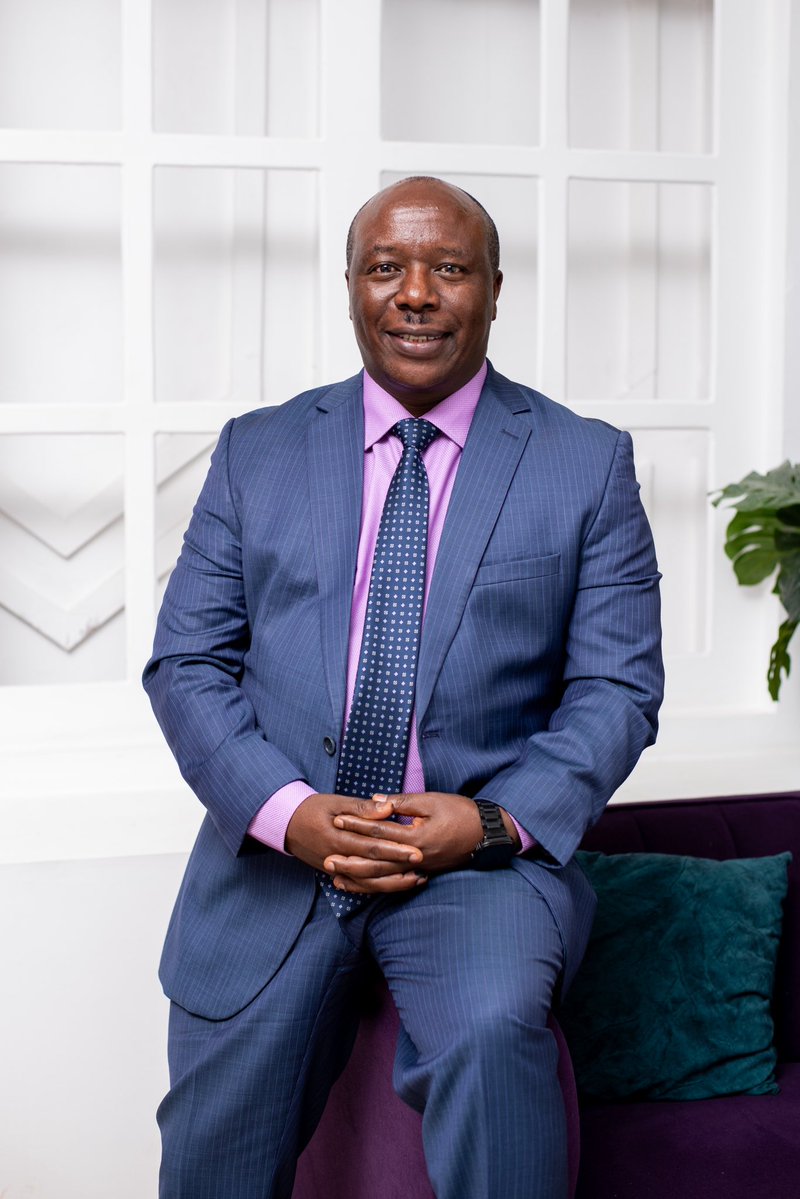
After 2 decades of climbing the corporate ladder, I walked away from my role as General Manager at Old Mutual Kenya.
This was a decision that puzzled many people, to many people it didn’t make sense. After all, most professionals spend their entire careers working towards senior leadership.
So why would anyone leave? The answer had everything to do with the purpose I was pursuing.
Over those 2 decades, I had the privilege of mentoring hundreds of financial advisors, building high-performing teams, and watching many people grow into successful professionals. It remains one of the most rewarding chapters of my career.
But somewhere along the journey, I realised something.
The higher I climbed in management, the further I moved from the conversations that had made me fall in love with this profession in the first place.
I missed the conversations with clients. The opportunity to sit across the table from someone, understand their dreams, their fears, their financial challenges, and help them build a plan that could genuinely change the course of their lives.
Management gave me the opportunity to lead people, but advising people gave me purpose.
That realisation changed everything. I began asking myself a question that was difficult to ignore: Was I simply managing a successful career, or was I fulfilling the calling that first brought me into this profession?
The answer became clearer with time.
So I made a decision that surprised many people. I stepped away from management and started Hisa Africa Insurance Agency.
From the outside, it looked like I was starting over. In reality, I was building on the experience i had gained.
The difference was that I was now free to focus on what mattered most, 𝐦𝐲 𝐜𝐥𝐢𝐞𝐧𝐭𝐬.
Instead of being limited to one perspective, I now had freedom to listen first and recommend what genuinely served each person’s needs without being confined to one solution.
Something remarkable happened after I made that decision.
The relationships I had built over the years became even stronger. Clients began turning to me not just for solutions, but for guidance on investments, retirement planning, protecting their families, and building long-term wealth
That trust naturally led to something I had never set out to chase
Clients began introducing me to their spouses, siblings, colleagues, friends, and business partners because they had experienced the value of honest, thoughtful financial advice firsthand. The greatest endorsement I could receive was hearing someone say, “You should have a conversation with Alfred.” Those simple referrals became the foundation of relationships that continue to grow today.
Looking back today, I don’t see my decision as walking away from success. I see it as walking towards significance.
Maybe philosophy would catch on with the youth if we started calling it “depthmaxxing”.
One can imagine the infomercial…
“ARE YOU TIRED of being SHALLOW?
Do you find yourself COPING with unexamined assumptions? Are your beliefs just… sitting there? Soft. Unjustified. Embarrassing?
There has to be a better way.
Introducing DEPTHMAXXING™.
The world’s first epistemically optimized self-improvement system—used by Socrates, Kant, and that one guy at your university who made everyone uncomfortable at dinner.
With DEPTHMAXXING™ you’ll learn to:
∙DESTROY weak assumptions using nothing but your own rationality
∙MOG the entire room with a single well-placed “but how do you know that?”
∙Achieve SIGMA EPISTEMIC STATUS in as little as 2,400 years of reading
But wait—there’s more.
Order NOW and we’ll include our FREE bonus module: Coping With Certainty: Why You Have None.
RESULTS NOT TYPICAL. Side effects may include: alienating your friends, an inexplicable urge to examine your own death, and being sentenced to drink hemlock.
DEPTHMAXXING™. Know thyself. Slay.”
Tablets should have no place in learning centers, especially for younger children who are learning their letters. The study by Van der Weel & Van der Meer (2024), published in Frontiers in Psychology highlighted the importance of hand writing over typing. That the act of physically forming letters by hand engages the brain in ways that promote learning and memory, while typing does not activate these same connectivity networks. The more we rely on technology, the further we get from optimizing our brains for learning. Do not give your children devices and make sure you are encouraging them to write by hand when they first start learning.
This is precisely what I described as one of the mechanisms through which compliance is manufactured: the deployment of religion to transmit a theology of earthly resignation and otherworldly reward that discourages any serious engagement with the material conditions of one’s life.
“Prioritise getting your kids into Heaven, not Harvard”. Read that again. This is someone, on a public platform literally opposing higher education to spiritual salvation, as though knowledge and intellectual formation are somehow in competition with divine favour and that the most responsible thing a parent in the most educationally underserved continents on earth can do is deprioritise their child’s access to the best institutions of learning in the world.
This is the most politically convenient version of faith, the one that has always served the interests of those who benefit from an uneducated, economically precarious, politically disengaged population that directs its energy upward toward heaven rather than outward toward the structures producing its suffering.
And the tragedy is not the person who wrote it. The tragedy is that millions of people have been so thoroughly processed by this theology that they repeat it with genuine conviction. Because the religious clerics disseminating this worldview are the very same people collecting their congregations’ money every week and quietly enrolling their own children in boarding schools in Europe and the finest universities in the West.
They know exactly what a Harvard education does for a child’s future. They have simply decided that this knowledge is for their children, and that yours should be content with heaven.
In my address titled "The Political Economy of Obedience," delivered last month at the Josef Korbel School of Global Affairs at the University of Denver, I identified five key mechanisms through which African populations have been trained into political compliance. I am sharing a summary here because they explain precisely what we are watching play out in real time every day on this continent.
The first is colonial education. The curriculum inherited from the French, the Brits or the Portugese administration was not designed to produce critical citizens. It was designed to produce a particular kind of political subject. one who understood authority as something to be respected rather than questioned, and who experienced his own political traditions as a source of shame rather than institutional possibility. As I said in Denver, the most effective political prisons are not made of concrete. They are made of curriculum. The Togolese school I attended taught us the genealogy of French kings with more precision than the history of the governance systems that predated French colonial presence on our territory.
The second is the economy of obedience itself. Authoritarian systems endure not primarily through permanent terror but because they structure the relationship between political compliance and material survival so that obedience becomes, for most people most of the time, the rational choice. Access to employment, scholarships, market licenses, import authorizations, health clinic access: none of it politically neutral, all of it conditioned on loyalty. People in these systems do not collaborate with power because they are morally deficient. They collaborate because the scaffolding of their daily lives has been designed to make non-collaboration economically catastrophic.
The third is the family as a site of control. In conditions of economic precarity, the individual who considers a dissident act must calculate not only her own risk but the risk she imposes on her parents, her siblings, her children, her cousins etc. I have watched people of intelligence and moral clarity retreat from political engagement not because they were afraid for themselves but because they could not justify the devastating exposure their activism would bring to their families. The authoritarian state does not need to threaten everyone. It only needs to ensure that the threat to one is visible and comprehensible to all.
The fourth is religion. In many parts of Africa, religious institutions have been deployed, not by their most honest practitioners but by their most politically convenient ones, to transmit a theology of earthly resignation and otherworldly reward that discourages political engagement. The pastoral instruction to render unto Caesar what is Caesar's sits very comfortably with the interests of Caesars who have no intention of rendering anything to anyone. Liberation theology, which in Latin America produced an extraordinary tradition of religiously grounded political resistance, has had a far more contested reception in much of African Christianity and Islam, partly because of the direct entanglement of many religious institutions with state power, which has made spiritual authority and political compliance structurally allied.
The fifth is media. In authoritarian African contexts, state and privately owned media aligned with power do not typically practice crude propaganda. They practice something more subtle and more durable: the selection of what is visible and what is invisible; the framing of social problems as natural phenomena rather than political choices; and the treatment of opposition voices as marginal or foreign-funded. The film industry participates in this discipline in its own way, through the systematic promotion of narratives that depict poverty and wealth as conditions of fate or personal failure, stories in which the distance between the poor and the rich has everything to do with luck, talent or divine favour and nothing to do with power, policy or the deliberate engineering of inequality.
The cumulative effect, over decades, is a population whose political imagination has been narrowed to the point where alternatives are genuinely difficult to conceive, not because the alternatives do not exist, but because the political ecosystem has ensured they remain invisible.
These are the operating manual of authoritarian systems on this continent. And authoritarianism today is not limited to regimes with a known dictator who has held power for decades. It extends equally to regimes that perform a change of leadership through placebo elections conducted every four to five years, producing a new face every eight to ten years while the same system of impunity, patronage and repression remains structurally intact.
I would argue that these are in fact the more dangerous form of authoritarianism because their citizens are deceived into believing they are living under a democracy when they are in reality governed by plutocrats. The citizen under an obvious dictatorship at least knows what he is fighting. The citizen under a rotating plutocracy has been convinced there is nothing to fight at all. He votes, he watches a new face take the oath, and he mistakes the performance of transition for the substance of change. He ends up with no voice, no justice, no agency, and worse, no drive to fight for his own dignity. For one can only fight for liberation after acknowledging one's condition of oppression.
I am filled with a deep existential sadness by the thought of anyone going through teenage and young adulthood without ever taking part in the joy of song and dance
It is a rite of passage💃🏾🕺🏾
Young people need to gather with no other agenda except dancing till the break of dawn.
There's a form of censorship that I had not reckoned with up to now, for some reason. It's censorship through policing people's timelines. Enough Kenyans have told me that a repost, like or comment on my posts gets them into trouble with their friends or Whatsapp groups.
Shame on you if you're doing this to other Kenyans. If you want to remain narrow-minded, don't force people to join you through passive aggression. That's cowardly.
💯
“There are people who simply lack the capacity to understand anything outside their own perspective. Not because the truth is complicated, but because accepting it would require humility… reflection… responsibility.
Stop debating with people who don’t debate in good faith.”
This year marked the 25th anniversary of my family’s departure from a refugee camp in Benin. We spent 7 years as refugees in the country. Thus my recent trip to Cotonou was a major homecoming & it was made even more special by the fact that I shared the journey with my father.
.@KICDKenya will deny deny deny what I'm saying. But this is what I've always asked: give me a 3-hour debate with the best of the CBE defenders, and bring your class activities with them and we'll explain them.
The media never put us in the same room. Ask yourselves why.
The kids using ChatGPT to cheat are massively fumbling the ball.
I would give almost anything to experience learning something like calculus for the first time with an AI assistant.