Stop paying for $3,000 "RAG" bootcamps.
Qdrant just put a full, production-grade vector search course on YouTube.
For free.
This isn't a demo. It's a 7-day sprint where the final project is to ship a complete, production-ready documentation search engine.
The full curriculum for real engineers:
➡️ Day 1
• Get on Qdrant Cloud & build your first basic vector search.
➡️ Day 2
• Master Points, Vectors, Payloads, & Chunking.
• Project: Build a Semantic Movie Search.
➡️ Day 3
• Learn HNSW Indexing fundamentals.
• Project: Benchmark HNSW for actual recall vs. latency.
➡️ Day 4:
• Master Hybrid Search (sparse + dense) with score fusion.
• Project: Build a Hybrid Search Engine that actually finds keywords.
➡️ Day 5:
• Learn Vector Quantization to slash memory costs.
• Master high-throughput ingestion & accuracy with rescoring.
• Project: Quantization Performance Optimization.
➡️ Day 6:
• Use Multivectors for advanced reranking.
• Learn the Universal Query API.
• Project: Build a Recommendation System.
➡️ Day 7:
• Final Project: Synthesize all 6 days to ship a production-ready doc search.
➡️ Bonus:
➕ Full integration guides for LlamaIndex, Tensorlake, camelAI, Jina AI, Unstructured(dot)io, and more.
This is the syllabus that separates the "demo builder" from the "production engineer."
This is how you build RAG that actually scales. (I will put the playlist in the comments.)
♻️ Repost to save someone $$$ and a lot of confusion.
✔️ You can follow @techNmak, for more insights.
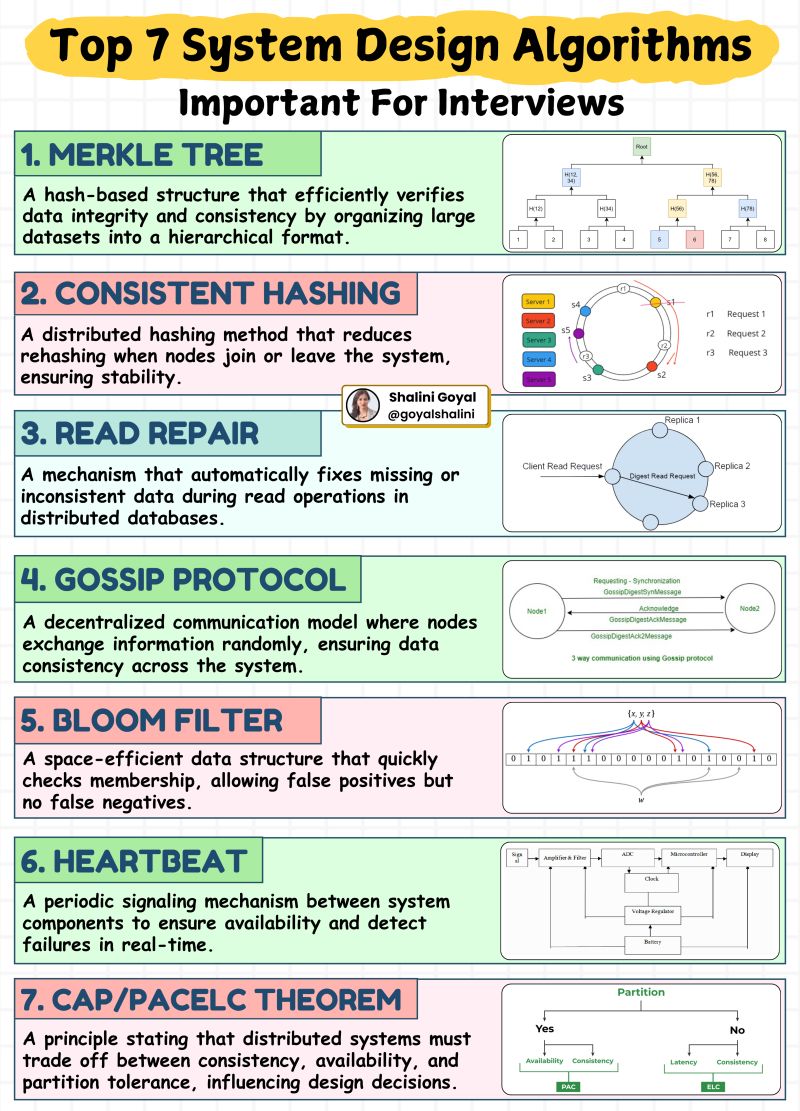
7 Essential System Design Algorithms You Must Know for Interviews!
System design interviews often test your knowledge of scalability, efficiency, and fault tolerance and these 7 key algorithms play a crucial role in designing robust distributed systems.
1. Merkle Tree – A hash-based structure that verifies data integrity and consistency in large datasets.
2. Consistent Hashing – Reduces rehashing when nodes join or leave a system, ensuring stability.
3. Read Repair – Automatically fixes missing or inconsistent data in distributed databases.
4. Gossip Protocol – A decentralized communication model that spreads data efficiently across nodes.
5. Bloom Filter – A space-efficient data structure that checks membership, allowing false positives but no false negatives.
6. Heartbeat – A periodic signal that ensures availability and detects failures in real-time.
7. CAP/PACELC Theorem – Explains trade-offs between consistency, availability, partition tolerance, and latency in distributed systems.
How AWS Manages Serverless Functions
→ AWS manages serverless compute primarily through AWS Lambda, a service that runs code without provisioning or managing servers.
→ AWS takes care of everything beneath your code: scaling, security, availability, and execution environments.
The Serverless Execution Model
→ When a function is triggered, AWS prepares a secure runtime environment.
→ This environment includes memory, CPU, network access, and your selected runtime (Node.js, Python, etc.).
→ You only upload code; AWS handles the infrastructure automatically.
Event-Driven Architecture
→ AWS Lambda is integrated with over 200+ AWS services.
→ Common event sources include:
→ S3 uploads
→ API Gateway requests
→ DynamoDB streams
→ EventBridge rules
→ CloudWatch alarms
→ Kinesis streams
→ AWS manages event routing, permissions, and retry logic behind the scenes.
Scaling Automatically
→ AWS scales Lambda automatically and instantly.
→ Each incoming request creates a new execution environment as needed.
→ No load balancer or autoscaling configuration required.
→ High traffic = more parallel Lambda invocations.
→ Low traffic = zero active instances, so no cost.
Cold Starts & Warm Starts
→ When Lambda creates a new environment, it may introduce a slight delay called a cold start.
→ AWS reduces cold starts by:
→ Reusing existing environments (warm starts)
→ Introducing Provisioned Concurrency to keep functions pre-initialized
→ Improving runtime performance over time
→ Optimizing the underlying Firecracker microVM technology
Secure Execution
→ Each Lambda function runs in a sandboxed microVM for isolation.
→ AWS enforces permissions using IAM roles, defining what the function can or cannot access.
→ Environment variables and encrypted secrets ensure secure configuration.
→ No direct server access exists, reducing attack surface.
Storage & Data Handling
→ AWS provides multiple storage options for serverless applications:
→ S3 for files
→ DynamoDB for NoSQL data
→ Aurora Serverless for relational data
→ EFS for persistent file system access
→ Lambda connects to these resources automatically through VPC or public endpoints.
VPC Integration
→ Lambda can access private resources by connecting to a VPC.
→ AWS handles elastic network interfaces (ENIs) and IP address assignments.
→ Improved VPC networking ensures faster initialization compared to earlier versions.
Monitoring & Logging
→ AWS integrates Lambda with:
→ CloudWatch Logs for execution logs
→ CloudWatch Metrics for performance tracking
→ X-Ray for tracing and debugging
→ These help developers analyze performance, failures, and bottlenecks.
Deployment & Versioning
→ AWS supports multiple deployment mechanisms:
→ ZIP file uploads
→ Container images
→ Infrastructure-as-code (SAM, CDK, CloudFormation)
→ Versioning allows frozen versions of your code.
→ Aliases point to versions, enabling safe deployments (e.g., blue/green).
High Availability & Reliability
→ AWS runs Lambda across multiple Availability Zones in each region.
→ If one AZ fails, functions continue running automatically in others.
→ No configuration is required to enable fault tolerance.
Cost Management
→ Lambda uses pay-per-use billing:
→ You pay only for the compute time your function uses.
→ No charges when the function is idle.
→ Provisioned Concurrency has additional cost but improves performance predictability.
Quick tip
→ AWS manages serverless functions by automating infrastructure, scaling, networking, security, and event handling.
→ Developers focus purely on logic while AWS handles everything else behind the scenes.
Grab this Ebook for deeper AWS mastery:
https://t.co/cZQIvhf99z
Data Without Labels — Models and Algorithms for Practical Unsupervised #MachineLearning: https://t.co/TPyL6ZPR4e
𝓦𝓱𝓪𝓽 𝓨𝓸𝓾 𝓦𝓲𝓵𝓵 𝓛𝓮𝓪𝓻𝓷:
🔶Fundamental building blocks and concepts of machine learning and unsupervised learning
🔶Data cleaning for structured and unstructured data like text and images
🔶Clustering algorithms like K-means, hierarchical clustering, DBSCAN, Gaussian Mixture Models, and Spectral clustering
🔶Dimensionality reduction methods like Principal Component Analysis (PCA), SVD, Multidimensional scaling, and t-SNE
🔶Association rule algorithms like aPriori, ECLAT, SPADE
🔶Unsupervised time series clustering, Gaussian Mixture models, and statistical methods
🔶Building neural networks such as GANs and autoencoders
🔶Dimensionality reduction methods like Principal Component Analysis and multidimensional scaling
🔶Association rule algorithms like aPriori, ECLAT, and SPADE
🔶Working with Python tools and libraries like sci-kit learn, numpy, Pandas, matplotlib, Seaborn, Keras, TensorFlow, and Flask
🔶How to interpret the results of unsupervised learning
🔶Choosing the right algorithm for your problem
🔶Deploying unsupervised learning to production
🔶Maintenance and refresh of an ML solution




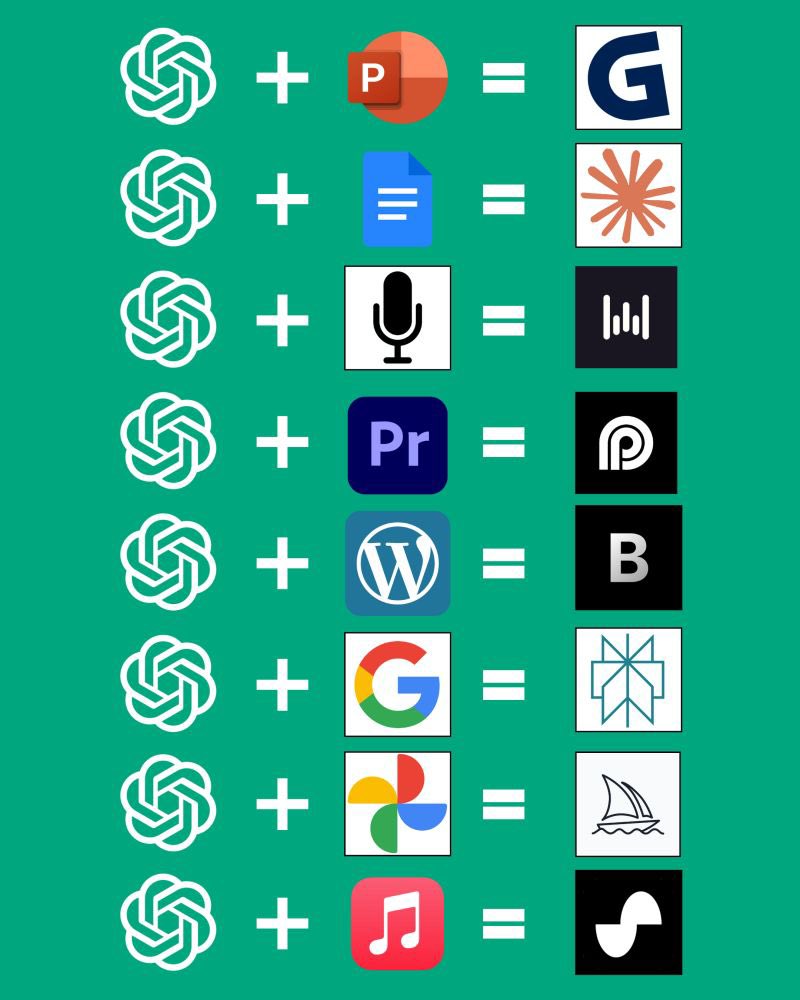

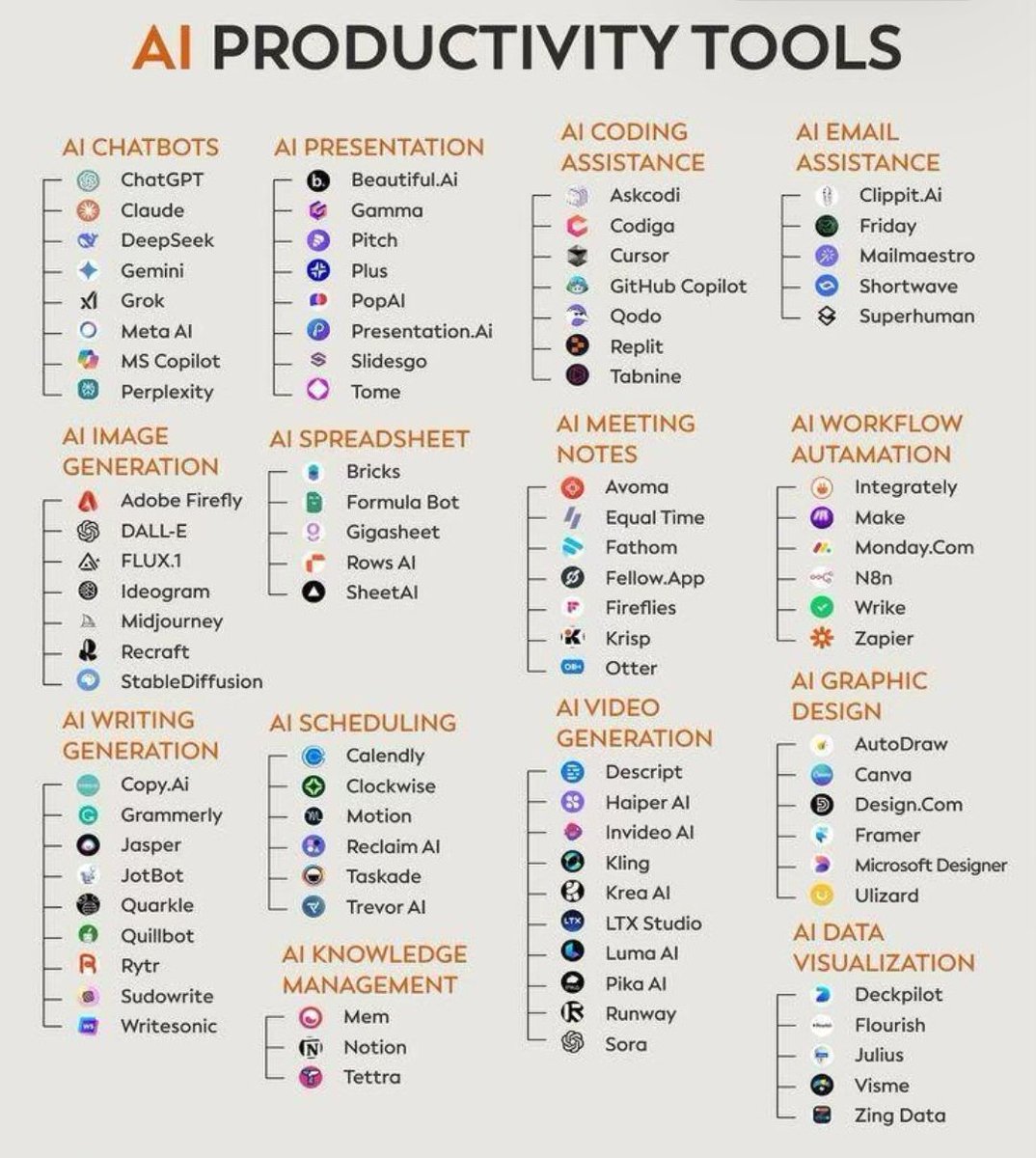
![Shipon_40AI's tweet photo. 15 AI tools you’ll actually use:
1. https://t.co/ehSlGoqGAu → Solve anything
2. https://t.co/9ir2cjJ7Bq → Make music
3. https://t.co/n3E9YwreMU → Edit audio
4. https://t.co/IVS513K20K → Research assistant
5. https://t.co/dhx7vYtdVS → Create videos
6. https://t.co/LsWY2xWjpN → 3D models
7. Gamma → Design docs
8. https://t.co/4Q7maIcVXN → Voiceovers
9. https://t.co/D7rQdYoGgI → Web design
10. https://t.co/K1HGeeuh9f → Chat with files
11. Tome App → Build presentations
12. Krea AI → Logo design
13. ElevenLabs → Clone voices
14. https://t.co/vw3NlizsYb → Image editing
15. Runway → Film editing
[ Bookmark for later 🔖]
—
Get 100% FREE AI and Tech news: 👇
Follow @Shipon_40AI](https://pbs.twimg.com/media/G7-IXMdagAgIGX3.jpg)