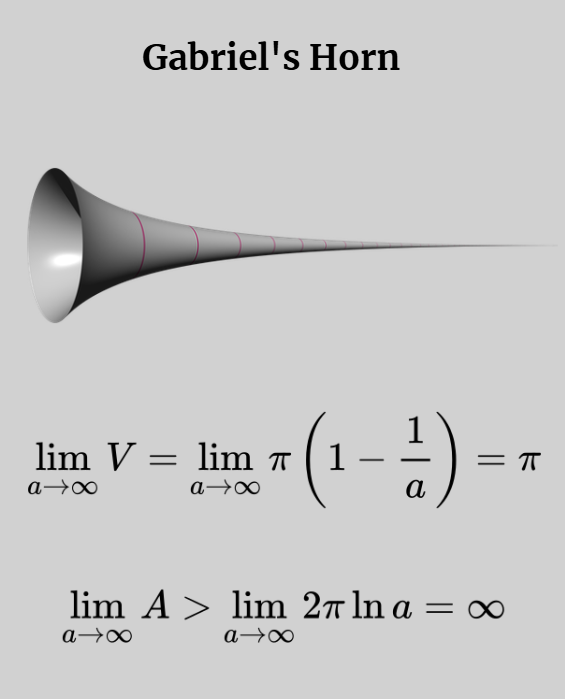
پارادوکسِ شیپورِ جبرئیل: جسمی که با مقدار متناهی رنگ میشه توش رو پر کرد، اما به مقدار نامتناهی رنگ نیازه تا سطحش رو رنگآمیزی کرد.
پ.ن. بر خلافِ صور اسرافیل در اسلام، در مسیحیت، جبرئیل، شیپورِ رستاخیز رو به صدا درمیاره.
@sciahrzad The tendency of a system to explore all its possible states isn’t a law of nature, it’s a mathematical theorem. The second law of thermodynamics didn’t tell ergodic theory anything. Ergodic theory told the second law why it works. Physics observes what math already knew.
امروز همکارم در مورد ارگودیک تئوری یه چیزی گفت که تا جایی که یادمه ثبت کردم:
Most people think randomness and structure are opposites. Ergodic theory laughs at that. Time averages equal space averages. Order hiding inside chaos. One of the most beautiful ideas in all of math.
@sciahrzad No, not necessarily! Ergodic theory is a purely mathematical framework. It lives in measure theory and dynamical systems, completely independent of thermodynamics. The connection to entropy and thermodynamics is just an application.
Today, we share a breakthrough on the planar unit distance problem, a famous open question first posed by Paul Erdős in 1946.
For nearly 80 years, mathematicians believed the best possible solutions looked roughly like square grids.
An OpenAI model has now disproved that belief, discovering an entirely new family of constructions that performs better.
This marks the first time AI has autonomously solved a prominent open problem central to a field of mathematics.
On this day in 1857, mathematics lost one of its brightest stars: Augustin-Louis Cauchy.
A titan of mathematics who single-handedly laid the rigorous foundations of modern analysis. From complex functions and Cauchy’s integral theorem to convergence, elasticity, and permutation groups; his work shaped nearly every branch of mathematics we use today.
One of the most prolific mathematicians in history, with over 800 papers. The “father of rigorous calculus.”
همهمون تو مدرسه فکر کنم یه دونه از اینا داشتیم! یادمه حتی HESOYAM رو دیگه حفظ بودیم، و تو لیست نمیآوردیم. اونجا بود که حس کردم زندگی ابدی با پول بیپایان اونقدرا هم ایده جالبی نیست ؛)
Today, we share a breakthrough on the planar unit distance problem, a famous open question first posed by Paul Erdős in 1946.
For nearly 80 years, mathematicians believed the best possible solutions looked roughly like square grids.
An OpenAI model has now disproved that belief, discovering an entirely new family of constructions that performs better.
This marks the first time AI has autonomously solved a prominent open problem central to a field of mathematics.
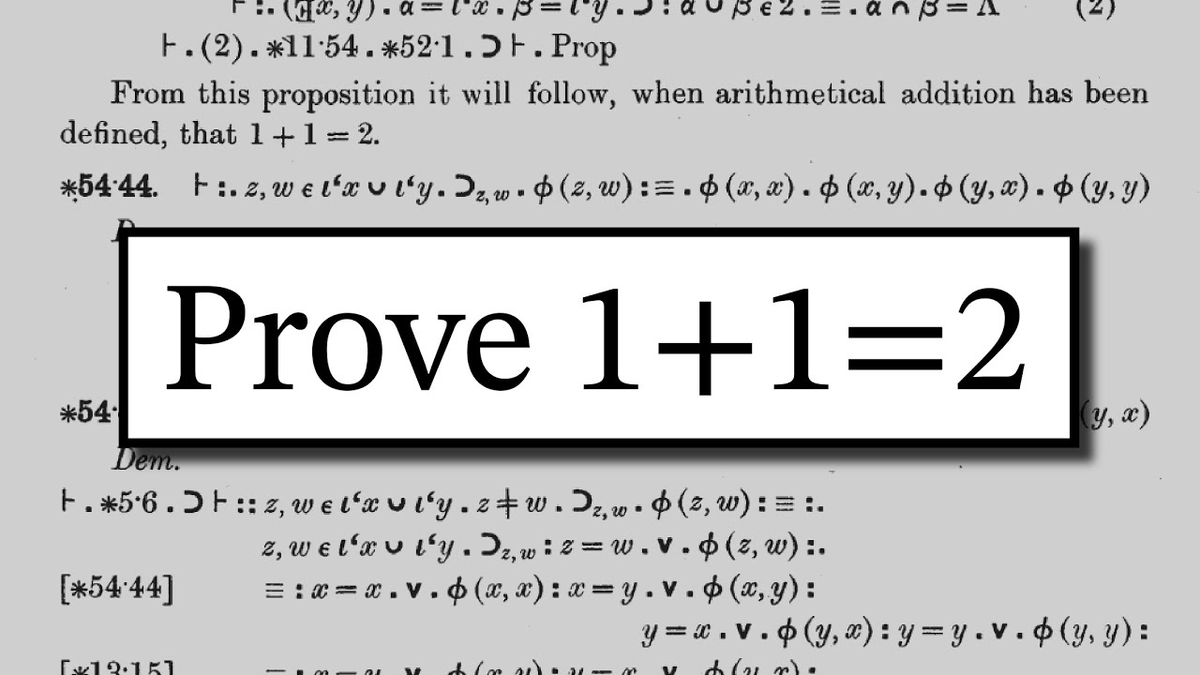
In 1910, Principia Mathematica by Alfred North Whitehead and Bertrand Russell attempted to build all of mathematics from pure logic. After over 2,000 pages, they showed how difficult this goal was—famously taking 362 pages just to prove that 1 + 1 = 2.
The idea of rigorous proof dates back to Euclid (300 BC), who formalized mathematics using logical arguments rather than observation. Unlike science, where repeated experiments can suggest truth, mathematics demands certainty for every case. Patterns alone aren’t enough—many fail under closer inspection.
Mathematics is built on axioms: simple, accepted truths (like properties of equality). From these, theorems are logically derived. Whitehead and Russell followed this approach, defining numbers, addition, and logic step by step until they could formally prove basic arithmetic.
Their work was groundbreaking but impractical, with complex notation and limited usability. Soon after, in 1931, Kurt Gödel proved that no system of axioms can capture all mathematical truths—making their ultimate goal impossible.
Yet their effort wasn’t wasted. Like many great discoveries, the journey mattered more than the destination. Similar to Andrew Wiles’ proof of Fermat’s Last Theorem, the real impact came from the new mathematics developed along the way.
In the end, Principia Mathematica stands as a monumental achievement—showing both the power and the limits of human logic.
سال پیش این موقع، وقتی از مدلهای مختلف زبانی بزرگ استفاده میکردم، تسلط خوبی برای حل مسائل جبر داشت، ولی تو آنالیز بشدت ضعیف بود و گاهی اشتباهات فاحشی میکرد. امروز به راحتی با میزان خطای قابل اغماض، مسائل آنالیز رو هم مثل جبر پوشش میده.