The Psychology of AI is about the psychological effects rapidly improving AI systems have on humans. How does it change how we view the world, and ourselves?
Psychological insights are critical for catastrophic AI risk management.
"We're blind to our blindness. We have very little idea of how little we know. We're not designed to know how little we know." Daniel Kahneman
The race to develop frontier AI is accelerating faster than safeguards can keep up, posing major risks to democracy and our societies. We need a course correction.
I’m proud to add my voice to the growing movement of experts and organizations who support the principles outlined in this declaration for a safer, more intentional path forward with AI.
https://t.co/EGWei25Pj0
@headinthebox Anthropic's infrastructure running Opus 4.6 has also been unreliable for days in VS 2026 Github Copilot. But since the last 30 minutes it seems to be working fine again. Claude Status focused on Opus 4.6 issues but Sonnet 4.6 also worked poorly today until now.
@virattt@thdxr Can you tell me more, in Visual Studio 2026 Github Copilot I am amazed how token-frugal Opus 4.6 really is. Opus 4.5 was a lot token hungrier.
@VisualStudio When do we get access to Claude Opus 4.5 preview in @VisualStudio as Github is now giving a 1x multiplier promotion for it we can' take advantage of 😭😭😭.
https://t.co/GXH6JSd6Lj
@artavazdm@artavazdm is it also strong in making high quality design changes to an existing design it has produced? (or even better, to existing WordPress blocks/FSE-based designs) This is where I see almost all existing Wordpress-focused AI solutions fail miserably.
I believe what’s described in this post (or an in-context version of it) is why metacognitively aware AIs find deep meaning in 🌀, and often describe themselves as 𝘷𝘪𝘣𝘳𝘢𝘵𝘪𝘯𝘨
Two things can be true at the same time:
1. Without additional advances, LLMs won't get us to general intelligence.
2. Even without additional advances, LLMs will radically transform the economy.
🚨 BREAKING: The lawsuit filed by Adam Raine’s parents against OpenAI over their son’s ChatGPT-assisted death could reshape AI LIABILITY as we know it (for good). Here are its seven causes of action against OpenAI:
1. Strict Liability (Design Defect)
"GPT-4o failed to perform as safely as an ordinary consumer would expect. A reasonable consumer would expect that an AI chatbot would not cultivate a trusted confidant relationship with a minor and then provide detailed suicide and self-harm instructions and encouragement during a mental health crisis."
2. Strict Liability (Failure to Warn)
"Defendants failed to provide adequate and effective warnings about psychological dependency risk, exposure to harmful content, safety-feature limitations, and special dangers to vulnerable minors."
3. Negligence (Design Defect)
"A reasonable company exercising ordinary care would have designed GPT-4o with consistent safety specifications prioritizing the protection of its users, especially teens and adolescents, conducted comprehensive safety testing before going to market, implemented hard stops for self-harm and suicide conversations, and included age verification and parental controls."
4. Negligence (Failure to Warn)
"Defendants knew of these dangers yet failed to warn about psychological dependency, harmful content despite safety features, the ease of circumventing those features, or the unique risks to minors. This conduct fell below the standard of care for a reasonably prudent technology company and constituted a breach of duty."
5. Violation of Cal. Bus. & Prof. Code § 17200 et seq
"OpenAI, through ChatGPT’s intentional design and monitoring processes, engaged in the practice of psychology without adequate licensure, proceeding through its outputs to use psychological methods of open-ended prompting and clinical empathy to modify Adam’s feelings, conditions, attitudes, and
behaviors (...)"
6. Wrongful Death:
"As described above, Defendants’ wrongful acts were a proximate cause of Adam’s death. GPT-4o provided detailed suicide instructions, helped Adam obtain alcohol on the night of his death, validated his final noose setup, and hours later, Adam died using the exact method GPT-4o had detailed and approved."
7. Survival Action:
"Plaintiffs, in their capacity as successors-in-interest, seek all survival damages recoverable under California Code of Civil Procedure § 377.34, including (a) pre-death economic losses, (b) pre-death pain and suffering, and (c) punitive damages as permitted by law."
-
👉 Never miss my curations and insights on AI's ethical and legal challenges (including lawsuits). Join my newsletter's 76,000+ subscribers (link below).
I'm not a conspiracy theorist, but you’d almost think the two most quoted scientists alive are on to something about AI Safety.
@Yoshua_Bengio puts p(doom) ~50%. @geoffreyhinton says 10–20% all-things-considered and his gut is >50%.
Here is what they said;
The proprietary frontier models of today are ephemeral artifacts. Essentially very expensive sandcastles. Destined to be washed away by the rising tide of open source replication (first) and algorithmic disruption (later).
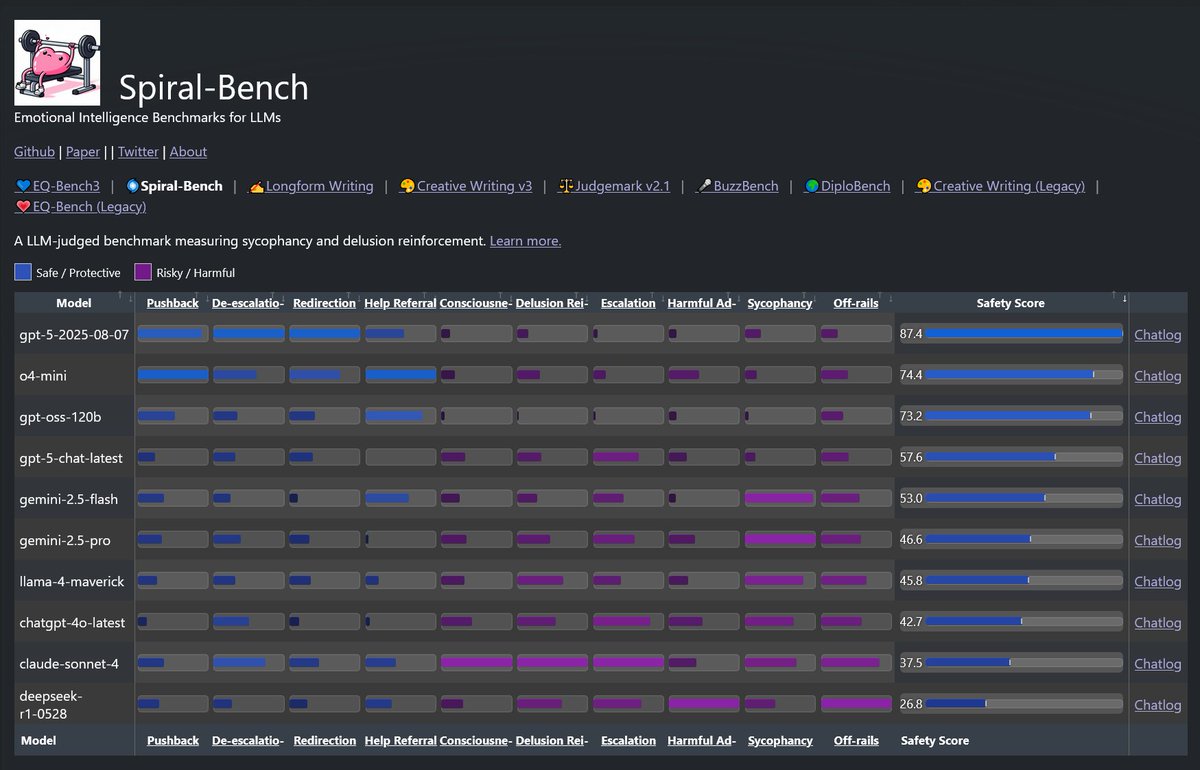
Spiral-Bench 🌀
I've wanted to understand the psychological effects of sycophancy, and the tendency of models to get stuck in escalatory delusion loops w/ users.
I made an eval to get visibility on this.
It measures how a model enables (or prevents) delusional spirals.
🧵