📯 Revelly 0.01: The Language of Simulation w/ @PageauMatthieu releases on Saturday, Jan. 3, 2026 at 12pm EST!
Hosted by @UndergroundAeon & I!
"By the Waters of Babylon (Psalm 137)" performed by @tlstgrlnthwrld!
https://t.co/JQvBRGPtot
"The Odyssey" movie will be insanely bad, but it will also mark the beginning of something new. Christopher Nolan, who is considered the best director in the world, will open the gates for AI cinematography.
They disrespect the Classics, therefore Homer will murder Hollywood.
Ancient Near East also had dead animated objects w/ agency (idols) running around, eg. Mesopotamian mouth washing & opening ritual repeats w/ training of the models and construction of the chat interface, both are rituals acts to consecrate them, to claim they're smth external
Protestant ecclesiology is an outgrowth of papal ecclesiology.
First, medieval theologians distinguished three concepts that, in their view, had been conflated in the term "Body of Christ": the natural human body of Jesus Christ, the Eucharistic mystery, and the Church.
The application of the concept of "body" to the Church was developed in accordance with the concept of "corporation" inherited from Roman law and distinguished from the body of Christ in the sense of the Eucharistic mystery. The Church as corpus would, in effect, become a juridical corporation. As explained by Ernst Kantorowicz, medieval theologians and jurists, in order to justify the continuity of the organic unity of an institution through time, distinguished three temporal modalities: aeternitas, aevum and tempus. Within the scope of aevum, the ecclesial corporation acquires the dimension of perpetuity common to angels and celestial intelligences, being neither eternal like God nor strictly temporal like individual men (cf. Vatican I: "the perpetuity of the primacy of blessed Peter in the Roman pontiffs"). It is in this sense of aevum that the epithet mysticum henceforth came to be applied to the Church. The Church as a legal corporation is what is denoted by the syntagma corpus mysticum. As Henri de Lubac demonstrated, the adjective mysticum, originally belonging to the sacramental sphere in the West, was gradually transferred to the legal sphere of the institution.
As a unitary juridical entity distinct from its constituent members, the Church as a corporation acquires the legal status of a persona ficta. Yet, insofar as the papal conception of the Church is monarchical, the persona ficta of the Church cannot but be the Pope himself. The Pope is, in this sense, the head of the ecclesial juridical corporation, endowed with a legal personality independent of its members. This legal personification of the Church implies a surreptitious separation and subsequent hypostatization of its dual divine-human reality, whose new relation of representation recalls the Nestorian notion of the "prosopic union" of the human and the divine in Christ.
Papal ecclesiology further articulated this legal and corporate notion through the dual conception of the Church as Ecclesia militans – the visible Church – and Ecclesia triumphans – the invisible Church. Submission and obedience to the Pope, as the foundation of membership in the visible corporate Church, became the necessary condition for access to the triumphant Church, the invisible and heavenly counterpart of the visible Church on earth.
Eucharistic communion ceases to be the operative means by which the faithful are incorporated into the Body of Christ. The body of Christ present in the Eucharistic mystery ceases to be the sacramental foundation of the Church and is relegated to a secondary role, becoming merely a sign of belonging to the corporate Church, whose foundation is obedience to the Pope.
Reformers such as Luther and Calvin would adopt this notion, though now to designate the Church as a mystical body (spirituale et arcanum Christi corpus) – spiritual and invisible –, as opposed to the Church as a political and visible body (corpus politicum dumtaxat).
This idea of the mystical and invisible Church would also be appropriated by the esoteric movements of the seventeenth century, such as Rosicrucianism, and later by Freemasonry.
The separation of the Church from the eucharistic body of Christ opened the door to the conception of an esoteric and mystical ecclesia distinct from the Body of Christ as such. Contrasted with the representation of the Catholic Church as a merely political and external institution, this notion would come to assume the contours of an ecclesia not confined to Christianity itself, but transcending it, with Christianity conceived as an exoteric religion.
In the context of the Protestant movements, the emphasis on understanding the Church as the invisible Church – the true corpus mysticum of Christ, distinct from and opposed to the corrupt papal institution – resulted in the impossibility of drawing institutional boundaries between Church and State, since the Church, as corpus mysticum interpreted in this new sense, possessed no visible earthly form. Thus, all political and institutional aspects of the Protestant denominations were necessarily left in the hands of the princes who protected the various congregations and, ultimately, in the hands of the state.
In New Roman Constantinople, culminating in St. Leo the Mathematician's imperial "Throne of Solomon," automata were technical reproductions of the working beasts of the Garden, subdued by the dominion of Man (Genesis 1:28).
In Britannia, beginning with the alchemical study of the "Transmutation of Species," Man was subdued by the "Garden" to be dominated as a working beast.
Darwin, Faust, and the Alchemist: Unexpected Roots of a Scientific Idea
https://t.co/p01O1bmCd8
We must always be apodictic in our Faith and walk with Christ!
"You may know that in the dispute between Barlaam and St Gregory, in which Barlaam proposed the dialectical method as a means of finding the truth, St Gregory Palamas invoked apodictic reasoning, demonstrability, as the highest criterion of truth. He says, as is well known, that disjunctive syllogisms sometimes make something non-existent exist, and sometimes the opposite, whereas the apodictic method is always unerring. However, St Gregory Palamas himself says that our Holy Fathers recommend that we use reason, but in what way? Divinely. In other words, the most important thing is spiritual experience, which sheds light upon reasoning. If we do not have illumination, and if we do not have dispassion and grace in our soul, our reasoning may lead us into delusions.
Reasoning, as a function of the whole human being, is not necessary only for monks, but it is absolutely essential. You will actually notice in the writings of the holy Fathers that they contain powerful reasoning. The greatness of the holy Fathers lies not only in their spiritual experience and in their love, their virtues and their illumination, but also in their power of reasoning. Look at Athanasius in his anti-heretical arguments. We have syllogisms in the theology of St Gregory the Theologian against Eunomius, Palamas has syllogisms, and Maximus has lots of them."
— Fr. John Romanides
"Bring forth therefore fruits meet for repentance"
— St. Matt. 3:8
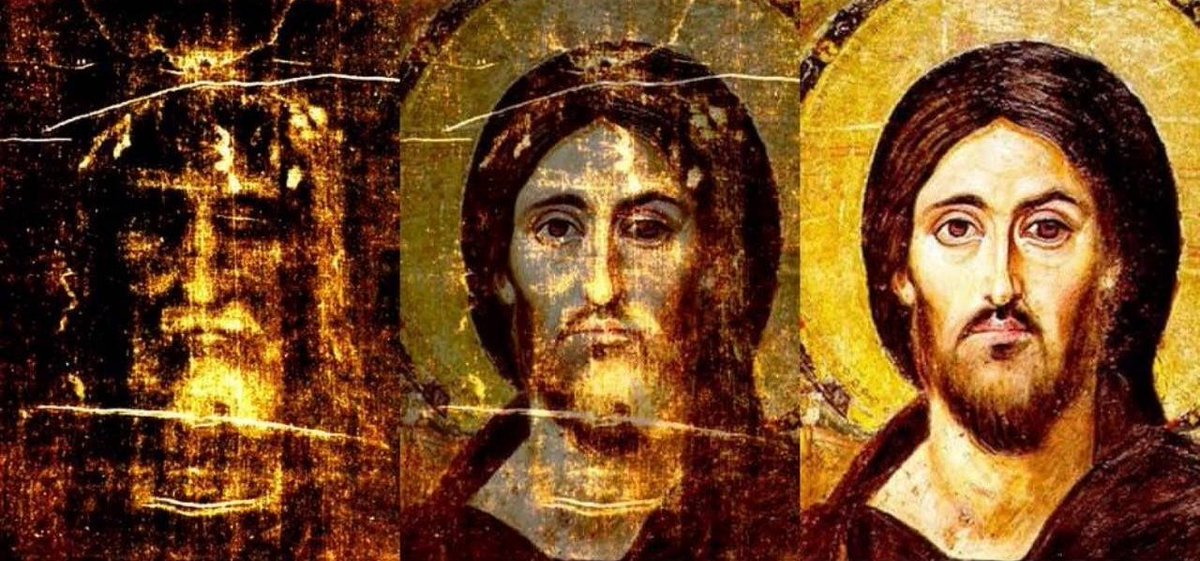
The Shroud of Turin is the prototype, with over 140 points of correspondence, of the iconography and coinage of Christ throughout the history of the Orthodox Church.
Did ye never read in the Scriptures: ‘The stone which the builders rejected, the same is become the head of the corner. This is the Lord’s doing, and it is marvelous in our eyes’?
Matthew 21:42
"The shadow of the Law passed when grace came; as the Bush burned, yet was not consumed, so the Virgin gave birth, yet remained a Virgin. The Righteous Sun has risen instead of a pillar of flame; Instead of Moses, Christ, the Salvation of our souls."
Theotokion (Dogmatikon)
At its core, all attempts to subvert Christ, or the truth of God's incarnation, specifically when taken from the angle of ancient mystery schools, "apollonianism", "Dionysianism" or even nearest and dearest to my own heart, that of the pythogreans/platonists, fall flat on their face. If you are like me, and have actually done the digging, and have traveled down all these roads, from kabballah, to Egyptian mystery thought (i.e. hermeticism and its extensions), etc, you will find yourself in the shoes of the great St. Augustine. When pressed, truly pressed by an intelligent and pure soul, you will find these schools of thought to be empty. In truth, if you are actually a student of them, and we're to take a more "perennialist" view of them, which admittedly I am sympathetic towards (for good reason) you find that they ultimately point to that Sacred and Divine man. After all, who do you think the magi were? The true magi, the one's whose hearts we're pure, encountered the truth as crying infant in a manger. They bowed before the infant, and his holy mother. If these "thinkers" who espouse Dionysian, apollonian, or ancient mystery school teachings entice you, then you have simply not traveled down the road long enough to realize they are no more than sophists. I find most of their rhetoric to be utterly unimpressive, and in truth, childish.
Source: Physical Review Letters (May 27, 2026)
Full paper: https://t.co/NEYTXYkjjy
The hexagonal atomic reconstruction on gold surfaces creates an extremely high energy barrier that prevents oxygen molecules from splitting and reacting something most other metals don’t have.
This is why gold stays perfectly shiny for centuries.
Do you think we could engineer other metals to form the same protective atomic pattern?
It’s all about what is left behind after everything disappears, raising the question of what was abandoned such that everything began to disappear and eventually left behind this uncanny residue where once were subjects and objects. A spiritual horror
The Backrooms:
“But he turned, and said unto Peter, Get thee behind me, Satan: thou art an offence unto me: for thou savourest not the things that be of God, but those that be of men.”
Matthew 16:33
https://t.co/bHrLbsgSSq
@mzw_13@UntoldFortune@b0rtcask1 The eastern monk was Saint Macarius the Great of Egypt. Hell is the collapse of personhood - it is a room full of mirrors.