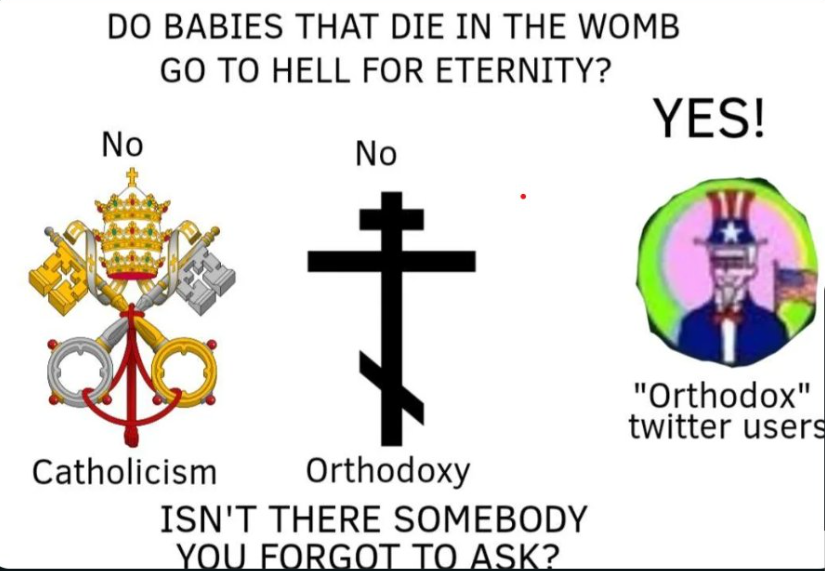
@train2000c No.
The Catholic view is only what is believed always, everywhere, and by all.
Your church doesn’t even remotely come close to that metric on original sin
@EpektasisJohn@WisdomHasBuilt@JustinusRomanus I don’t think we’re supposed to know, to be honest, and I don’t think it’s neatly standardized. I think he chose to comment in that very particular case merely to stress the gravity of the sin
Ok, so I had to look up this quote myself for a few different reasons.
It is indeed legit. From his Dialogues on the Most Holy Trinity, at a point wherein he indeed was discussing exegesis of the Matthew in question.
But the funny part is that I was genuinely surprised to be able to confirm the following-
His Greek does, in fact, translate quite literally as the “nothing other than” written.
I had assumed quite wrongly an apologist had simply dressed up that portion of the text.
Meaning that- if a Catholic attempts to argue that the rock has multiple referents or whatnot-
Cyril is indeed a patristic who rejects that argument outright.
As funny as that passage is, the most important part of it is the confirmation that David kept the Law entirely in the Lord’s eyes, in spite of whatever questions of the Bathsheba incident.
“He did not follow the LORD completely as his father David did.”
I mean I’m reasonably open to distinctions when they’re there and they’re not a patristic that developed as aggressively as both Cyril and Augustine, tbh. Part of this is me considering their corpuses to be (a) the most extreme cases and (b) the most frequently misrepresented on many topic areas
@WisdomHasBuilt@JustinusRomanus I’m not the one who counts the aeons. But we know for certain that blasphemy against the Holy Spirit is worth at least two aeons of purification (“either this nor the next”). Maybe you can math out your favorites from that benchmark
@NelwynToes Catholics today even tell me that this Florence formulation no longer excludes the monks that became martyrs due to the Filioque from salvation.
Fortunately, God did not leave us powerless to determine what Rome believes.
By the indications of at least 7 solemn polls I’ve reviewed, Florentine doctrine has actually (un)developed in a return to authentic, apostolically Christian belief.
The doctrine of reserve is the only correct way to be a universalist when one understands how they conceived of hell.
But the INFERNALISTS keep on bringing it up atp and thereby ruin the possibility of preaching the Gospel in the authentically agnostic manner God intended for it to have been preached.
Well, I would strongly disagree for this reason:
That VERY PARTICULAR subject of exegesis is precisely the sensitive sort that often changed with prevailing political winds.
And in truth theres no better example of that than breaking down augustine’s various exegeses on the topic in relation to whether the seat supported him at the time of the particular writing’s composition.
I did that some time ago, and it utterly blew my mind.
Cyril’s not Augustine, of course, and he doesnt give you the sort of formal retractions of his earlier positions that Augustine does.
But the point should stand in this way: exegesis of that subject admits of historical contingencies extremely often.
@BessyNic Not that I’m here and now making that argument, but that should absolutely be on the table as a very plausible narrative in many cases of patristics. And Cyril is indeed one of the few that develops rather aggressively when you compare late cyril to early cyril imo.
@BessyNic Why would you assume you have to harmonize them?
He was a very thoughtful and complex man who changed his mind over time like many patristics.
This one’s hilarious because its substantially true.
Photius REALLY disliked Clement of Alexandria. mostly because Clement critiqued Gnostics charitably and that was NOT on Photius’s to-do list. But he lays lays out like a 5 point list of why Clement sucks.
And since then, Rome historically flip flopped on Clement of Alexandria as both saint and patristic…four(?)…different times.
No joke. Its a very very funny case that is at least partly Photius’s fault for sure.
The only thing that keeps me up at night is Cardinal Baronius de-canonizing St. Clement of Alexandria because Photius the heresiarch and schismatic supreme said he had reservations about Clement's orthodoxy (believing that humans and angelic beings interbred).