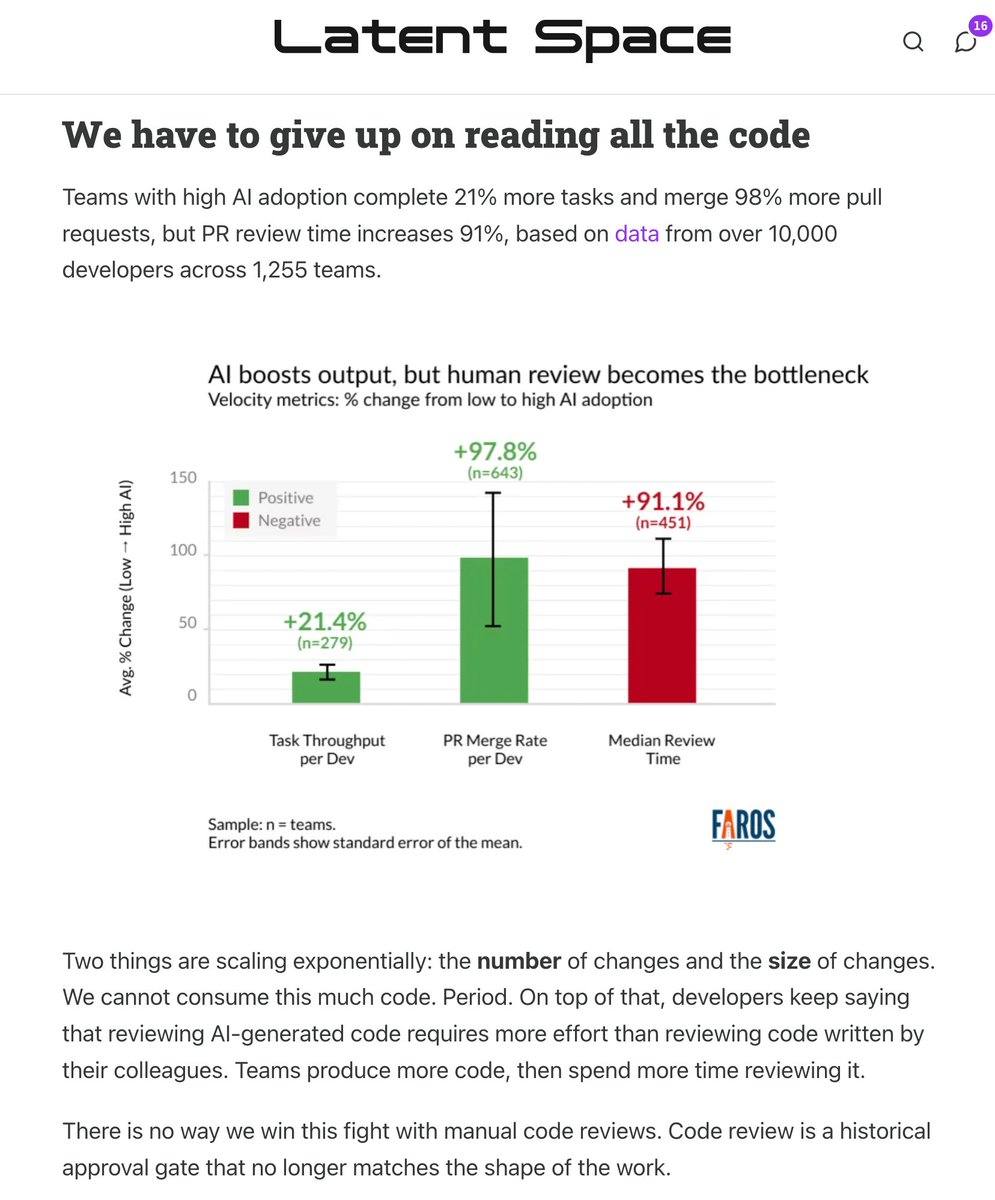
AI is kind of screwing up the whole maker-checker balance in teams. Makers don’t like checking. And checkers never liked makers.
Now both are using AI as a way of bypassing the other.
What a great time to observe and research the organization.
One of the highest ROI activities you can do in your life is to deeply internalize that building good habits is a short term investment that compounds to lifelong gains.
Any new good habit requires overcoming initial friction, but techniques like habit stacking and starting small help.
The trick is to realise that after a while, habit becomes effortless. So it’s just that initial dip you have to overcome. After that, all what you’re trying to do becomes automatic (that’s why it’s called a habit).
So if you’ve been sitting on reading, programming, exercising, dieting or anything else, know that mastering the meta-skill of habit building will probably change your life forever.
this is the Final Boss of Agentic Engineering:
killing the Code Review
at this point multiple people are already weighing how to remove the human code review bottleneck from agents becoming fully productive. @ankitxg was brave enough to map out how he sees SDLC being turned on its head.
i'm not personally there yet, but I tend to be 3-6 months behind these people and yeah its definitely coming.
Adult friendships require grace. People are busy. People are working. People are parenting. People are burnt out. People are healing. People are fighting health battles. People are prioritizing their true responsibilities. Don’t mistake minimal communication for a lack of care or love. Some of us are just getting by and giving everything we have to our families. Check in before you check out.
"You went to IIMA? What did you learn there?"
This question popped up late last year during one of my client pitch calls. I was talking to a smart young tech fellow, who had just raised money for his company. And usually these calls are about getting to know each other, what they do, what I do, how we can work together, communications, content, stories etc.
So... this question was unusual.
I am not a big credentials person. But when you are running your own business, every little helps, right?
Anyway, it made me think. And I thought: You know what? I should share this with my Twitter friends.
***
IIMA teaches you a lot about many things. And your mileage will vary. I loved it.
But two, ostensibly tiny, classroom experiences have really stuck with me from my time there from 2003-2005.
The first was the Arun Icecreams case study. (IIMA uses the case study methodology a lot. I don't think I appreciated this as much as I should have at the time.)
This case was a sweeping history of the company from its inception in 1970 all the way to an inflection point in 1997 where the company's leadership now had to make some business decisions in the face of rising competition from people like Unilever. Our job in the class was to discuss and debate options.
Two decades later I have zero memory of the conclusions of that session. But I remember one particular question that the professor asked to kick things off. It had to do with this section on page 1 of the case study. Let me paste the text here. (You can Google up the whole thing.)
Slightly long excerpt. But there is a point to this.
"Chandramogan, son of a vegetable wholesaler from the South Indian state of Tamil Nadu, set up Arun Ice Cream in 1970 in Madras (now re-named Chennai), essentially motivated by the urge to "do some thing". After his college studies were discontinued at the pre-university stage, Chandramogan agonised over several weeks about starting some business without being quite able to narrow down to any specific line, mainly because of heavy investments entailed. While driven by an urge to succeed as a businessman, he did not quite know how to go about setting up a business. It was his maternal uncle who suggested the business of ice cream. Investing Rs. 15,000 as his own capital and raising another Rs. 21,000 by way of a bank loan, he set up a small ice candy unit in a rented premises adjacent to his uncle's retail textile outlet. From a quick survey around the Madras market it appeared to Chandramogan that there were about 350 small-time ice candy manufacturers like himself competing in the low end of the market. These were offering no competition to the up-market segment dominated by the leading brands Dasaprakash, Joy and Kwality. Like the "others in the crowd", Chandramogan was also selling his Arun brand ice candies for 10 paise and 15 paise a piece predominantly through street-vendors. Thanks to its prominent location in a busy locality, Arun also quickly began attracting walk-in customers. The fact that one could get "fresh" ice candies right across the factory counter was a major selling point in promoting in-factory sales. In the very first year of operations, Chandramogan recalls, Arun clocked a turnover of about Rs. 150,000 and profit of about Rs. 40,000."
And the question posed to the class was: "Why did Chandramogan choose that particular location to start the business?"
This was a location in Royapuram. And if I remember correctly, it was in a busy commercial area next to a flyover. The details are not super relevant as you will soon see.
With all the alacrity of young MBA students, who all wanted to work at Goldman Sachs or McKinsey, we dove into the location question.
Because of footfall! Because of traffic! Maybe it had uninterrupted power supply? Maybe he had access to manpower? Maybe there were other ice cream shops nearby? One guy even suggested it was because Royapuram was very hot, and maybe that would make people buy more icecreams.
The professor, who was clearly having fun, kept provoking us. And eventually he said: "Ok good. Now let me tell you my perspective on what really happened?"
This is a bit of a cheat. But because many of our cases were written by our own faculty, they sometimes had more info than was obvious from the text. And part of our job was to tease this out? Anyway. I will pause on Arun Icecreams here. And I want you to think about his question: Why did Chandramogan start the first shop in that location in Royapuram.
***
Second story. One of the final courses I did was one on Entrepreneurship, that was run by the venerable Sunil Handa. It was a bewildering, often bizarre course. And the point was to make a room full of campus-placement obsessed fellows think about running their own businesses. (Please remember, this was way back in 2005, when all this VC-funded startup frenzy was very very nascent. The default thing to do was very much get a campus job.)
Right at the end of the course Sunil Handa told us that it was time to grade our performance on the course. He said there would be no exam, no tests, no presentations. Nothing. We were all handed a piece of paper. And we were told grade ourselves on the standard IIMA Scale. A, B+, B and so on. (Was there an A+? I have forgotten.) On what basis, we asked. Whatever basis, he said. You decide. I don't care. Whatever you grade yourselves I will accept as your grade for this course.
We all graded ourselves and handed the slips in. The next week, the last session of the course, Prof. Handa bid us all farewell and good tidings. And then gave us a distribution of the scores. "Most of you gave yourselves a B of some sort," he said. And it turned out that exactly one guy gave himself the highest possible score. Nobody else. And the scores had very little correlation with performance. Most of us thought about attendance and participation and field trips and so on, and scored ourselves aiming for some notion of "fairness". Something like that.
He said: "You guys need to realize that entrepreneurship is not primarily about fairness or justice or anything. Entrepreneurship is about making the most of the opportunity given to you. When someone gives you a chance, for god's sake, take it. You should have all given yourself an A+. Never talk yourself out of success. Go you fools, and never forget this lesson!"
I embellish, of course. But that moment remains etched in stone on my heart. I gave myself a B+.
Back to Arun Icecreams.
***
Professor: "So guys. Let's talk about the uncle figure."
"What do you think the maternal uncle is thinking to himself? Look at this guy, my nephew. He has dropped out of college. He wants do something but doesn't know what. I had to tell him what to do. Plus he has now taken a loan and put in some of his own money. Maybe I have given him some money myself? I am not letting that guy out of my sight. I want to make sure I can keep an eye on my nephew, in case he screws this icecream thing up."
And that is why, the professor told us, he opened the shop right next to his uncle's. His uncle found the location for him. So that he can keep an eye on this nephew's shenanigans.
"Business is not always location, footfall, tactics, and 2x2 matrices and stuff like. Often business is just human beings doing human being things. With simple human incentives and motivations. Never ignore the human aspects of business. Always keep the individuals, their motivations, fears, excitements, tendencies, and eccentricities in mind. Ask the human question first, apply the framework second."
***
Two decades later, a day doesn't go by when I don't think of those two lessons.
When I talk to clients I am always provoking them to tell me why... they are in Royapuram. And I have to constantly tell myself that there is a time to be humble, and there is a time to be your own champion.
Many thanks for your attention. Cheers. And have a nice day. Oh, and have a great 2026.
I give this note an A+.
Thinking more on this, scaling can be linear (errors don't compound) or compositional (errors tend to explode). AI scaling is probably both compositional and linear which is both useful and problematic.
Linear scaling refers to systems where increasing size, capacity, or complexity happens in a straightforward, additive manner. Each additional component operates relatively independently, so errors or failures in one part don't propagate or amplify across the system. This makes the system more predictable and robust to faults, as issues remain localised.
Compositional scaling involves building systems from interconnected, hierarchical, or recursive components where outputs from one part become inputs to another. This creates emergent complexity, but it also means errors can propagate, amplify, or "explode" exponentially, leading to cascading failures if not carefully managed.
Scaling in AI, particularly in LLMs, exhibits characteristics of both linear and compositional scaling, which aligns with the idea from complexity theory that sophisticated behaviours emerge from iterated simple rules. This duality explains why AI has seen rapid progress via "scaling laws" (e.g., predictable performance gains from more data, parameters, and compute) while also facing challenges like brittleness or hallucinations.
Overall, AI's hybrid nature is a strength: the linear scaling enables brute-force progress, while the compositional side drives qualitative leaps (e.g., reasoning abilities from iterated self-attention). But it also poses risks, scaling up without addressing compounding errors could lead to unreliable systems at superhuman levels. Future directions, like modular architectures or better error-correction layers, might tilt it more toward linear robustness while preserving compositional power.
Sharing an interesting recent conversation on AI's impact on the economy.
AI has been compared to various historical precedents: electricity, industrial revolution, etc., I think the strongest analogy is that of AI as a new computing paradigm (Software 2.0) because both are fundamentally about the automation of digital information processing.
If you were to forecast the impact of computing on the job market in ~1980s, the most predictive feature of a task/job you'd look at is to what extent the algorithm of it is fixed, i.e. are you just mechanically transforming information according to rote, easy to specify rules (e.g. typing, bookkeeping, human calculators, etc.)? Back then, this was the class of programs that the computing capability of that era allowed us to write (by hand, manually).
With AI now, we are able to write new programs that we could never hope to write by hand before. We do it by specifying objectives (e.g. classification accuracy, reward functions), and we search the program space via gradient descent to find neural networks that work well against that objective. This is my Software 2.0 blog post from a while ago. In this new programming paradigm then, the new most predictive feature to look at is verifiability. If a task/job is verifiable, then it is optimizable directly or via reinforcement learning, and a neural net can be trained to work extremely well. It's about to what extent an AI can "practice" something. The environment has to be resettable (you can start a new attempt), efficient (a lot attempts can be made), and rewardable (there is some automated process to reward any specific attempt that was made).
The more a task/job is verifiable, the more amenable it is to automation in the new programming paradigm. If it is not verifiable, it has to fall out from neural net magic of generalization fingers crossed, or via weaker means like imitation. This is what's driving the "jagged" frontier of progress in LLMs. Tasks that are verifiable progress rapidly, including possibly beyond the ability of top experts (e.g. math, code, amount of time spent watching videos, anything that looks like puzzles with correct answers), while many others lag by comparison (creative, strategic, tasks that combine real-world knowledge, state, context and common sense).
Software 1.0 easily automates what you can specify.
Software 2.0 easily automates what you can verify.
IDEA ABSORPTION
Idea generation is one of my biggest strengths as a problem solver but the inability to watch when / where i was doing it, was a big weakness early in my career as an executive / leader. I didn’t even realize I was inundating my org with ideas, until a peer Eng leader came to me and said ���Gokul you’ve got to stop generating idea confetti. The org needs focused execution, not more ideas.” I’ve never forgotten that line from nearly two decades ago. I made two changes: (a) ideating in very small, mostly 1:1,settings with senior leaders, to flesh out a concept (I do this with AI today!), vs in groups, unless the goal of the group meeting was to ideate, and (b) trying to be Socratic in phrasing: “should we consider X” and being clear that X is a suggestion, not a directive, and it’s the team’s job to decide if X makes sense vs all the other things on their plate. Learnt this the hard way after being presented work output by someone who had worked on a project for a week based on misinterpreting a throwaway comment from me at a meeting.
It was cathartic to see that Bezos had the same issue early on in his career. From a recent interview:
“Jeff Wilke came to me one day he worked for Amazon for a quarter of a century but this is when he probably knew me only for a year and he said “Jeff you have enough ideas to destroy Amazon.” And this was such a shocking idea for me
Jeff said you have enough ideas per minute per day per week to destroy Amazon. I was like what do you what do you mean? He’s like you have to release the work at the right rate that the organization can accept it and he was a manufacturing expert and so you know his view of the world was every time I released an idea I was creating a backlog a queue work in process and because it was just stacking up it was adding no value and in fact it was creating distraction and so he said ‘Look you have to figure out when to release these new ideas at a rate that the organization can accept them and this was I mean this sounds so obvious but it was not obvious at the time to me and this was a profound insight for me and so I started prioritizing the ideas better keeping lists of them keeping them to myself until the organization was ready for the ideas and then I also started figuring out how can I build an organization that can be ready for more ideas that’s about having the right senior team and the right leadership and getting those people the executive bandwidth so they could do more ideas per unit time and so and and that is what we built we built a company that’s very good at inventing and doing more than one thing at a time and you do want to build as the company gets bigger you do want to be able to do more than one thing at a time but that idea of releasing the work was very profound for me and it made it made us operationally more effective while still being inventive and do you think you’re a better inventor.”
When you join a new organization, it is quite natural to feel a strong urge to fix things. Let me ruffle some feathers here...
You will notice processes, tools, or practices that feel inefficient, outdated, or even wrong. Maybe the team uses Jira instead of Linear, Java instead of Go, MongoDB instead of MySQL (for a use case), or Tabs instead of Spaces. It will be tempting to point it all out immediately. Resist that urge.
Do not get overwhelmed by outrage. Every organization has quirks, and yours is no exception.
Complaining loudly in your early days won't make people rally behind you. You may be right, but what you lack is context. What looks foolish from the outside might have made perfect sense at the time.
So, start by asking why. Be curious. Ask questions, and listen closely. The more context you gather, the clearer the rationale will become.
At first, focus on integrating rather than fixing. Show reliability, do good work, and build relationships. Once you have established credibility, you'll find that people are more open to your perspective. That's when you can choose your battles carefully.
Keep this simple framework in mind:
- Ask why before suggesting what
- Listen more than you speak
- Build trust before pushing change
- Pick one thing, not everything
Prove your ideas with small wins, and show that you understand the context. Over time, you will gain the influence to bring major changes and improvements.
You can't fix everything on day one, but you can ruin trust in one.
Hope this helps.
Last year I had a conversation with someone who majored in physics at UChicago. He initially started in math & thought he was prepared having taken AP Calculus BC, but he got smacked in the face by the level of abstraction and proof-writing ability that was assumed.
He couldn't keep up with his classmates who had already done proofs while taking even MORE advanced courses in high school. So he switched to physics where proofs were less frequent & the playing field felt more level in terms of prior knowledge that classmates had coming in.
He would have liked to study math if he had more time to catch up, or if he knew earlier how far behind he was – but he did great in his high school math classes & was recognized as one of the "smart kids," so he never suspected he was actually behind the curve.
Zooming out, this case study is representative of a general phenomenon that can sneak up on you when you’re at, say, the 99th percentile of a skill.
At first, you’re exceptional enough that you receive praise from virtually everyone, and you may never go head-to-head with someone who can beat you.
That is, until you join some specialized program where everyone is at the 99.9th percentile – where, suddenly, you’re the worst one there.
And here’s the real kicker: if it’s a time-sensitive program, you may be so far behind that it’s infeasible to catch up.
If you knew the caliber of these people earlier, you could have spent time working harder to join their ranks in the 99.9th percentile…
but that moment has passed, and now the door is closed on this opportunity.